Nephrology Nursing Track · By Role · Module 1 of 18
Taking Charge: Authority, Boundaries, and the Shift You Inherit
Who decides what, reading a rule by who wrote it, the two staffing ratios side by side, and the authority to pause.
PublishedNailathalaGipatikPepalwal:ReferencesMga SanggunianMga TinubdanReng Reperensya:8Audience: Experienced hemodialysis nurses who take charge of a shift · nurses being prepared for charge duty · head nurses and educators who orient themRead timeOras ng pagbasaOras sa pagbasaOras ning pamamasa:
This module is study material for charge nurses in hemodialysis units. It explains the reasoning behind common decisions; it is not a protocol. On the floor, follow your unit’s protocol and always ask the attending nephrologist for guidance. Doses, limits, and cut-off values are set by your unit. Every case is fictional.
Learning objectives
After this module you should be able to
Tell the charge nurse role apart from the head nurse, the physician on duty, the attending nephrologist, and the technical staff, and say who decides what.
Read a requirement by its issuer, jurisdiction, scope, clause, and version, and tell a regulation from payer policy, professional guidance, and employer policy.
Explain the Department of Health (DOH) station-based limit and the Philippine Society of Nephrology (PSN) patient-based ratio, and why one cannot quietly replace the other.
Use the authority to pause with a four-part statement: hazard, protection now, help needed, and recheck time.
Record a decision so that the next charge nurse does not have to rebuild it at 5:35 in the morning.
Pre-testBefore you read, answer the 8 self-assessment questions and note your score. After the module, select New set of questions and compare. The difference is what you learned; the questions you still miss are what to reread.
Start here
The big picture, in plain words
In plain wordsThink of the charge nurse as the air-traffic controller of the dialysis floor. The controller does not fly any plane, design the runway, or repair an engine. The controller knows where every plane is, which runway is open, and which pilot can land in fog, and can hold a plane on the ground until it is safe.
The picture is useful and it has limits. A controller watches screens and has no plane of her own. A charge nurse usually also has two or three patients of her own, so her attention is split. And unlike a control tower, a hemodialysis (HD) unit has no system that stops two machines from going wrong at the same minute. The charge nurse’s tools are the opening checks, the assignment, the habit of walking the floor, and clear words to the people who hold each decision.
Figure 1 · Key terms for this module
Charge nurseThe registered nurse who coordinates one shift: who works where, what is checked, and who is called.
Head nurseThe nurse who leads the unit over time: staffing, training, audits, and improvement.
Physician on duty (POD)The physician present or on call for the shift, who answers clinical questions and gives orders.
Attending nephrologistThe physician responsible for each patient’s plan and prescription.
Technical releaseA signed statement from the authorized technical staff that water or a machine is fit to use.
EscalationMoving a problem to the person who can decide it, with the facts they need.
Requirement registerA table of the rules the unit follows, each with its source, clause, owner, and review date.
Opening case · fictional
Case: “Use the PSN ratio today”
It is Monday, 5:35 in the morning, at a 16-station hospital-based unit in Pampanga. Nurse Carmela Dizon takes charge. Two nurses have called in sick. Four nurses are present, including Carmela, plus one nursing assistant. Sixteen patients are booked for the first shift.
The administrator sends a text message: “PSN allows 1:6 if there is an assistant. Open all 16.” The licensing file on the shelf shows the DOH order with a nurse-to-station limit of 1:4. One of the four nurses is in her third week of orientation and has never connected a catheter alone.
Before reading on, decide:
What exactly does each source count, and who issued it?
Can Carmela open all sixteen stations, and with whom carrying how many?
What does she say, to whom, and what does she write down?
Keep your answers in mind. The lesson gives you what you need, and the case review near the end shows one sound response.
Lesson · part 1
Four lanes on every shift
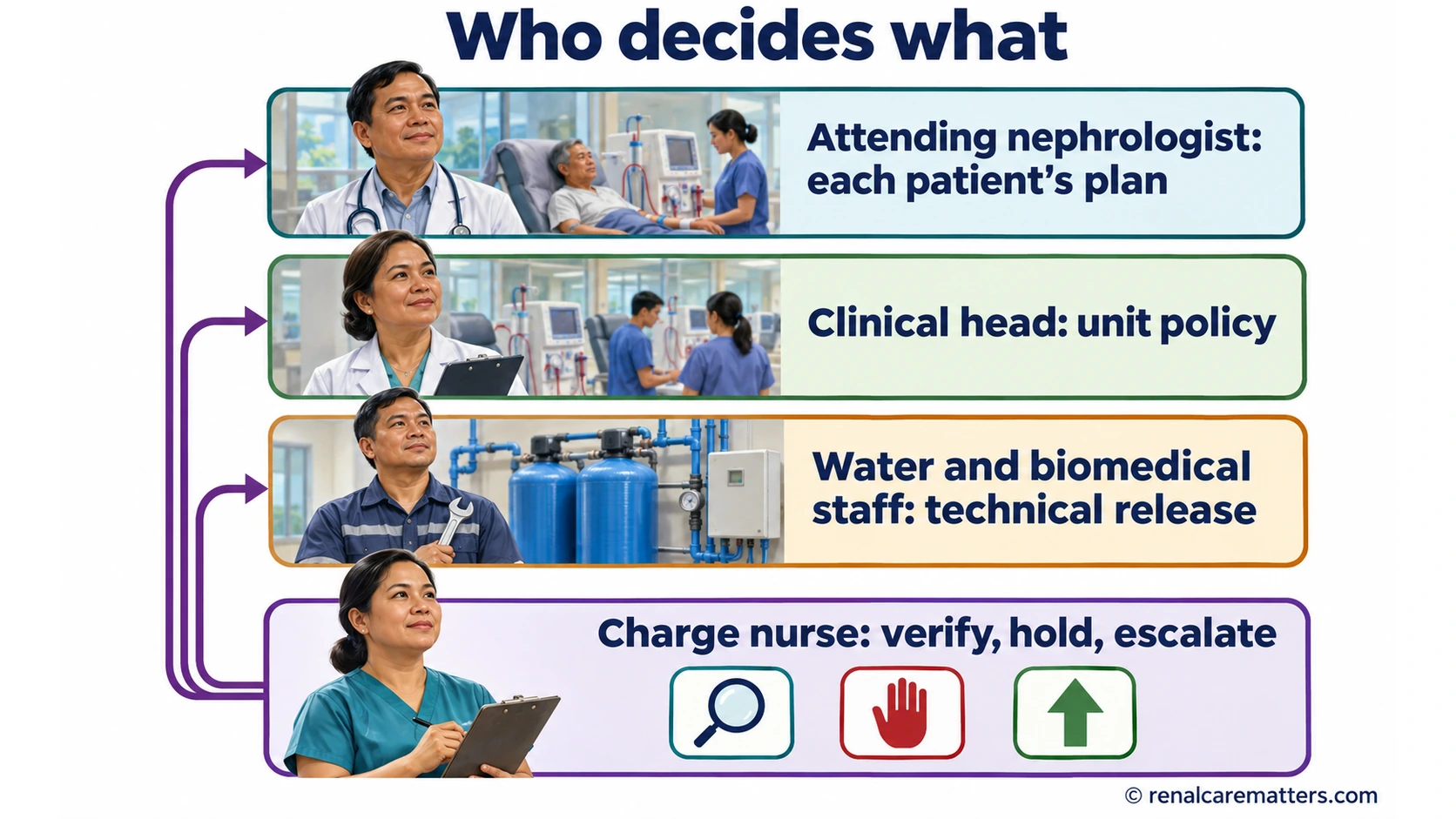
Four lanes run through every dialysis shift. The attending nephrologist decides each patient’s plan: the prescription, the dry weight, the medicines. The medical director or Dialysis Clinical Head sets unit policy. The water and biomedical staff, under the director, release water and machines. The charge nurse verifies, coordinates, holds, and escalates.
Figure 2. Who decides what. The charge nurse verifies, holds, and escalates; the plan, the policy, and the technical release belong to others.
Most charge-nurse mistakes are lane mistakes, not knowledge mistakes. A charge nurse who types a new dry weight on a verbal word, or plugs in a machine the technician tagged “do not use,” has left her lane. She may even be right about the patient. The record will still show that the decision was made by someone who did not hold it.
Charge duty is a role a staff nurse takes for a shift. The head nurse post is different. The PSN 2024 standards describe a head nurse with continuing responsibility for staffing, teaching, infection control, and improvement, and with entry requirements of structured renal nursing training of three months or more, current life support certificates, and two years of dialysis experience.1 Taking charge for a day does not make anyone a head nurse, and the head nurse track in this Academy covers that role.
On the floor · The verbal dry weight
At 6:20 the physician on duty, still on the ward, calls Nurse Jomar Pineda, who is in charge. “Mrs. Aquino’s dry weight is too high. Make it 52.5 in the system, I’ll sign later.”
Jomar reads it back: “Mrs. Aquino, Bed 8, dry weight from 54.0 to 52.5 kilograms, effective today.” He writes it as a verbal order with the time and the doctor’s name, follows the unit’s verbal-order procedure, and flags it on the board for countersignature before the doctor leaves the building. He does not quietly edit the prescription screen as if he had decided it. The decision stays in the doctor’s lane; the safe recording of it is in Jomar’s.
Illustrative scenario. Names and details are invented.
RememberVerify, hold, escalate. If a decision is not in one of those three words, ask whose lane it is.
Lesson · part 2
Read a rule by who wrote it
Not every rule carries the same weight. A DOH administrative order is a licensing condition: the facility must meet it to keep its license to operate. A Philippine Health Insurance Corporation (PhilHealth) circular is payer policy: it decides what is reimbursed, not how a shift is staffed. A PSN guideline is professional guidance. An employer memo is local policy. These answer different questions, and people under pressure often quote the one that suits them.
Before you act on a rule that someone quotes at you, ask five things:
Question
Why it matters
Who issued it?
A regulator, a payer, a society, or your employer carry different authority.
Where does it apply?
A rule for hospital units may not cover freestanding units, and foreign rules do not apply here.
What does it cover?
Stations or patients? Shifts or days? Staff nurses or all nurses?
Which clause?
“PSN says” is not a citation. The section number is.
Which version?
An older edition may have been replaced.
A requirement register keeps these answers in one place: the rule, the source, the exact clause, what it means for your unit, who owns the interpretation, and when it is next reviewed. The head nurse usually keeps it. The charge nurse is the person who most often needs it at short notice.
On the floor · “PhilHealth requires two nurses per patient”
A new administrative officer tells the charge nurse that PhilHealth requires a certain staffing level, or the claims will be denied. The charge nurse asks for the circular number. The officer cannot find it.
The head nurse later checks: the PhilHealth hemodialysis circular sets the covered sessions and the payment per session; staffing for licensing is in the DOH order.2,3 The officer was mixing a payer rule with a licensing rule. Nobody was lying. The five questions found the mix-up in one day instead of one argument per shift.
Illustrative scenario. Names and details are invented.
Lesson · part 3
The two staffing ratios, side by side
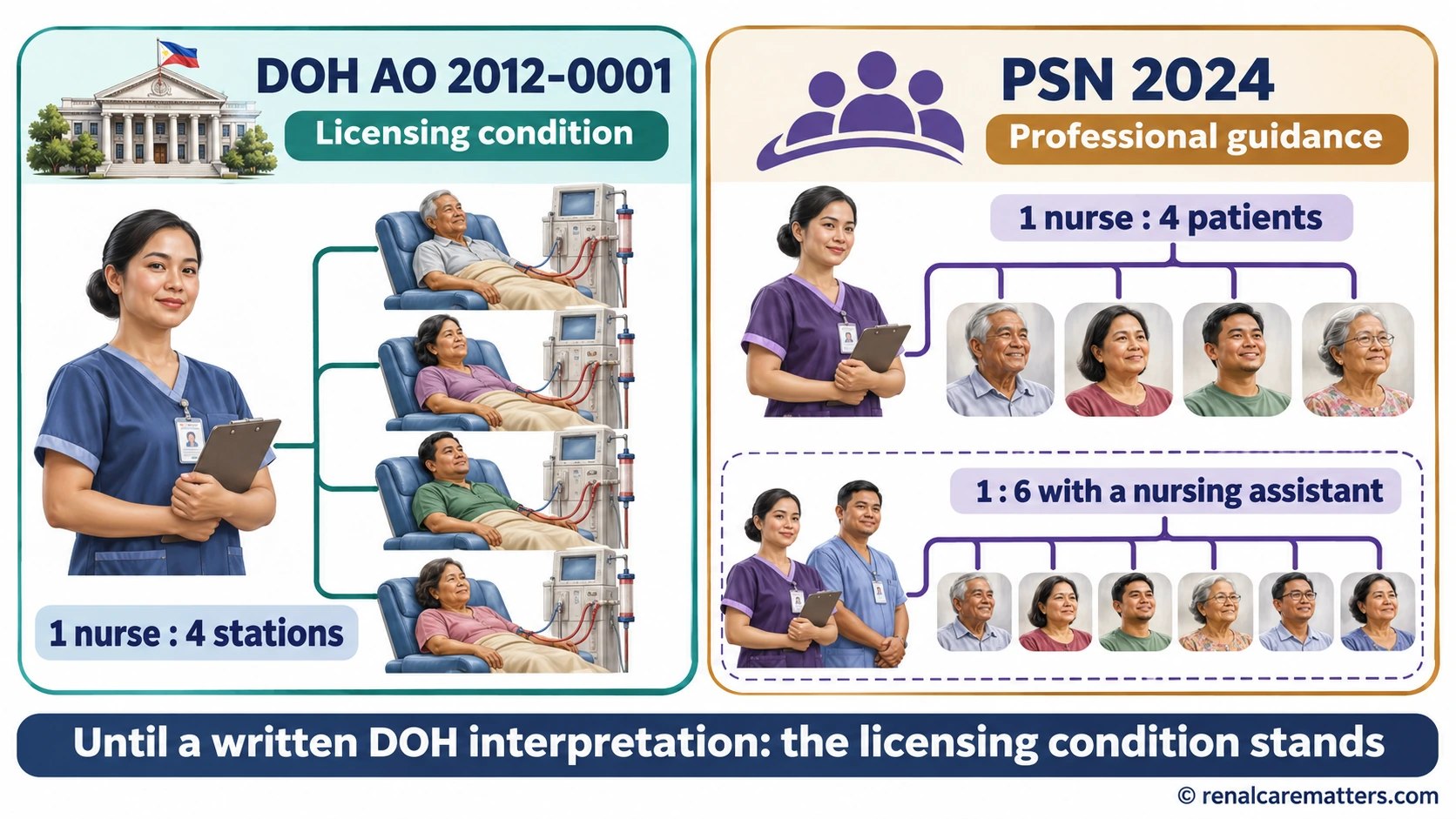
DOH Administrative Order (AO) 2012-0001 sets a nurse-to-hemodialysis-station ratio no greater than 1:4 per shift, and requires at least one nurse trained in Advanced Cardiovascular Life Support (ACLS) on each shift.3 The PSN 2024 standards discuss a ratio of one nurse to four patients, with an exception of one nurse to six patients when a nursing assistant is present.1
Figure 3. Two ratios, two authorities. The DOH limit counts stations and is a licensing condition; the PSN text counts patients and is professional guidance.
Look at what each counts. The DOH order counts stations. The PSN text counts patients. Look at who wrote each. DOH is the regulator that licenses the facility; PSN is a professional society. A professional recommendation does not amend a licensing order. Until the DOH regional licensing office, or the facility’s compliance lead with a written interpretation from it, says otherwise, the stricter licensing condition is the one an inspector will apply.
A ratio is a ceiling, not a target. Four stable patients with mature fistulas are not the same load as four patients with new catheters, one of whom drops her pressure every session. Module 3 builds the assignment by need. The ratio only tells you when you have run out of room.
Source
What it counts
What it says
Authority
DOH AO 2012-0001
Stations per shift
No more than 1 nurse to 4 stations; at least one ACLS-trained nurse per shift
Licensing condition
PSN 2024 standards
Patients
1 nurse to 4 patients; 1 to 6 when a nursing assistant is present
Professional guidance
RememberWhen two rules disagree, do not pick the convenient one. Show both, apply the licensing condition, and ask for a written interpretation.
Lesson · part 4
What the evidence says about staffing and harm
Why does a ratio matter at all? Because thin staffing turns into missed checks. In United States dialysis units, nurses who cared for more patients, and who reported more care left undone, also reported more adverse events: hypotension, missed treatments, and patient complaints.4,5 In Korea, units in which every nurse had at least two years of dialysis experience met more targets for dialysis dose, blood pressure, and albumin.6
These studies are cross-sectional. They show an association, not proof that adding one nurse prevents one event. Better-run units may simply staff better and do everything else better too. Still, the direction is consistent across countries, and it matches what nurses see on the floor: when there are too few hands, the checks that take a minute are the first to go.
The Philippine context makes this sharper. The DOH estimated a national shortage of about 106,000 nurses in 2022, and the Commission on Higher Education put the gap at up to 190,000 in 2025.7,8 A charge nurse cannot fix the shortage. She can refuse to let it become invisible, by stating clearly on each short-staffed morning what is safe to open and what is not.
Lesson · part 5
The authority to pause, and how to use it
Before you accept charge for the first time, find out three things: your written job description, the escalation ladder with working phone numbers, and whether you may pause an unsafe activity. If nobody can answer the third question, ask the head nurse to put the answer in writing. A charge nurse without the authority to pause is a coordinator with responsibility and no tools.
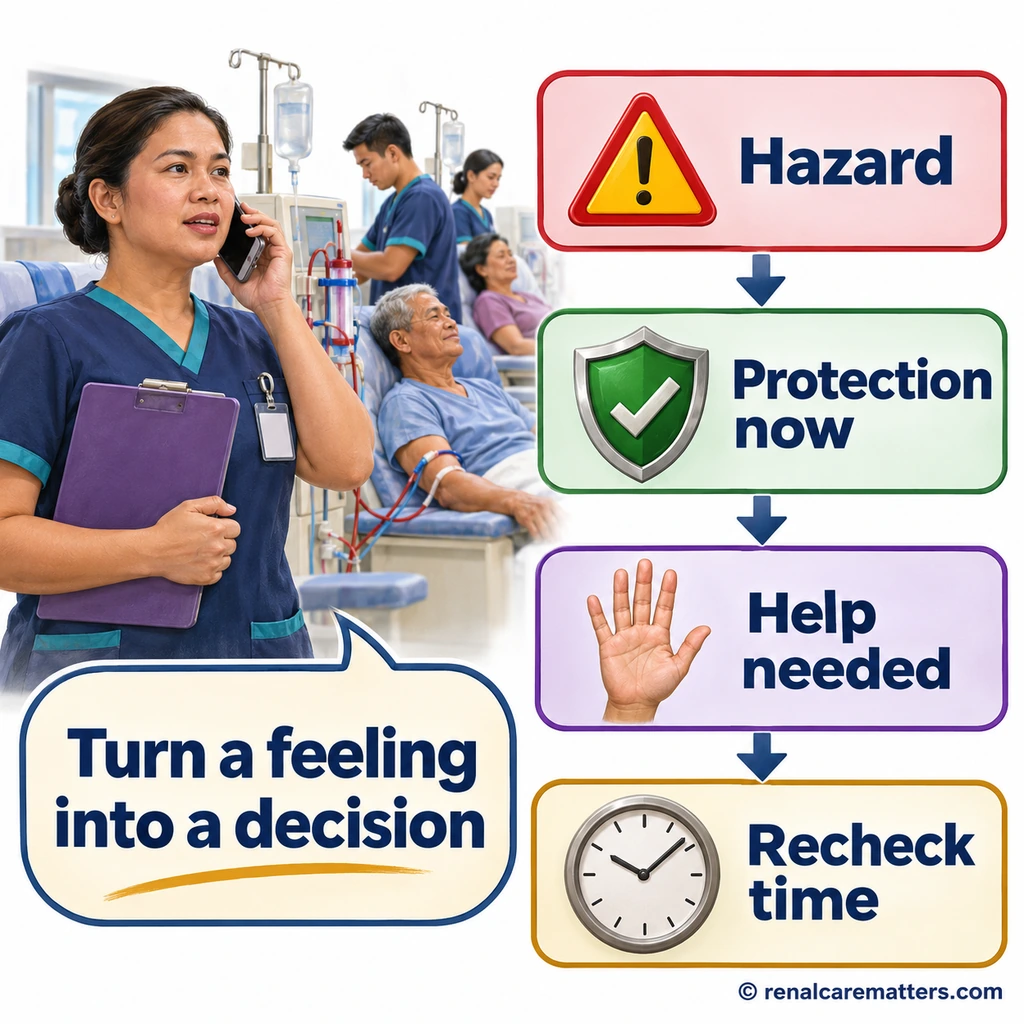
When you pause, use four parts:
Figure 4. The four-part pause turns “we are short” into a decision someone can act on.
Figure 5 · The four-part pause
Hazard“Beds 13 to 16 have no nurse who can work alone.”
Protection now“I have not connected them.”
Help needed“I need one more nurse, or approval to move four patients to a later slot.”
Recheck time“I will call you back at 6:00.”
“We are short today” is a feeling. The four-part statement is a decision someone can act on. It also protects you: it shows that you saw the hazard, protected the patients, asked for what you needed, and set a time to look again.
On the floor · The 5:50 call
Nurse Ellen Ramos is in charge at a freestanding unit in Bulacan. At 5:50 she calls the head nurse at home: “Ma’am, the hazard is that Kris is sick and Beds 9 to 12 have only the orientee, who is not signed off for catheters; two of them are catheter patients. I have not connected Beds 9 to 12. I need Arnel from the afternoon shift to come in early, or your approval to move those four to the 10:30 slot. I’ll call you back at 6:10 with what I’ve arranged.”
The head nurse calls Arnel. Ellen writes two lines in the shift log. Nobody had to guess what she needed.
Illustrative scenario. Names and details are invented.
Lesson · part 6
Write the decision down
Record the rule you applied, the person you called, what was decided, who decided it, and the time. One line in the shift log is enough for most decisions. A staffing decision that left patients waiting, or moved them, deserves a line in the requirement register too, so the question is not argued again next Monday.
Good records are short and factual. “5:50 called head nurse re: 3 RNs + 1 orientee for 16 stations. DOH 1:4 stations applied. Head nurse approved early call-in of Arnel. Beds 13–16 started 6:40.” Anyone who reads that line next month knows what happened and why.
RememberIf it is not written, the next charge nurse will have to decide it again, probably at 5:35 in the morning.
On the floor
Real situations: problems and solutions
These are fictional but typical. For each one, cover the answer, decide what you would do, then compare. Where a step depends on local rules, your unit’s procedure and your supervisor’s direction come first.
“Just enter the new dry weight”
What you see
The physician on duty asks you by phone to type a new dry weight into the system.
What is likely going on
A prescriber’s decision is being routed through you.
What to do
Read it back, record it as a verbal order per procedure, and flag it for countersignature before he leaves the building.
Why it matters
The decision stays in his lane; safe recording is in yours.
The certificate at home
What you see
A nurse’s renal dialysis training certificate is not in her file.
What is likely going on
The personnel file was never completed.
What to do
Log the gap with a date to close it, and ask the head nurse whether she counts toward the ratio until it is.
Why it matters
“Show me” should never become a scramble.
The ACLS nurse goes home sick
What you see
At 9:00 the only ACLS-trained nurse leaves with a fever.
What is likely going on
The shift no longer meets a licensing condition.
What to do
Call the head nurse for a replacement; until one arrives, keep the physician on duty close and start no new connections without him.
Why it matters
The requirement exists for the minutes when it is needed.
Field notes
Keep the escalation ladder taped inside the charge folder.
Look up a clause before you quote it.
A written interpretation outlives a phone call.
Case review
Back to the case: “Use the PSN ratio today”
What each source counts, and who issued it. The DOH order counts stations and is a licensing condition. The PSN text counts patients and is professional guidance. The administrator is quoting the PSN exception as if it were the operating rule. Carmela does not argue about whether 1:6 is reasonable; she shows what each document says.
Can she open all sixteen? By the station rule, four nurses cover at most sixteen stations: 16 ÷ 4 = 4 per nurse. On paper this passes. Now subtract what paper hides. Carmela is one of the four, and on a busy opening the charge role takes a large share of her time, so she can safely carry two or three chairs, not four. The orientee can carry four only if none of them is a catheter patient. And at break time, two nurses will each cover eight running machines for half an hour unless breaks are staggered. A safer plan: open fourteen stations now, with Carmela carrying two; ask the attending nephrologist which two patients can safely move to a 10:30 start or the second shift; and stagger breaks so that no nurse ever covers more than four running machines (Toolkit #c1 and #c3).
What she says and writes. She calls the administrator: the licensing condition is 1:4 stations; a society exception does not amend it; she will open fourteen safely and move two with the attending’s agreement. She records the call in the shift log and asks the head nurse to obtain a written interpretation from the regional licensing office, so the question is settled once.
Skills lab · with your preceptor
Skills checklist: Taking charge: lanes, rules, and the pause
A facilitator plays the administrator, the physician on duty, and the head nurse. Use the opening case and two other short-staffed mornings. Your preceptor rates each step as satisfactory, needs practice, or not observed. Steps marked Critical must all be satisfactory before sign-off. This checklist supports supervised learning; your unit’s own procedure and competency form are the authority. A printable version of every checklist is on the trainer page.
CriticalStates the four decision lanes and gives an example of each.
Classifies a quoted requirement by issuer, jurisdiction, scope, clause, and version.
CriticalExplains why the PSN 1:6 exception does not override the DOH station limit.
CriticalCalculates stations per independent nurse, including the charge nurse’s own load and break cover.
CriticalGives a four-part pause statement aloud, with a recheck time.
CriticalRecords a verbal order with read-back and flags it for countersignature.
Writes a one-line shift-log entry for a staffing decision.
Completes a requirement register entry with an owner and a review date.
Placement activity. On two supervised shifts, write down every rule someone quotes to you and check its source the same day with the head nurse.
Self-assessment
Check your understanding
Each visit draws 8 questions at random from this module’s 15-question bank. Choose the single best answer for each, then select Check answers; an explanation appears under the best answer. Select New set of questions for a different mix. A good target is 7 of 8 on two different sets. Nothing you select is sent anywhere; scoring happens in your browser.
Thomas-Hawkins, C., Flynn, L., & Clarke, S. P. (2008). Relationships between registered nurse staffing, processes of nursing care, and nurse-reported patient outcomes in chronic hemodialysis units. Nephrology Nursing Journal, 35(2), 123–130, 145; quiz 131.
Thomas-Hawkins, C., Flynn, L., & Dillon, J. (2020). Registered nurse staffing, workload, and nursing care left undone, and their relationships to patient safety in hemodialysis units. Nephrology Nursing Journal, 47(2), 133–142.
Jeong, E. (2023). Impact on health outcomes of hemodialysis patients based on the experience level of registered nurses in the hemodialysis department: a cross-sectional analysis. Frontiers in Health Services, 3, 1154989. https://doi.org/10.3389/frhs.2023.1154989
ABS-CBN News. (2022, September 29). Philippines lacks 106,000 nurses, DOH says. Retrieved November 24, 2026, from https://news.abs-cbn.com/news/09/29/22/philippines-lacks-106000-nurses-doh-says
The Philippine Star. (2026, November 8). Editorial: A continuing shortage. The Philippine Star. Retrieved November 24, 2026, from https://www.philstar.com/opinion/2026/11/08/2568575/editorial-continuing-shortage
Educational study material for nurses. Does not replace the attending nephrologist’s orders, the unit’s protocols, required training and certification, or supervised practice.