Diagnose peritonitis to ISPD 2022, start intraperitoneal antibiotics at once, and drive the unit's infection rate down.
PublishedNailathalaGipatikPepalwal:ReferencesMga SanggunianMga TinubdanReng Reperensya:13Audience: Pediatric nephrologists · pediatric nephrology fellows · adult nephrologists, intensivists and neonatologists who share kidney care for children in the clinic, ward, NICU, PICU, dialysis unit and homeRead timeOras ng pagbasaOras sa pagbasaOras ning pamamasa:
Training track for attending pediatric nephrologists
This module is study material for attending pediatric nephrologists and fellows. It explains the reasoning behind common decisions; it is not a protocol and it gives no doses. Doses, fill volumes and thresholds must come from current pediatric guidelines, product labels, your institution’s approved pediatric protocols and a pediatric pharmacist. Benefit rules change: confirm them on the date of service. Every case is fictional.
Learning objectives
After this module you should be able to
Diagnose peritoneal dialysis (PD) peritonitis in a child using the 2024 international pediatric criteria, and start empirical intraperitoneal antibiotics without delay.
Classify refractory, relapsing, recurrent and repeat peritonitis and fungal peritonitis, and decide when the catheter must come out.
Score and treat exit-site and tunnel infection, calculate the unit’s peritonitis rate, and lead retraining and quality improvement after every episode.
Pre-testBefore you read, answer the 5 self-assessment questions and note your score. After the module, select New set of questions and compare. The difference is what you learned; the questions you still miss are what to reread.
Start here
The big picture, in plain words
Your role · the night call and the unit’s ratePeritonitis usually reaches you by phone, at night, from a mother far from the peritoneal dialysis (PD) center. You decide within minutes whether the child is treated now and where, you make sure cultures are taken and antibiotics start, and you own the follow-up: the culture result, the response at day 3 to 5, the catheter decision, and the retraining. Each month you also own the program’s infection rate.
In plain wordsPeritonitis in a child on PD is like a house fire that starts in the kitchen. The smoke (cloudy fluid) shows early, and a fire caught in the first minutes is put out with a kitchen extinguisher. Wait until morning and you may lose the house.
The picture has a limit. A fire has one source. Peritonitis has several routes in, and the route tells you what to fix afterward: a hand that touched a connection, an infected exit site, a gut that leaked bacteria, or blood that carried them. And unlike a house, the peritoneum that survives a bad infection may not work as well again; repeated episodes thicken the membrane and shorten PD life. The infant recommendations put it plainly: the aim is to preserve the peritoneal membrane, not the catheter.1
Figure 1 · Key numbers
Diagnosis (2024 pediatric guideline)Two of three: clinical features; effluent white cells over 100/mm³ with at least 50% neutrophils after a dwell of at least 2 hours; positive culture
Overall peritonitis rateNo more than 0.40 episodes per patient-year (International Society for Peritoneal Dialysis [International Society for Peritoneal Dialysis (ISPD)] 2022; pediatric benchmark 0.4)
Peritonitis-free patientsMore than 80% per year (ISPD 2022)
Culture-negative episodesLess than 15% (pediatric benchmark)
Standardizing Care to Improve Outcomes in Pediatric End Stage Kidney Disease (SCOPE) collaborative0.46 episodes per patient-year overall; 0.62 in children 2 years or younger
Most episodes in children respond to prompt empirical antibiotics given into the peritoneum. A few are refractory, fungal or relapsing and cost the child the catheter or the membrane. Your work is to treat cloudy effluent as peritonitis until proven otherwise, start treatment the same night, follow the response by day, and use every episode to fix the step that failed.
Opening case · fictional
Case: Cloudy at 10 p.m.
Kyla Mendoza is 5 years old and weighs 17 kg. She has been on home continuous ambulatory PD (CAPD) for 11 months. At 10 p.m. her mother, Jenny, calls your mobile phone from Baliuag, Bulacan. The bag from the evening exchange is cloudy; she cannot read the newspaper through it. Kyla has had a tummy ache since the afternoon and a temperature of 38.2 °C. She is drinking and talking. Yesterday the cap of the transfer set fell on the floor and Jenny put it back on “quickly.”
The pediatric PD center is 90 minutes away by car, and the family has no car tonight. A district hospital is 15 minutes away; it has a pediatric resident on duty but no pediatric nephrologist and has never treated PD peritonitis. Jenny asks whether she can give paracetamol and bring Kyla to the center in the morning.
Before reading on, decide:
Is this peritonitis, and what must happen tonight?
Where should Kyla be treated, and what will you tell the district hospital?
What happens after the episode, for Kyla and for the program?
Keep your answers in mind. The lesson gives you what you need, and the case review near the end shows one sound response.
Lesson · part 1
How organisms reach the peritoneum
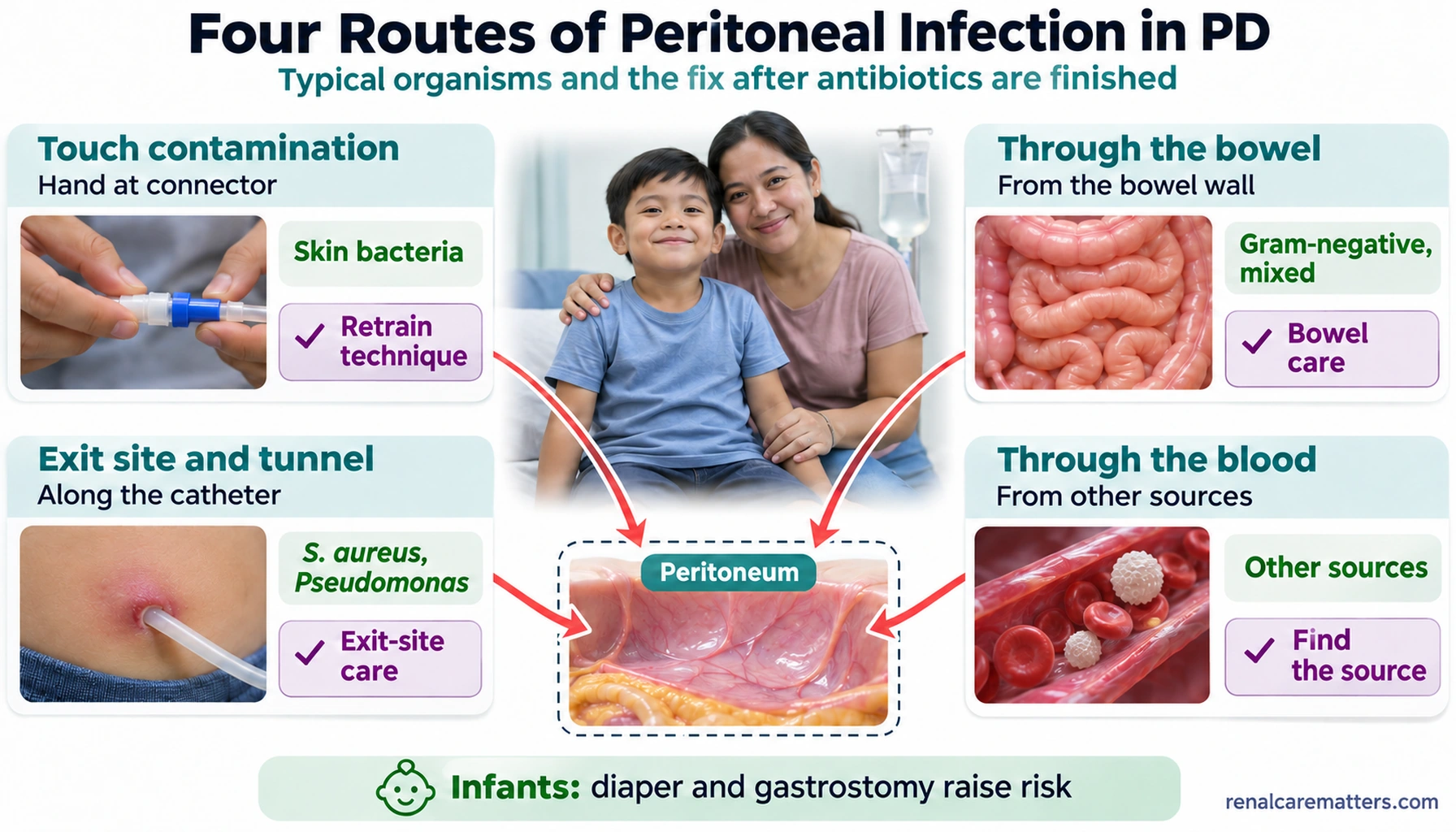
The peritoneum has good defenses: resident macrophages, mesothelial cells and a fluid that dilutes and clears bacteria. PD weakens them. Every exchange dilutes the immune cells and opsonins, glucose solutions impair cell function, and the catheter is a foreign body crossing the skin. Organisms arrive by four routes, and each route has a typical organism and a typical fix.
Route
How it happens in a child
Typical organisms
What it tells you to fix
Touch contamination (intraluminal)
A hand, a dropped cap or a broken bag at connection
Bacteria track along the catheter from an infected exit site
S. aureus, Pseudomonas
Exit-site care, catheter orientation, treatment of exit-site infection
Transmural from the bowel
Constipation, diarrhea, colitis, a nearby gastrostomy or ostomy
Gram-negative rods, anaerobes, several organisms together
Bowel care; look for surgical pathology if polymicrobial
Hematogenous or ascending
Bacteremia; rarely via the genital tract
Streptococci, others
Source elsewhere
Children differ. Infants have the highest rates. In SCOPE, 156 infants with a PD catheter placed before their first birthday had an in-hospital peritonitis rate of 1.73 and an overall rate of 0.76 episodes per patient-year; nephrectomy at or before catheter placement and a gastrostomy placed after the catheter were associated with nearly sixfold and nearly threefold higher risk, and infants with peritonitis had lower survival (86.3% versus 95.6%).2 Gram-negative “diaper peritonitis” is more frequent in infants, and fungal infection is more common in children with a gastrostomy.1 Touch contamination is common: 846 of 2,685 children (32%) in SCOPE reported at least one, more often in younger children.3
What children grow and how episodes end. In 391 episodes among 734 children in SCOPE, gram-positive organisms caused 37.8%, culture-negative episodes made up 24.7%, gram-negative organisms 19.5%, polymicrobial infections 10.3% and fungi alone 7.7%. Treatment with antibiotics alone resolved 76.6% of episodes; 12.2% ended in permanent catheter removal and 6% in removal with return to PD.4 Organisms and susceptibilities vary by region: in an international registry, gram-negative episodes and Pseudomonas were more frequent in some regions than others, and susceptibility to first-generation cephalosporins and aminoglycosides varied significantly.5 Your own program’s culture log is therefore part of the empirical choice.
Very young children on PD may have low immunoglobulin levels from protein loss in the effluent. The infant recommendations note that the link with severe infection is not straightforward, that antibody responses to vaccines are usually normal, and that there is no evidence for routine prophylactic immunoglobulin.1 Keep the child’s vaccinations up to date; they protect against the bacteremias that can seed the peritoneum.
RememberEvery episode has a route. Name it, because the route tells you what to change after the antibiotics are finished.
After the second episode · fictional
An 18-month-old boy on PD has his second Klebsiella peritonitis in four months. Both times his mother reported loose stools for two days before the effluent turned cloudy, and his catheter exit sits close to the edge of his diaper.
You treat the episode, ask the surgeon whether the exit can be relocated at the next procedure, and teach the family a diaper routine that keeps the exit site above and away from soiling.
What this shows. Repeat gram-negative episodes in an infant point to the bowel and the diaper, not only to hand hygiene.
Figure 2. Four routes into the peritoneum. Each route has typical organisms and a different fix after the antibiotics are finished.
Lesson · part 2
Cloudy effluent is peritonitis until proven otherwise
The criteria. The 2024 international pediatric guideline diagnoses peritonitis when two of three criteria are present: clinical features (abdominal pain, cloudy effluent, fever); an effluent white blood cell count over 100/mm³ with at least 50% polymorphonuclear cells after a dwell of at least 2 hours; and a positive effluent culture (an ungraded statement).6 In a child on automated PD (APD) without a day dwell, the guideline notes that 50% or more neutrophils suggests peritonitis even when the total count is below 100/mm³, because the short dwells leave less time for cells to accumulate.6 The adult ISPD 2022 guideline uses the same structure.7
The specimen. Take the effluent for cell count, Gram stain and culture before the first antibiotic dose, using the culture method your laboratory has validated. Culture technique matters. In SCOPE, 165 of 620 episodes (27%) were culture-negative; centers varied widely in their culture techniques, and no single practice separated low-rate from high-rate centers.8 Worldwide, the culture-negative proportion ranged from 11% in North America to 67% in Mexico in an international pediatric registry of 501 episodes.5 The pediatric guideline sets a benchmark of less than 15% culture-negative episodes; a higher rate is a reason to review sampling and culture methods.6
Do not wait for the count. If the effluent is cloudy and the child has pain or fever, start treatment once the specimen is taken. The pediatric guideline says empirical antibiotics should begin as soon as possible after appropriate microbiological specimens are obtained (ungraded).6
Not infection; check for trauma or menstruation in adolescents
Chylous effluent
Milky, high triglyceride, few cells
Lymphatic leak, not infection
Eosinophilic effluent
Eosinophils predominate, early after catheter placement
Usually benign; still exclude infection
Figure 3 · The 10 p.m. phone call
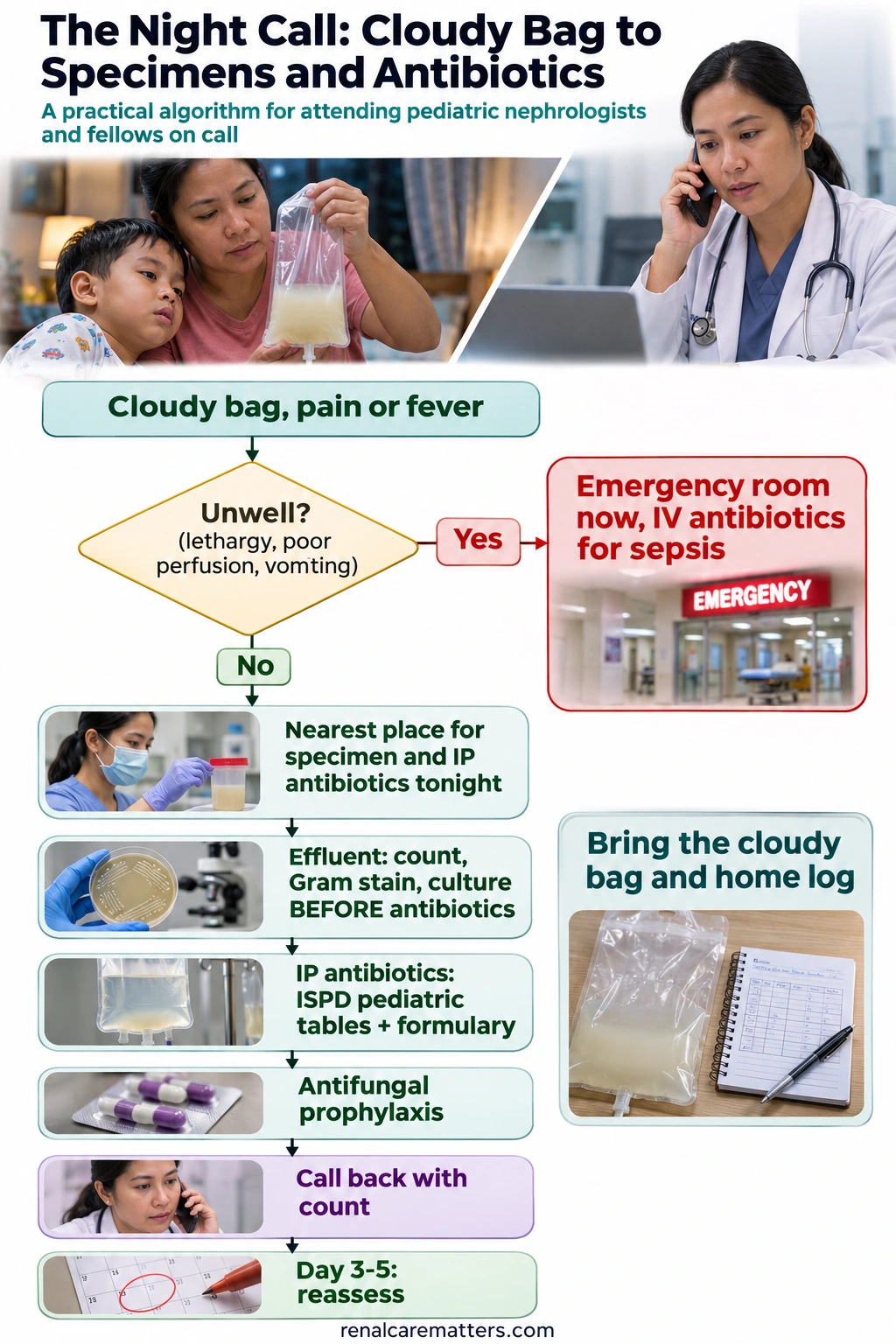
Is the effluent cloudy, or is there pain or fever?Any one: treat as possible peritonitis tonight.
Is the child unwell?Lethargy, poor perfusion, persistent vomiting, severe pain: emergency room now, intravenous antibiotics for sepsis.
Where can a sample be taken and antibiotics given within hours?The PD center if reachable; otherwise the nearest hospital, with you on the phone.
Tell the family what to bringThe cloudy bag, the home log, transfer set supplies, and the PD booklet.
Speak to the receiving doctorSpecimen first, then intraperitoneal antibiotics from the ISPD pediatric tables and the formulary; agree who calls you with the count.
Write it downTime of call, advice, where the child went, who is following up.
When the PD center is far. Most Philippine families on PD live hours from a pediatric PD center, and the hospital nearest to them may never have treated PD peritonitis. Prepare for this before the first episode. Give each family a sealed “peritonitis packet”: a one-page letter to any receiving doctor describing the child, the catheter, the diagnostic criteria, the need for an effluent specimen before antibiotics, the empirical options in your program’s protocol, and your phone number; a copy of the ISPD pediatric antibiotic table your unit uses; and spare transfer-set supplies. Agree in advance with one hospital near each cluster of families that it will take the effluent sample and start therapy while you guide by phone.
RememberCloudy effluent, pain or fever in a child on PD is peritonitis until proven otherwise. Take the specimen and start antibiotics the same night.
Figure 4. The night call. From a cloudy bag to specimens and antibiotics within hours, with the attending on the phone.
Lesson · part 3
Empirical treatment, response and the catheter decision
Empirical therapy. The 2024 pediatric guideline suggests either intraperitoneal cefepime alone, or gram-positive coverage with a first-generation cephalosporin or vancomycin combined with gram-negative coverage, with ceftazidime preferred and an aminoglycoside where ceftazidime is unavailable (2D). Children with features of sepsis should receive intravenous antibiotics. Center-specific susceptibility patterns and the child’s history should guide the choice (ungraded).6 The intraperitoneal route reaches high local concentrations; give it as the ISPD pediatric tables and your formulary direct, with intermittent or continuous dosing and dwell adjustments for APD as your protocol sets. Add antifungal prophylaxis with nystatin or fluconazole during the antibiotic course; the guideline suggests this (2D) and favors stopping it when antibiotics stop.6
When the culture returns. Narrow the therapy. In 379 gram-negative episodes in 308 children from 45 centers in the International Pediatric Peritoneal Dialysis Network (IPPN) registry, 74% responded well to empirical therapy and 82% achieved full functional recovery. Severe abdominal pain at onset and at 60–72 hours, Pseudomonas, and in vitro resistance to the empirical antibiotics were associated with failure to recover; monotherapy as definitive treatment was associated with lower risk, and dual therapy showed no benefit for Pseudomonas after adjustment. Cefazolin monotherapy for susceptible Enterobacterales gave similar full recovery to ceftazidime or cefepime (91% versus 93%).9 This is registry evidence, but it supports de-escalation to the narrowest effective drug.
Following the response. Most children improve within 48–72 hours: less pain, clearer effluent, a falling cell count. Repeat the effluent count at day 3 to 5. Persistent severe pain at 60–72 hours predicted poor recovery in the gram-negative cohort.9
Category (2024 pediatric guideline)
Definition
What it means for the catheter
Refractory
Persistently cloudy effluent or effluent white cells over 100/mm³ after 5 days of appropriate therapy
Removal of the catheter suggested (2D)
Relapsing
Within 4 weeks of finishing therapy, same organism (or one culture-negative episode)
Removal once controlled if a tunnel infection persists or after a second relapse (2C)
Recurrent
Within 4 weeks of finishing therapy, different organism
Look for a new route; consider the bowel
Repeat
More than 4 weeks after finishing therapy, same organism
Look for a reservoir: biofilm, exit site, carrier state
Fungal
Fungal elements in effluent
Immediate catheter removal; antifungal therapy for at least 2 weeks after removal (both 2D)
Exit-site or tunnel infection with peritonitis, same organism
Infection along the catheter feeding the peritoneum
Removal suggested (2D)
These definitions come from the pediatric guideline’s tables, and the removal statements are weak suggestions on low or very low-quality evidence.6 Removal is still the right call when the membrane is at stake. A child who loses the catheter can often return to PD after a period on hemodialysis (HD); a child who loses the membrane cannot.
Special situations. Polymicrobial growth, especially with anaerobes, raises the possibility of a bowel perforation or an intra-abdominal source, and needs an early surgical opinion. A culture-negative episode that improves can be completed as the protocol directs; one that does not improve needs a repeat specimen with attention to culture technique and a search for unusual organisms with the infectious diseases team. Peritonitis in a child with a recent gastrostomy, colitis or an invasive procedure should prompt a question about the route before the next procedure is planned.
Day 4, on the ward · fictional
A 10-year-old boy treated for Pseudomonas peritonitis still has severe abdominal pain on day 3, and his effluent count has fallen only from 2,400 to 1,600/mm³. His exit site is red with a crust, and the tunnel is tender.
You discuss catheter removal with the surgeon the same day rather than waiting until day 5, because the exit site and tunnel are infected with the likely same organism and severe pain at 60–72 hours predicted poor recovery in the IPPN cohort.
What this shows. The day 3 review is a decision point, not a formality.
After removal. When the catheter is removed for peritonitis, the child needs a temporary hemodialysis access and a plan. Many children can return to PD with a new catheter after the infection has cleared, if the membrane recovers; simultaneous removal and replacement is considered in selected relapsing or exit-site situations once the effluent has cleared, as the pediatric guideline describes.6 Fungal peritonitis and repeated severe episodes are the situations most likely to end PD. Discuss the likely course with the family before surgery, not after.
RememberReassess at day 3 to 5. Refractory or fungal peritonitis means the catheter comes out, because the goal is to save the membrane, not the tube.
Lesson · part 4
Exit-site and tunnel infection
The exit site is where the catheter crosses skin, and the route by which S. aureus and Pseudomonas travel down the tunnel to the peritoneum. The 2024 pediatric guideline defines a definite exit-site infection by purulent discharge at the catheter–skin junction, with or without a positive culture (2C), and a tunnel infection by inflammation along the subcutaneous segment, with or without fluid on ultrasound (2C).6
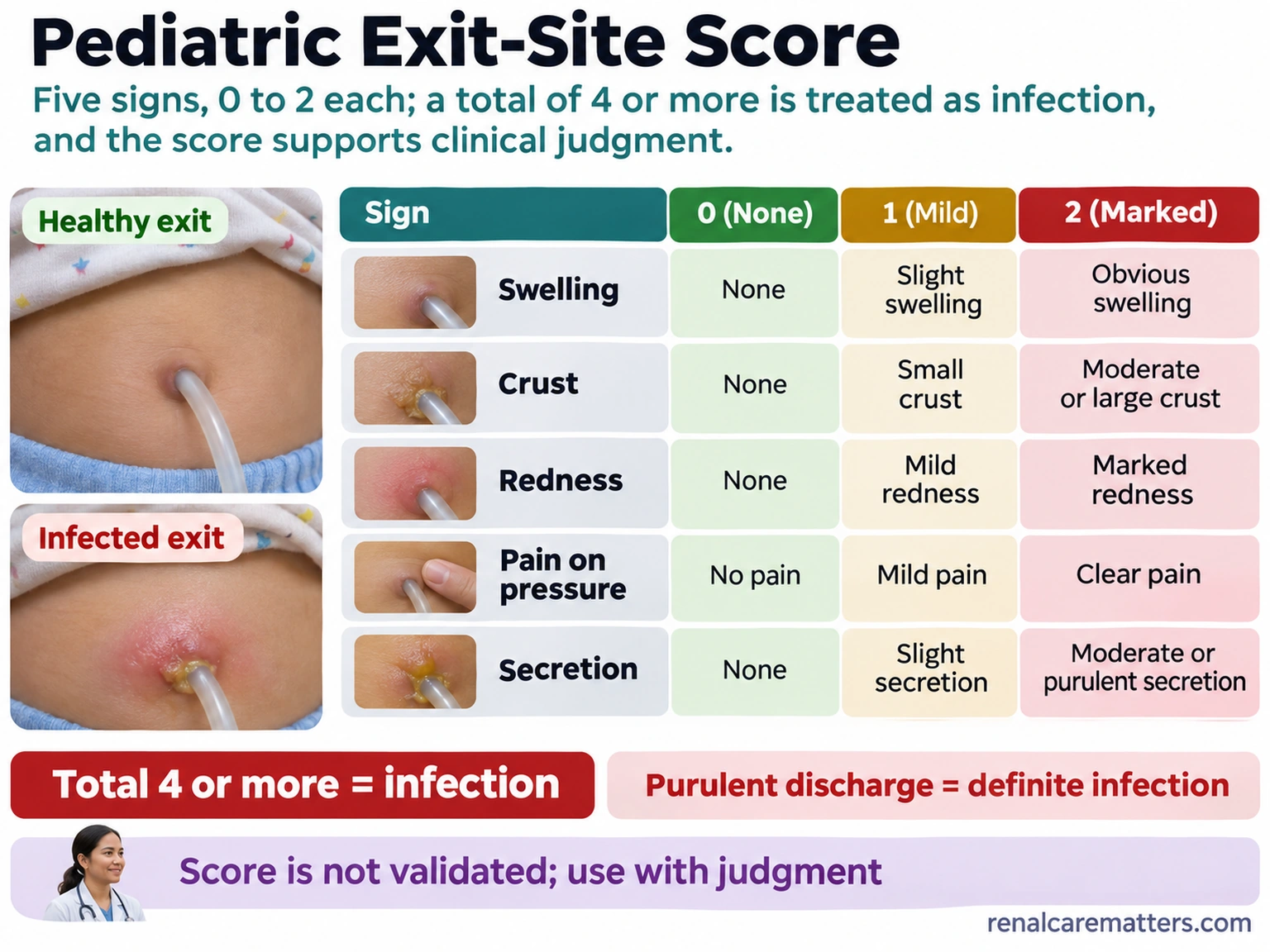
The score. The guideline suggests a pediatric exit-site score (2D) that rates five signs from 0 to 2: swelling, crust, redness, pain on pressure and secretion. A total of 4 or more is treated as infection. The authors note that the score is not validated and its reproducibility is limited, so it supports clinical judgment rather than replacing it.6 In SCOPE, an exit-site score above 0 at the previous month’s visit, or no documented review of site care, was associated with more exit-site infection.10
Sign (scored 0 to 2)
What you look for
Swelling
Induration around the exit, along the first part of the tunnel
Crust
Dried exudate at the exit
Redness
Erythema and its width around the catheter
Pain on pressure
Tenderness over the exit or tunnel
Secretion
Serous or purulent discharge
How often and how bad. SCOPE recorded 207 exit-site infections in 124 children, 0.25 per dialysis year, with a median time to infection of 392 days; 69% involved the exit only, 23% the tunnel only and 8% both. Peritonitis followed in 6%, 24% needed hospitalization and 9% needed catheter removal, usually for tunnel infection.10 The ISPD 2023 recommendations set an overall exit-site infection target of no more than 0.40 episodes per year at risk.11
Treatment. Empirical oral therapy should cover methicillin-susceptible S. aureus, for example a first-generation cephalosporin or an antistaphylococcal penicillin (ungraded), continued for 7–14 days according to response and culture (2D), and for at least 3 weeks for Pseudomonas, with catheter removal if remission is incomplete (2C).6 Take a swab before starting. A tunnel infection that does not settle, or one linked to peritonitis, usually means a new catheter.
Prevention. Exit-site care is taught at training and reviewed at every visit: hand hygiene, a clean dressing as your protocol directs, and an immobilized catheter so that it does not pull on the exit. The ISPD 2023 update downgraded its recommendation on routine topical antibiotic cream or ointment at the exit site and clarified its suggestion on covering the exit with a dressing.11 Follow your program’s protocol on topical agents, and remember that SCOPE linked documented review of site care with fewer infections.10
At the clinic · fictional
A 12-year-old girl’s exit site has a small crust and slight redness for the second month in a row. Her mother says it “always looks like that.” The score is 2.
You review the dressing technique, check how the catheter is anchored, swab the site, and book a review in two weeks instead of a month. The swab grows S. aureus; her mother is retrained in exit-site care and the redness settles.
What this shows. A score above zero is not an infection yet, but it is a reason to look closer and sooner.
RememberScore the exit site at every visit and photograph it. A score above zero is a reason to look closer, and a score of 4 is an infection.
Figure 5. The pediatric exit-site score. Five signs, 0 to 2 each; a total of 4 or more is treated as infection, and the score supports clinical judgment.
Lesson · part 5
Driving the unit’s peritonitis rate down
The benchmarks. The ISPD 2022 guideline sets an overall peritonitis rate of no more than 0.40 episodes per year at risk and more than 80% of patients peritonitis-free per year.7 The 2024 pediatric guideline sets ungraded benchmarks of no more than 0.4 episodes per year, less than 15% culture-negative episodes, and peritonitis within 30 days in fewer than 5% of catheter insertions.6
Calculating the rate. Count every episode in the period and divide by the total patient-years at risk (the sum of days each child was on PD, divided by 365). A program with 14 children on PD for a whole year (14 patient-years) and 6 episodes has a rate of 0.43 per patient-year. Plot it monthly as a rolling 12-month rate on a run chart; small programs swing widely, so look at the trend, not one month.
What lowers it. SCOPE, a North American quality-improvement collaborative, found an aggregate rate of 0.46 episodes per patient-year in 734 children; compliance with a standardized follow-up care bundle was associated with fewer episodes (rate ratio 0.49), while an upward-facing exit site (rate ratio 4.2) and touch contamination (rate ratio 2.22) were associated with more.4 After touch contamination, prophylactic antibiotics were associated with less peritonitis (23% versus 38%) in the 2026 SCOPE analysis.3 The pediatric guideline considers a single dose of intraperitoneal cefazolin reasonable after wet contamination for most children (the related statement is 2D).6 In the IPPN training survey, training under 20 hours was associated with higher peritonitis rates.12 All of these are observational associations; the bundle effect is the strongest signal because it was tested inside a structured program.
After every episode. The ISPD 2022 update revised its recommendations on PD training and reassessment.7 In practice, every episode should trigger a root-cause review with the family: watch an exchange, inspect the home corner, check the exit site and the bowel history, and retrain the step that failed. Record the route you think was responsible.
Figure 6 · Root-cause questions after an episode
The connectionWho did the exchange, where, with what light, and was anything dropped or touched?
The exit siteWhat was the last score, and was there an exit-site infection with the same organism?
The bowelConstipation, diarrhea, a gastrostomy or a recent procedure?
The suppliesA broken bag, a new brand of transfer set, wet storage?
The caregiverWho is tired, who is new, and when were they last retrained?
The responseHow fast did the family call, and how long until antibiotics started?
The last question matters in the Philippines more than almost anywhere. Record the hours from cloudy bag to first antibiotic dose for every episode. If the delay is long, the fix is not only technique; it is the peritonitis packet, the agreement with a nearer hospital, and the family’s confidence that a night call is welcome.
Coverage. The Philippine Health Insurance Corporation (PhilHealth) pediatric PD Z package includes outpatient treatment of PD-related peritonitis and exit-site and peritonitis prevention care.13 Confirm what applies on the date of service; coverage never decides which antibiotic or route the child receives.
Measure
Benchmark
If you miss it
Overall peritonitis rate
No more than 0.40 per patient-year
Review routes by episode; audit technique and the follow-up bundle
Peritonitis-free patients
More than 80% per year
Find the children with repeated episodes; look for a reservoir
Culture-negative episodes
Less than 15%
Review sampling, transport and culture method with the laboratory
Peritonitis within 30 days of insertion
Fewer than 5% of insertions
Review insertion technique, early use, exit-site dressing
Exit-site infection rate
No more than 0.40 per year at risk
Review site care, orientation, scoring at every visit
At the quarterly program meeting · fictional
The PD nurse presents a rate of 0.71 episodes per patient-year for the past 12 months. Seven of 10 episodes were in children cared for by grandparents, and four followed a dropped cap or a touched connection that was never reported.
You agree on three actions: a touch-contamination hotline with a same-day plan, retraining of every grandparent caregiver, and an observed exchange at each quarterly review. The rate is plotted monthly.
What this shows. A rate is a set of stories. Read the episodes, and the fix is usually visible.
RememberCalculate the rate monthly, read every episode for its route, and retrain the step that failed. The rate falls when the program learns.
Stop and call
Cloudy effluent with lethargy, poor perfusion or persistent vomiting (sepsis)
Fungal elements on the Gram stain or culture
Effluent still cloudy or cell count above 100/mm³ after 5 days of therapy
Polymicrobial or anaerobic growth (possible bowel perforation)
Peritonitis with a tunnel infection or with the same organism as an exit-site infection
On the floor
Real situations: problems and solutions
These are fictional but typical. For each one, cover the answer, decide what you would do, then compare. Where a step depends on local rules, your unit’s procedure and your supervisor’s direction come first.
The cap that fell on the floor
What you see
A father calls at noon to say the transfer-set cap fell on the floor during a morning exchange. The effluent is clear and his son is well.
What is likely going on
This is a touch contamination. The child does not have peritonitis now, but the risk over the next days is higher.
What to do
Follow your unit's contamination protocol: change the transfer set as directed, decide on prophylactic intraperitoneal antibiotics, and book retraining this week.
Why it matters
Prophylaxis after touch contamination was associated with less peritonitis in SCOPE (23% versus 38%). Families report contaminations only if they are not blamed.
The emergency room that gave intravenous antibiotics only
What you see
A child with cloudy effluent was given intravenous ceftriaxone at a provincial emergency room and sent home without an effluent sample.
What is likely going on
No specimen was taken, and the drug and route do not match pediatric PD peritonitis guidance.
What to do
Bring the child back for an effluent sample, cell count and culture, start intraperitoneal therapy per the ISPD pediatric tables and your formulary, and call the emergency room to share the PD peritonitis plan.
Why it matters
Missing the specimen makes the episode culture-negative and the next decision blind.
Still cloudy on day 5
What you see
A 7-year-old's effluent is still cloudy with 600 white cells/mm3 on day 5 of appropriate therapy for Staphylococcus aureus peritonitis.
What is likely going on
This meets the definition of refractory peritonitis.
What to do
Plan catheter removal with the surgeon, arrange temporary hemodialysis access, and continue antibiotics as the guideline and infectious diseases advice direct.
Why it matters
Holding on to the catheter risks the membrane. Removal is suggested for refractory bacterial peritonitis.
The rate that doubled
What you see
Your program's rolling 12-month peritonitis rate has risen from 0.35 to 0.70 episodes per patient-year.
What is likely going on
Small programs swing, but a doubling usually has a pattern: one route, one caregiver group, or one supply change.
What to do
Review every episode for its route, compare caregivers and supplies, audit the follow-up bundle, and set three actions with a date to re-measure.
Why it matters
Quality improvement starts with reading the stories behind the number.
Field notes
Give every family a laminated cloudy-bag card with your number and the nearest hospital that can take an effluent sample.
Keep the ISPD pediatric antibiotic tables and your formulary page ready to send by message to a remote doctor.
Photograph the exit site at every visit and keep the photographs in the chart.
Record the suspected route for every episode; it is the most useful column in your peritonitis log.
Case review
Back to the case: Cloudy at 10 p.m.
Tonight. Cloudy effluent with abdominal pain and fever meets at least two of the three criteria before any count is back. This is peritonitis until proven otherwise, and a dropped cap yesterday suggests touch contamination as the route. Paracetamol and a morning visit are not safe: delay gives bacteria hours to multiply and the membrane hours of inflammation. Tell Jenny that Kyla needs a sample taken and antibiotics started tonight, ask her to bring the cloudy bag, the home log and her PD supplies, and stay on the phone until there is a plan.
Where. Kyla is alert and drinking, so she does not need a resuscitation bay, but she does need treatment within hours. The district hospital 15 minutes away is the right place tonight if you support it. Call the resident yourself: take effluent for cell count, Gram stain and culture before antibiotics; give empirical intraperitoneal antibiotics as the 2024 pediatric guideline suggests, with doses from the ISPD pediatric tables you send and the hospital formulary; add antifungal prophylaxis; give intravenous antibiotics if she shows signs of sepsis; and call you with the count and the Gram stain. Arrange transfer to the PD center the next morning for follow-up, or sooner if she worsens.
Afterward. Narrow the antibiotics when the culture returns, repeat the count at day 3 to 5, and remove the catheter if the peritonitis is refractory or fungal. Then retrain: observe Jenny’s full exchange, teach what to do when a cap falls (report it the same day so the team can decide on prophylaxis), and check the exit site and bowel history. For the program, record the episode, its route and its outcome, update the rolling 12-month rate, and look for a pattern across families.
Interactive case · fictional
Interactive case: “The bag is cloudy, Doc”
Work through a shift one decision at a time. The panel at the top changes with what you choose. After each choice you see why it is, or is not, the best move; after a weaker one you can try again or carry on and see where it leads. Your first choice at each step is scored. The score stays on this device and nothing is sent anywhere. In real practice, your unit’s protocol and the people responsible for each decision come first.
Skills lab · with your preceptor
Skills checklist: PD peritonitis and exit-site and tunnel infection
Complete with a preceptor, in simulation or at your own unit. Sign-off is local. Your preceptor rates each step as satisfactory, needs practice, or not observed. Steps marked Critical must all be satisfactory before sign-off. This checklist supports supervised learning; your unit’s own procedure and competency form are the authority. A printable version of every checklist is on the trainer page.
Applies the 2024 pediatric criteria to a cloudy effluent case and orders specimens before antibiotics
Gives a remote hospital a complete telephone plan for empirical intraperitoneal therapy using the unit formulary
Scores an exit site and decides between observation, oral therapy and catheter review
Calculates a program peritonitis rate per patient-year and presents it on a run chart
Placement activity. Pediatric PD unit, telephone simulation or program quality meeting
Self-assessment
Check your understanding
Each visit draws 5 questions at random from this module’s 5-question bank. Choose the single best answer for each, then select Check answers; an explanation appears under the best answer. Select New set of questions for a different mix. A good target is 4 of 5 on two different sets. Nothing you select is sent anywhere; scoring happens in your browser.
Zurowska, A. M., Fischbach, M., Watson, A. R., Edefonti, A., Stefanidis, C. J., & European Paediatric Dialysis Working Group. (2013). Clinical practice recommendations for the care of infants with stage 5 chronic kidney disease (CKD5). Pediatric Nephrology, 28(9), 1739–1748. https://doi.org/10.1007/s00467-012-2300-z
Zaritsky, J. J., Hanevold, C., Quigley, R., Richardson, T., Wong, C., Ehrlich, J., Lawlor, J., Rodean, J., Neu, A., Warady, B. A., & SCOPE Investigators. (2018). Epidemiology of peritonitis following maintenance peritoneal dialysis catheter placement during infancy: A report of the SCOPE collaborative. Pediatric Nephrology, 33(4), 713–722. https://doi.org/10.1007/s00467-017-3839-5
Same, R. G., Grills, N. K., Dutta, S., Neu, A. M., Warady, B. A., & Begin, B. (2026). Touch contamination and associated peritonitis in children undergoing maintenance peritoneal dialysis. Pediatric Nephrology, 41(12), 4589–4596. https://doi.org/10.1007/s00467-026-07455-8
Sethna, C. B., Bryant, K., Munshi, R., Warady, B. A., Richardson, T., Lawlor, J., Newland, J. G., Neu, A., & SCOPE Investigators. (2016). Risk factors for and outcomes of catheter-associated peritonitis in children: The SCOPE collaborative. Clinical Journal of the American Society of Nephrology, 11(9), 1590–1596. https://doi.org/10.2215/CJN.02540316
Schaefer, F., Feneberg, R., Aksu, N., Donmez, O., Sadikoglu, B., Alexander, S. R., Mir, S., Ha, I. S., Fischbach, M., Simkova, E., Watson, A. R., Möller, K., von Baum, H., & Warady, B. A. (2007). Worldwide variation of dialysis-associated peritonitis in children. Kidney International, 72(11), 1374–1379. https://doi.org/10.1038/sj.ki.5002523
Warady, B. A., Same, R., Borzych-Duzalka, D., Neu, A. M., El Mikati, I., Mustafa, R. A., Begin, B., Nourse, P., Bakkaloglu, S. A., Chadha, V., Cano, F., Yap, H. K., Shen, Q., Newland, J., Verrina, E., Wirtz, A. L., Smith, V., & Schaefer, F. (2024). Clinical practice guideline for the prevention and management of peritoneal dialysis associated infections in children: 2024 update. Peritoneal Dialysis International, 44(5), 303–364. https://doi.org/10.1177/08968608241274096
Li, P. K., Chow, K. M., Cho, Y., Fan, S., Figueiredo, A. E., Harris, T., Kanjanabuch, T., Kim, Y. L., Madero, M., Malyszko, J., Mehrotra, R., Okpechi, I. G., Perl, J., Piraino, B., Runnegar, N., Teitelbaum, I., Wong, J. K., Yu, X., & Johnson, D. W. (2022). ISPD peritonitis guideline recommendations: 2022 update on prevention and treatment. Peritoneal Dialysis International, 42(2), 110–153. https://doi.org/10.1177/08968608221080586
Davis, T. K., Bryant, K. A., Rodean, J., Richardson, T., Selvarangan, R., Qin, X., Neu, A., & Warady, B. A. (2021). Variability in culture-negative peritonitis rates in pediatric peritoneal dialysis programs in the United States. Clinical Journal of the American Society of Nephrology, 16(2), 233–240. https://doi.org/10.2215/CJN.09190620
Borzych-Dużałka, D., Same, R., Neu, A., Yap, H. K., Verrina, E., Bakkaloglu, S. A., Cano, F., Patel, H., Szczepańska, M., Obrycki, Ł., Spizzirri, A. P., Sartz, L., Vondrak, K., Rebori, A., Milosevski-Lomic, G., Chan, E. Y., Basu, B., Pezo, A. L., Zaloszyc, A., ... Warady, B. A. (2024). Best practice of peritoneal dialysis-associated gram-negative peritonitis in children: Insights from the International Pediatric Peritoneal Dialysis Network Registry. Kidney International Reports, 9(6), 1654–1663. https://doi.org/10.1016/j.ekir.2024.03.031
Swartz, S. J., Neu, A., Skversky Mason, A., Richardson, T., Rodean, J., Lawlor, J., Warady, B., & Somers, M. J. G. (2018). Exit site and tunnel infections in children on chronic peritoneal dialysis: Findings from the Standardizing Care to Improve Outcomes in Pediatric End Stage Renal Disease (SCOPE) Collaborative. Pediatric Nephrology, 33(6), 1029–1035. https://doi.org/10.1007/s00467-018-3889-3
Chow, K. M., Li, P. K., Cho, Y., Abu-Alfa, A., Bavanandan, S., Brown, E. A., Cullis, B., Edwards, D., Ethier, I., Hurst, H., Ito, Y., de Moraes, T. P., Morelle, J., Runnegar, N., Saxena, A., So, S. W., Tian, N., & Johnson, D. W. (2023). ISPD catheter-related infection recommendations: 2023 update. Peritoneal Dialysis International, 43(3), 201–219. https://doi.org/10.1177/08968608231172740
Kamath, N., Borzych-Dużałka, D., Kaur, A., Neto, G., Arbeiter, K., Yap, Y. C., Lahoche, A., Eid, L., Hooman, N., Richardson, T., Schaefer, F., Warady, B. A., & IPPN participants. (2023). Pediatric peritoneal dialysis training program and its relationship to peritonitis: A study of the International Pediatric Peritoneal Dialysis Network. Pediatric Nephrology, 38(12), 4111–4118. https://doi.org/10.1007/s00467-023-05995-x
Educational material for physicians. Completing it is an Academy learning record only. It does not confer CPD units, PNSP or board certification, privileges, or PhilHealth accreditation, and it does not replace current guidelines, regulations, your institution’s pediatric protocols and formulary, or clinical judgment.