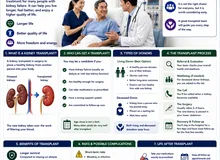
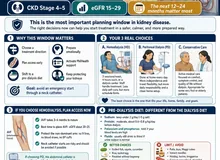
Lay out transplant, PD, HD and conservative care with a family, and keep coverage separate from the clinical plan.
PublishedNailathalaGipatikPepalwal:ReferencesMga SanggunianMga TinubdanReng Reperensya:14Audience: Pediatric nephrologists · pediatric nephrology fellows · adult nephrologists, intensivists and neonatologists who share kidney care for children in the clinic, ward, NICU, PICU, dialysis unit and homeRead timeOras ng pagbasaOras sa pagbasaOras ning pamamasa:
Training track for attending pediatric nephrologists
This module is study material for attending pediatric nephrologists and fellows. It explains the reasoning behind common decisions; it is not a protocol and it gives no doses. Doses, fill volumes and thresholds must come from current pediatric guidelines, product labels, your institution’s approved pediatric protocols and a pediatric pharmacist. Benefit rules change: confirm them on the date of service. Every case is fictional.
Learning objectives
After this module you should be able to
Lay out preemptive transplantation, peritoneal dialysis (PD), hemodialysis (HD) and conservative care for a child approaching kidney failure, with what each asks of the child and family.
Use registry and guideline evidence on survival, transplantation and dialysis in children to support a recommendation, naming what the data cannot show.
Lead a shared decision with a family in Philippine conditions (distance, an overseas parent, Philippine Health Insurance Corporation (PhilHealth) coverage) without letting coverage become the clinical plan.
Pre-testBefore you read, answer the 5 self-assessment questions and note your score. After the module, select New set of questions and compare. The difference is what you learned; the questions you still miss are what to reread.
Start here
The big picture, in plain words
Your role · the guide to the decisionYou are the doctor who tells a family that their child’s kidneys are failing and who helps them choose what comes next. You lay out every realistic option, recommend one with reasons, start the preparation early enough that the choice is real, and record the decision so that every hospital and unit the child passes through follows the same plan.
In plain wordsChoosing kidney replacement therapy (KRT) for a child is like planning a long journey with a family that has never traveled. There are several roads. One is best if the bridge is ready; one is safest for the smallest travelers; one is for when the other roads are closed. The family must choose before the old road ends.
The picture has a limit. Journeys can be postponed; kidney failure cannot. The roads also join: most children move between PD, HD and transplantation over their lives, and a choice made at 3 years shapes the veins, the peritoneum and the bladder available at 15. A good decision now keeps later roads open.
Figure 1 · Key numbers
Preemptive first transplant, European Renal Association (ERA) RegistryAdjusted hazard ratio 0.66 for death and 0.89 for graft failure, 12,623 patients with childhood-onset KRT
Dialysis versus transplant at age 18Adjusted hazard ratio for death 5.44 on dialysis, 2,944 young adults
Maintenance PD in children, International Pediatric Peritoneal Dialysis Network (IPPN)5% probability of death at 3 years (2% North America to 9% Eastern Europe)
Infant transplantationPostponed in most centers until a body weight of 8–10 kg
Starting dialysis (European guidance)Estimated glomerular filtration rate (eGFR) 10–15 mL/min/1.73 m², unless the child is growing well and asymptomatic
Most children with progressive chronic kidney disease (CKD) can be guided to a planned start: a transplant before dialysis where a donor and a safe bladder exist, or PD at home. A few start in crisis, through an emergency catheter in an adult unit, because no one prepared the family in time. Your work is to start the conversation early, lay out the options honestly, recommend one, prepare for it, and keep coverage and the clinical plan in separate sentences.
Opening case · fictional
Case: Four hours from the pediatric center
Gabriel Santos is 3 years old, weighs 12.5 kg and is below the 3rd percentile for height. He had posterior urethral valves ablated as a newborn and has renal dysplasia. His estimated glomerular filtration rate (eGFR) has fallen from 16 to 9 mL/min/1.73 m² over eight months. He vomits most mornings, eats little, and his hemoglobin is 9.1 g/dL, bicarbonate 16 mmol/L and potassium 5.6 mmol/L. He passes good volumes of urine.
The family lives in Infanta, Quezon, about four hours by road from the pediatric center in Manila where you see him. His mother, Liza, comes with his grandmother; his father, Rommel, works in Qatar and joins by video call. The grandmother asks why Gabriel cannot simply have hemodialysis at the adult unit 40 minutes from their house. Rommel says he will give a kidney “now, tomorrow.” Liza asks how many sessions PhilHealth will give, and whether PD at home is possible when the power goes out every week.
Before reading on, decide:
What options will you lay out, and which will you recommend for Gabriel?
Why is the adult HD unit near home not the answer, and what do you do with Rommel’s offer?
How will you explain PhilHealth coverage without letting it become the plan?
Keep your answers in mind. The lesson gives you what you need, and the case review near the end shows one sound response.
Lesson · part 1
Four paths and what each asks of a child
Every child approaching kidney failure has up to four paths. The attending’s first job is to name all of them, including the ones the family has not heard of and the one you do not recommend.
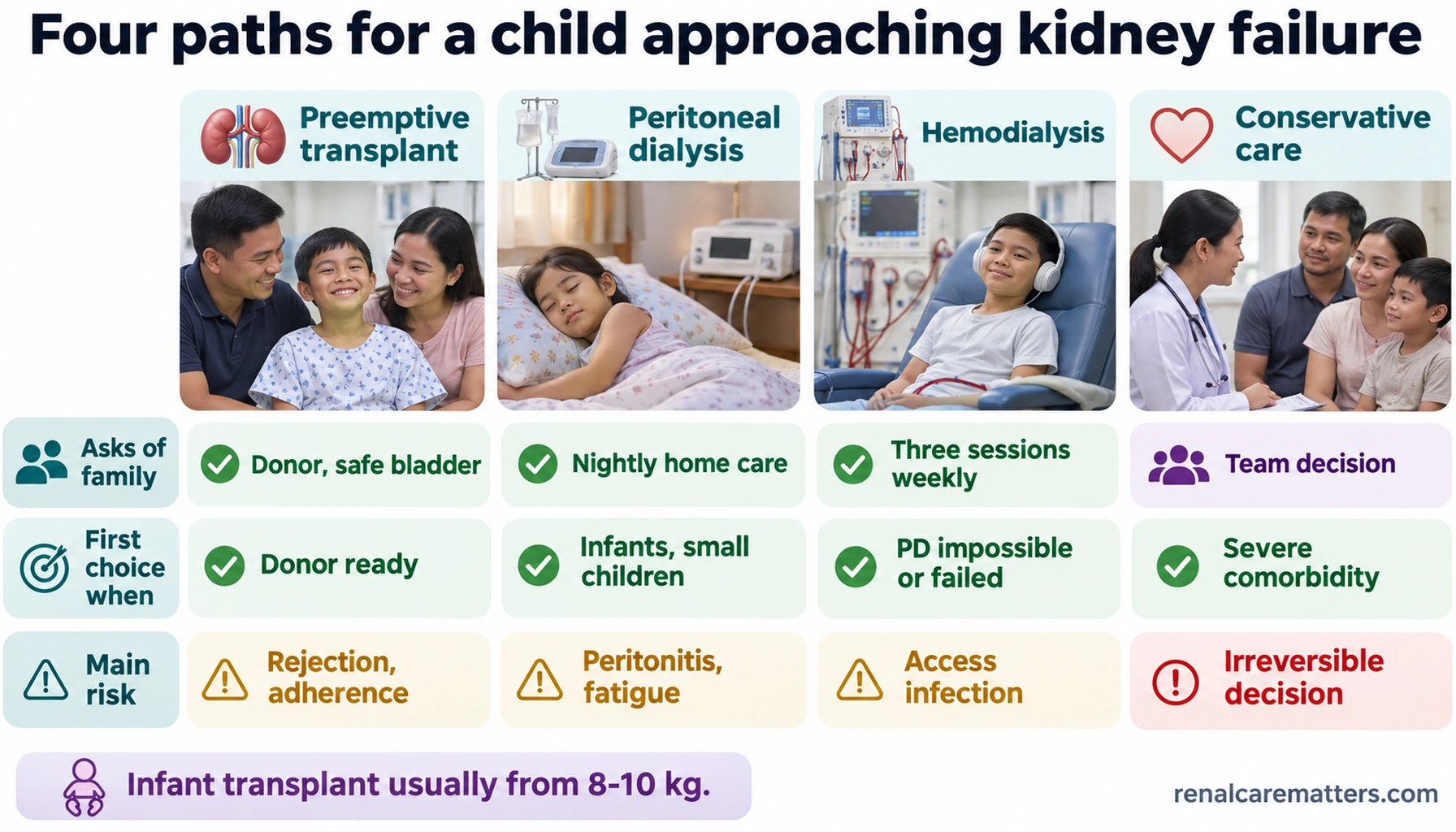
Preemptive transplantation. A kidney transplant before dialysis begins avoids dialysis access, the peritoneum’s exposure to glucose, and months of missed school. It needs a donor, a safe bladder, vaccinations completed before immunosuppression, and time: the evaluation of recipient and donor takes months, so it must start while the eGFR is still well above the level at which dialysis would begin (Module 26). In infants, most centers postpone transplantation until the child reaches 8–10 kg.1
Peritoneal dialysis. PD is the preferred kidney replacement therapy (KRT) in infants, graded 1B by the European Pediatric Dialysis Working Group, because it preserves residual urine output and veins, allows larger feeding volumes, and runs at home.1 It remains the usual first dialysis for small children worldwide (Modules 20 to 22).
Hemodialysis. HD in infants and small children is effective and must be available, but keeping vascular access working limits its long-term use. It is the first choice in infants with primary oxalosis and in those who cannot have PD (omphalocele, gastroschisis, diaphragmatic hernia, an obliterated peritoneal cavity, bladder exstrophy), and a short-term rescue after PD catheter problems or abdominal surgery.1 For older children, HD is the route when PD has failed or the home cannot support it. The European pediatric HD guideline calls dialysis a temporary measure compared with transplantation, which gives the best chance of rehabilitation in education and psychosocial functioning.2
Conservative care. For a few infants with severe non-renal disease, offering no dialysis is a legitimate choice. The infant recommendations ask that both starting and withholding KRT be decided by consensus, guided by the child’s best interest, with the family fully informed and involved (1B). They list what the team must weigh: short- and long-term prognosis including comorbidities, the availability of equipment, expertise, money and a future transplant, and the predicted quality of life for the child and family. They warn that conservative management may last months, that parents may bond and change their minds, and that irreversible growth and developmental damage may occur in the meantime, so the decision should be made as early as possible.1
Path
What it asks of the child and family
First choice when
Main risks
Preemptive transplant
A donor, a safe bladder, months of evaluation, lifelong medicines
A suitable donor and bladder are ready before dialysis is needed
Rejection, infection, nonadherence in adolescence
PD
A trained caregiver every night, a clean space, power for a cycler
Infants and small children; families who can do home therapy
Vascular access, three sessions a week in a unit, travel
PD impossible or failed; oxalosis in infants
Access infection and loss, hypotension, school lost
Conservative care
Symptom-focused care, often palliative, decided with the team
Severe comorbidity where dialysis would not serve the child’s interest
A decision that cannot be undone once growth is lost
Timing. European guidance cited in the infant recommendations suggests starting dialysis at an eGFR between 15 and 10 mL/min/1.73 m² unless the child is growing well and is asymptomatic; in infants, eGFR is a weaker guide and the main determinant is maintaining growth, nutrition and development (1B). Infants with high urine output may thrive at a low eGFR, while oliguric infants need an early start to avoid fluid overload.1 Gabriel’s vomiting, poor growth and acidosis already argue for a planned start soon.
RememberName all four paths, recommend one, and start preparing for it while there is still time for the best path to be possible.
Figure 2. Four paths. What preemptive transplantation, PD, HD and conservative care each ask of a child and family, and when each is the first choice.
Lesson · part 2
What the registries show, and what they cannot
Children rarely need KRT, so there are no randomized trials comparing modalities. The evidence comes from large registries, which describe outcomes well but cannot separate the effect of a treatment from the kind of child who receives it.
Transplantation versus dialysis. In the ERA Registry, 2,944 young people who had started KRT in childhood reached age 18 between 2008 and 2019. Unadjusted 5-year survival after age 18 was 96.9%, but those on dialysis had a much higher risk of death than transplant recipients (adjusted hazard ratio 5.44). Compared with the general population, expected remaining life at 18 was 17 years shorter for transplant recipients and 40 years shorter for those on dialysis.3 Healthier children are more likely to receive transplants, so part of the gap is selection, not treatment.
Preemptive and living-donor transplantation. In 12,623 patients from the same registry who started KRT before age 20, a preemptive first transplant was associated with lower mortality (adjusted hazard ratio 0.66) and less graft failure (0.89), and a living-donor transplant with lower mortality (0.71) and graft failure (0.76). Graft failure risk was highest between ages 10 and 24 years.4 The analysis is descriptive and adjusted, but residual confounding is likely: families who achieve a preemptive transplant may differ in many ways.
PD outcomes around the world. In 2,956 children who started maintenance PD in the IPPN registry, the probability of death within 3 years was 5%, from 2% in North America to 9% in Eastern Europe. Country income explained 50.1% of the variation in mortality between regions.5 Survival on pediatric PD is high where programs are resourced, and resources, not the modality alone, drive much of the difference. A review in The Lancet Child & Adolescent Health summarizes that morbidity and mortality remain higher with chronic dialysis than after transplantation, and that cost limits dialysis for children where resources are constrained.6
Why the cause matters. In 23,620 children starting KRT in 80 countries, immune-mediated glomerular disease was the most common cause in Southeast Asia, while congenital anomalies of the kidney and urinary tract (CAKUT) and hereditary disease predominated in younger children.7 The cause changes the plan: CAKUT means the bladder must be assessed before any transplant, and some glomerular and genetic diseases recur in a graft.
Access as a signal of the plan. In the International Pediatric Hemodialysis Network (IPHN) registry, children dialyzed through catheters were transplanted sooner (median 14 versus 20 months) and had a threefold higher living-related transplant rate than those with fistulas, because catheters were chosen when an early transplant was expected.8 Access choice reflects the expected time to transplant; plan both together.
Finding
Design and size
What it does not show
Dialysis at 18 carries far higher mortality than a functioning graft
RememberThe registries favor transplantation, preferably preemptive and from a living donor, and support PD for small children. They are associations; say so when you quote them.
Lesson · part 3
Coverage, distance and the family
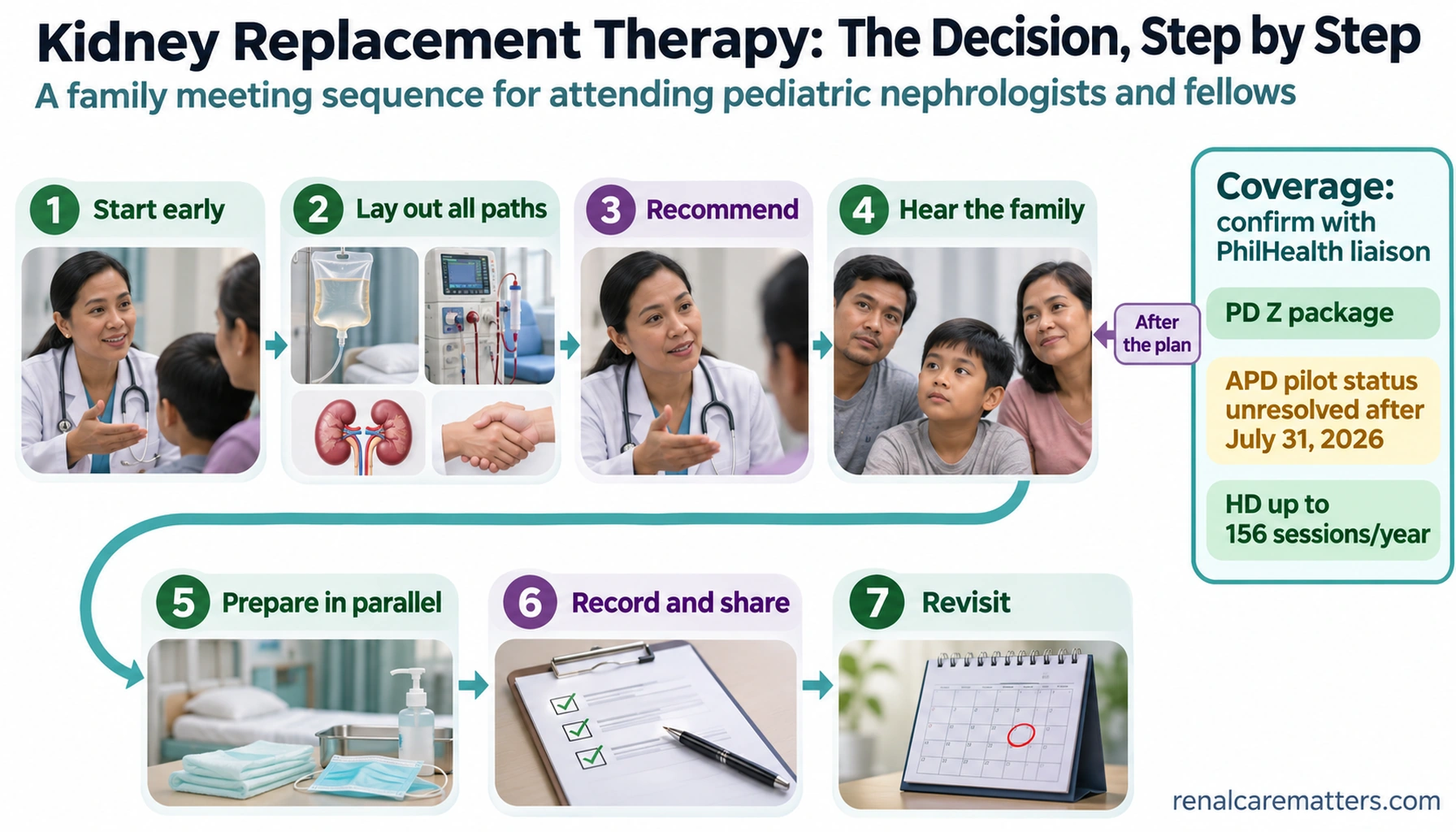
PD coverage. PhilHealth Circular 2024-0036 created separate adult and pediatric PD Z packages. For children it covers continuous ambulatory PD (CAPD) and, as a pilot at selected facilities, automated PD (APD).9 Pediatric eligibility requires an age of 0 to 18 years and 364 days, written informed consent from parents or guardian, stage 5 CKD needing KRT, a permanent PD catheter, PD initiation at an accredited facility, and a trained caregiver.10 The APD pilot began at three government tertiary centers in Metro Manila11 and was extended to July 31, 2026 by Advisory 2026-0013.12 Its status after that date is unresolved: confirm it with your PhilHealth liaison before telling a family whether APD is covered.
HD and transplant coverage. PhilHealth covers up to 156 HD sessions a year under Circular 2024-0023.13 Kidney transplantation has its own Z benefit, raised under Circular 2024-0035;14 the transplant center’s PhilHealth coordinator can confirm the current pediatric terms (Module 26).
What the family asks
The true answer
What you do
“How many sessions does PhilHealth give?”
Up to 156 HD sessions a year; that is coverage, not a prescription
Say what the child needs clinically first, then the coverage
“Is the machine at home covered?”
Pediatric APD was a pilot, extended to July 31, 2026; later status unresolved
Confirm with the liaison; do not promise
“Can we do PD if the power goes out?”
CAPD needs no electricity; APD does
Plan CAPD or a brownout plan for APD (Module 21)
“Can the father donate from abroad?”
Donor evaluation needs tests and visits in the Philippines
Start donor work-up planning early with the transplant team
“Who signs?”
Parents or legal guardian give consent; the child gives assent as able
Include the absent parent by call; record who consented
Distance. A family four hours from the pediatric center cannot bring a child three times a week for HD without losing work, school and money. An adult unit near home is close but is rarely equipped for a small child (Module 23). PD at home keeps the child in the barangay, with monthly visits to the center; it also means the family must manage peritonitis far from help, so the plan needs a nearer hospital that agrees to take an effluent sample and start antibiotics (Module 22).
Families. Many Filipino children have a parent working abroad, a grandmother who carries the daily care, and an extended family that expects a voice. Ask who decides, who will do the exchanges, and who will donate if a transplant is chosen. Bring the overseas parent into the meeting by video call, and send a written summary in plain language afterward.
RememberCoverage is not a prescription. State the clinical recommendation first, then the coverage facts, and confirm coverage on the date of service.
Lesson · part 4
Leading the decision with a frightened family
Shared decision-making in pediatric KRT means the team brings the evidence and its experience, the family brings its values, home and resources, and the child’s voice is heard as far as age allows. It is a series of meetings, not one.
Figure 3 · The KRT decision, step by step
Start earlyRaise KRT when the eGFR is falling toward the dialysis range and growth or symptoms are worsening, not at the first emergency.
Lay out all pathsPreemptive transplant, PD, HD and, where relevant, conservative care, with what each asks of the family.
RecommendSay which path you advise for this child and why.
Hear the familyWho will do the care, the home, the money, the distance, the fears, the absent parent.
PrepareStart transplant and donor evaluation, plan the PD catheter or access, vaccinate, protect veins, secure feeding.
Record and shareWrite the decision and the preparation plan; send it to every unit and hospital involved.
RevisitReview the decision at every visit; a plan can change.
Preparation that cannot wait. Several steps take months and protect later choices. Complete vaccinations, including live vaccines, before any transplant. Protect arm veins from cannulas and blood draws as your unit’s vein-preservation policy directs. Assess the bladder with the urologist in a child with CAKUT. If tube feeding will be needed, plan a gastrostomy before or with the PD catheter rather than after PD starts, because placement after PD has begun carries a high risk of peritonitis, including fungal peritonitis.1 Treat anemia, acidosis and bone disease so the child reaches KRT in the best condition (Modules 17 and 18).
Before the first meeting
At the meeting
After the meeting
eGFR trend, growth chart, symptoms, cause of kidney disease, bladder status
Plain language; draw the four paths; check understanding
Written summary for the family, in Filipino or English as they prefer
Who is in the family, who decides, who might donate
Recommend one path and give the reason
Referrals: transplant team, surgeon, PD nurse, social worker, dietitian
Coverage facts confirmed with the liaison
Coverage stated after the clinical plan
Date for the next meeting
At the second family meeting · fictional
A 13-year-old girl from Leyte listens while her parents discuss PD versus HD. When you ask her directly, she says she wants to go to school and does not want “the machine with blood.” Her mother had assumed HD because a neighbor is on it.
You explain nightly APD, confirm the coverage question with the liaison, and start her uncle’s donor evaluation in parallel.
What this shows. Ask the child. An adolescent’s assent is part of the decision, and her priorities may settle it.
RememberStart early, recommend clearly, prepare in parallel, and write the decision down where every unit can see it.
Stop and call
Potassium rising despite diet and medicines, or electrocardiogram (ECG) changes
Fluid overload or hypertension that does not respond to treatment
Persistent vomiting, weight loss or a falling height velocity in a child near the dialysis range
A family being pushed toward an emergency catheter in an adult unit without a plan
Figure 4. The decision, step by step. A family meeting sequence that keeps PhilHealth coverage in a separate box from the clinical plan.
On the floor
Real situations: problems and solutions
These are fictional but typical. For each one, cover the answer, decide what you would do, then compare. Where a step depends on local rules, your unit’s procedure and your supervisor’s direction come first.
The first conversation in the emergency room
What you see
A 7-year-old with known CKD arrives at a provincial emergency room with potassium 7.1 mmol/L and fluid overload. No one has ever discussed dialysis with the family.
What is likely going on
The KRT conversation was postponed until the crisis, so the first dialysis will be through an emergency catheter.
What to do
Treat the emergency, then hold the family meeting you would have held months ago: all four paths, your recommendation, and a preparation plan. Review your clinic list for other children approaching the same point.
Why it matters
Children who start KRT in crisis lose the chance of a preemptive transplant or a planned PD start.
The grandmother who decides
What you see
Parents of a 4-year-old keep deferring the decision to the grandmother, who has not come to any visit.
What is likely going on
In many Filipino families an elder carries real authority, and the parents will not agree to anything she has not heard.
What to do
Invite her to the next meeting, in person or by video call, and explain the options to her directly, while making sure the parents give the legal consent.
Why it matters
A decision made without the person who actually decides will not hold at home.
The father abroad who wants to donate
What you see
An overseas Filipino worker (OFW) father offers a kidney but can take leave only once a year.
What is likely going on
Donor evaluation needs tests and visits in the Philippines and cannot be done in one short visit without planning.
What to do
Refer him to the transplant team now, ask them for a donor work-up schedule he can plan his leave around, and keep the child's dialysis preparation moving in parallel.
Why it matters
Living-donor and preemptive transplants were associated with the best outcomes in the ERA Registry; planning makes them possible.
The family told that PhilHealth decides
What you see
A mother says a unit told her that her son can have only the dialysis PhilHealth pays for.
What is likely going on
Coverage has been presented as the prescription.
What to do
Explain the clinical plan, then the coverage facts as confirmed by the liaison, and document the child's needs truthfully; involve the social worker for costs outside coverage.
Why it matters
Coverage is not a prescription; families should hear the clinical plan and the coverage as two separate answers.
Field notes
Start the KRT conversation when the eGFR is falling toward the dialysis range, and write the date of the first meeting in the chart.
Draw the four paths on paper for the family and let them keep it.
Invite the overseas parent by video call to every decision meeting.
Send a one-page decision summary to every hospital and unit that may see the child.
Case review
Back to the case: Four hours from the pediatric center
The options. Lay out all four paths. Conservative care is not appropriate for a 3-year-old without severe comorbidity, but naming it shows the family that every path was considered. Recommend PD as the bridge he needs now, because he is symptomatic, not growing and acidotic, and start transplant evaluation at the same time. At 12.5 kg he is above the weight at which most centers transplant, so a living-donor transplant is a realistic goal once his bladder has been assessed after his valves and a donor has been evaluated. If the work-up moves quickly and he remains stable, a preemptive transplant may still be possible, and the registry data favor it.
The adult unit and the father. An adult unit 40 minutes away would mean a central catheter, a circuit built for adults, three sessions a week and a child who stops growing between them. PD keeps his veins, works with his good urine output, and lets him sleep at home. Thank Rommel and take his offer seriously: refer him to the transplant team for donor evaluation now, explain that tests and visits will be needed in the Philippines, and plan his leave around them. A donor offer is a reason to start the work-up, not to skip it.
Coverage. Answer the clinical question first: Gabriel needs PD now and a transplant as soon as it can be done safely. Then the coverage: PhilHealth has a pediatric PD package that covers CAPD; coverage for children on the home cycler was a pilot extended to July 31, 2026, and you will confirm its current status with the liaison. Because power fails every week in Infanta, CAPD may suit them better than APD for now. HD sessions and kidney transplantation have their own benefits. Tell Liza that the number of sessions or bags PhilHealth covers will never decide what Gabriel receives; his needs will, and you will document them truthfully.
Skills lab · with your preceptor
Skills checklist: Choosing kidney replacement therapy with families
Complete with a preceptor, in simulation or at your own unit. Sign-off is local. Your preceptor rates each step as satisfactory, needs practice, or not observed. Steps marked Critical must all be satisfactory before sign-off. This checklist supports supervised learning; your unit’s own procedure and competency form are the authority. A printable version of every checklist is on the trainer page.
Leads a family meeting that lays out transplant, PD, HD and conservative care with a clear recommendation
Starts transplant and donor evaluation in parallel with dialysis preparation
States PhilHealth PD, APD pilot, HD and transplant coverage accurately and separately from the plan
Writes a decision summary that every hospital and unit involved can follow
Placement activity. Pediatric CKD clinic or simulated family meeting
Self-assessment
Check your understanding
Each visit draws 5 questions at random from this module’s 5-question bank. Choose the single best answer for each, then select Check answers; an explanation appears under the best answer. Select New set of questions for a different mix. A good target is 4 of 5 on two different sets. Nothing you select is sent anywhere; scoring happens in your browser.
Zurowska, A. M., Fischbach, M., Watson, A. R., Edefonti, A., Stefanidis, C. J., & European Paediatric Dialysis Working Group. (2013). Clinical practice recommendations for the care of infants with stage 5 chronic kidney disease (CKD5). Pediatric Nephrology, 28(9), 1739–1748. https://doi.org/10.1007/s00467-012-2300-z
Fischbach, M., Edefonti, A., Schröder, C., Watson, A., & European Pediatric Dialysis Working Group. (2005). Hemodialysis in children: General practical guidelines. Pediatric Nephrology, 20(8), 1054–1066. https://doi.org/10.1007/s00467-005-1876-y
Montez de Sousa, I. R., Bonthuis, M., Kramer, A., Ordoñez, F. A., de la Cerda Ojeda, F., Rydell, H., Helve, J., Groothoff, J. W., Hommel, K., Buchwinkler, L., Segelmark, M., Arici, M., Palsson, R., Bell, S., Trujillo-Alemán, S., Bakkaloglu, S. A., Sørensen, S. S., Vila, A., Ortiz, A., ... Jager, K. J. (2025). Adult outcomes of childhood kidney replacement therapy in Europe from 2008 to 2019: An ERA Registry study. Nephrology Dialysis Transplantation, 40(4), 707–719. https://doi.org/10.1093/ndt/gfae189
Preka, E., Bonthuis, M., Marks, S. D., Kramer, A., Stel, V. S., Buchwinkler, L., Ponte, B., Åsberg, A., Stabouli, S., Stojanovic, J., Sørensen, S. S., Gjerstad, A. C., Herrero-Goñi, M., Rodriguez Arévalo, O. L., Tsimaratos, M., Kuzema, V., Segelmark, M., Palsson, R., Ortiz, A., ... Harambat, J. (2026). Long-term patient and graft survival for children and young adults after kidney transplantation and retransplantation: Results from the European Renal Association Registry. American Journal of Transplantation. Advance online publication. https://doi.org/10.1016/j.ajt.2026.10.017
Ploos van Amstel, S., Noordzij, M., Borzych-Duzalka, D., Chesnaye, N. C., Xu, H., Rees, L., Ha, I. S., Antonio, Z. L., Hooman, N., Wong, W., Vondrak, K., Yap, Y. C., Patel, H., Szczepanska, M., Testa, S., Galanti, M., Kari, J. A., Samaille, C., Bakkaloglu, S. A., ... Schaefer, F. (2021). Mortality in children treated with maintenance peritoneal dialysis: Findings from the International Pediatric Peritoneal Dialysis Network Registry. American Journal of Kidney Diseases, 78(3), 380–390. https://doi.org/10.1053/j.ajkd.2020.11.031
Rees, L., Schaefer, F., Schmitt, C. P., Shroff, R., & Warady, B. A. (2017). Chronic dialysis in children and adolescents: Challenges and outcomes. The Lancet Child & Adolescent Health, 1(1), 68–77. https://doi.org/10.1016/S2352-4642(17)30018-4
Borzych-Dużałka, D., Bonthuis, M., Ali, U., Yap, Y. C., Manno, M., Zhai, Y., Loza, R., Hashmi, S., Choi, N., Soulami, K., Exantus, J., Al Riyami, M. S., Mabrouk, S., Angeles, M. M., Zelaya-Camacho, C., Puspitasari, H. A., Huque, S. S., Cano, F., Ng, K. H., ... Schaefer, F. (2026). Regional variation of underlying kidney diseases in children undergoing chronic kidney replacement therapy around the globe. Pediatric Nephrology, 41(5), 1451–1463. https://doi.org/10.1007/s00467-025-07096-3
Borzych-Duzalka, D., Shroff, R., Ariceta, G., Yap, Y. C., Paglialonga, F., Xu, H., Kang, H. G., Thumfart, J., Aysun, K. B., Stefanidis, C. J., Fila, M., Sever, L., Vondrak, K., Szabo, A. J., Szczepanska, M., Ranchin, B., Holtta, T., Zaloszyc, A., Bilge, I., ... Schmitt, C. P. (2019). Vascular access choice, complications, and outcomes in children on maintenance hemodialysis: Findings from the International Pediatric Hemodialysis Network (IPHN) Registry. American Journal of Kidney Diseases, 74(2), 193–202. https://doi.org/10.1053/j.ajkd.2019.02.014
Philippine Health Insurance Corporation. (2025). Conduct of the pilot implementation of the Z benefits package for peritoneal dialysis (PD) covering automated PD in children (PhilHealth Advisory No. 2025-0074). https://www.philhealth.gov.ph/advisories/2025/PA2025-0074.pdf
Philippine Health Insurance Corporation. (2026). Extension of the pilot implementation of the Z benefits package for peritoneal dialysis (PD) covering automated PD in children (PhilHealth Advisory No. 2026-0013). https://www.philhealth.gov.ph/advisories/2026/PA2026-0013.pdf
Educational material for physicians. Completing it is an Academy learning record only. It does not confer CPD units, PNSP or board certification, privileges, or PhilHealth accreditation, and it does not replace current guidelines, regulations, your institution’s pediatric protocols and formulary, or clinical judgment.