AKI in children: sepsis, nephrotoxins and tropical infections
Manage pediatric AKI from dengue, leptospirosis, sepsis and nephrotoxins, and follow the kidney after recovery.
PublishedNailathalaGipatikPepalwal:ReferencesMga SanggunianMga TinubdanReng Reperensya:11Audience: Pediatric nephrologists · pediatric nephrology fellows · adult nephrologists, intensivists and neonatologists who share kidney care for children in the clinic, ward, NICU, PICU, dialysis unit and homeRead timeOras ng pagbasaOras sa pagbasaOras ning pamamasa:
Training track for attending pediatric nephrologists
This module is study material for attending pediatric nephrologists and fellows. It explains the reasoning behind common decisions; it is not a protocol and it gives no doses. Doses, fill volumes and thresholds must come from current pediatric guidelines, product labels, your institution’s approved pediatric protocols and a pediatric pharmacist. Benefit rules change: confirm them on the date of service. Every case is fictional.
Learning objectives
After this module you should be able to
Stage pediatric acute kidney injury (AKI) with Kidney Disease: Improving Global Outcomes (KDIGO) and pRIFLE criteria, estimate a missing baseline honestly, and calculate percentage fluid overload.
Manage AKI in dengue, leptospirosis and sepsis with attention to the phase of illness, fluid balance and nephrotoxin exposure.
Plan follow-up after pediatric AKI, using KDIGO 2012 as the current guideline and the KDIGO 2026 acute kidney disease concept as a draft.
Pre-testBefore you read, answer the 5 self-assessment questions and note your score. After the module, select New set of questions and compare. The difference is what you learned; the questions you still miss are what to reread.
Start here
The big picture, in plain words
Your role · the consultant who reads the fluid chartIn the Philippine wet season your phone fills with children in dengue shock, leptospirosis after floods and sepsis from every cause. The pediatric resident and the intensivist own the bedside; your duty is to stage the kidney injury from trends, to say plainly when fluid has become the problem, to remove the drugs that are adding injury, to decide when dialysis is needed and where it can be done, and to make sure the child is seen again after discharge.
In plain wordsThink of the kidney in a sick child as a rice field during a typhoon. First the field is dry because the irrigation has failed; then the water comes all at once and the field floods. The same field needs opposite help a day apart.
The picture has a limit. A rice field does not die from flooding in an hour, and it has no lungs. A child does. In dengue, fluid that leaked out during the critical phase returns to the vessels during recovery, and a child who needed boluses yesterday can drown in pleural fluid today. The kidney also has its own injury that does not simply reverse when perfusion returns. So you read the phase of illness and the fluid balance together, every few hours.
Figure 1 · Key numbers
AWARE (4,683 pediatric intensive care unit (PICU) patients)AKI 26.9%; severe AKI 11.6%; 28-day death 11.0% vs 2.5% without severe AKI
Creatinine alone (AWARE)Missed AKI in 67.2% of patients with low urine output
Fluid overload meta-analysis (44 studies, 7,507 children)Adjusted odds of death up 6% per 1% fluid overload
NINJA (pediatric wards)AKI rate down 64%, 2.96 to 1.06 per 1,000 patient-days
Follow-up (KDIGO 2012, ungraded)Evaluate about 3 months after AKI
Most pediatric AKI is prerenal or early tubular injury that improves when perfusion is restored and harmful drugs are stopped. A few children have severe AKI with fluid overload that needs dialysis. Your work is to tell the two apart early, keep the second group from being harmed by more fluid, and follow both after they go home.
Opening case · fictional
Case: Day 5 of dengue, and the urine has stopped
It is August, during a dengue outbreak. At 1 a.m. the pediatric resident at a provincial hospital in Iloilo City calls you. Kyla Mendoza is 10 years old and weighed 32 kg on admission. She is on day 5 of illness; she went into shock on day 4 and received crystalloid boluses and then a colloid, following the dengue protocol. Her hematocrit was 48% at the worst and is now 36%. Her platelets are 18,000/µL.
Over the last 10 hours she has passed 0.3 mL/kg of urine per hour. Her creatinine is 1.2 mg/dL; no earlier value exists. She now weighs 35.2 kg. Her respiratory rate is 40, oxygen saturation 92% on nasal cannula, and the chest film shows bilateral pleural effusions; the abdomen is tense with ascites. Blood pressure is 118/70 and her pulse is 104 and full. The resident has written another fluid bolus “for oliguria” and asks you to approve it. The intensive care unit is full. Her father, a tricycle driver, asks whether she needs dialysis and whether Philippine Health Insurance Corporation (PhilHealth) will pay for it.
Before reading on, decide:
Does Kyla have AKI, what stage, and how much fluid overload does she have?
Should she receive another bolus? What is driving the oliguria, and what should happen tonight?
What follow-up does she need after discharge, and how would you answer her father about coverage?
Keep your answers in mind. The lesson gives you what you need, and the case review near the end shows one sound response.
Lesson · part 1
How a child’s kidney fails in critical illness
A child’s kidneys receive a large share of cardiac output, and the medulla works close to hypoxia. Three mechanisms dominate in sick children, often together.
Low perfusion. In hypovolemia or shock, afferent constriction and low pressure lower filtration. Early on, tubules are intact: they conserve sodium avidly, urine sodium is low and urine is concentrated. If perfusion is restored quickly, function returns.
Sepsis. Septic AKI is not only low flow. Inflammatory mediators, microvascular dysfunction and mitochondrial stress injure tubules even when cardiac output is normal or high. Fluid restores flow but not this injury, so giving more fluid to a septic child with normal perfusion and low urine output adds overload without adding filtration.
Venous congestion. When central venous and intra-abdominal pressures rise, the pressure gradient across the kidney falls and the encapsulated organ is compressed. Ascites, a tense abdomen and high ventilator pressures all raise this outflow pressure. The kidney then makes less urine because of the fluid already given.
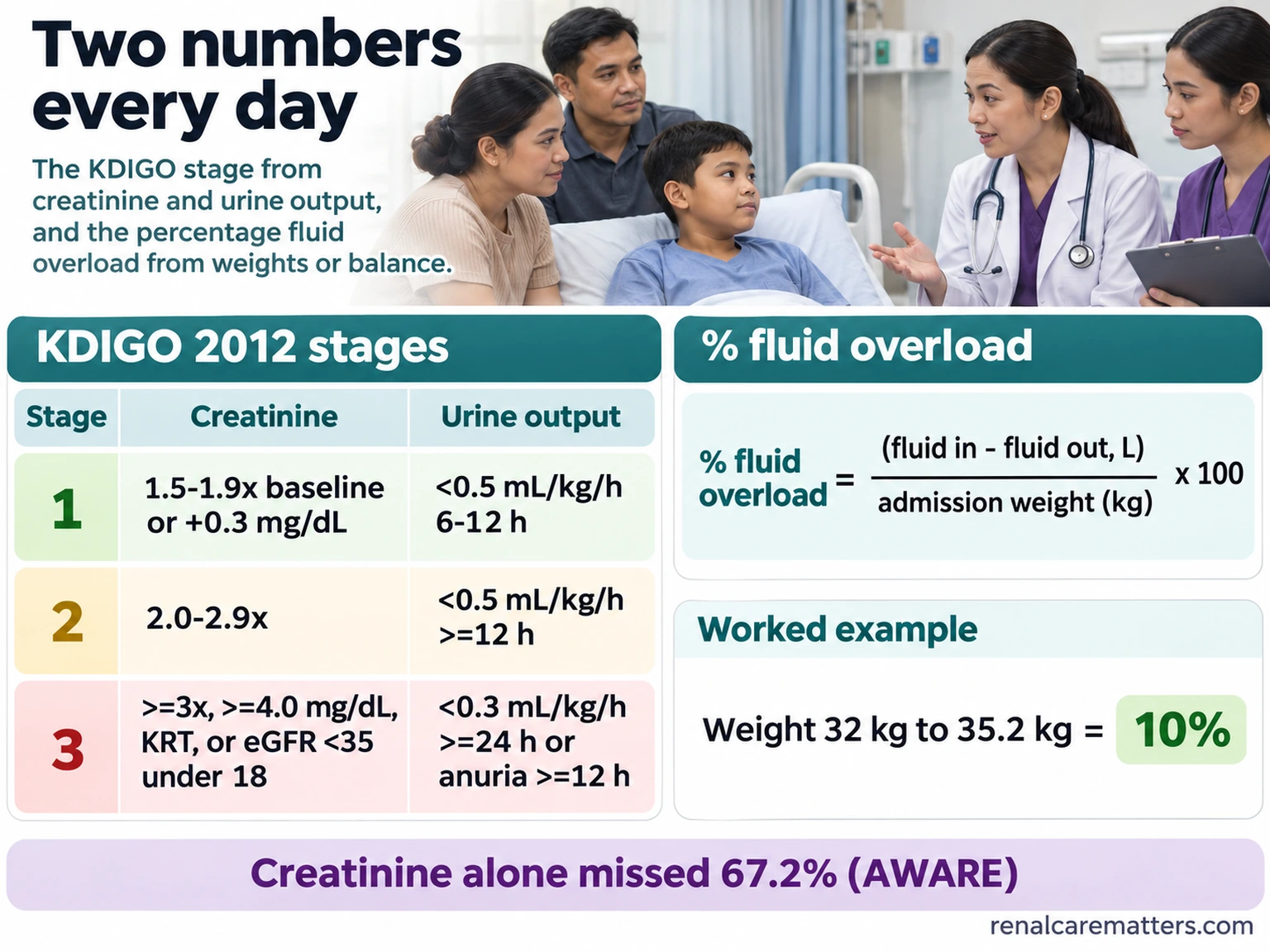
Fluid overload as an outcome. Percentage fluid overload is calculated as (fluid in minus fluid out, in liters) divided by the admission weight in kilograms, times 100; many units use daily weights instead.1 It matters because overloaded tissue oxygenates poorly, lungs stiffen, bowel swells, and creatinine is diluted so the AKI looks smaller than it is.
Why creatinine lags. Creatinine rises only after filtration has been low for hours, and how far it rises depends on how much creatinine the body makes. A small or malnourished child, or a child with wasted muscle after a long illness, makes little creatinine, so even a severe fall in filtration produces a modest number. A doubling from 0.3 to 0.6 mg/dL can look normal on a laboratory sheet built for adults. Fluid overload adds dilution. Each of these makes creatinine a late and quiet signal in children, which is why urine output, weight and the trend carry so much weight.
Treat the source; avoid overload; avoid nephrotoxins
Venous congestion
Transrenal gradient falls; kidney compressed
Edema, effusions, ascites, rising weight
Stop fluid; diuretic if responsive; remove fluid by dialysis if not
Nephrotoxins
Direct tubular or hemodynamic injury
Creatinine rise days after exposure
Stop, substitute, adjust; count exposures daily
RememberBefore you approve a bolus for oliguria, ask whether this child is underfilled or congested. Oliguria is a symptom of both, and the treatments are opposite.
Lesson · part 2
Staging and measuring pediatric AKI
The pediatric modification of the RIFLE criteria (pRIFLE) was developed in 150 critically ill children and staged AKI by estimated creatinine clearance and urine output; AKI was associated with death independent of illness severity (odds ratio 3.0).2 The Kidney Disease: Improving Global Outcomes (KDIGO) 2012 definition, still the current final version, unified the adult and pediatric criteria and is what most pediatric studies now use.3 The KDIGO 2026 AKI and acute kidney disease (AKD) guideline is a public-review draft; until it is final, quote the 2012 criteria and grades.4
KDIGO 2012 stage
Creatinine
Urine output
1
1.5–1.9 times baseline, or a rise of ≥0.3 mg/dL
<0.5 mL/kg/h for 6–12 h
2
2.0–2.9 times baseline
<0.5 mL/kg/h for ≥12 h
3
≥3 times baseline, or ≥4.0 mg/dL, or kidney replacement therapy (KRT) started, or in patients under 18 an estimated glomerular filtration rate (eGFR) <35 mL/min/1.73 m²
<0.3 mL/kg/h for ≥24 h, or anuria for ≥12 h
Urine output is not optional. The Assessment of Worldwide Acute Kidney Injury, Renal Angina and Epidemiology (AWARE) study prospectively followed 4,683 patients aged 3 months to 25 years in 32 pediatric intensive care units (PICUs). Creatinine alone failed to identify AKI in 67.2% of patients who met the urine output criterion.5 In a ward without catheters, weighed diapers or measured voids, charted at fixed times, are the test.
The missing baseline. Many Filipino children have never had a creatinine measured. When no baseline exists, units commonly back-calculate an expected value from the child’s height with a bedside pediatric equation and an assumed normal glomerular filtration rate (GFR). Write in the note that the baseline is estimated and how; a staging built on an assumed baseline is a hypothesis that the next creatinines will test.
Fluid overload is a second staging. Calculate it every day in every child with AKI. In the case, Kyla has gained 3.2 kg on an admission weight of 32 kg: 10% fluid overload by weight, before counting the pleural and peritoneal fluid already on the film.
RememberStage AKI from both creatinine and urine output, write down how you chose the baseline, and calculate percentage fluid overload every day.
Figure 2. Two numbers every day. The KDIGO stage from creatinine and urine output, and the percentage fluid overload from weights or balance.
Lesson · part 3
Dengue, leptospirosis and sepsis
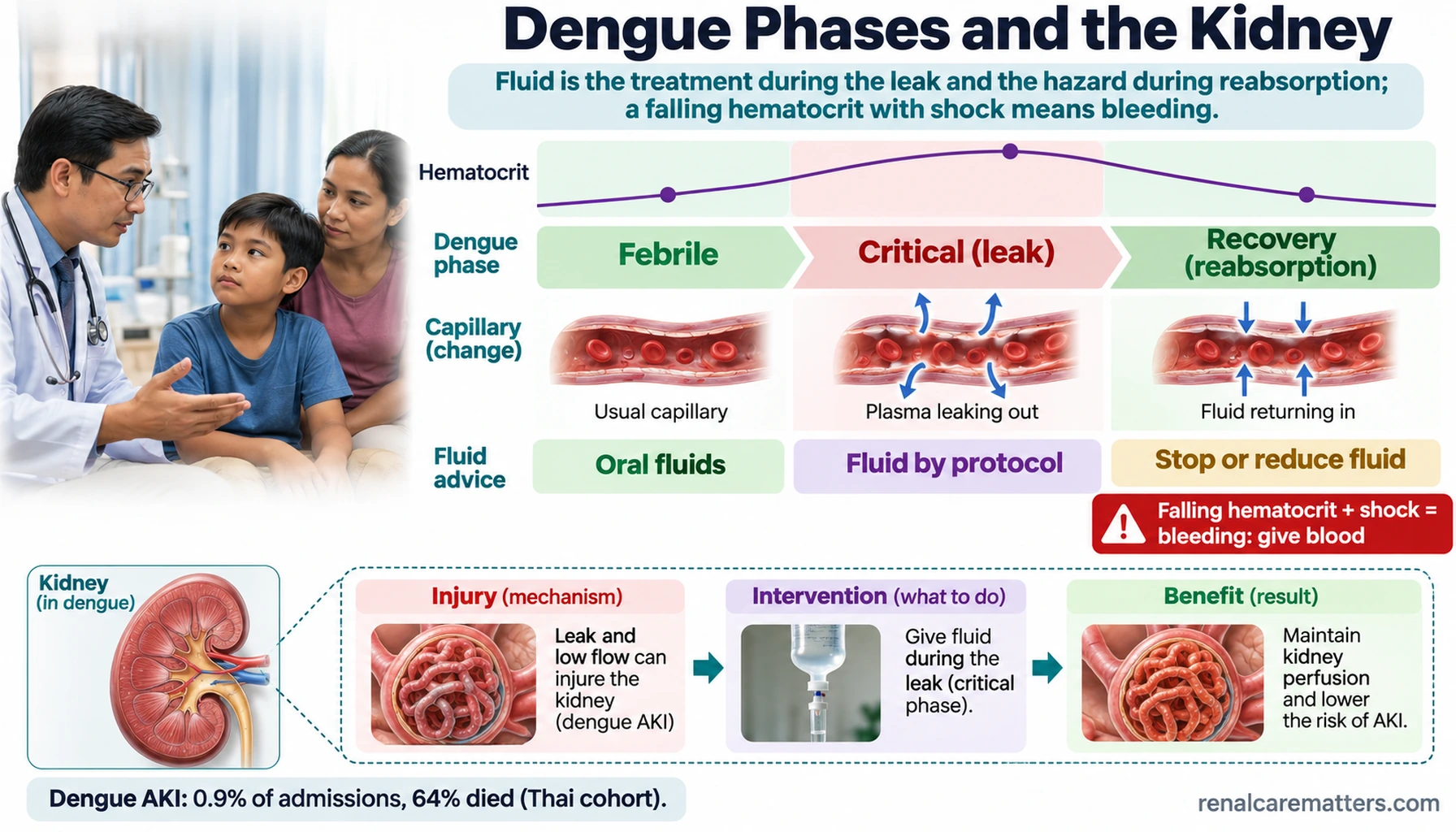
Dengue. The World Health Organization (WHO) 2009 guideline describes three phases: febrile, critical and recovery. In the critical phase, around defervescence, capillaries leak plasma, hematocrit rises and shock can develop; in the recovery phase, leaked fluid is reabsorbed into the circulation, hematocrit falls, and the child who received generous fluid during the leak can develop pulmonary edema, effusions and heart strain. The guideline warns about fluid overload as a major cause of complications and advises reducing or stopping intravenous fluid once leak stops.6
AKI is uncommon in pediatric dengue but grave when it occurs. In a Thai review of children under 15 admitted with dengue hemorrhagic fever from 1989 to 2007, AKI occurred in 25 of 2,893 admissions (0.9%), and 64.0% of those children died; dengue grade intravenous (IV) shock and obesity were the main risk factors, and survivors recovered normal creatinine.7 The numbers are from a single referral center over two decades with older intensive care, so mortality today may be lower, but the message holds: dengue AKI is a marker of profound shock, bleeding and multiorgan failure.
Dengue phase
Fluid physiology
Kidney picture
What the attending says
Febrile
Intake may be poor; leak has not begun
Usually normal
Oral fluids; watch for warning signs
Critical (leak)
Plasma leaks; hematocrit rises; shock possible
Prerenal; low urine output with high hematocrit
Fluid by the dengue protocol, titrated to perfusion and hematocrit
Recovery (reabsorption)
Leaked fluid returns; hematocrit falls
Urine output usually rises; if it does not, AKI plus overload
Stop or reduce fluid; diuretic if stable and responsive; dialysis if overloaded and anuric
Falling hematocrit with instability
Bleeding, not reabsorption
Prerenal from blood loss
Look for bleeding; blood, not crystalloid
Leptospirosis. Children wade in floodwater too. Leptospiral injury to the proximal tubule and thick ascending limb typically causes nonoliguric AKI with potassium and sodium wasting, and severe disease adds jaundice, low platelets and pulmonary hemorrhage. The Pediatric Infectious Disease Society of the Philippines (PIDSP) published a pediatric leptospirosis guideline (2019 edition, published 2023), developed with the GRADE method, for diagnosis, antibiotic management and prevention.8 Follow it and your hospital formulary for antibiotics; your part is the kidney, the potassium and the lungs. PhilHealth has a benefits package for moderate to severe leptospirosis with separate packages for cases needing hemodialysis and for cases needing peritoneal dialysis.9 Confirm the current rules on the date of service, and choose the modality for clinical reasons, not because of the package.
Sepsis. Septic AKI is the most common form in the PICU. In AWARE, severe AKI (stage 2 or 3) occurred in 11.6% and was associated with 28-day death after adjustment for 16 covariates (adjusted odds ratio 1.77, 95% confidence interval 1.17 to 2.68); 11.0% of children with severe AKI died, against 2.5% without.5 This is an association. It identifies the children who need closer monitoring; it does not show that treating the creatinine changes survival.
Fluid overload in the evidence. A meta-analysis of 44 studies including 7,507 critically ill children found that fluid overload, however defined, was associated with in-hospital death (odds ratio 4.34), and after adjustment for illness severity each 1% increase in fluid overload raised the odds of death by 6% (adjusted odds ratio 1.06, 1.03 to 1.10).10 Most included studies were retrospective cohorts, so sicker children may simply receive more fluid; no randomized trial has shown that restricting fluid after resuscitation saves lives in children. The association is consistent enough to make daily fluid balance a vital sign.
By Viber, from a district hospital in Leyte · fictional
A 13-year-old boy who helped clear a flooded canal has fever, calf pain, jaundice and a creatinine of 3.4 mg/dL. He is passing urine, and his potassium is 3.0 mmol/L. The resident asks whether he can wait for leptospirosis serology before treating.
You ask them to start antibiotics now per the PIDSP guideline, replace potassium cautiously, count respiratory rate and oxygen saturation every hour, and call you at once for hemoptysis. You also find him a dialysis-capable bed in Tacloban in case his lungs or urine fail.
What this shows. In leptospirosis, the serology can wait; the antibiotics, the potassium and the lungs cannot.
RememberIn dengue, know the phase. A falling hematocrit with stable vital signs and effusions means reabsorption: stop the fluid. A falling hematocrit with shock means bleeding: give blood.
Lesson · part 4
What the attending does
At the first call. Ask for the trend, not the last value: creatinine series, hourly urine output, weights, fluid in and out, hematocrit and platelets in dengue, potassium and bicarbonate, and the drug chart. Examine, or ask the resident to describe, perfusion, the jugular venous pressure if visible, lung sounds, effusions, liver size and the abdomen.
Steward nephrotoxins. The Nephrotoxic Injury Negated by Just-in-Time Action (NINJA) program screened noncritically ill hospitalized children receiving an intravenous aminoglycoside for more than 3 days or more than 3 nephrotoxins at once, and pharmacists recommended daily creatinine. Over 43 months, nephrotoxin exposures fell by 38% (11.63 to 7.24 per 1,000 patient-days) and AKI by 64% (2.96 to 1.06 per 1,000 patient-days); the authors estimated 398 AKI episodes avoided.11 It was a single-center quality improvement project in a well-resourced hospital, without a control group, but the method is cheap: a daily list, a daily creatinine and a daily question about each drug.
Decide about fluid and dialysis. If the child is perfused and congested, stop maintenance fluid beyond what drugs and nutrition need, try a loop diuretic if blood pressure allows and urine is still being made, and plan kidney replacement if overload is progressing, the lungs are failing, or potassium and acidosis are not controlled. Peritoneal dialysis (PD) and continuous kidney replacement therapy (CKRT) are covered in Module 16. If the intensive care unit is full, the decision about where the child goes is yours to make with the intensivist and the referring physician, and it is made tonight.
Dose drugs to the kidney you have today. Antibiotics, anticonvulsants, antivirals and sedatives cleared by the kidney accumulate as filtration falls, and creatinine overestimates function while it is still rising. Ask the pharmacist to adjust every renally cleared drug to the current, not the admission, kidney function, and to readjust when the kidney recovers or dialysis starts; under-dosing an antibiotic in sepsis is also harm. The unit’s pediatric formulary sets the numbers.
Feed the child. A catabolic child breaks down muscle, which raises potassium, phosphate and urea and weakens recovery. Fluid restriction for overload should not become starvation; concentrated feeds and early dialysis to create room for nutrition are often the better trade.
Figure 3 · The oliguric child at 1 a.m.
Stage itCreatinine trend, urine output, and an estimated baseline written as estimated.
Weigh the fluidPercentage fluid overload from weights or balance; effusions and ascites on examination.
Name the phaseIn dengue, critical leak or reabsorption; in sepsis, resuscitated or not.
Choose the directionUnderfilled: fluid. Congested: stop fluid, diuretic if responsive.
Remove what harmsNephrotoxins, contrast, unnecessary drugs; adjust the rest.
Set the triggerPotassium, acidosis, oxygen need or overload that will start dialysis, written in the chart.
Place the childThe bed where that dialysis can happen.
Plan the follow-up. KDIGO 2012 advises evaluating patients about 3 months after AKI for resolution, new onset or worsening of chronic kidney disease (CKD) (ungraded).3 The KDIGO 2026 draft describes acute kidney disease, the period of ongoing kidney dysfunction after an AKI episode, as a phase that needs its own monitoring; until the guideline is final, use the concept to justify follow-up, not as a graded rule.4 For a child, write the AKI stage, the peak and discharge creatinine, the drugs to avoid, and who checks blood pressure, urinalysis for protein and creatinine at about 3 months. The family needs the same plan in plain words.
At discharge after pediatric AKI
Why
Stage, peak and discharge creatinine
The next clinician needs the size of the injury
Blood pressure
Hypertension can be the first sign of residual damage
Urinalysis or urine protein-to-creatinine ratio
Proteinuria marks persisting injury
Creatinine at about 3 months
KDIGO 2012 practice, ungraded
Nephrotoxin warning
The family and the next doctor should avoid unnecessary nonsteroidal anti-inflammatory drugs (NSAIDs) and aminoglycosides
Named owner
Without a name, follow-up does not happen
In clinic, three months later · fictional
Jerome, 7, had stage 3 AKI from septic shock after a perforated appendix and needed four days of PD in Bacolod. He comes to your clinic because the discharge summary named you. His creatinine is back to an estimated normal, but his urine protein-to-creatinine ratio is raised and his blood pressure is at the 95th percentile.
You repeat both, confirm them, and enroll him in CKD follow-up.
What this shows. A normal creatinine after AKI is not the end of the story; protein and blood pressure tell the rest.
Stop and call
Oliguria with rising oxygen need or effusions
Potassium rising despite treatment, or electrocardiogram (ECG) changes
Fluid overload of 10% or more and still climbing
Leptospirosis with hemoptysis or falling saturation
Dengue with falling hematocrit and shock (suspect bleeding)
RememberEvery child who had AKI leaves with a stage, a 3-month check, a blood pressure and urine plan, and a name.
Figure 4. Dengue phases and the kidney. Fluid is the treatment during the leak and the hazard during reabsorption; a falling hematocrit with shock means bleeding.
On the floor
Real situations: problems and solutions
These are fictional but typical. For each one, cover the answer, decide what you would do, then compare. Where a step depends on local rules, your unit’s procedure and your supervisor’s direction come first.
The flood week
What you see
After a typhoon, a district hospital in Marikina admits four children with fever, calf pain and red eyes. One, aged 12, has a creatinine of 2.8 mg/dL, potassium 3.1 mmol/L and good urine output.
What is likely going on
Leptospirosis with nonoliguric AKI and potassium wasting.
What to do
Ask the team to start antibiotics per the PIDSP guideline and formulary without waiting for serology, replace potassium cautiously, and watch oxygen saturation for pulmonary hemorrhage. Arrange a dialysis-capable bed if the lungs or the urine fail.
Why it matters
A low potassium in leptospirosis is the tubule’s injury showing; it does not mean the kidney is coping.
The vancomycin trough on the weekend
What you see
A 6-year-old with osteomyelitis on vancomycin and piperacillin-tazobactam has a creatinine that rose from 0.4 to 0.7 mg/dL over three days. No one has flagged it because it is “still normal.”
What is likely going on
A 75% rise is stage 1 AKI in a small child, hidden by a low absolute number.
What to do
Stage it, ask the infectious disease team and pharmacist whether the combination can change, adjust doses, and check creatinine daily.
Why it matters
In a small child, a normal-looking creatinine can be a doubled one. Read the ratio, not the range.
The septic toddler after three boluses
What you see
A 2-year-old with pneumonia and septic shock has received three boluses. Perfusion is now good, but urine output is low and the liver edge has descended 3 cm.
What is likely going on
Resuscitation is done; congestion has begun.
What to do
Advise stopping further boluses, keeping maintenance fluid minimal, calculating fluid overload, and setting dialysis triggers with the intensivist.
Why it matters
Fluid that rescued perfusion an hour ago becomes the injury once perfusion is restored.
Field notes
Ask for weights in every child with AKI; a scale is cheaper than a chest film and more honest than an input-output chart.
Write “baseline estimated from height” when you had to estimate it.
Keep a printed dengue phase card at the nurses’ station that pairs hematocrit trends with fluid advice.
Put the 3-month kidney check on the discharge prescription so the family carries it.
Case review
Back to the case: Day 5 of dengue, and the urine has stopped
AKI and fluid overload. She has had urine output of 0.3 mL/kg per hour for 10 hours, which meets KDIGO stage 1 by urine output whatever her baseline creatinine, and becomes stage 2 if it continues for two more hours. Her creatinine of 1.2 mg/dL is likely well above an estimated baseline for a 10-year-old, and dilution means it understates the injury. Her weight has risen 3.2 kg on 32 kg: 10% fluid overload, with effusions and ascites besides.
Another bolus? No. Her hematocrit has fallen from 48% to 36% with a full pulse, stable blood pressure, effusions and ascites: this is reabsorption on day 5 to 6, not ongoing leak, and the oliguria reflects AKI plus congestion. Ask the resident to cancel the bolus and stop maintenance fluid beyond what is needed. Check for bleeding (stool, gastric aspirate, vital signs) because a falling hematocrit with shock would change everything. If she is passing any urine and blood pressure allows, a diuretic trial is reasonable. Set triggers for dialysis (worsening oxygenation, potassium, acidosis, rising overload) and agree tonight with the intensivist where she goes if they are met; a full intensive care unit is a reason to arrange transfer early, not to wait.
Follow-up and coverage. At discharge she needs a summary with stage, peak and discharge creatinine, and a check of blood pressure, urine protein and creatinine at about 3 months, with your name on it. Tell her father that if dialysis is needed it will be chosen for her safety, that hospitals bill PhilHealth for an admission like this under the rules in force on the date of service, and that the hospital’s PhilHealth desk and social worker can confirm what applies. Do not quote an amount you have not confirmed.
Skills lab · with your preceptor
Skills checklist: AKI in children: sepsis, nephrotoxins and tropical infections
Complete with a preceptor, in simulation or at your own unit. Sign-off is local. Your preceptor rates each step as satisfactory, needs practice, or not observed. Steps marked Critical must all be satisfactory before sign-off. This checklist supports supervised learning; your unit’s own procedure and competency form are the authority. A printable version of every checklist is on the trainer page.
Stages pediatric AKI by creatinine and urine output and documents how the baseline was chosen
Calculates percentage fluid overload from weights and from fluid balance
Identifies the dengue phase from hematocrit, vital signs and fluid signs, and advises on fluid accordingly
Writes a pediatric post-AKI discharge plan with a named owner and a 3-month review
Placement activity. Supervised ward or PICU consultation, or simulation
Self-assessment
Check your understanding
Each visit draws 5 questions at random from this module’s 5-question bank. Choose the single best answer for each, then select Check answers; an explanation appears under the best answer. Select New set of questions for a different mix. A good target is 4 of 5 on two different sets. Nothing you select is sent anywhere; scoring happens in your browser.
Sutherland, S. M., Zappitelli, M., Alexander, S. R., Chua, A. N., Brophy, P. D., Bunchman, T. E., Hackbarth, R., Somers, M. J. G., Baum, M., Symons, J. M., Flores, F. X., Benfield, M., Askenazi, D., Chand, D., Fortenberry, J. D., Mahan, J. D., McBryde, K., Blowey, D., & Goldstein, S. L. (2010). Fluid overload and mortality in children receiving continuous renal replacement therapy: The prospective pediatric continuous renal replacement therapy registry. American Journal of Kidney Diseases, 55(2), 316–325. https://doi.org/10.1053/j.ajkd.2009.10.048
Akcan-Arikan, A., Zappitelli, M., Loftis, L. L., Washburn, K. K., Jefferson, L. S., & Goldstein, S. L. (2007). Modified RIFLE criteria in critically ill children with acute kidney injury. Kidney International, 71(10), 1028–1035. https://doi.org/10.1038/sj.ki.5002231
Kidney Disease: Improving Global Outcomes (KDIGO) Acute Kidney Injury Work Group. (2012). KDIGO clinical practice guideline for acute kidney injury. Kidney International Supplements, 2(1), 1–138. https://doi.org/10.1038/kisup.2012.1
Kaddourah, A., Basu, R. K., Bagshaw, S. M., Goldstein, S. L., & AWARE Investigators. (2017). Epidemiology of acute kidney injury in critically ill children and young adults. The New England Journal of Medicine, 376(1), 11–20. https://doi.org/10.1056/NEJMoa1611391
World Health Organization & Special Programme for Research and Training in Tropical Diseases. (2009). Dengue: Guidelines for diagnosis, treatment, prevention and control (New ed.). https://www.who.int/publications/i/item/9789241547871
Laoprasopwattana, K., Pruekprasert, P., Dissaneewate, P., Geater, A., & Vachvanichsanong, P. (2010). Outcome of dengue hemorrhagic fever-caused acute kidney injury in Thai children. The Journal of Pediatrics, 157(2), 303–309. https://doi.org/10.1016/j.jpeds.2010.02.008
Pediatric Infectious Disease Society of the Philippines. (2023). Clinical practice guidelines on leptospirosis in children 2019. Pediatric Infectious Disease Society of the Philippines Journal, 5–69. https://search.bvsalud.org/portal/resource/pt/wpr-984382
Alobaidi, R., Morgan, C., Basu, R. K., Stenson, E., Featherstone, R., Majumdar, S. R., & Bagshaw, S. M. (2018). Association between fluid balance and outcomes in critically ill children: A systematic review and meta-analysis. JAMA Pediatrics, 172(3), 257–268. https://doi.org/10.1001/jamapediatrics.2017.4540
Goldstein, S. L., Mottes, T., Simpson, K., Barclay, C., Muething, S., Haslam, D. B., & Kirkendall, E. S. (2016). A sustained quality improvement program reduces nephrotoxic medication-associated acute kidney injury. Kidney International, 90(1), 212–221. https://doi.org/10.1016/j.kint.2016.03.031
Educational material for physicians. Completing it is an Academy learning record only. It does not confer CPD units, PNSP or board certification, privileges, or PhilHealth accreditation, and it does not replace current guidelines, regulations, your institution’s pediatric protocols and formulary, or clinical judgment.