Own the child's renal plan across hospital, dialysis unit and home, with verified credentials, delineated privileges and a named owner for every night.
PublishedNailathalaGipatikPepalwal:ReferencesMga SanggunianMga TinubdanReng Reperensya:10Audience: Pediatric nephrologists · pediatric nephrology fellows · adult nephrologists, intensivists and neonatologists who share kidney care for children in the clinic, ward, NICU, PICU, dialysis unit and homeRead timeOras ng pagbasaOras sa pagbasaOras ning pamamasa:
Training track for attending pediatric nephrologists
This module is study material for attending pediatric nephrologists and fellows. It explains the reasoning behind common decisions; it is not a protocol and it gives no doses. Doses, fill volumes and thresholds must come from current pediatric guidelines, product labels, your institution’s approved pediatric protocols and a pediatric pharmacist. Benefit rules change: confirm them on the date of service. Every case is fictional.
Learning objectives
After this module you should be able to
Separate the three permissions an attending pediatric nephrologist needs (professional, facility and payer) and verify each before accepting a child.
Name, in writing, who owns a child’s renal plan at every hour, including nights, weekends and shared care with adult nephrologists and intensivists.
Obtain parental permission and the child’s assent, and complete Philippine Health Insurance Corporation (PhilHealth) documentation without turning coverage into a prescription.
Pre-testBefore you read, answer the 5 self-assessment questions and note your score. After the module, select New set of questions and compare. The difference is what you learned; the questions you still miss are what to reread.
Start here
The big picture, in plain words
Your role · attending of record for a childYou may be the only pediatric nephrologist for several hospitals, a few adult hemodialysis (HD) units and a province of families who reach you by phone or Viber. Your name goes on the Philippine Health Insurance Corporation (PhilHealth) pediatric peritoneal dialysis (PD) checklist as the attending pediatric nephrologist,1 and on the plan that a resident, a nurse or an adult nephrologist will carry out at 2 a.m. This module is about making that ownership real.
In plain wordsThink of a child’s kidney care as a relay race. The plan is the baton. It passes from the ward to the dialysis unit to the home and back, and the race is lost the moment the baton is dropped between runners.
The picture has a limit. In a relay only one runner holds the baton at a time. In pediatric kidney care several people hold parts of it at once: the adult nephrologist who is attending of record in the HD unit, the pediatric intensivist who owns the ventilator, the resident who writes the fluids, the mother who does the exchanges at home. Nobody drops the baton on purpose. It falls when each holder assumes another has it. So the attending’s first job is not a prescription. It is a written answer to “who decides what, and who is called when.”
Figure 1 · Key numbers
PhilHealth hemodialysis benefitUp to 156 sessions a year (PC 2024-0023)
PD survey tool, nurse staffingAt least one full-time PD nurse; nurse-to-patient ratio a minimum of 1:20
Pediatric automated PD pilotExtended six months, to July 31, 2026 (PA 2026-0013); status after that date unresolved, confirm with your PhilHealth liaison
Transition planning (KDIGO 2024)Start at ages 11 to 14
Most of your children are safe because the plan is clear and the people around them know it. A few come to harm in the gaps: a child dialyzing in an adult unit on lines that are too large, a referral that says only “pedia nephro to follow,” a PhilHealth annex read as an order. Your work is to verify your own permissions and the unit’s capability, name the owner of every hour, and bring the family in as members of the team.
Opening case · fictional
Case: “Pedia nephro to follow”
It is Friday, 4:40 p.m. You are finishing clinic in Angeles City when the head nurse of a freestanding adult HD unit in San Fernando, Pampanga, messages you on Viber. Angelo Villanueva, 9 years old and 24 kg, has dialyzed there three times a week for two months through a right internal jugular tunneled catheter. His attending of record is an adult nephrologist, who is at a conference in Cebu until Monday. The transfer note from the provincial hospital says only “Chronic kidney disease (CKD) 5, for HD, pedia nephro to follow.” You have never seen him.
Today his pre-dialysis potassium is 6.4 mmol/L, his blood pressure is 150/96 mm Hg, and he arrived 1.6 kg above his target weight. The unit uses adult blood lines and an adult dialyzer, because that is what it stocks. The nurse asks two things: may she run his usual adult-style order tonight, and will you sign the PhilHealth form the billing clerk has left on the desk? His mother, Mrs. Liza Villanueva, is beside him. Her husband works in Riyadh. She asks the nurse, within your hearing on the call, “So is she his doctor now?”
Before reading on, decide:
Who owns Angelo’s renal plan tonight, and how do you make that explicit?
What must you verify before you agree to direct his dialysis in this unit?
What do you tell Mrs. Villanueva, and what do you ask Angelo himself?
Keep your answers in mind. The lesson gives you what you need, and the case review near the end shows one sound response.
Lesson · part 1
Three authorities, three permissions
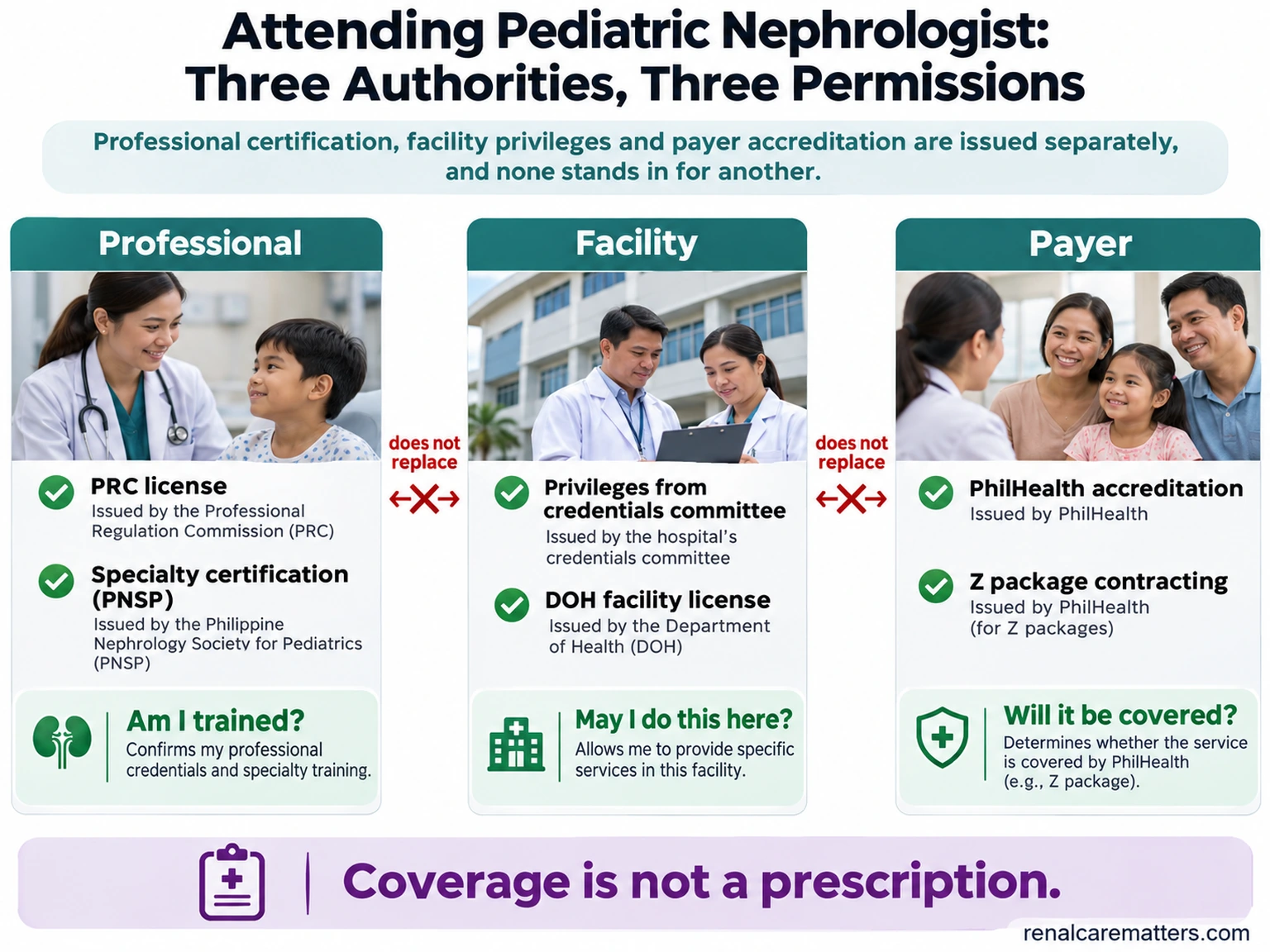
An attending pediatric nephrologist needs three separate permissions, issued by three separate authorities. They answer three different questions, and none of them stands in for another.
The first is professional. The Professional Regulation Commission (PRC) licenses you to practice medicine. Specialty certification says you were trained and examined in pediatrics and in pediatric nephrology. In the Philippines the Pediatric Nephrology Society of the Philippines (PNSP) is the society PhilHealth names: its kidney transplant survey tool asks, under its pediatric staffing items, for a pediatric nephrologist certified by the PNSP with valid PhilHealth accreditation.2 The PD survey tool accepts a board-certified nephrologist, adult or pediatric, who is a diplomate or fellow of the Philippine Society of Nephrology (PSN) or of the pediatric society, and lists fallbacks for geographically isolated areas.3
The second is the facility’s. A hospital or dialysis unit grants you an appointment and delineated privileges: which procedures, which modalities, which ages and sizes of patient. The Department of Health (DOH) licenses the dialysis facility itself and sets what it must have to operate.4 Your certificate does not license the unit, and the unit’s license does not make it able to dialyze a 9 kg child.
The third is the payer’s. PhilHealth accredits you as a professional and contracts facilities as benefit providers. The pediatric PD eligibility checklist carries a line for the attending pediatric nephrologist’s printed name, signature and PhilHealth accreditation number.1 A signature there is a payer attestation. It is not a clinical privilege and not proof that the facility can care for the child.
Permission
Who issues it
What it lets you do
What it does not do
Professional license and certification
PRC; specialty board and society (PNSP for pediatric nephrology)
Practice medicine; present yourself as a pediatric nephrologist
Grant privileges in any hospital or unit
Appointment and delineated privileges
The hospital or unit, through its credentials committee
Admit, order dialysis, place or remove access, as written in your privilege list
Make the unit capable of pediatric care
Facility license
DOH
Lets the unit operate as a dialysis facility
Certify pediatric equipment, staff or rescue
Professional accreditation and facility contracting
PhilHealth
Lets you and the facility claim a benefit
Set a prescription, a frequency or a fill volume
Keep a credential file with each document, its issuer, its expiry date and its scope. When a unit asks you to cover a child, compare the request with your privilege list, not with your certificate. If the list says nothing about children under a certain weight, or about HD at that site, you do not yet have the privilege, however well trained you are.
The PNSP wording above follows PhilHealth’s survey tools. Your own credentials committee may name the board route differently; confirm the exact wording with it and keep a copy of what it accepted.
RememberThree authorities, three permissions. Check each one separately, and never let a certificate, a privilege or a PhilHealth signature stand in for the other two.
At a new appointment · fictional
A provincial hospital in Nueva Ecija offers you courtesy privileges so you can see its children on PD. The medical director says, “You are PNSP-certified, so you can do everything.” The draft privilege list covers outpatient consultation and PD only.
You ask the credentials committee to add, in writing, inpatient co-management and supervision of acute PD in the pediatric ward, and you leave HD off until the hospital has pediatric lines and a nurse trained to use them.
What this shows. A privilege list is a description of what you and the site can do together. Write it for the site as it is.
Figure 2. Three authorities, three permissions. Professional certification, facility privileges and payer accreditation are issued separately, and none stands in for another.
Lesson · part 2
Who owns this child at 2 a.m.
Pediatric nephrology is a scarce specialty. In much of the country one pediatric nephrologist covers several hospitals and the adult HD units around them. Most hours of a child’s care are therefore delivered by someone else: a pediatric resident, a physician on duty in an adult unit, an adult nephrologist who is attending of record, a pediatric intensivist. This is safe when each person knows which decisions are theirs and whom to call for the rest. It is unsafe when a referral note says “to follow” and nobody knows what “follow” means.
Write the ownership down. For each child, the chart and the unit file should name the attending of record, the co-managing specialists and what each owns, the covering doctor for nights and weekends, and the number the nurse should call. When you co-manage, say what you are taking on: “I will set the dialysis prescription and target weight; the adult nephrologist remains attending of record for the unit; the pediatric resident at the referring hospital owns his other medicines.”
Who
What they usually own
What they need from you
Attending of record (sometimes an adult nephrologist in an adult unit)
The unit admission, unit protocols, final say on the session
A written pediatric plan and a clear statement of what you are co-managing
Co-managing pediatric nephrologist (you)
The child’s renal plan: prescription, target weight, growth, medicines that touch the kidney, transplant pathway
Accurate data and an early call
Physician on duty in the unit
Immediate response within the unit’s protocol
Stop-and-call rules written for this child
Pediatric intensivist
Airway, circulation, sedation, the bed
A shared fluid and dialysis plan, agreed daily
Parents
Home care, the first warning, consent
Plain words, a number to call, a voice in decisions
Accept care only where the child can be cared for. A unit that dialyzes children needs lines and dialyzers sized for them, nurses who have used them, a pediatric resuscitation cart, and a transfer route to a pediatric bed. If those are missing, the safe answer is often to stabilize, then move the child, rather than to adapt an adult order. Module 25 covers what a child needs in an adult unit in detail.
Figure 3 · A closed-loop call
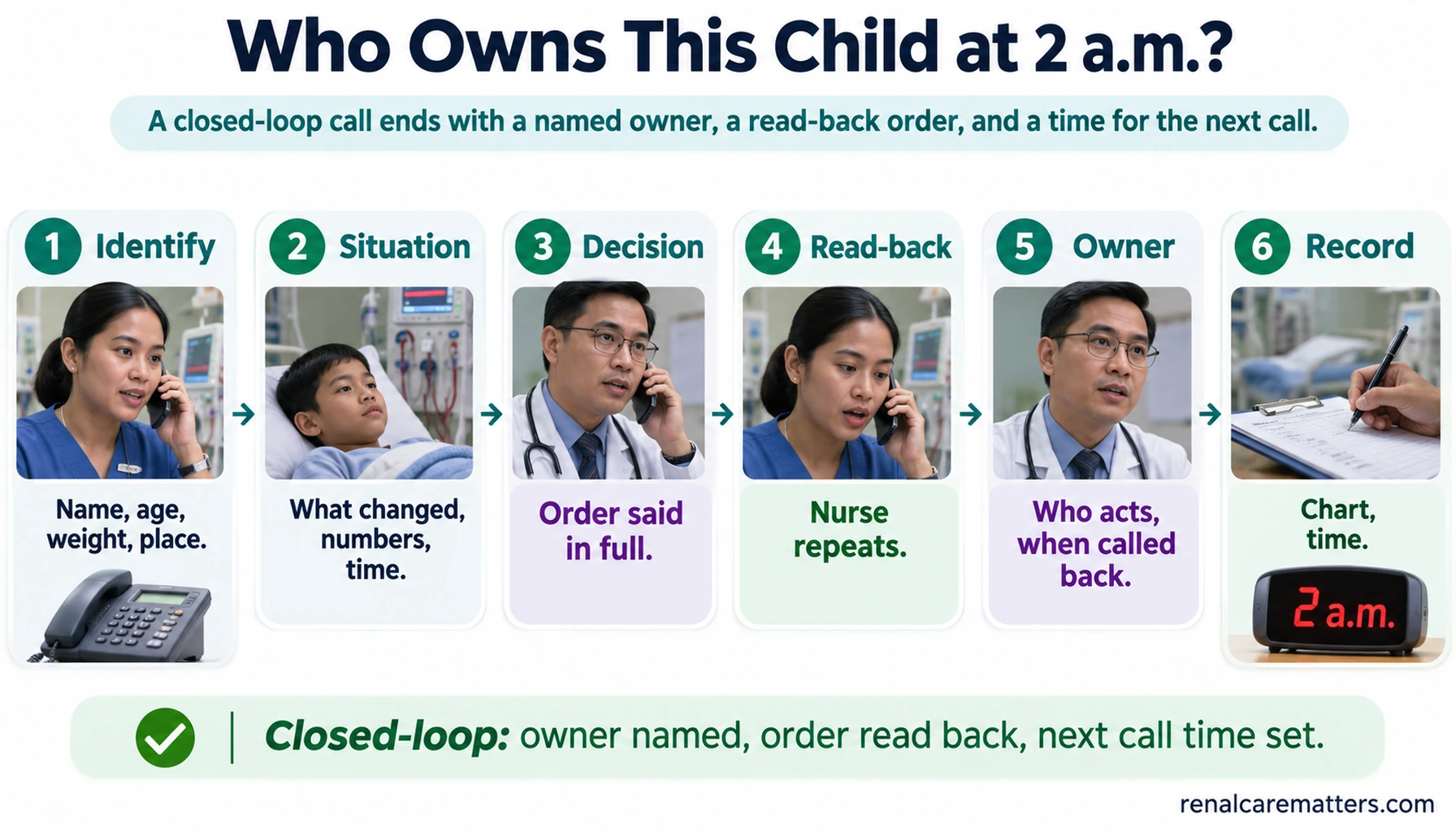
IdentifyYour name, the child’s name, age and weight, and where the child is.
SituationWhat changed, with the numbers and the time.
DecisionWhat you are asking for or ordering, said in full.
Read-backThe nurse or resident repeats the order; you confirm it.
OwnerWho acts, who checks, and when you will be called back.
RecordThe order and the call are written in the chart with the time.
Stop and call
A child is placed in a unit or ward without the equipment, staff or rescue route for their size
No named owner can be reached for a decision that cannot wait
A unit proposes to adapt an adult order for a child because no pediatric order exists
A family is told something about the plan that the team has not agreed
RememberEvery child has a named owner for every hour. If you cannot name the owner, you are the owner until you hand over in writing.
Saturday morning, by phone · fictional
A pediatric resident in Tarlac calls about a 6-year-old on home PD admitted overnight with vomiting. The admitting order says “refer to nephro.” Nobody has examined the effluent.
You ask for a bag to be held up to the light, an effluent cell count and culture, and you dictate a short note naming yourself as co-managing pediatric nephrologist for PD and the pediatric consultant as attending of record.
What this shows. “Refer to nephro” is a wish. A named owner with a written scope is a plan.
Figure 4. Who owns this child at 2 a.m. A closed-loop call ends with a named owner, a read-back order and a time for the next call.
Lesson · part 3
What the documents actually require
Much of the attending’s paperwork comes from PhilHealth and the DOH. Read the documents themselves, not a summary, and note what each one decides and what it leaves to you.
Peritoneal dialysis. PhilHealth Circular 2024-0036 created the Z benefits package for PD, with separate adult and pediatric provisions.5 The pediatric eligibility checklist asks, among other items, that the child has a permanent PD catheter in place and has completed PD initiation in an accredited facility or PD Z benefit provider, and it is signed by the attending pediatric nephrologist with an accreditation number.1 Automated PD (APD) for children began as a pilot under Advisory 2025-0074.6 Advisory 2026-0013, signed February 5, 2026, extended the pilot for an additional six months, until July 31, 2026.7 No later issuance on its status was found when this module was written. Treat the status after July 31, 2026 as unresolved and confirm it with your PhilHealth liaison before you promise a family anything.
Hemodialysis. PhilHealth Circular 2024-0023 covers up to 156 HD sessions a year.8 That number is a coverage ceiling. A child who needs more frequent or longer dialysis still needs it, and a child who needs less should not receive more because it is paid for.
Kidney transplantation. The PhilHealth kidney transplant survey tool lists, for pediatric programs as applicable, a PNSP-certified pediatric nephrologist, a pediatric infectious disease specialist and a pediatric cardiovascular specialist, each with valid accreditation.2
The facility. DOH Administrative Order 2012-0001 sets the licensing rules for dialysis facilities.4 It is the unit’s license. The medical director and the unit, not you alone, are answerable for whether the unit meets it.
Document
What it names or requires
What it does not decide
PC 2024-0036 and pediatric annexes (PD)
Eligibility, the attending pediatric nephrologist’s attestation, covered supplies
Fill volume, number of exchanges, dwell time
PA 2025-0074 and PA 2026-0013 (pediatric APD pilot)
Pilot conduct; extension to July 31, 2026
What happens after that date (unresolved; confirm with the liaison)
PC 2024-0023 (HD)
Up to 156 sessions a year
Session length, frequency or blood flow for a child
Kidney transplant survey tool
A PNSP-certified pediatric nephrologist for pediatric programs
Your hospital privileges
DOH administrative order (AO) 2012-0001
Licensing of dialysis facilities
Whether a unit is equipped for a particular child
The commonest error is reading a benefit annex as an order. A PD annex lists bags and solutions because PhilHealth pays for them; the bag volume is a supply unit, not a child’s fill volume. The prescription comes from the child’s size, residual function, membrane and tolerance, and from your unit’s pediatric protocol (Module 20).
RememberCoverage is not a prescription. Read every benefit as a ceiling or a supply list, and write every order from the child.
Truthful documentation protects the child as well as the claim. Sign only what you have verified. If a form asks you to attest that a child completed PD initiation, check the training record. If you are co-managing rather than attending of record, say so on the form where the form allows it. Confirm benefit details on the date of service, because circulars and annexes change.
Lesson · part 4
Consent, assent and the family as the bedside team
In pediatrics the decision is shared three ways. The parents give informed permission. The child, as far as their development allows, gives assent. The clinician brings the information and a recommendation. The American Academy of Pediatrics (AAP) describes parental permission and the child’s assent as an active process that engages both, with the child’s view carrying more weight as the child matures, and with special care around adolescent consent and refusal.9
In the Philippines the age of majority is 18. Below it, a parent or legal guardian gives consent. Assent is still worth seeking from school-age children, and an adolescent’s refusal deserves a real conversation, not an override by default. Many Filipino families decide together: a grandmother, an aunt, a father working overseas on a video call. Ask who the family wants present, and who has legal authority to sign.
Age and stage
What assent looks like
What you do
Infant and toddler
None in words; distress is information
Parents decide; minimize pain and separation
School age
Can understand what will happen and why
Explain in plain words; ask “Is it okay if …”; offer real choices (which arm, which chair)
Adolescent
Can weigh risks and futures
Talk with them alone for part of the visit; involve them in every treatment choice; begin transition planning
Transition starts early. The Kidney Disease: Improving Global Outcomes (KDIGO) 2024 chronic kidney disease (CKD) guideline advises beginning transition planning at ages 11 to 14.10 Module 28 covers the handover letter and adolescent confidentiality.
The family is the bedside team. The mother who does exchanges at home sees the cloudy bag first. The father who weighs the child every morning sees the gain first. Teach them what you want reported and how quickly, and give them a number that someone answers.
RememberAsk the child, not only the parent. Assent is part of care, and a child who understands the plan keeps it better.
In clinic, a 14-year-old · fictional
Kristine, 14, on PD for a year, sits silent while her mother answers every question. Her exit site is red. You ask the mother to step out for five minutes.
Alone, Kristine says she skips the afternoon exchange at school because she is ashamed to do it in the clinic room. You agree together on a plan with the school nurse, and she agrees to tell her mother herself.
What this shows. Adolescents tell the truth more often when you make space for it.
On the floor
Real situations: problems and solutions
These are fictional but typical. For each one, cover the answer, decide what you would do, then compare. Where a step depends on local rules, your unit’s procedure and your supervisor’s direction come first.
The roster with your name at three hospitals
What you see
The weekend coverage list at three hospitals in Central Luzon names you as the pediatric nephrologist on call for all of them, with no backup.
What is likely going on
Each hospital filled its roster independently, assuming you could cover by phone.
What to do
Agree with the medical directors which decisions you can make by phone, which require a transfer, and who covers when you are in a procedure. Put a named backup on each roster.
Why it matters
A roster is a promise to a nurse at 2 a.m. A promise nobody can keep is a hidden gap in the child’s care.
The form left on the desk
What you see
A billing clerk asks you to sign a PhilHealth pediatric PD checklist for a child you have not examined, because the claim is due today.
What is likely going on
The claim deadline is driving the paperwork ahead of the clinical review.
What to do
See the child or the records first. Sign only what you have verified, in the capacity you actually hold, and tell the clerk what is missing.
Why it matters
Your signature is an attestation. A false one harms the child, the facility and you.
The adult order adapted for a child
What you see
An adult HD unit has written a 7-year-old’s order by halving its standard adult order, because no pediatric template exists.
What is likely going on
The unit has no pediatric protocol, lines or dialyzer, and is improvising.
What to do
Stop the session from starting on that order. Ask the medical director whether the unit can obtain pediatric supplies and training; if not, arrange care at a center that can, and stabilize meanwhile.
Why it matters
A child is not a small adult. Circuit volume, blood flow and fluid removal scale differently, and halving an adult order is not a pediatric order.
The father on video from Dubai
What you see
A 4-year-old needs a PD catheter. The mother agrees, but says she cannot sign until her husband, who works in Dubai, agrees.
What is likely going on
The family makes decisions together; the father wants to hear it from the doctor.
What to do
Offer a video call at a time that works for him. Explain once, plainly, with the mother present, and document who gave consent and who joined the discussion.
Why it matters
Respecting how a family decides saves time later and builds the trust that home dialysis depends on.
Field notes
Keep your credential file in one folder with each document’s issuer, scope and expiry written on the cover sheet.
End every phone order with a read-back and the time you will be called again.
Write “co-managing pediatric nephrologist, scope: …” in the chart when you are not attending of record.
Check PhilHealth issuances on the date of service; a pilot or annex may have changed since the last claim.
Case review
Back to the case: “Pedia nephro to follow”
Who owns the plan tonight? Nobody does yet, and that is the problem. The adult nephrologist is attending of record but unreachable; the transfer note named no one. Call the unit’s covering adult nephrologist or medical director, agree that you will co-manage Angelo’s renal plan from tonight, and write it down: you set the prescription and target weight, the unit remains responsible for its protocols, and the physician on duty calls you, with stop-and-call rules written for him. Until that note exists, you are the owner of the decision in front of you.
What to verify. First, your privileges at this unit: if you have none, the medical director must grant temporary ones or you advise by phone while the attending of record’s covering colleague signs. Second, the unit’s capability: pediatric lines and dialyzer, a nurse who has used them, a pediatric resuscitation cart, and a transfer route. If these are missing, an adult order is not a safe substitute; tonight’s potassium and pressure may need a hospital with pediatric capability. Third, the PhilHealth form: sign only what you have verified, and only in the capacity you hold. Do not let the form drive the order.
What to say. Tell Mrs. Villanueva who you are, that you will share Angelo’s care with his attending nephrologist, what will happen tonight, and the number to call. Offer to include her husband by video. Then speak to Angelo: explain in plain words why his blood needs cleaning tonight, ask what bothers him most about dialysis, and ask whether it is okay to check his catheter. His assent, and his worries, are part of the plan.
Skills lab · with your preceptor
Skills checklist: Taking attending responsibility for children
Complete with a preceptor, in simulation or at your own unit. Sign-off is local. Your preceptor rates each step as satisfactory, needs practice, or not observed. Steps marked Critical must all be satisfactory before sign-off. This checklist supports supervised learning; your unit’s own procedure and competency form are the authority. A printable version of every checklist is on the trainer page.
Builds a credential file that separates professional, facility and payer permissions, with issuer, scope and expiry
Writes a co-management note naming the owner of each decision and the night and weekend contact
Completes a PhilHealth pediatric PD checklist truthfully, without copying supply items into the order
Obtains parental permission and documents the child’s assent in age-appropriate words
Placement activity. Supervised practice or simulation
Self-assessment
Check your understanding
Each visit draws 5 questions at random from this module’s 5-question bank. Choose the single best answer for each, then select Check answers; an explanation appears under the best answer. Select New set of questions for a different mix. A good target is 4 of 5 on two different sets. Nothing you select is sent anywhere; scoring happens in your browser.
Philippine Health Insurance Corporation. (2025). Conduct of the pilot implementation of the Z benefits package for peritoneal dialysis (PD) covering automated PD in children (PhilHealth Advisory No. 2025-0074). https://www.philhealth.gov.ph/advisories/2025/PA2025-0074.pdf
Philippine Health Insurance Corporation. (2026). Extension of the pilot implementation of the Z benefits package for peritoneal dialysis (PD) covering automated PD in children (PhilHealth Advisory No. 2026-0013). https://www.philhealth.gov.ph/advisories/2026/PA2026-0013.pdf
Katz, A. L., Webb, S. A., & Committee on Bioethics. (2016). Informed consent in decision-making in pediatric practice. Pediatrics, 138(2), e20161485. https://doi.org/10.1542/peds.2016-1485
Kidney Disease: Improving Global Outcomes (KDIGO) CKD Work Group. (2024). KDIGO 2024 clinical practice guideline for the evaluation and management of chronic kidney disease. Kidney International, 105(4S), S117–S314. https://doi.org/10.1016/j.kint.2023.10.018
Educational material for physicians. Completing it is an Academy learning record only. It does not confer CPD units, PNSP or board certification, privileges, or PhilHealth accreditation, and it does not replace current guidelines, regulations, your institution’s pediatric protocols and formulary, or clinical judgment.