Defend longitudinal decisions across clinic, ward, dialysis unit and home.
PublishedNailathalaGipatikPepalwal:ReferencesMga SanggunianMga TinubdanReng Reperensya:7Audience: Practicing nephrologists · senior nephrology fellows · internists who share longitudinal kidney care in the clinic, ward, ICU, dialysis unit, and homeRead timeOras ng pagbasaOras sa pagbasaOras ning pamamasa:
Training track for attending nephrologists in adult practice
This module is study material for attending nephrologists and senior fellows in adult practice. It explains the reasoning behind common decisions; it is not a protocol. Doses and thresholds must be checked against current product labels, guidelines, and your institution’s approved protocols. Regulatory and benefit rules change: confirm them on the date of service. Every case is fictional.
Learning objectives
After this module you should be able to
Defend longitudinal decisions across clinic, ward, dialysis unit and home.
Demonstrate escalation, handoff and follow-through to receipt.
Correct a claim and propose a measurable improvement.
Pre-testBefore you read, answer the 5 self-assessment questions and note your score. After the module, select New set of questions and compare. The difference is what you learned; the questions you still miss are what to reread.
Start here
The big picture, in plain words
Your duty · Section 1.2, 2024 hemodialysis guidelinesUnder the Philippine Society of Nephrology (PSN) guidelines: All fourteen duties meet in one patient. The capstone asks you to show where each one applies.
In plain wordsReal patients do not stay inside one module. The capstone joins the threads: an urgent start, a complication, a modality choice deferred by illness, and a paperwork error, all in one person over a few weeks.
Figure 1 · Key numbers
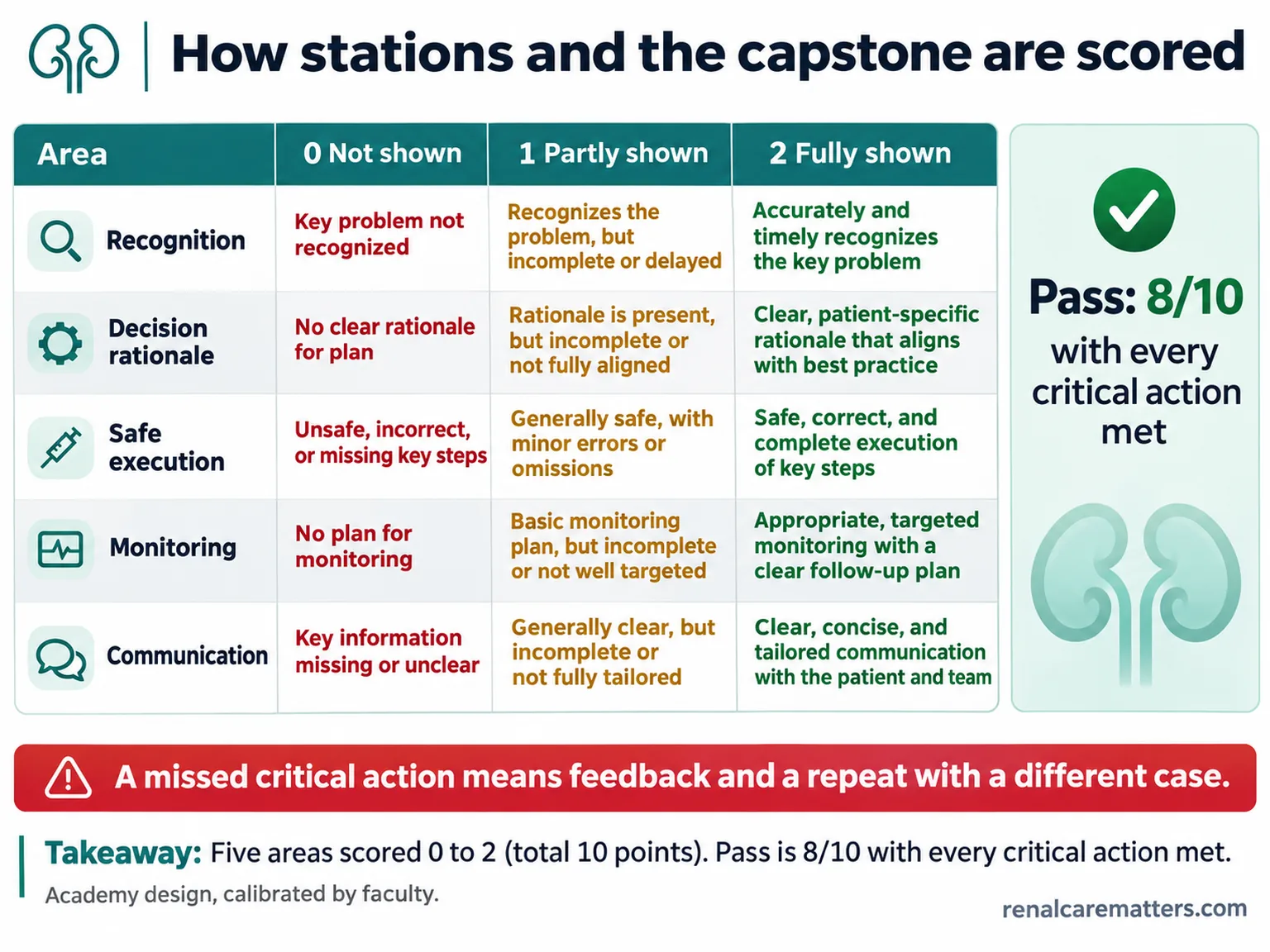
Station and capstone pass8/10 with all critical actions met (Academy design)
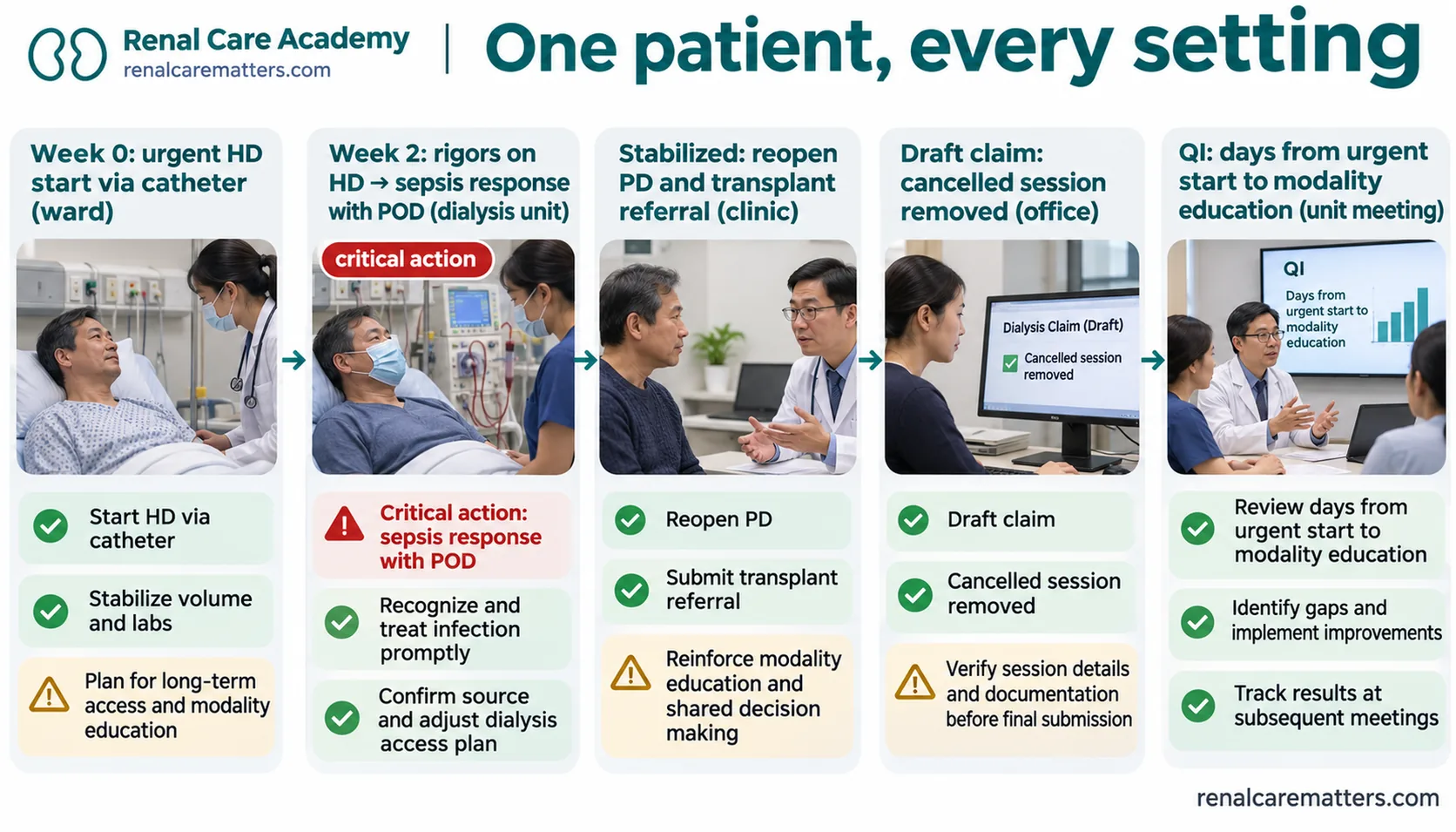
Figure 2. The capstone patient’s path through the ward, dialysis unit, clinic, claims office and a quality meeting.
Opening case · fictional
Case: Three weeks of one patient
Mr. Salazar, 57, had chronic kidney disease (CKD) G5 and wanted peritoneal dialysis at home. Three weeks ago he was admitted breathless, with a potassium of 6.8 mmol/L, and started hemodialysis through a temporary jugular catheter. He now dialyzes at your unit.
In his second week, 40 minutes into a session, he develops rigors and his blood pressure falls to 84/50 mm Hg. Dr. Ilagan, the physician on duty, calls you. Two days later, while you are reviewing the month’s claims, you notice that a session cancelled during his admission appears on his draft Philippine Health Insurance Corporation (PhilHealth) claim. His wife asks you whether “the home dialysis plan is finished now.”
Before reading on, decide:
What do you tell Dr. Ilagan in the first call?
Is the home dialysis plan finished?
What will you correct, and what will you measure so the next patient does better?
Keep your answers in mind. The lesson gives you what you need, and the case review near the end shows one sound response.
Lesson · part 1
How it works
The capstone reuses the causal chains from earlier modules: why the kidney failed, why dialysis was needed, why a catheter infects, why residual function matters for peritoneal dialysis (PD), and why a claim must match the record. Assessors look for the reasoning between the steps, not only the final orders.
The capstone panel · fictional
A candidate presents Mr. Salazar’s case. She lists the right orders but cannot say why his catheter infected, or why his residual urine output matters for peritoneal dialysis.
The examiner asks her to link each step to the earlier modules. Her reasoning improves her score more than any single order.
What this shows. The capstone scores the reasoning between the steps.
Lesson · part 2
What the evidence shows
Integrated case assessment with defined critical actions is standard in specialty certification and in work-based assessment programs. The Academy’s scoring rubric (five dimensions scored 0–2, pass at 8/10 with all critical actions met) is a design choice subject to faculty calibration, not an external standard.
Submit two artifacts: a continuity plan and a one-page quality improvement (QI) brief. The continuity plan covers the first call (immediate response, transfer decision and confirmation), the dialysis trigger and the initial versus maintenance prescription, the access plan, the return to PD and transplant planning after stabilization with named clinicians and dates, and the traceable claim correction. The QI brief states the aim, baseline, numerator, denominator, data owner, change, process and balancing measures, and the review date.
Figure 3. How stations and the capstone are scored. Scoring grid for the final stations and capstone: five areas scored 0 to 2, with the pass rule.
Writing the continuity plan · fictional
For Mr. Salazar, the plan has five lines. First call: stop, cultures, antibiotics, transfer confirmed with Dr. Ramos at the receiving hospital. Catheter: remove and replace on Thursday. Modality: peritoneal dialysis education with the PD nurse on the 14th. Transplant referral: sent on the 10th. Claim: corrected through the workflow on the 3rd.
Each line has a person and a date.
What this shows. A plan becomes real when each step has an owner and a deadline.
Stop and call
Any missed critical action
Handoff without confirmed receipt
Claim attested before reconciliation
QI claim without baseline or denominator
On the floor
Real situations: problems and solutions
These are fictional but typical. For each one, cover the answer, decide what you would do, then compare. Where a step depends on local rules, your unit’s procedure and your supervisor’s direction come first.
The patient whose story crosses every module
What you see
A new patient arrives with acute kidney injury (AKI), a new catheter, a missed transplant referral, and a billing error.
What is likely going on
Real patients do not stay inside one module.
What to do
Work through each thread in order of danger: immediate safety first, then the plans, then the paperwork.
Why it matters
The capstone tests the reasoning between the steps.
The handoff that was not received
What you see
You sent a plan to the night physician on duty by message, but he never saw it.
What is likely going on
Closed-loop communication failed.
What to do
Call, confirm receipt, and ask for a read-back.
Why it matters
A missed handoff is a critical action in the capstone.
The quality brief with no baseline
What you see
A fellow proposes a change without a baseline measure.
What is likely going on
Improvement cannot be shown without a baseline.
What to do
Collect baseline data first, and define the numerator and denominator.
Why it matters
Without a baseline, any change looks like success.
Field notes
Name a person and a date for every plan.
Confirm receipt of every handoff.
Correct claims before attesting.
Bring a baseline to every quality proposal.
Case review
Back to the case: Three weeks of one patient
The first call. Stop the session, resuscitate, take blood cultures from the catheter and a peripheral vein, start empiric antibiotics, and transfer him with acceptance confirmed by a named receiving doctor. Ask Dr. Ilagan to read the plan back. Review the catheter as the likely source and plan its removal or exchange. A catheter placed in an emergency is a bridge, and it is the commonest route for infection.
Home dialysis. No. An urgent start does not cancel his choice. Once he is stable, reopen the conversation about peritoneal dialysis, which may suit him even soon after an urgent start, and refer him for transplant evaluation. Write down the named clinicians and the dates. Explain to his wife that the plan was delayed, not abandoned.
The claim. Remove the cancelled session through the approved correction workflow, with an audit trail. Do not edit the source record. Check his other dates against the flowsheets before you attest.
The measure. Propose one change with a baseline, for example the number of days from an urgent start to modality education. Track a balancing measure such as delayed discharges. Mr. Salazar touched almost every module of this track in three weeks; the capstone asks you to hold all of those threads at once, and to explain the reasoning between each step.
Skills lab · with your preceptor
Skills checklist: Skills checklist
Complete with a preceptor, in simulation or at your own unit. Sign-off is local. Your preceptor rates each step as satisfactory, needs practice, or not observed. Steps marked Critical must all be satisfactory before sign-off. This checklist supports supervised learning; your unit’s own procedure and competency form are the authority. A printable version of every checklist is on the trainer page.
Defends initial and maintenance plans
Demonstrates escalation and handoff to confirmed receipt
Corrects the claim and proposes a measurable change
Placement activity. Simulation or supervised practice
Self-assessment
Check your understanding
Each visit draws 5 questions at random from this module’s 5-question bank. Choose the single best answer for each, then select Check answers; an explanation appears under the best answer. Select New set of questions for a different mix. A good target is 4 of 5 on two different sets. Nothing you select is sent anywhere; scoring happens in your browser.
Kidney Disease: Improving Global Outcomes (KDIGO) CKD Work Group (2024). KDIGO 2024 clinical practice guideline for the evaluation and management of chronic kidney disease. Kidney International, 105(4S), S117–S314. https://doi.org/10.1016/j.kint.2023.10.018
International Society for Peritoneal Dialysis. (n.d.). ISPD guidelines and recommendations. https://ispd.org/guidelines/
Lok, C. E., Huber, T. S., Lee, T., Shenoy, S., Yevzlin, A. S., Abreo, K., Allon, M., Asif, A., Astor, B. C., Glickman, M. H., Graham, J., Moist, L. M., Rajan, D. K., Roberts, C., Vachharajani, T. J., Valentini, R. P., & National Kidney Foundation. (2020). KDOQI clinical practice guideline for vascular access: 2019 update. American Journal of Kidney Diseases, 75(4 Suppl 2), S1–S164. https://doi.org/10.1053/j.ajkd.2019.12.001
Educational material for physicians. Completing it is an Academy learning record only. It does not confer CPD units, PSN certification, privileges, or PhilHealth accreditation, and it does not replace current guidelines, regulations, your institution’s protocols, or clinical judgment.