Reconcile delivered services with records before attesting.
PublishedNailathalaGipatikPepalwal:ReferencesMga SanggunianMga TinubdanReng Reperensya:9Audience: Practicing nephrologists · senior nephrology fellows · internists who share longitudinal kidney care in the clinic, ward, ICU, dialysis unit, and homeRead timeOras ng pagbasaOras sa pagbasaOras ning pamamasa:
Training track for attending nephrologists in adult practice
This module is study material for attending nephrologists and senior fellows in adult practice. It explains the reasoning behind common decisions; it is not a protocol. Doses and thresholds must be checked against current product labels, guidelines, and your institution’s approved protocols. Regulatory and benefit rules change: confirm them on the date of service. Every case is fictional.
Learning objectives
After this module you should be able to
Reconcile delivered services with records before attesting.
Resolve mismatches through a traceable correction workflow.
Protect patient privacy and declare financial conflicts.
Pre-testBefore you read, answer the 5 self-assessment questions and note your score. After the module, select New set of questions and compare. The difference is what you learned; the questions you still miss are what to reread.
Start here
The big picture, in plain words
Your duty · Section 1.2, 2024 hemodialysis guidelinesUnder the Philippine Society of Nephrology (PSN) guidelines: Provide a complete clinical abstract with the prescription and current medicines when needed (b5); comply with the documentary requirements of the Philippine Health Insurance Corporation (PhilHealth), the Philippine Charity Sweepstakes Office (PCSO), the Department of Social Welfare and Development (DSWD), and other payers (b11); and accept no gift or rebate from the unit (b14).
In plain wordsA claim is a sworn statement that a service happened on a date. The attending’s signature lends clinical credibility to every line, so a single unchecked date can turn an honest unit into an inaccurate one.
Figure 1 · Key numbers
Annual hemodialysis (HD) session limit156 sessions (3 per week x 52 weeks)
HD package ratePHP 6,350 per session from October 9, 2024; up to PHP 990,600 per year
Opening case · fictional
Case: The claim you are asked to sign on Friday
It is your monthly visit, on the last Friday of the month. The billing clerk hands you a stack of Philippine Health Insurance Corporation (PhilHealth) claim forms for all of your patients at the unit, to sign before the 5 p.m. courier. “They are all correct, Doctor. Just sign on the flags.” You pull one at random: Mr. Lopez, 12 sessions.
You compare it with the treatment flowsheets. On the 9th, his session was cancelled because the water system was down, but the date is on the claim. The 16th appears twice. The clerk explains that the system bills from the schedule, and that the server crashed on the 16th and the entries were typed again. “It is only two sessions, Doctor, and we have done it this way for years.”
Before reading on, decide:
Do you sign the stack?
How is the claim corrected, and by whom?
What is the real problem, and how will you fix it?
Keep your answers in mind. The lesson gives you what you need, and the case review near the end shows one sound response.
Lesson · part 1
How it works
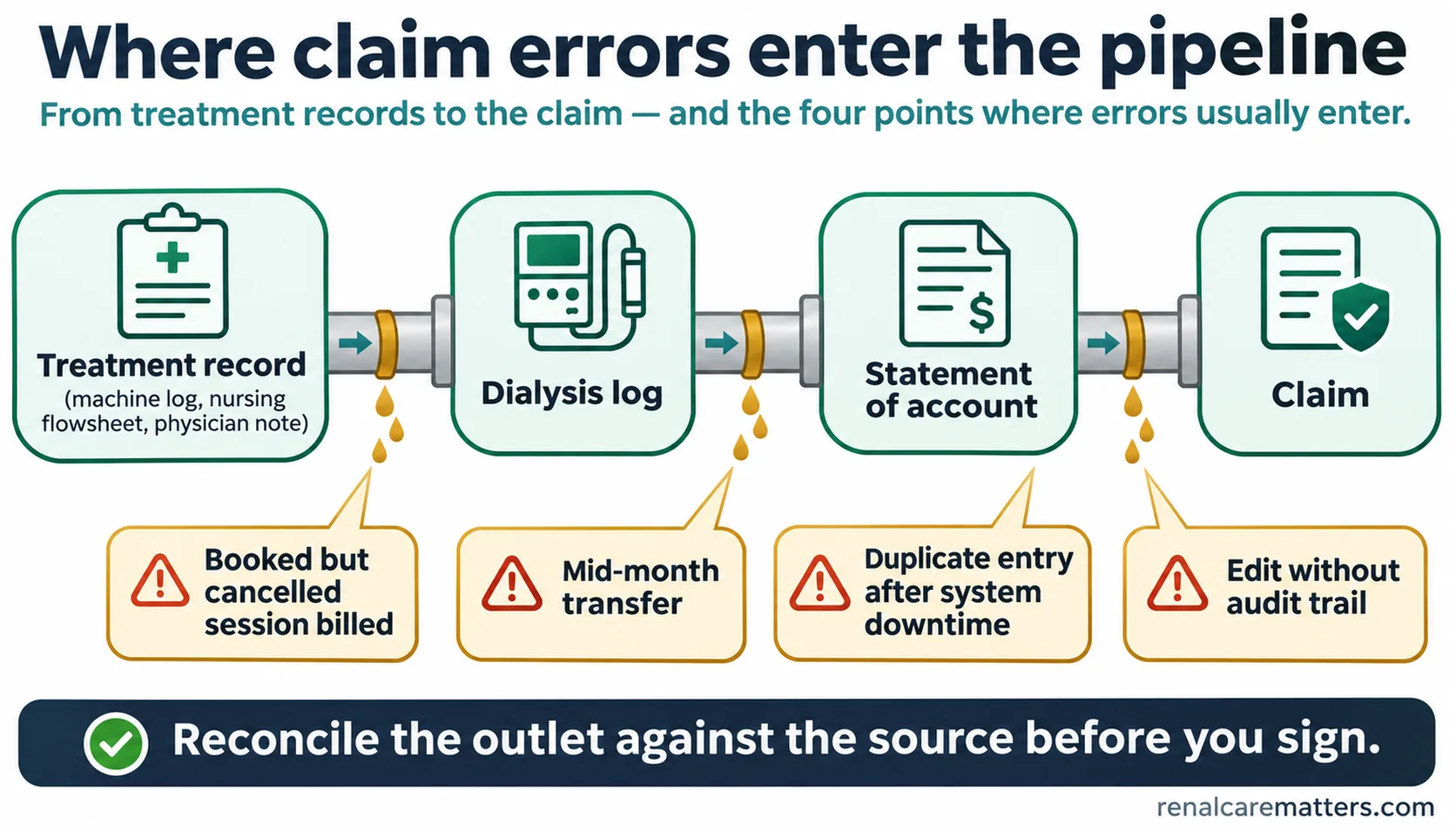
Think of the claim as the downstream product of a data pipeline: the treatment record (machine log, nursing flowsheet, physician note) is upstream, the dialysis log and statement of account are midstream, and the claim is the outlet. Errors enter at predictable points: sessions scheduled but cancelled, transfers mid-month, duplicated entries after system downtime, and edits made without an audit trail. Reconciliation checks the outlet against the source.
Tracing one date · fictional
You pick one date from Mr. Lopez’s claim, the 9th, and follow it upstream. The claim says a session happened. The statement of account says the same. The dialysis log says “cancelled, water system down.” There is no machine log and no nursing flowsheet.
The error entered at the first step, where the system copied the schedule into the billing file.
What this shows. Reconciliation means checking the outlet against the source, one date at a time.
Figure 2. Where claim errors enter the pipeline. A pipeline from treatment records to the claim, showing the four points where errors usually enter.
Lesson · part 2
What the evidence shows
This module is regulatory. Philippine Health Insurance Corporation (PhilHealth) Circular 2023-0009 institutionalized up to 156 HD sessions per year for chronic kidney disease (CKD) stage 5 patients registered in the PhilHealth Dialysis Database. Circular 2024-0023 (Revision 2) raised the package to PHP 6,350 per session effective October 9, 2024, up to PHP 990,600 per year, inclusive of anticoagulation and anemia medicines and standard supplies. Circular 2024-0029 sets maintenance HD quality standards. The Philippine Society of Nephrology (PSN) 2024 HD guidelines address abstracts, transfer endorsement, payer documentation and avoidance of rebates. Rates and forms change; always use the version in force on the date of service.
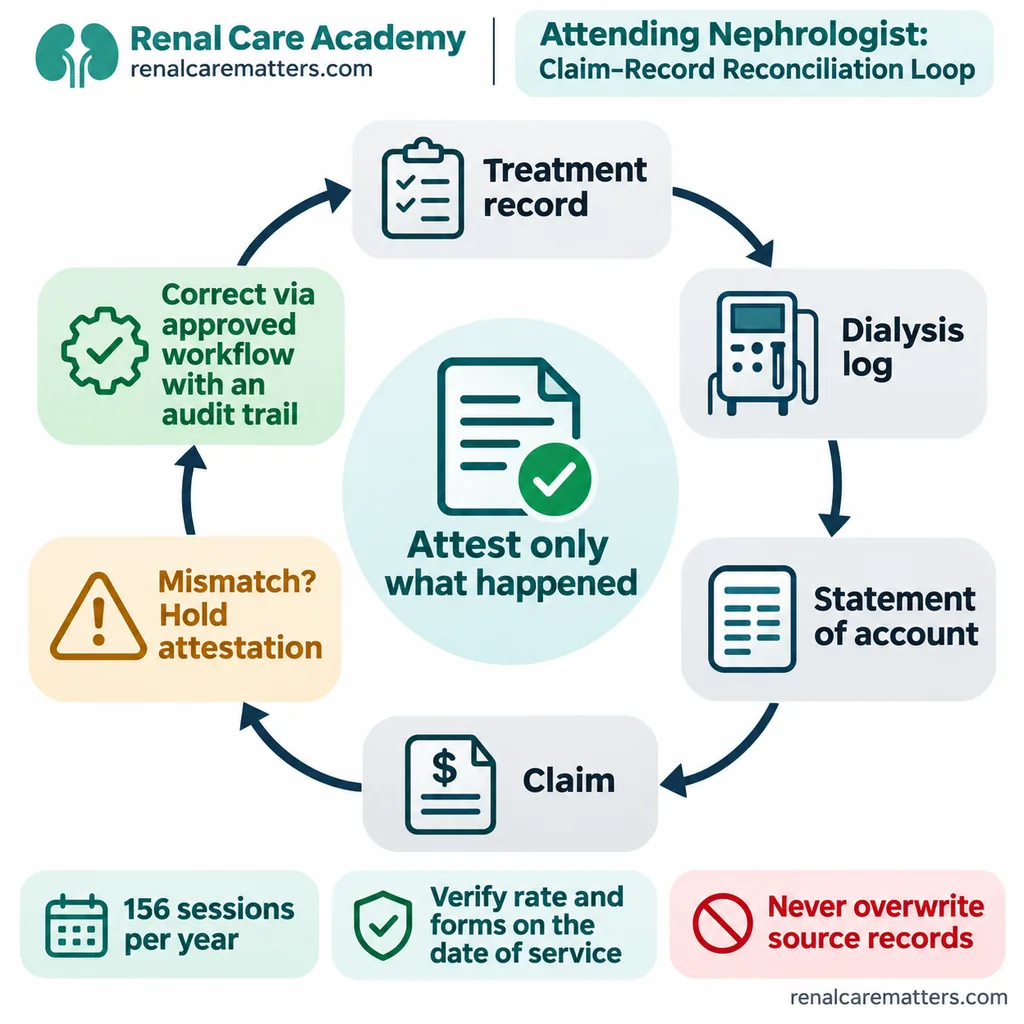
Before attesting, match each claimed date to the treatment record, then check the dialysis log, statement of account and claim data. Hold any discrepant claim and notify authorized billing staff. Correct it through the approved workflow, keeping an audit trail that shows who changed what and why. Never overwrite source records. Confirm the patient’s PhilHealth Dialysis Database (PDD) registration, the facility’s and your own accreditation, and package-specific forms. Share data only through approved, privacy-compliant channels, and declare any financial relationship with suppliers or the facility.
Figure 3. A loop for checking each claimed dialysis session against the treatment records before signing, and correcting mismatches with an audit trail.
The correction, done properly · fictional
The billing clerk deletes the two wrong dates and prints a new claim. You ask her to undo it and use the correction workflow instead, so the record shows the original entry, the change, who made it, and why.
A month later, a PhilHealth auditor asks about that claim. The audit trail answers the question in two minutes.
What this shows. A correction without a trail looks the same as an alteration.
Stop and call
Claimed date with no treatment record
Duplicate dates after system downtime
Requests to ’adjust’ logs to match a claim
Rebate or incentive offers tied to referrals or supplies
Lesson · part 4
The abstract and the claims you sign
You rarely sit at the dialysis center’s billing desk, but your name is on its paperwork. Two documents carry it most often.
The clinical abstract. When a patient needs one, you provide a complete medical abstract with the dialysis prescription and current medicines, and the unit keeps a duplicate abstract and a medical certificate on file.8 Patients ask for abstracts for PhilHealth, for travel or transfer, for other payers such as the Philippine Charity Sweepstakes Office (PCSO) and the Department of Social Welfare and Development (DSWD), and for work or disability papers. The PSN guidelines ask you to meet the documentary requirements of each payer.8 An abstract is a summary you certify, so write it from the record and date it. Most payers and receiving units also look for the diagnosis and its cause, the date dialysis started, the access, and recent serologies; ask the requesting office what it needs.
The claims you sign. In Philippine practice, the attending nephrologist signs the PhilHealth claims for every one of his patients at the unit, often as a stack on the monthly visit. The PSN text does not name the signatory. It asks you to meet the payers’ documentary requirements, and it makes the unit’s operations manager responsible for forms being filled out properly and truthfully.8 Your signature still states that each listed session happened. Sign what you have checked against the treatment record, or what the unit’s reconciliation has checked and shown you, and nothing else.
No rebates. The guidelines are explicit: no physician accepts any gift or monetary consideration from the dialysis center in the form of rebate fees or the like. Your professional fee is the one set in the current PSN guidelines.8
In your clinic · fictional
Mr. Lopez needs an abstract for a disability card. His daughter brings a sample from another patient and asks you to “just copy this and change the name.”
You write his from his own record instead: his diagnosis and its cause, the date he started dialysis, his access, his current prescription and medicines, and his latest serologies. You date it, sign it, and send a duplicate to the unit for its file.
What this shows. An abstract certifies one patient’s facts on one date. A copied template certifies someone else’s.
RememberSign every claim as if you had to explain each date to an auditor, because one day you may.
On the floor
Real situations: problems and solutions
These are fictional but typical. For each one, cover the answer, decide what you would do, then compare. Where a step depends on local rules, your unit’s procedure and your supervisor’s direction come first.
The patient who transferred mid-month
What you see
A patient who moved to another unit on the 15th is claimed for the whole month by both units.
What is likely going on
Transfer dates were not reconciled.
What to do
Confirm the dates with the other unit and correct the claim through the approved workflow.
Why it matters
Each session can be claimed once, by the unit that delivered it.
The supplier’s offer
What you see
A supplier offers you a “consultancy fee” tied to the dialyzers your unit buys.
What is likely going on
This is a rebate offer.
What to do
Decline and declare it to the medical director in writing.
Why it matters
PSN guidance asks physicians to avoid rebates, and a conflict of interest erodes trust.
“Adjust the log”
What you see
A staff member asks you to approve a change to a treatment log so it matches the claim.
What is likely going on
The claim is being treated as the source of truth.
What to do
Refuse. Correct the claim, never the log.
Why it matters
Source records protect patients, staff, and the unit.
Field notes
Sample a few claims against the flowsheets every month.
Never sign what you have not checked.
Keep an audit trail for every correction.
Use the rate and form in force on the date of service.
Case review
Back to the case: The claim you are asked to sign on Friday
Do you sign? Not this claim, and not the stack until it has been checked. Your signature states that each listed session happened on that date. A cancelled session and a duplicate are two false statements, however small, and the attending’s name is what gives the claim its credibility.
The correction. Hold the claim. Ask authorized billing staff to remove the cancelled and duplicated dates through the approved correction workflow, so the audit trail shows who changed what, when, and why. Nobody edits or rewrites the flowsheets to match a claim; the treatment record is the source, and the claim follows it. Recheck the corrected claim against the flowsheets and machine logs, and record who reviewed it and when.
The real problem. A system that bills the schedule rather than delivered treatments will produce this error every month, for every patient who misses a session. Change the process so claims are generated only from completed treatment records, and add a duplicate check after any downtime. Sample a few claims each month against the flowsheets. Tell the administrator plainly why the 5 p.m. courier will carry fewer forms today.
Skills lab · with your preceptor
Skills checklist: Skills checklist
Complete with a preceptor, in simulation or at your own unit. Sign-off is local. Your preceptor rates each step as satisfactory, needs practice, or not observed. Steps marked Critical must all be satisfactory before sign-off. This checklist supports supervised learning; your unit’s own procedure and competency form are the authority. A printable version of every checklist is on the trainer page.
Matches session dates to source records
Holds the discrepant claim
Logs the reviewer, correction and result
Placement activity. Simulation or supervised practice
Self-assessment
Check your understanding
Each visit draws 5 questions at random from this module’s 5-question bank. Choose the single best answer for each, then select Check answers; an explanation appears under the best answer. Select New set of questions for a different mix. A good target is 4 of 5 on two different sets. Nothing you select is sent anywhere; scoring happens in your browser.
Educational material for physicians. Completing it is an Academy learning record only. It does not confer CPD units, PSN certification, privileges, or PhilHealth accreditation, and it does not replace current guidelines, regulations, your institution’s protocols, or clinical judgment.