Refer suitable patients early with a complete, actionable dataset.
PublishedNailathalaGipatikPepalwal:ReferencesMga SanggunianMga TinubdanReng Reperensya:4Audience: Practicing nephrologists · senior nephrology fellows · internists who share longitudinal kidney care in the clinic, ward, ICU, dialysis unit, and homeRead timeOras ng pagbasaOras sa pagbasaOras ning pamamasa:
Training track for attending nephrologists in adult practice
This module is study material for attending nephrologists and senior fellows in adult practice. It explains the reasoning behind common decisions; it is not a protocol. Doses and thresholds must be checked against current product labels, guidelines, and your institution’s approved protocols. Regulatory and benefit rules change: confirm them on the date of service. Every case is fictional.
Learning objectives
After this module you should be able to
Refer suitable patients early with a complete, actionable dataset.
Explain living- and deceased-donor pathways and independent donor assessment.
Triage graft dysfunction and coordinate immunosuppression changes with the transplant team.
Pre-testBefore you read, answer the 5 self-assessment questions and note your score. After the module, select New set of questions and compare. The difference is what you learned; the questions you still miss are what to reread.
Start here
The big picture, in plain words
Your duty · Section 1.2, 2024 hemodialysis guidelinesUnder the Philippine Society of Nephrology (PSN) guidelines: Long-term medical planning with the patient (b9) includes a timely transplant referral.
In plain wordsFor most suitable patients, a kidney transplant is the treatment with the best survival and quality of life. The commonest reason it does not happen is a late referral, not a medical contraindication.
Figure 1 · Key numbers
Referral timing (Kidney Disease: Improving Global Outcomes (KDIGO) 2020)At least 6–12 months before expected dialysis; generally estimated glomerular filtration rate (eGFR) <30 and declining
Transplant benefit revisionPhilippine Health Insurance Corporation (PhilHealth) 2026-0019 listed November 21, 2026; full text pending
Opening case · fictional
Case: The clarithromycin from the corner clinic
Mrs. Ramos, 46, dialyzed at your unit for three years before a living-donor transplant five months ago. She still visits your clinic for blood pressure and shared follow-up with the transplant center in Manila.
Today she comes in with a fever of 38.3 °C. Her creatinine, 1.2 mg/dL last month, is now 1.9. Her urine output has dropped a little. Ten days ago a clinic near her home started clarithromycin for bronchitis. She takes tacrolimus, mycophenolate, and prednisone. Your clinic nurse asks whether to schedule her for a session “since her kidney is going down.”
Before reading on, decide:
What could be causing the creatinine rise?
Which of these causes did a single prescription create?
What do you do today, and what must you not do on your own?
Keep your answers in mind. The lesson gives you what you need, and the case review near the end shows one sound response.
Lesson · part 1
How it works
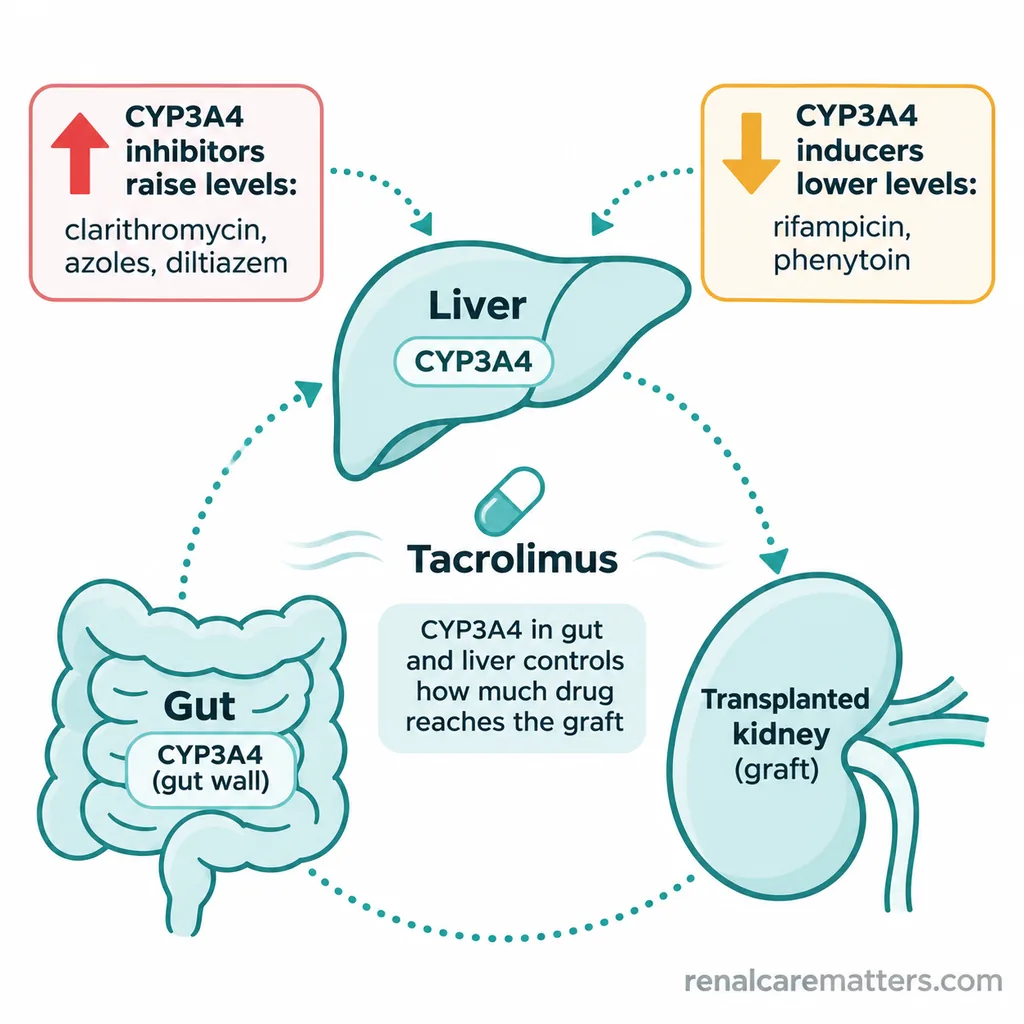
A transplanted kidney restores continuous filtration, endocrine function (erythropoietin, calcitriol) and homeostasis that dialysis only approximates. Rejection is driven by T cells recognizing donor HLA (human leukocyte antigen) and by donor-specific antibodies injuring the graft’s capillaries. Calcineurin inhibitors such as tacrolimus block T-cell activation, but they also constrict the afferent arteriole and are metabolized by CYP3A4 (cytochrome P450 3A4). Inhibitors of that enzyme (clarithromycin, azole antifungals, diltiazem, grapefruit) raise drug levels and cause nephrotoxicity. Inducers (rifampicin, phenytoin, carbamazepine) lower levels and risk rejection.
In the clinic, the grapefruit question · fictional
Mrs. Ramos asks whether she can eat pomelo. Her neighbor said it is “good for the kidneys.”
You explain that pomelo, like grapefruit, can block the liver enzyme CYP3A4, which breaks down tacrolimus. Her levels could rise and injure the new kidney. She asks you to write it on her medicine card.
What this shows. Transplant medicines interact with food as well as drugs. Ask about both.
Figure 2. Line-art sigil of gut, liver and transplanted kidney showing how drug interactions in the gut and liver change tacrolimus levels.
Lesson · part 2
What the evidence shows
Large registry analyses show transplantation is associated with substantially lower long-term mortality than remaining on dialysis while waitlisted (observational, with selection effects). KDIGO 2020 suggests referral for transplant evaluation at least 6–12 months before the anticipated start of dialysis, generally once eGFR is below 30 and declining, so that pre-emptive transplantation is possible. Pre-emptive transplantation is associated with better graft and patient survival than transplantation after dialysis. Philippine benefit rules sit in separate instruments; transplant revision 2026-0019 was listed on November 21, 2026 but its full text was unavailable at review, so confirm current provisions with the PhilHealth regional office.
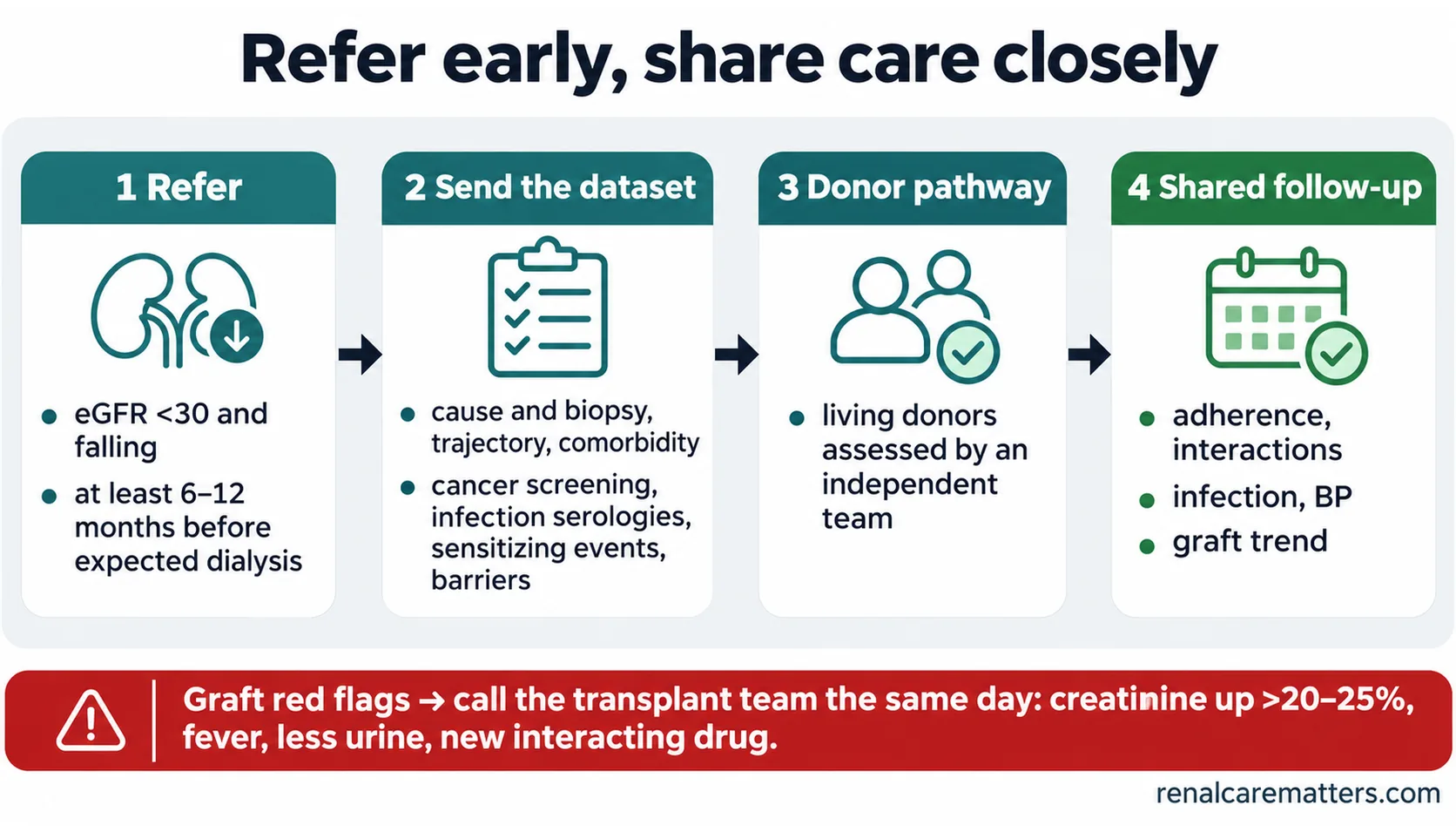
Refer once eGFR is below 30 and falling, or when the 2-year Kidney Failure Risk Equation (KFRE) exceeds 40%. Send the cause of kidney disease (with biopsy if any), trajectory, comorbidities, cancer screening, infection serologies, sensitizing events (transfusions, pregnancies, prior grafts) and barriers you can help address. Explain that potential living donors are assessed independently, with their own advocate. In shared follow-up, review adherence, drug interactions, infection, blood pressure and graft function trends. For fever, rising creatinine or reduced urine output, contact the transplant team the same day before changing immunosuppression.
Figure 3. Refer early, share care closely. Four steps for transplant referral and shared follow-up, with the warning signs that need a same-day call.
Your panel, a census check · fictional
You review your 40 hemodialysis patients for transplant referral. Eleven are under 60 and have no clear contraindication. Only three have ever been referred.
You write eight referral letters that month, each with the cause of kidney disease, serologies, transfusion history, and the barriers you can help with.
What this shows. The commonest reason a suitable patient is not transplanted is that nobody referred them.
Stop and call
Creatinine rise >20–25% from the graft’s baseline
Fever in the first year after transplant
New interacting drug started by another prescriber
Missed immunosuppressant doses
On the floor
Real situations: problems and solutions
These are fictional but typical. For each one, cover the answer, decide what you would do, then compare. Where a step depends on local rules, your unit’s procedure and your supervisor’s direction come first.
The patient on dialysis who was never referred
What you see
A 45-year-old has dialyzed at your unit for three years and has never been referred for transplant.
What is likely going on
Late or absent referral is the commonest reason transplants do not happen.
What to do
Refer now, with a full summary, and look at your whole panel for others.
Why it matters
Most suitable patients do better with a transplant than on dialysis.
The antifungal for a fungal rash
What you see
A transplant patient is prescribed fluconazole for a skin infection by another clinic.
What is likely going on
Azole antifungals inhibit CYP3A4 and raise tacrolimus levels.
What to do
Call the transplant team before the drug starts, and check tacrolimus levels.
Why it matters
Interactions are predictable, so they are preventable.
The missed doses
What you see
A transplant patient admits he has missed tacrolimus doses because of cost.
What is likely going on
Rejection risk is rising.
What to do
Contact the transplant team the same day and connect him with financial support.
Why it matters
A missed dose today can be a lost graft months from now.
Field notes
Refer for transplant when eGFR is below 30 and falling.
Living donors are assessed independently.
Call the transplant team before changing immunosuppression.
Ask every transplant patient about new medicines from other clinics.
Case review
Back to the case: The clarithromycin from the corner clinic
Possible causes. Several may be present at once: tacrolimus toxicity, infection (urinary sepsis, cytomegalovirus, or BK virus), acute rejection, or obstruction. A 58% rise in creatinine with a fever five months after transplant needs all of them considered.
The prescription. Tacrolimus is broken down by the liver enzyme CYP3A4. Clarithromycin blocks that enzyme, so tacrolimus levels can climb. High tacrolimus constricts the afferent arteriole and injures the graft. The interaction is well established and predictable, which is why it is preventable.
Today. Check whether she is stable. Send a tacrolimus trough level, blood and urine cultures, CMV and BK PCR where available, a urinalysis, and a graft ultrasound. Replace clarithromycin with an antibiotic that does not interact. Call the transplant team today and agree with them who adjusts immunosuppression and who follows the levels. Do not change her tacrolimus, mycophenolate, or prednisone on your own. Dialysis is not the question today; finding the cause is.
Afterwards. Give her a wallet card that lists her immunosuppressants and says “check interactions before prescribing,” and ask her to show it at every clinic she visits.
Skills lab · with your preceptor
Skills checklist: Skills checklist
Complete with a preceptor, in simulation or at your own unit. Sign-off is local. Your preceptor rates each step as satisfactory, needs practice, or not observed. Steps marked Critical must all be satisfactory before sign-off. This checklist supports supervised learning; your unit’s own procedure and competency form are the authority. A printable version of every checklist is on the trainer page.
Writes a transplant referral with a complete dataset
Identifies urgent graft red flags
Confirms transplant-service acceptance and the monitoring plan
Placement activity. Simulation or supervised practice
Self-assessment
Check your understanding
Each visit draws 5 questions at random from this module’s 5-question bank. Choose the single best answer for each, then select Check answers; an explanation appears under the best answer. Select New set of questions for a different mix. A good target is 4 of 5 on two different sets. Nothing you select is sent anywhere; scoring happens in your browser.
Chadban, S. J., Ahn, C., Axelrod, D. A., Foster, B. J., Kasiske, B. L., Kher, V., Kumar, D., Oberbauer, R., Pascual, J., Pilmore, H. L., Rodrigue, J. R., Segev, D. L., Sheerin, N. S., Tinckam, K. J., Wong, G., & Knoll, G. A. (2020). KDIGO clinical practice guideline on the evaluation and management of candidates for kidney transplantation. Transplantation, 104(4S1 Suppl 1), S11–S103. https://doi.org/10.1097/TP.0000000000003136
Educational material for physicians. Completing it is an Academy learning record only. It does not confer CPD units, PSN certification, privileges, or PhilHealth accreditation, and it does not replace current guidelines, regulations, your institution’s protocols, or clinical judgment.