Evaluate cloudy effluent the same day and start empiric therapy promptly.
PublishedNailathalaGipatikPepalwal:ReferencesMga SanggunianMga TinubdanReng Reperensya:2Audience: Practicing nephrologists · senior nephrology fellows · internists who share longitudinal kidney care in the clinic, ward, ICU, dialysis unit, and homeRead timeOras ng pagbasaOras sa pagbasaOras ning pamamasa:
Training track for attending nephrologists in adult practice
This module is study material for attending nephrologists and senior fellows in adult practice. It explains the reasoning behind common decisions; it is not a protocol. Doses and thresholds must be checked against current product labels, guidelines, and your institution’s approved protocols. Regulatory and benefit rules change: confirm them on the date of service. Every case is fictional.
Learning objectives
After this module you should be able to
Evaluate cloudy effluent the same day and start empiric therapy promptly.
Follow cultures and response, and decide on catheter removal.
Distinguish leaks, migration, constipation and drainage problems from infection.
Pre-testBefore you read, answer the 5 self-assessment questions and note your score. After the module, select New set of questions and compare. The difference is what you learned; the questions you still miss are what to reread.
Start here
The big picture, in plain words
Your duty · Section 1.2, 2024 hemodialysis guidelinesUnder the Philippine Society of Nephrology (PSN) guidelines: The PSN hemodialysis guidelines do not cover peritoneal dialysis, but the same principle applies: you stay in active management with the team that sees the patient first (b7, b8).
In plain wordsCloudy bags mean peritonitis until proven otherwise. Every hour of delay lets infection damage the membrane the patient depends on, so the system has to make same-day assessment easy.
Figure 1 · Key numbers
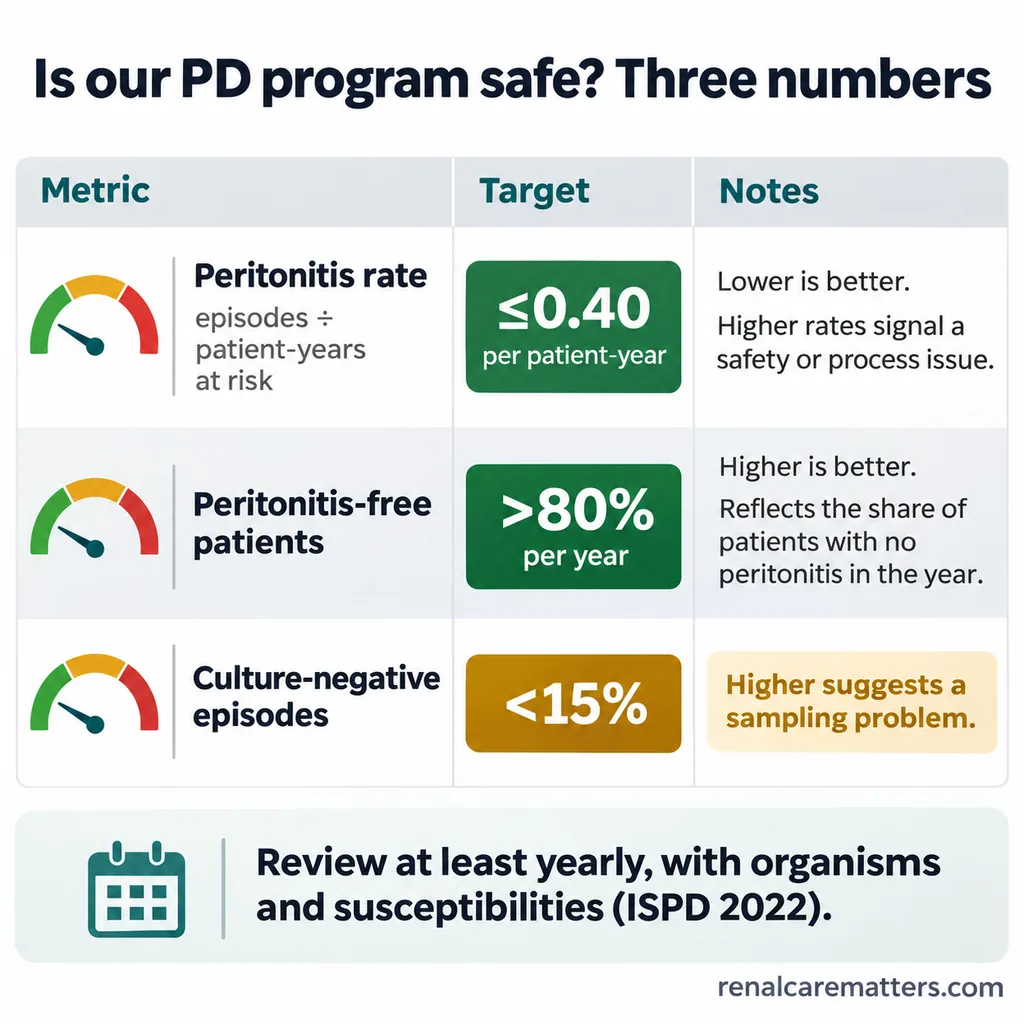
Effluent diagnostic thresholdwhite blood cell count (WBC) >100/µL with >50% neutrophils after ≥2 h dwell
Unit peritonitis rate target≤0.40 episodes per patient-year at risk
Peritonitis-free patients>80% per year
Culture-negative episodes<15%
Refractory definitionNo clearing after 5 days of appropriate antibiotics
Opening case · fictional
Case: “Just come to clinic next week”
On a Sunday evening, Mr. Castro, 60, calls your unit’s after-hours number. He has been on peritoneal dialysis (PD) for two years. His bags are cloudy, his abdomen hurts, and his temperature is 38.4 °C. The call is answered by Nurse Ruiz, who joined the unit two weeks ago from the hemodialysis floor.
She tells him to take paracetamol and come to the PD clinic on Thursday. She mentions the call to you on Monday morning, almost in passing. When you look at the unit’s PD records, you find this is the fourth peritonitis episode among your 14 PD patients this year, and two of the effluent cultures were negative.
Before reading on, decide:
What should have happened on Sunday night, and what happens now?
Why does a delay of days matter to the peritoneum?
What do the four episodes and two negative cultures tell you about the program?
Keep your answers in mind. The lesson gives you what you need, and the case review near the end shows one sound response.
Lesson · part 1
How it works
Touch contamination, exit-site and tunnel infection, and bowel translocation (constipation, diverticular disease, procedures) introduce organisms. Neutrophils pour into the peritoneal cavity, which clouds the effluent. Repeated or severe inflammation drives mesothelial loss and fibrosis, which can lead to ultrafiltration failure and eventually encapsulating peritoneal sclerosis. Mechanical problems differ: constipation or omental wrap causes one-way outflow obstruction, and leaks show up as abdominal wall or genital edema with poor ultrafiltration, without cloudy fluid.
By phone, the constipated patient · fictional
Mr. Rosales calls because his bags drain slowly. The fluid is clear and he has no fever. He has not moved his bowels in four days.
This is a drainage problem, not an infection. A full colon presses on the catheter and blocks outflow. You start a laxative and ask him to call back after his bowels move, and you book an X-ray if drainage does not improve.
What this shows. Cloudy fluid is infection until proven otherwise. Clear fluid that will not drain is usually mechanical.
Lesson · part 2
What the evidence shows
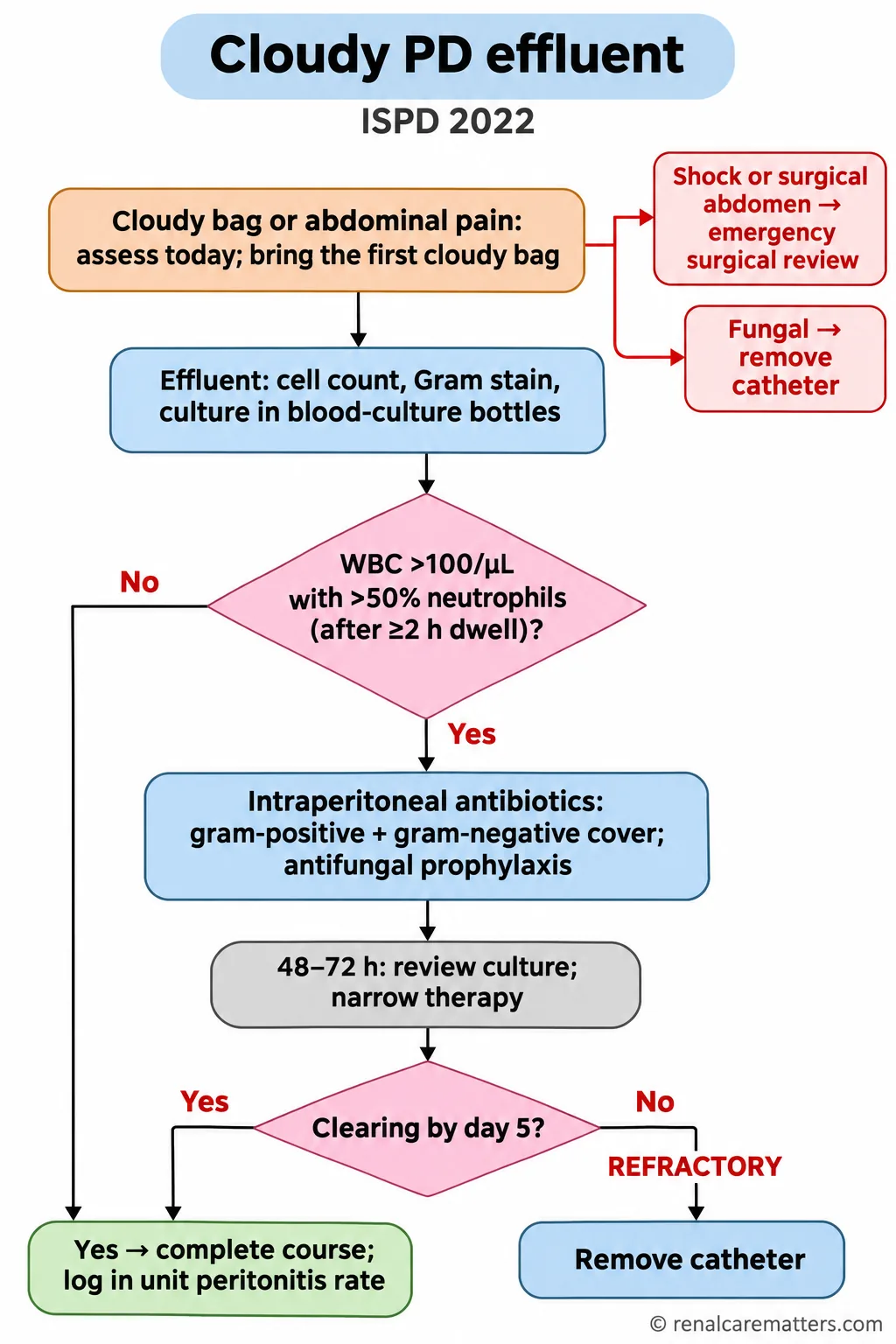
International Society for Peritoneal Dialysis (ISPD) 2022 diagnoses peritonitis when at least two of these are present: compatible clinical features, effluent white cell count above 100/µL (after a dwell of at least 2 hours) with more than 50% neutrophils, and a positive culture (1C). It recommends culturing effluent in blood-culture bottles and keeping culture-negative peritonitis below 15% of episodes. Targets are an overall peritonitis rate of no more than 0.40 episodes per patient-year at risk and more than 80% of patients peritonitis-free per year. Empiric therapy should cover gram-positive and gram-negative organisms, usually by the intraperitoneal route. Catheter removal is recommended for refractory peritonitis (effluent not clearing after 5 days of appropriate antibiotics) and for fungal peritonitis.
Arrange same-day assessment: effluent cell count, differential, Gram stain and culture in blood-culture bottles. Start intraperitoneal empiric antibiotics with gram-positive coverage (vancomycin or a first-generation cephalosporin) and gram-negative coverage (an aminoglycoside or third-generation cephalosporin) per center antibiogram. Add antifungal prophylaxis during antibiotic courses. Review cultures at 48–72 hours, narrow therapy, and recheck the effluent count by day 5. Remove the catheter for refractory, fungal or relapsing tunnel-related infection. Track the unit’s peritonitis rate and organism profile each year.
Figure 2. Cloudy PD effluent. Same-day pathway for cloudy peritoneal dialysis fluid: tests, antibiotics, culture review, and when the catheter must come out.Figure 3. Is our PD program safe? Three numbers. Three quality targets for a peritoneal dialysis program: peritonitis rate, share of patients free of peritonitis, and culture-negative rate.
At the annual PD review · fictional
You calculate your program’s numbers with the PD nurse: 6 episodes in 18 patient-years, a rate of 0.33 per patient-year, within the target of 0.40 or less. Two cultures were negative.
You trace both back to the same problem: effluent sent in a plain container, not in blood-culture bottles. The nurse rewrites the collection sheet.
What this shows. A peritonitis rate is useful only when the cultures behind it are reliable.
Stop and call
Septic shock or peritonism suggesting surgical abdomen
Multiple organisms or anaerobes (bowel perforation)
Fungal elements on Gram stain
Effluent not clearing by day 5
On the floor
Real situations: problems and solutions
These are fictional but typical. For each one, cover the answer, decide what you would do, then compare. Where a step depends on local rules, your unit’s procedure and your supervisor’s direction come first.
Several organisms on the Gram stain
What you see
Effluent from a PD patient grows several gram-negative organisms and an anaerobe.
What is likely going on
Possible bowel perforation.
What to do
Ask for an urgent surgical review and broaden antibiotic cover.
Why it matters
Surgical peritonitis does not respond to intraperitoneal antibiotics alone.
Yeast on the Gram stain
What you see
Effluent shows fungal elements.
What is likely going on
Fungal peritonitis.
What to do
Remove the catheter and start antifungal treatment.
After five days of appropriate antibiotics, the effluent is still cloudy.
What is likely going on
Refractory peritonitis.
What to do
Remove the catheter.
Why it matters
Persisting to save the catheter risks the membrane and the patient.
Field notes
Same-day assessment for every cloudy bag.
Culture the effluent in blood-culture bottles.
Add antifungal prophylaxis during antibiotic courses.
Track your unit’s peritonitis rate each year.
Case review
Back to the case: “Just come to clinic next week”
Now. Call Mr. Castro and see him today. Ask him to bring the first cloudy bag. Send effluent for cell count and differential, Gram stain, and culture in blood-culture bottles. Start intraperitoneal antibiotics that cover both gram-positive and gram-negative organisms, according to your antibiogram, and add antifungal prophylaxis. Review the cultures at 48 to 72 hours, narrow the treatment, and repeat the effluent count by day 5. If he looks septic or his abdomen is rigid, he needs a surgical opinion. Several organisms, or anaerobes, suggest a bowel perforation.
Why the delay matters. Peritonitis is an inflammation of the membrane that is his dialyzer. Each episode, and each day it goes untreated, injures the mesothelium and can lead to scarring and loss of ultrafiltration. Cloudy bags mean peritonitis until proven otherwise.
The program. Four episodes in about 14 patient-years is roughly 0.29 per patient-year at risk, within the ISPD target of 0.40 or less. But two of four culture-negative is 50%, far above the target of under 15%. That usually means a sampling or laboratory problem, so check that effluent goes into blood-culture bottles. Most of all, the after-hours call failed. Brief Nurse Ruiz kindly, then write a call-back pathway that any staff member can follow: cloudy bag, same-day assessment, no exceptions.
Skills lab · with your preceptor
Skills checklist: Skills checklist
Complete with a preceptor, in simulation or at your own unit. Sign-off is local. Your preceptor rates each step as satisfactory, needs practice, or not observed. Steps marked Critical must all be satisfactory before sign-off. This checklist supports supervised learning; your unit’s own procedure and competency form are the authority. A printable version of every checklist is on the trainer page.
Gives the urgent call-back plan
Specifies studies and the empiric treatment pathway
Assigns response review and catheter decision dates
Placement activity. Simulation or supervised practice
Self-assessment
Check your understanding
Each visit draws 5 questions at random from this module’s 5-question bank. Choose the single best answer for each, then select Check answers; an explanation appears under the best answer. Select New set of questions for a different mix. A good target is 4 of 5 on two different sets. Nothing you select is sent anywhere; scoring happens in your browser.
International Society for Peritoneal Dialysis. (n.d.). ISPD guidelines and recommendations. https://ispd.org/guidelines/
Li, P. K., Chow, K. M., Cho, Y., Fan, S., Figueiredo, A. E., Harris, T., Kanjanabuch, T., Kim, Y. L., Madero, M., Malyszko, J., Mehrotra, R., Okpechi, I. G., Perl, J., Piraino, B., Runnegar, N., Teitelbaum, I., Wong, J. K., Yu, X., & Johnson, D. W. (2022). ISPD peritonitis guideline recommendations: 2022 update on prevention and treatment. Peritoneal Dialysis International, 42(2), 110–153. https://doi.org/10.1177/08968608221080586
Educational material for physicians. Completing it is an Academy learning record only. It does not confer CPD units, PSN certification, privileges, or PhilHealth accreditation, and it does not replace current guidelines, regulations, your institution’s protocols, or clinical judgment.