Peritoneal dialysis prescription and home follow-up
Design goal-directed peritoneal dialysis (PD) with the patient around residual function and lifestyle.
PublishedNailathalaGipatikPepalwal:ReferencesMga SanggunianMga TinubdanReng Reperensya:4Audience: Practicing nephrologists · senior nephrology fellows · internists who share longitudinal kidney care in the clinic, ward, ICU, dialysis unit, and homeRead timeOras ng pagbasaOras sa pagbasaOras ning pamamasa:
Training track for attending nephrologists in adult practice
This module is study material for attending nephrologists and senior fellows in adult practice. It explains the reasoning behind common decisions; it is not a protocol. Doses and thresholds must be checked against current product labels, guidelines, and your institution’s approved protocols. Regulatory and benefit rules change: confirm them on the date of service. Every case is fictional.
Learning objectives
After this module you should be able to
Design goal-directed peritoneal dialysis (PD) with the patient around residual function and lifestyle.
Separate peritoneal transport assessment from clinical adequacy.
Teach home red flags and confirm 24-hour access to the PD team.
Pre-testBefore you read, answer the 5 self-assessment questions and note your score. After the module, select New set of questions and compare. The difference is what you learned; the questions you still miss are what to reread.
Start here
The big picture, in plain words
Your duty · Section 1.2, 2024 hemodialysis guidelinesUnder the Philippine Society of Nephrology (PSN) guidelines: The PSN hemodialysis guidelines do not cover peritoneal dialysis, but the same duties carry over: a prescription that is yours (b4) and long-term planning with the patient (b9).
In plain wordsPD uses the patient’s own peritoneum as the dialyzer and the home as the unit. It works best when the prescription fits the person’s day and the remaining kidney function carries part of the load.
Figure 1 · Key numbers
Transport test4-hour dialysate-to-plasma creatinine (PET)
Adequacy approach (International Society for Peritoneal Dialysis (ISPD) 2020)Goal-directed; Kt/V is one input, not the target
Opening case · fictional
Case: The midday exchange that never happens
You follow a few patients on peritoneal dialysis (PD) through a hospital program, and you see them in your clinic every month. Ms. Herrera, 44, is a bank teller on continuous ambulatory peritoneal dialysis, four exchanges a day. Over three months her urine output has fallen from 800 to 250 mL a day. She is tired, her ankles are swollen, and she has gained 2 kilograms.
The PD nurse shows you her exchange log. On workdays the midday exchange is blank. “She says she cannot do it in the bank restroom,” the nurse explains. Ms. Herrera says quietly, “Maybe I should just move to the machine here, Doctor. I am failing at this.”
Before reading on, decide:
What two things have changed?
Is she failing at peritoneal dialysis, or is the prescription failing her?
What would you change, and how would you protect the urine she still makes?
Keep your answers in mind. The lesson gives you what you need, and the case review near the end shows one sound response.
Lesson · part 1
How it works
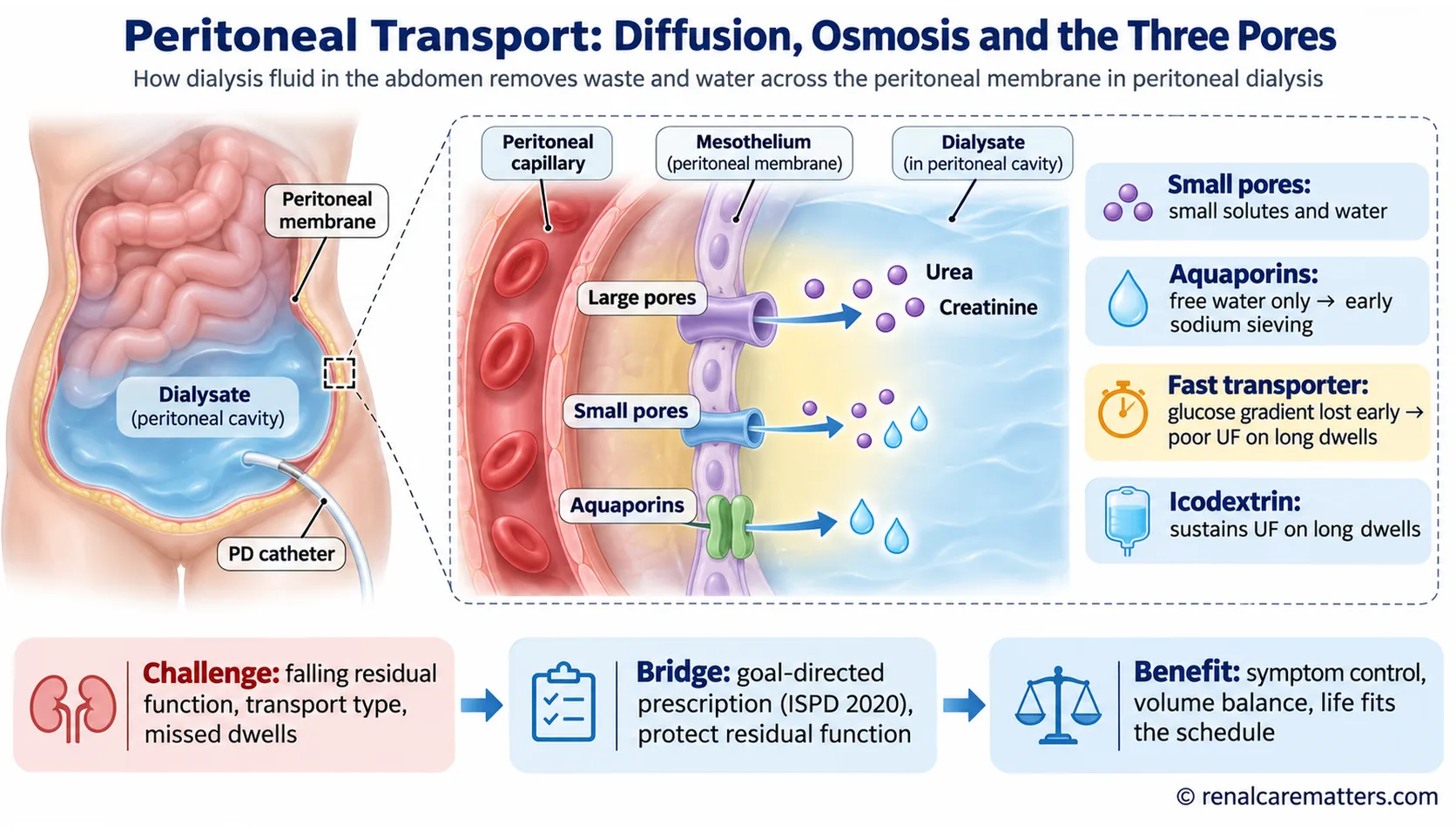
Solutes diffuse from peritoneal capillaries into the dialysate along concentration gradients, and water moves by osmosis driven by glucose or icodextrin. Small pores carry small solutes and water, while aquaporins carry free water only, which explains sodium sieving early in a hypertonic dwell. Transport type, measured by the 4-hour dialysate-to-plasma creatinine ratio in a peritoneal equilibration test, sets the dwell length. Fast transporters equilibrate quickly but lose the glucose gradient early and need short dwells or icodextrin for long dwells. Slow transporters need longer dwells. Residual kidney function often supplies a large share of total clearance early in PD.
At the PD clinic · fictional
Mrs. Lacson, a fast transporter on her peritoneal equilibration test, drains less than she infuses after her long overnight dwell.
Her membrane moves glucose quickly, so the osmotic gradient disappears early in the dwell, and fluid flows back. You change the long dwell to icodextrin, whose large molecules hold the gradient for many hours.
What this shows. Transport type decides how long a dwell can work.
Figure 2. How dialysis fluid in the abdomen removes waste and water across the peritoneal membrane through different pores.
Lesson · part 2
What the evidence shows
ISPD 2020 recommends goal-directed PD: shared decisions on prescription based on patient goals, symptoms, volume status and nutrition. Kt/V and creatinine clearance remain part of assessment, but not the sole adequacy measure. ADEMEX and the Hong Kong trial found no survival benefit from raising peritoneal small-solute clearance above moderate levels. Incremental PD, starting with fewer exchanges while residual function is preserved, is supported by observational data.
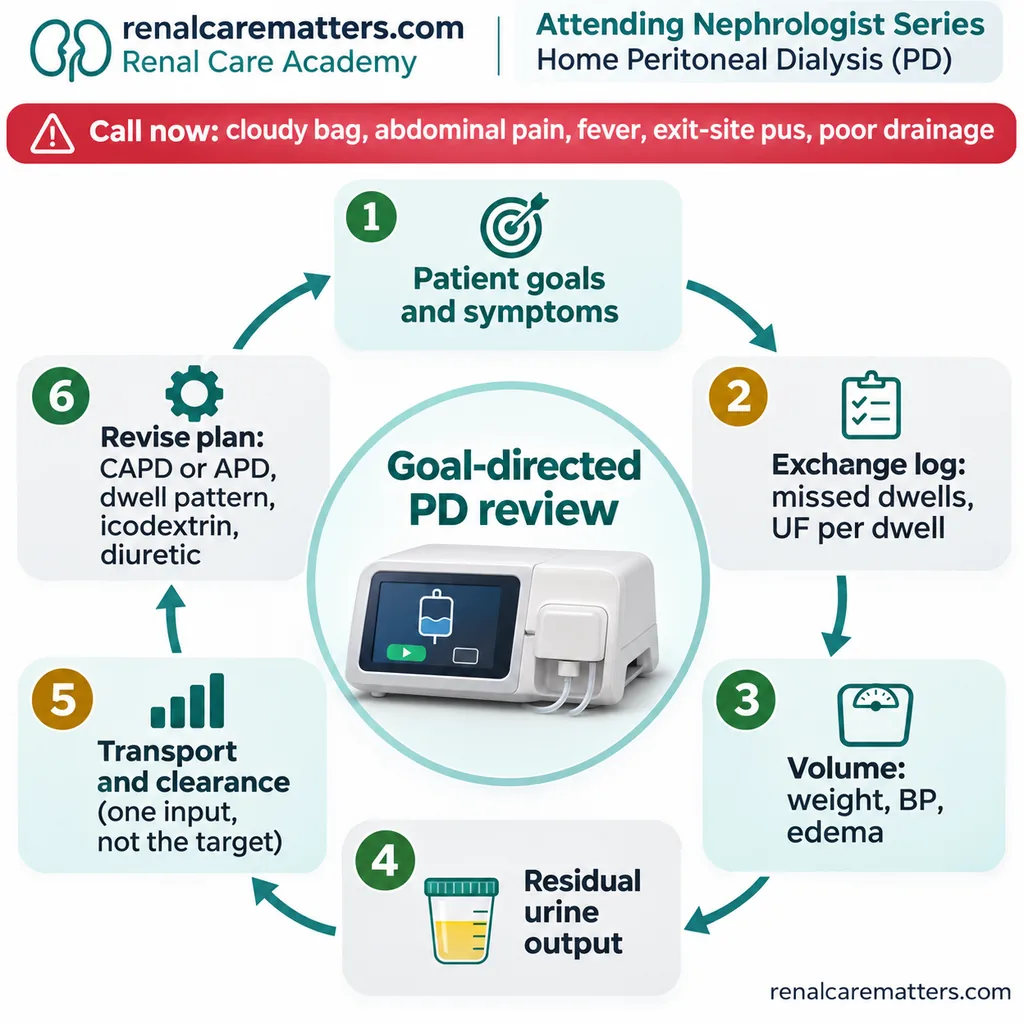
Agree goals with the patient (symptom control, work schedule, volume), then choose continuous ambulatory peritoneal dialysis (CAPD) or automated peritoneal dialysis (APD) and the dwell pattern. At each review, read the exchange log for missed dwells, ultrafiltration per dwell, weight, blood pressure and edema, and check residual urine output. Protect residual function: avoid nephrotoxins, consider renin-angiotensin system (RAS) blockade and use diuretics for urine volume. Teach the patient to call immediately for cloudy effluent, abdominal pain, fever, exit-site pus or poor drainage. Confirm a working after-hours number. Check PD First Z Benefit package requirements and provider accreditation separately from the clinical plan.
Figure 3. A review cycle for home peritoneal dialysis centered on the patient’s goals, with the warning signs that need a same-day call.
Reading the exchange log · fictional
You read Mr. Aquino’s log line by line. Ultrafiltration falls on weekends, when he visits his mother in the province and skips the evening exchange. His weight is up 1.5 kilograms on Mondays.
You ask him what would make the weekend work. He chooses to bring supplies and do the exchange at his mother’s house, and the PD nurse arranges a home check there.
What this shows. The prescription that fits the patient’s life is the one that gets delivered.
Stop and call
Falling urine output with new edema
Repeated missed exchanges
Poor drainage or one-way obstruction
Weight loss with low albumin
On the floor
Real situations: problems and solutions
These are fictional but typical. For each one, cover the answer, decide what you would do, then compare. Where a step depends on local rules, your unit’s procedure and your supervisor’s direction come first.
Poor drainage on Monday
What you see
A PD patient reports that fluid goes in but drains slowly.
What is likely going on
Constipation or catheter malposition is the usual cause.
What to do
Treat constipation first, then check the catheter position with an X-ray.
Why it matters
One-way obstruction is common and usually fixable.
The patient who stopped urinating
What you see
A PD patient’s urine output falls after a course of an aminoglycoside.
What is likely going on
Residual function was harmed by a nephrotoxin.
What to do
Avoid nephrotoxins where alternatives exist, and review his volume and prescription.
Why it matters
Residual kidney function carries much of the load early in PD.
The weight that keeps falling
What you see
A PD patient is losing weight and his albumin is falling.
What is likely going on
Poor intake, protein loss into the dialysate, or inflammation.
What to do
Ask the dietitian to see him, check for infection, and review his prescription.
Why it matters
Malnutrition predicts poor outcomes on PD.
Field notes
Read the exchange log at every visit.
Ask about urine output every time.
Fit the prescription to the patient’s day.
Make sure the after-hours number works.
Case review
Back to the case: The midday exchange that never happens
Two changes. Her own kidneys are doing less, and the prescription is not being delivered. Early in PD, residual kidney function often does a large share of the work, so when urine output falls, a missed exchange that used to be tolerable becomes fluid overload. Check her volume, look for constipation and catheter position (both can slow drainage), and review her medicines for anything harmful to the kidneys.
Is she failing? No. Tell her so plainly. Under ISPD 2020, adequacy is goal-directed: the prescription should fit her life, her symptoms, and her volume, with Kt/V as one input among several. A plan that needs an exchange in a bank restroom does not fit her life.
What to change. Consider automated PD at night, with an icodextrin dwell during the day. Icodextrin pulls water by a large-molecule gradient that lasts through a long dwell, so the day stops competing with her job. Add a loop diuretic to keep her urine volume up, avoid nephrotoxic drugs, and continue renin-angiotensin blockade if she tolerates it. The evidence that these steps preserve residual function is mostly observational, but the mechanism is sound and the cost is low. Agree on the plan with her and the PD nurse, and check the PD benefit package requirements separately from the clinical decision.
Skills lab · with your preceptor
Skills checklist: Skills checklist
Complete with a preceptor, in simulation or at your own unit. Sign-off is local. Your preceptor rates each step as satisfactory, needs practice, or not observed. Steps marked Critical must all be satisfactory before sign-off. This checklist supports supervised learning; your unit’s own procedure and competency form are the authority. A printable version of every checklist is on the trainer page.
Reviews home logs
Identifies one modifiable barrier
Documents monitoring and after-hours contact instructions
Placement activity. Simulation or supervised practice
Self-assessment
Check your understanding
Each visit draws 5 questions at random from this module’s 5-question bank. Choose the single best answer for each, then select Check answers; an explanation appears under the best answer. Select New set of questions for a different mix. A good target is 4 of 5 on two different sets. Nothing you select is sent anywhere; scoring happens in your browser.
International Society for Peritoneal Dialysis. (n.d.). ISPD guidelines and recommendations. https://ispd.org/guidelines/
Paniagua, R., Amato, D., Vonesh, E., Correa-Rotter, R., Ramos, A., Moran, J., & Mujais, S. (2002). Effects of increased peritoneal clearances on mortality rates in peritoneal dialysis: ADEMEX, a prospective, randomized, controlled trial. Journal of the American Society of Nephrology, 13(5), 1307–1320. https://doi.org/10.1681/ASN.V1351307
Educational material for physicians. Completing it is an Academy learning record only. It does not confer CPD units, PSN certification, privileges, or PhilHealth accreditation, and it does not replace current guidelines, regulations, your institution’s protocols, or clinical judgment.