Support immediate bedside action for hypotension, hemolysis, air embolism, reactions and arrhythmia.
PublishedNailathalaGipatikPepalwal:ReferencesMga SanggunianMga TinubdanReng Reperensya:4Audience: Practicing nephrologists · senior nephrology fellows · internists who share longitudinal kidney care in the clinic, ward, ICU, dialysis unit, and homeRead timeOras ng pagbasaOras sa pagbasaOras ning pamamasa:
Training track for attending nephrologists in adult practice
This module is study material for attending nephrologists and senior fellows in adult practice. It explains the reasoning behind common decisions; it is not a protocol. Doses and thresholds must be checked against current product labels, guidelines, and your institution’s approved protocols. Regulatory and benefit rules change: confirm them on the date of service. Every case is fictional.
Learning objectives
After this module you should be able to
Support immediate bedside action for hypotension, hemolysis, air embolism, reactions and arrhythmia.
Distinguish individual from shared hazards and trigger a unit-level response.
Document the event, the disposition and the learning.
Pre-testBefore you read, answer the 5 self-assessment questions and note your score. After the module, select New set of questions and compare. The difference is what you learned; the questions you still miss are what to reread.
Start here
The big picture, in plain words
Your duty · Section 1.2, 2024 hemodialysis guidelinesUnder the Philippine Society of Nephrology (PSN) guidelines: Coordinate with the nurses and the physician on duty during emergencies (b8). Unit-wide hazards are led by the clinical head; your patients are yours.
In plain wordsMost intradialytic problems belong to one patient. A cluster belongs to the unit. When two or more patients deteriorate at once, think water, dialysate or a product batch first, because every other patient on the floor may be next.
Figure 1 · Key numbers
Dialysate coolingAbout 0.5 °C below core temperature (hypotension-prone patients)
Hemolysis ruleDo not return circuit blood
Opening case · fictional
Case: Two patients, one minute apart
It is 10:40 on a Tuesday morning. Dr. Alonzo, the physician on duty, calls you from the floor. “Doctor, station 3 has chest pain and back pain, and the blood in his venous line looks dark, almost like wine. Then station 7 said the same thing a minute later. Station 7’s blood pressure is 80/50.”
Station 3 is your patient; station 7 belongs to another attending nephrologist. Both started at 10 a.m. from the same water loop. Twelve other patients are running. The water technician changed the carbon tanks yesterday afternoon. Dr. Alonzo asks, “Should I return their blood and stop?”
Before reading on, decide:
What is this until proven otherwise?
What do you tell Dr. Alonzo to do with the two patients, and with the other twelve?
Who must be told, and what must be kept?
Keep your answers in mind. The lesson gives you what you need, and the case review near the end shows one sound response.
Lesson · part 1
How it works
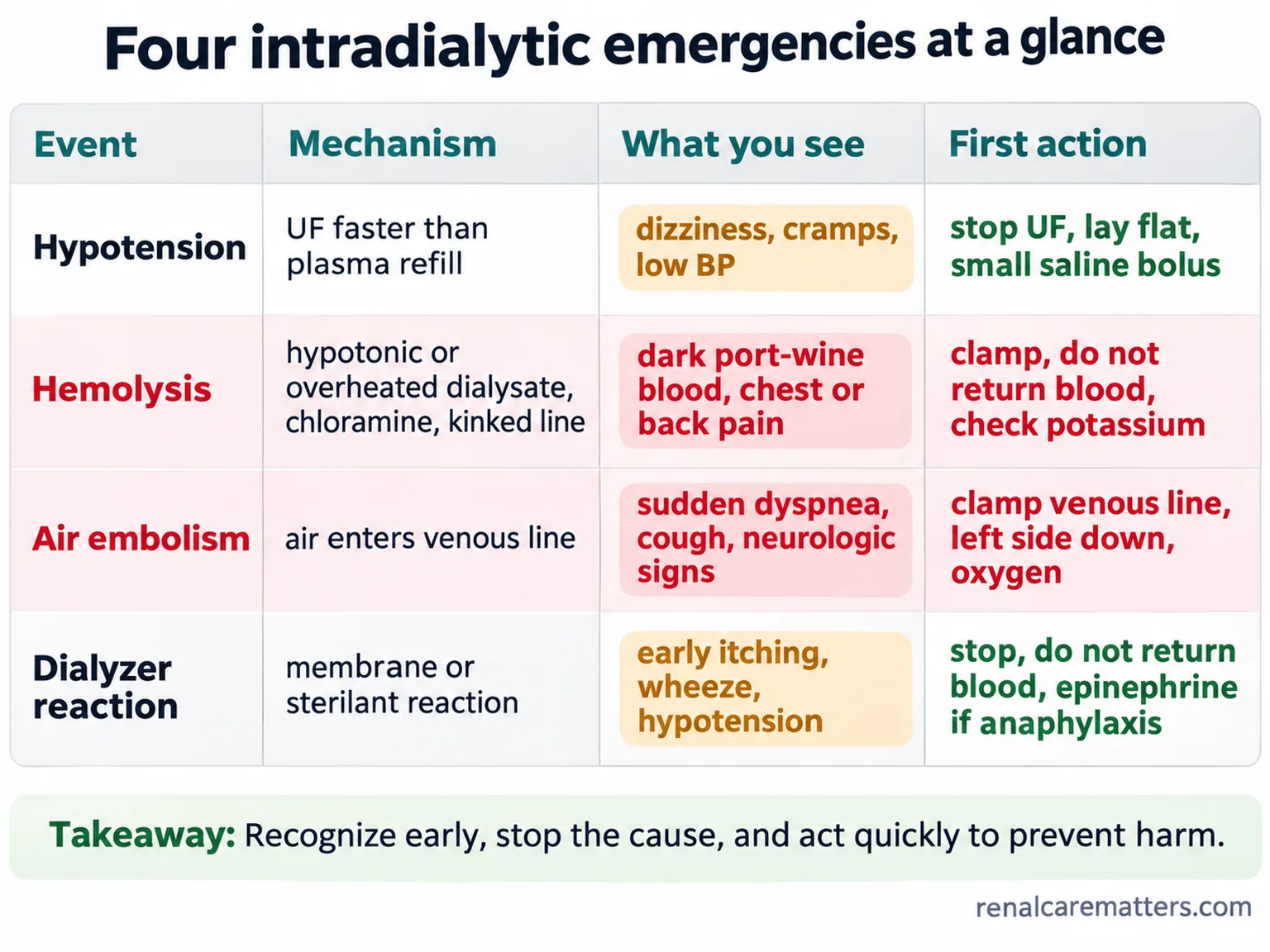
Intradialytic hypotension occurs when ultrafiltration outpaces plasma refill, especially with autonomic neuropathy, heart failure, warm dialysate or food during treatment. Hemolysis happens when red cells meet hypotonic or overheated dialysate, chloramine or copper contamination, or mechanical shear from kinked lines or pump malfunction. Released potassium can cause cardiac arrest, and returning the circuit blood adds to the load. Air entering the venous line travels to the right heart and pulmonary circulation, or across a patent foramen ovale to the brain. Dialyzer reactions range from early anaphylactoid responses to sterilant or membrane components to milder complement-mediated reactions.
By telemedicine, warm dialysate · fictional
Mr. Santos becomes hypotensive in the third hour of most sessions. His target weight was lowered last month. The dialysate is set at 37 °C.
Fluid removal is outpacing refill from his tissues, and warm dialysate dilates his skin vessels when he needs them constricted. You ask for a target-weight review, a cap on his ultrafiltration rate, and dialysate cooled about 0.5 °C below his core temperature.
What this shows. Intradialytic hypotension is fluid removal minus refill, made worse by heat and food.
Figure 2. Four intradialytic emergencies at a glance. Reference table of four dialysis emergencies: cause, signs and first action.
Lesson · part 2
What the evidence shows
Emergency management of these events rests on physiology, case series and outbreak investigations rather than randomized trials. Cluster hemolysis outbreaks traced to chloramine, copper or hypotonic dialysate are well documented, and stopping all affected treatments and investigating water and dialysate is standard. Cooler dialysate (0.5 °C below core temperature) is associated with fewer hypotensive episodes in small trials and meta-analyses; the large MyTEMP trial (2022) found no reduction in cardiovascular events.
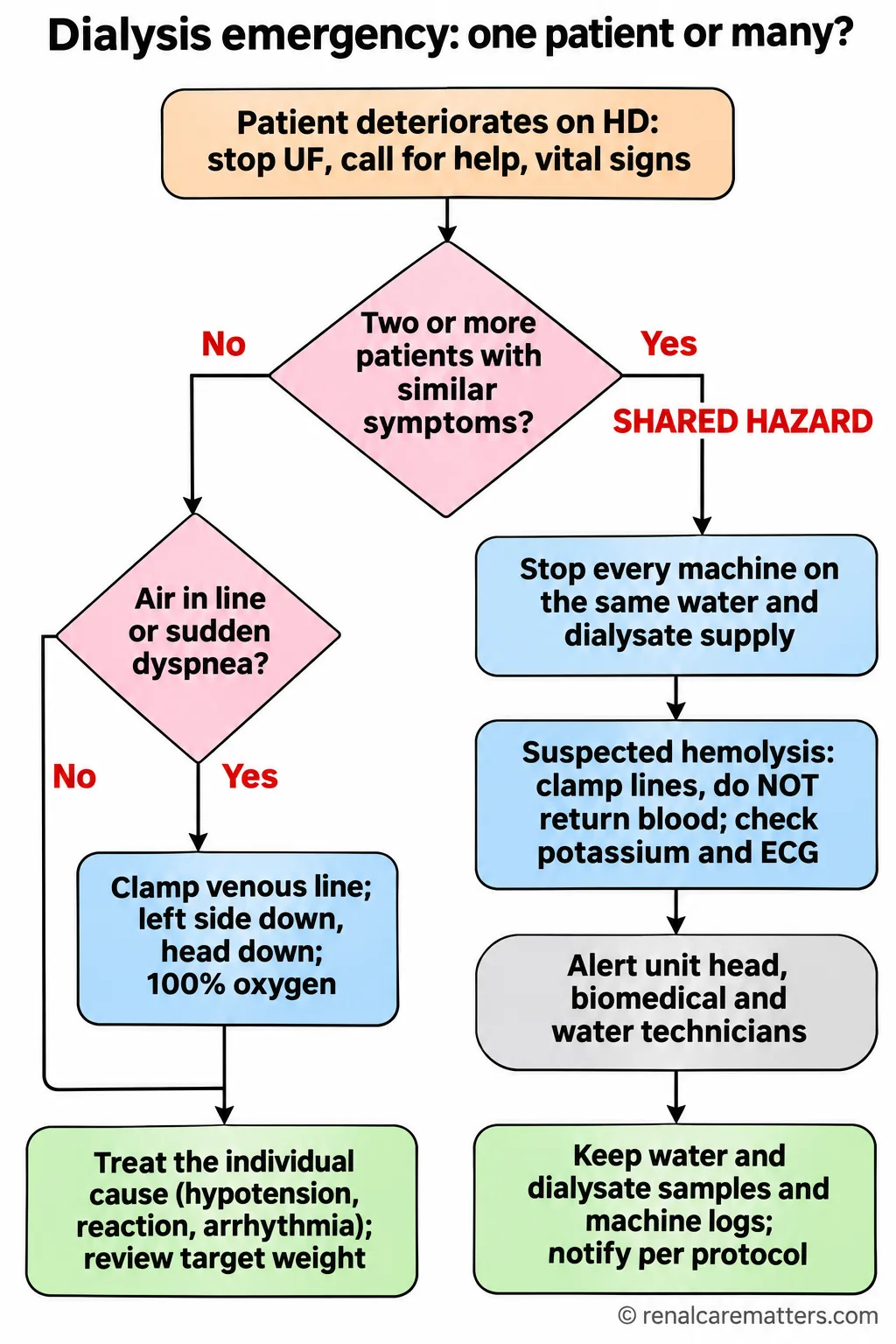
Hypotension: stop ultrafiltration, lay the patient flat, give a saline bolus within protocol and review the target weight. Hemolysis (dark port-wine blood, chest or back pain, dyspnea): stop the pump, clamp lines and do not return blood. Check potassium urgently, treat hyperkalemia and transfer. Air embolism: clamp the venous line, place the patient left side down with head down, give 100% oxygen and call for emergency help. Anaphylactoid reaction: stop and do not return blood, then give epinephrine and supportive care. Whenever more than one patient is affected, stop treatments on the shared supply, alert unit leadership, keep samples and logs, and notify per Department of Health (DOH) and unit protocol.
Figure 3. Dialysis emergency: one patient or many?. Emergency flowchart that first asks whether one patient or several are affected, then shows the steps for a shared hazard, air embolism or an individual problem.
The drill · fictional
On your monthly visit you sit in on the air embolism drill the clinical head runs with the floor team. The nurse clamps the venous line in 20 seconds. Turning the “patient” onto the left side with the head down takes 90 seconds, because nobody knew how the chair reclined.
The team repeats the drill until it takes 30 seconds, and the chair instructions go on the wall.
What this shows. Rare emergencies are handled the way they were practiced.
Stop and call
Two or more patients with similar symptoms within minutes
Dark or cherry-red blood in the venous line
Sudden dyspnea, cough or neurologic signs after a line disconnection
Chest pain with electrocardiogram (ECG) changes during hemodialysis (HD)
On the floor
Real situations: problems and solutions
These are fictional but typical. For each one, cover the answer, decide what you would do, then compare. Where a step depends on local rules, your unit’s procedure and your supervisor’s direction come first.
Air in the venous line
What you see
A disconnected line lets air into the circuit; the patient becomes breathless and confused.
What is likely going on
Air embolism.
What to do
Clamp the venous line, place the patient on the left side with the head down, give 100% oxygen, and call for emergency help.
Why it matters
Speed matters, and the steps must be practiced before they are needed.
Itching and wheeze in the first minutes
What you see
A patient develops wheeze and hives five minutes into a session on a new dialyzer brand.
What is likely going on
A dialyzer reaction, possibly anaphylactoid.
What to do
Stop the session and do not return the blood. Give epinephrine and supportive care, and record the dialyzer and its lot number.
Why it matters
Early reactions can be severe, and the lot number may connect cases across units.
Low blood pressure every session
What you see
A patient’s blood pressure falls in the third hour of every session.
What is likely going on
Fluid removal is outpacing plasma refill, perhaps with warm dialysate or a target weight set too low.
What to do
Review the target weight, consider cooling the dialysate by about 0.5 °C, cap the ultrafiltration rate, and avoid meals during treatment.
Why it matters
Repeated hypotension injures the heart and brain over time.
Field notes
Two patients with the same symptoms means stop the shared supply.
Never return blood after suspected hemolysis.
Keep samples, logs, and lot numbers after any reaction.
Ask that the air embolism response be drilled with the team.
Case review
Back to the case: Two patients, one minute apart
What it is. Two patients with the same symptoms within minutes, and dark blood in the lines, is a cluster hemolysis event until proven otherwise. Think of the water first: chloramine breaking through a newly changed carbon tank is a known cause. Every patient on that water is at risk.
The two patients. Stop both pumps, clamp the lines, and do not return the blood. It is full of potassium released from broken red cells. Put both on monitors, check potassium urgently, record an electrocardiogram, treat hyperkalemia, and transfer the hypotensive patient for monitored care.
The other twelve. Most of them are not your patients. Tell Dr. Alonzo to follow the unit protocol now: every treatment on the same water and dialysate supply is held before anyone else develops symptoms, and the clinical head is called to lead. Holding them is a unit safety decision, not a prescription for another doctor’s patients. Each patient is assessed, potassium is checked in any with symptoms, and each attending nephrologist is told about his own patients.
Who is told, and what is kept. Make sure the clinical head, the biomedical and water technicians, and the head nurse have been called, and offer to come in. The clinical head leads from here. Keep dialysate and water samples, the lines and dialyzers, the chlorine test records, and the machine logs. Do not restart until the water has been tested and released. Notify the DOH as your unit protocol requires. Afterwards, write the timeline and each patient’s outcome. This is the event the morning chlorine test exists to prevent.
Skills lab · with your preceptor
Skills checklist: Skills checklist
Complete with a preceptor, in simulation or at your own unit. Sign-off is local. Your preceptor rates each step as satisfactory, needs practice, or not observed. Steps marked Critical must all be satisfactory before sign-off. This checklist supports supervised learning; your unit’s own procedure and competency form are the authority. A printable version of every checklist is on the trainer page.
Uses a closed-loop call
Identifies a shared-exposure trigger
Documents event, actions and disposition
Placement activity. Simulation or supervised practice
Self-assessment
Check your understanding
Each visit draws 5 questions at random from this module’s 5-question bank. Choose the single best answer for each, then select Check answers; an explanation appears under the best answer. Select New set of questions for a different mix. A good target is 4 of 5 on two different sets. Nothing you select is sent anywhere; scoring happens in your browser.
Educational material for physicians. Completing it is an Academy learning record only. It does not confer CPD units, PSN certification, privileges, or PhilHealth accreditation, and it does not replace current guidelines, regulations, your institution’s protocols, or clinical judgment.