Stage acute kidney injury (AKI) from creatinine and urine-output trends and identify reversible causes in parallel.
PublishedNailathalaGipatikPepalwal:ReferencesMga SanggunianMga TinubdanReng Reperensya:4Audience: Practicing nephrologists · senior nephrology fellows · internists who share longitudinal kidney care in the clinic, ward, ICU, dialysis unit, and homeRead timeOras ng pagbasaOras sa pagbasaOras ning pamamasa:
Training track for attending nephrologists in adult practice
This module is study material for attending nephrologists and senior fellows in adult practice. It explains the reasoning behind common decisions; it is not a protocol. Doses and thresholds must be checked against current product labels, guidelines, and your institution’s approved protocols. Regulatory and benefit rules change: confirm them on the date of service. Every case is fictional.
Learning objectives
After this module you should be able to
Stage acute kidney injury (AKI) from creatinine and urine-output trends and identify reversible causes in parallel.
Manage leptospirosis-associated AKI in the Philippine context.
Write a post-AKI follow-up plan with named labs, timing and owner.
Pre-testBefore you read, answer the 5 self-assessment questions and note your score. After the module, select New set of questions and compare. The difference is what you learned; the questions you still miss are what to reread.
Start here
The big picture, in plain words
Your duty · Section 1.2, 2024 hemodialysis guidelinesUnder the Philippine Society of Nephrology (PSN) guidelines: Coordinate with the nurses and the physician on duty in emergencies (b8), endorse properly when your patient is admitted under another nephrologist (b12), and plan long-term care with the patient (b9).
In plain wordsAKI is a symptom, not a diagnosis, like ’fever of the kidney.’ Your job is to treat the immediate danger, find the cause while you do it, and remember that the kidney that survives AKI carries a lasting scar.
Figure 1 · Key numbers
Stage 1Creatinine 1.5–1.9x baseline or ≥0.3 mg/dL rise; UO <0.5 mL/kg/h for 6–12 h
Stage 2Creatinine 2.0–2.9x; UO <0.5 mL/kg/h for ≥12 h
Stage 3Creatinine ≥3x or ≥4.0 mg/dL or kidney replacement therapy (KRT); UO <0.3 mL/kg/h for ≥24 h or anuria ≥12 h
BICARICU-2 90-day mortality62.1% bicarbonate vs 61.7% control (no difference)
Post-AKI reviewCreatinine and urine albumin-to-creatinine ratio (UACR) at about 3 months
Opening case · fictional
Case: The flood patient sent for dialysis
It is the third day after a typhoon. A provincial hospital calls your unit at 7 a.m. to transfer Mr. Gatdula, 34, a construction worker who waded through floodwater five days ago. He has fever, calf pain, and yellow eyes. His platelets are 48,000/µL, creatinine 4.6 mg/dL, and potassium 3.2 mmol/L. After fluids his mean arterial pressure is 70, but his urine output is only 0.3 mL/kg an hour. The referring doctor says, “His potassium is low, so he does not need dialysis yet. Can you just see him in your clinic?”
Your head nurse tells you the unit is already full because patients from a flooded satellite unit have been added to every shift.
Before reading on, decide:
What is your working diagnosis, and what should start now?
Does a low potassium mean dialysis can wait?
Where should he be treated, given that your unit is full?
Keep your answers in mind. The lesson gives you what you need, and the case review near the end shows one sound response.
Lesson · part 1
How it works
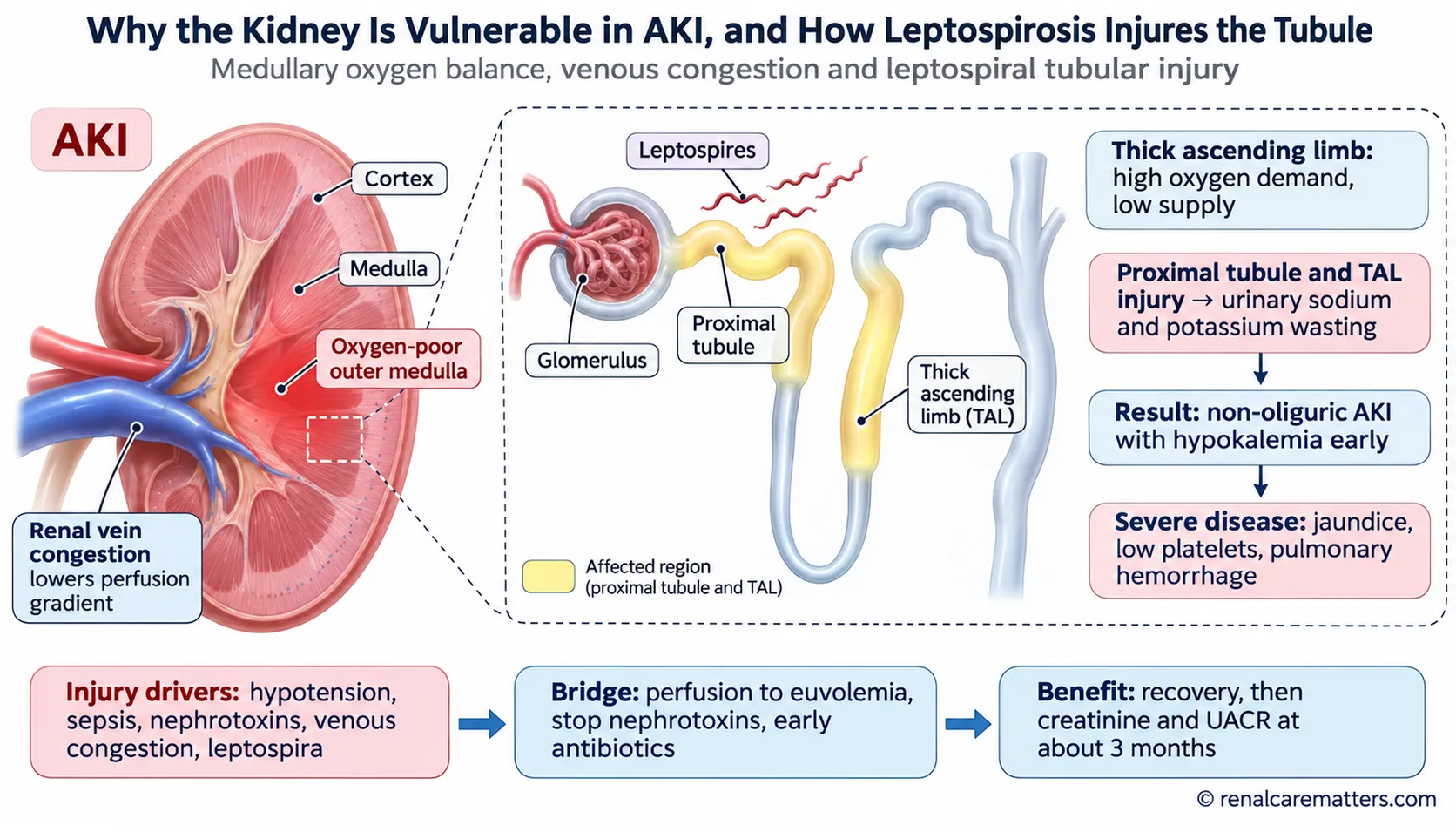
The kidney receives about 20% of cardiac output but its medulla runs near hypoxia. The thick ascending limb pumps sodium aggressively in a region with sparse blood supply. Hypotension, sepsis-related microvascular dysfunction, nephrotoxins and venous congestion all tip this balance. Congestion matters because a high central venous pressure lowers the transrenal perfusion gradient and raises interstitial pressure inside a capsule that cannot expand. Recovery is incomplete when injured tubular cells arrest in the G2/M phase of the cell cycle and secrete profibrotic signals, which links AKI to later chronic kidney disease (CKD). Leptospirosis, endemic after Philippine floods, causes a characteristic non-oliguric, hypokalemic tubulointerstitial nephritis. The leptospiral outer membrane protein injures the proximal tubule and thick ascending limb, producing urinary potassium and sodium wasting. Severe disease (Weil syndrome) adds jaundice, thrombocytopenia and pulmonary hemorrhage.
On a partner hospital’s ward · fictional
Mrs. Uy has AKI after pneumonia. Over two days she has received 7 liters of fluid. Her urine output has not risen, her neck veins are full, and her oxygen requirement is climbing. The ward team asks if she needs “one more liter.”
You explain the physiology at the bedside. High venous pressure lowers the gradient that pushes blood through the kidney, and fluid swells a kidney that sits inside a capsule that cannot stretch. More fluid is now making perfusion worse.
What this shows. Euvolemia, not maximum fluid, is the target in AKI.
Figure 2. Kidney and nephron diagram showing the oxygen-poor medulla, venous congestion and where leptospirosis injures the tubule.
Lesson · part 2
What the evidence shows
Kidney Disease: Improving Global Outcomes (KDIGO) 2012 (current final) stages AKI by creatinine and urine output. The 2026 draft keeps functional criteria, adds structural biomarkers, and emphasizes risk prediction, nephrotoxin stewardship and follow-up. Balanced crystalloids reduced a composite of death, new KRT or persistent dysfunction in a large pragmatic intensive care unit (ICU) trial (SMART, 2018); the effect was modest. BICARICU-2 (JAMA 2025; 640 patients with pH ≤7.20 and stage 2–3 AKI) showed no 90-day mortality difference with sodium bicarbonate (62.1% vs 61.7%). Kidney replacement therapy (KRT) was started later and used less often in the bicarbonate group. In leptospirosis, Philippine guidance supports early antibiotics (penicillin, ceftriaxone or doxycycline by severity), and early dialysis in severe or oliguric disease. That recommendation rests mainly on observational data.
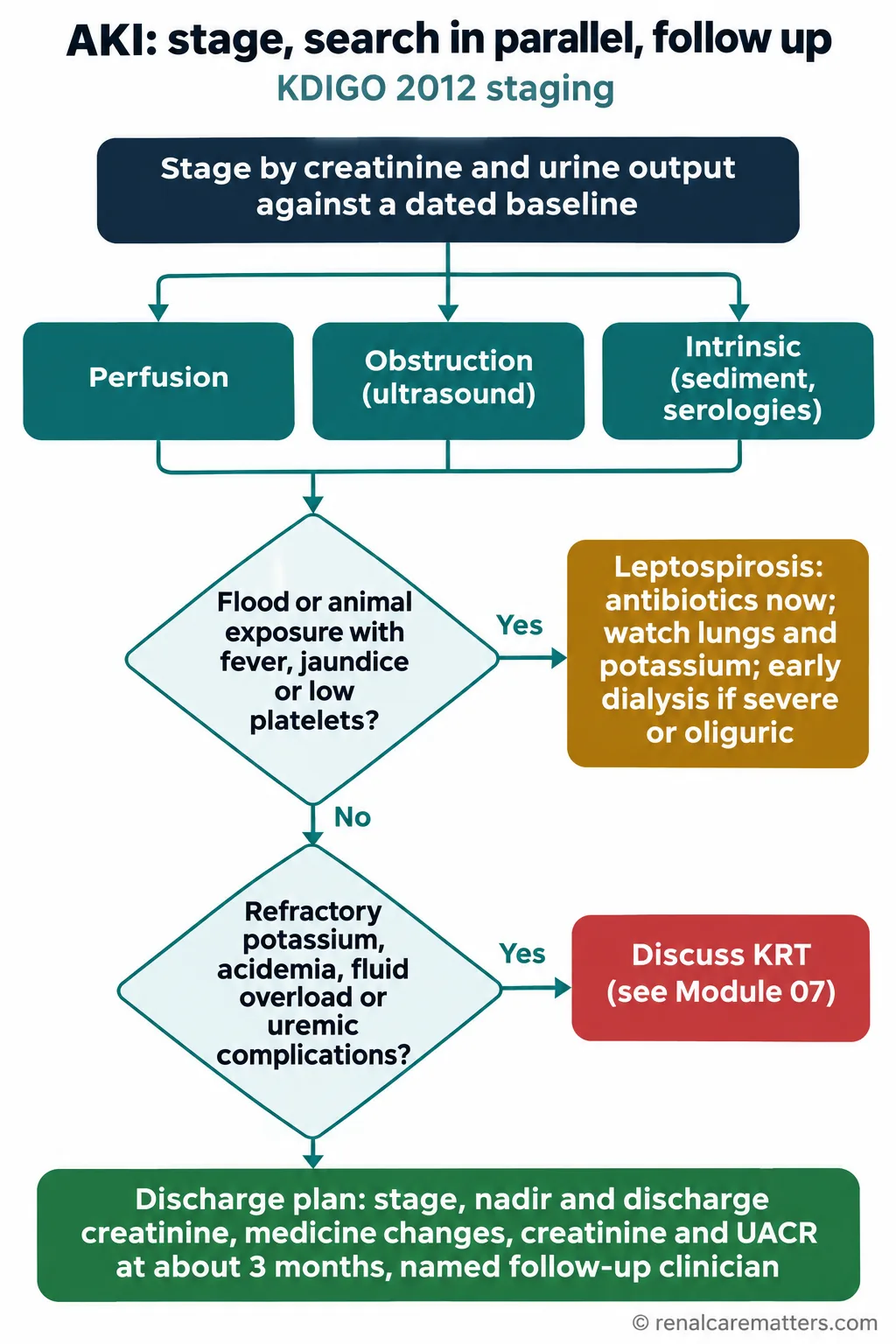
Evaluate perfusion, obstruction and intrinsic disease in parallel; do not finish one before starting the next. Stop nephrotoxins, adjust drug doses and target euvolemia, not blindly ’more fluid.’ After flood or animal exposure with fever, myalgia, conjunctival suffusion, jaundice or thrombocytopenia, think leptospirosis. Start antibiotics without waiting for serology and watch potassium (often low early) and lungs closely. At discharge, document the AKI stage, nadir and discharge creatinine, medication changes, and labs at about 3 months (creatinine and UACR) with a named follow-up clinician. AKI survivors have a higher risk of later CKD.
Figure 3. AKI: stage, search in parallel, follow up. AKI flowchart: stage the injury, look for causes in parallel, recognize leptospirosis, escalate for dialysis, and plan follow-up.
At discharge, a forgotten patient · fictional
Three months after a dialysis-requiring AKI, Mr. Ferrer comes to your unit’s clinic only because his pharmacist told him to. His discharge summary lists no stage, no follow-up, and no medicine changes. His creatinine is 1.8 mg/dL, and his baseline was 1.0.
You record the AKI stage, check his urine albumin, review his medicines, and book him into your CKD clinic.
What this shows. AKI survivors carry a higher risk of later CKD. A named follow-up owner is part of the treatment.
Stop and call
Oliguria persisting after perfusion is restored
Leptospirosis with hemoptysis or falling oxygen saturation (pulmonary hemorrhage)
Potassium ≥6.5 mmol/L or electrocardiogram (ECG) changes
Fluid overload with rising oxygen requirement
On the floor
Real situations: problems and solutions
These are fictional but typical. For each one, cover the answer, decide what you would do, then compare. Where a step depends on local rules, your unit’s procedure and your supervisor’s direction come first.
The patient who recovered and was forgotten
What you see
A man who needed dialysis for AKI two months ago was discharged with a creatinine of 2.1 mg/dL and no follow-up.
What is likely going on
AKI survivors carry a higher risk of later CKD, and nobody owns his follow-up.
What to do
Arrange creatinine and urine albumin at about three months, review his medicines, and name a follow-up doctor.
Why it matters
The kidney that survives AKI is not the kidney it was before.
Low potassium during an outbreak
What you see
During a leptospirosis outbreak, several AKI patients referred to your unit have low potassium.
What is likely going on
Leptospiral injury causes potassium and sodium wasting through the tubules.
What to do
Replace potassium cautiously, watch for pulmonary hemorrhage, and do not let a low potassium delay dialysis when the patient is oliguric and severely ill.
Why it matters
The usual hyperkalemia trigger for dialysis does not apply to this disease.
More fluid for a falling urine output
What you see
A ward patient with AKI has received 6 liters of fluid; his urine output is still low and his oxygen requirement is rising.
What is likely going on
Venous congestion now lowers the pressure gradient across the kidney and raises pressure inside its capsule.
What to do
Stop fluid loading, aim for euvolemia, and treat congestion. Consider whether dialysis is needed for fluid.
Why it matters
More fluid is not always more perfusion; past a point it is less.
Field notes
Stage AKI with both creatinine and urine output.
Look for perfusion, obstruction, and intrinsic disease at the same time.
After floods, ask about wading in water.
Every AKI discharge needs a three-month review with a named owner.
Case review
Back to the case: The flood patient sent for dialysis
The diagnosis. This is severe leptospirosis, Weil syndrome, with stage 3 AKI. Ask the referring doctor to start intravenous penicillin G or ceftriaxone now, without waiting for serology.
Can dialysis wait? No. Leptospiral kidney injury wastes potassium, so a low value is expected and does not mean the kidney is coping. Oliguria that persists after resuscitation in severe leptospirosis is an accepted indication for early dialysis in Philippine practice. That recommendation rests mainly on observational data, but waiting for the classic metabolic triggers in a patient this sick risks losing the window. Replace potassium cautiously, avoid giving fluid beyond what he needs, and watch his oxygen saturation closely. Pulmonary hemorrhage is the complication that kills, and a drop in oxygen saturation or hemoptysis means intensive care.
Where? He needs a hospital bed with monitoring and a temporary dialysis catheter, not a clinic chair. With jaundice, low platelets, and a risk of lung bleeding, he is not a patient for a freestanding unit at full capacity. Arrange admission to a hospital that can dialyze him today, confirm acceptance with a named doctor, and document the stage, the plan, and who follows him after discharge. Ask for kidney function and urine albumin to be checked at about three months.
Skills lab · with your preceptor
Skills checklist: Skills checklist
Complete with a preceptor, in simulation or at your own unit. Sign-off is local. Your preceptor rates each step as satisfactory, needs practice, or not observed. Steps marked Critical must all be satisfactory before sign-off. This checklist supports supervised learning; your unit’s own procedure and competency form are the authority. A printable version of every checklist is on the trainer page.
Stages AKI from trends
Works up perfusion, obstruction and intrinsic causes in parallel
Identifies leptospirosis features and starts antibiotics
Drafts a post-AKI plan with named labs and owner
Placement activity. Simulation or supervised practice
Self-assessment
Check your understanding
Each visit draws 5 questions at random from this module’s 5-question bank. Choose the single best answer for each, then select Check answers; an explanation appears under the best answer. Select New set of questions for a different mix. A good target is 4 of 5 on two different sets. Nothing you select is sent anywhere; scoring happens in your browser.
Jung, B., Jabaudon, M., De Jong, A., Bitker, L., Audard, J., Klouche, K., Sarton, B., Guitton, C., Lasocki, S., Rieu, B., Canet, E., Jeantrelle, C., Roquilly, A., Mayaux, J., Verdonk, F., Pottecher, J., Ferrandiere, M., Riu, B., Garcon, P., ... BICARICU-2 Study Group (2025). Sodium bicarbonate for severe metabolic acidemia and acute kidney injury: The BICARICU-2 randomized clinical trial. JAMA, 334(22), 2000–2010. https://doi.org/10.1001/jama.2025.20231
Educational material for physicians. Completing it is an Academy learning record only. It does not confer CPD units, PSN certification, privileges, or PhilHealth accreditation, and it does not replace current guidelines, regulations, your institution’s protocols, or clinical judgment.