Instructions
Section A — Urine Output Rate
UO rate (mL/kg/h) = urine volume (mL) ÷ [weight (kg) × time (hours)]
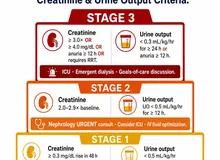
KDIGO AKI criteria by urine output:
- Stage 1: <0.5 mL/kg/h for ≥6 hours
- Stage 2: <0.5 mL/kg/h for ≥12 hours
- Stage 3: <0.3 mL/kg/h for ≥24 hours OR anuria for ≥12 hours
Normal target: 0.5–1.0 mL/kg/h (adults); 1 mL/kg/h (children). Post-operative target: often 0.5 mL/kg/h minimum.
Section B — Fluid Balance & Overload
Fluid balance = total inputs − total outputs
Fluid overload % = (cumulative balance L / admission weight kg) × 100
Clinical significance:
- Fluid overload >10% is associated with worse ICU/AKI outcomes
- In dialysis patients, fluid overload >15% is associated with increased mortality
When to Use
Appropriate settings
- Hourly monitoring of oliguria/AKI in ICU/ward settings
- Post-operative fluid management
- Assessment of fluid overload in CKD/ESRD patients
- Guiding ultrafiltration targets in dialysis
Oliguria is the earliest detectable sign of AKI in many patients. Serial UO calculation guides timely escalation of care before serum creatinine rises detectably.
Pearls & Pitfalls
Pearls
- Foley catheter required for accurate hourly UO monitoring
- In obese patients, use ideal body weight (IBW) for UO rate calculation
- Trending UO hourly (not just totals) detects oliguria faster
Pitfalls
- "Adequate" UO does not exclude AKI — creatinine-based staging must also be checked
- Insensible losses (~500–800 mL/day) should be included in total output estimate
- Positive fluid balance >10% IBW correlates with increased AKI severity and mortality in critical illness
Why Use It
Oliguria is the earliest detectable sign of AKI in many patients. Serial UO calculation guides timely escalation. Hourly UO rate standardized to weight removes inter-patient variability and aligns directly with KDIGO staging criteria — enabling earlier recognition of oliguria before creatinine rises.
Concurrent fluid balance tracking prevents iatrogenic fluid overload, which is independently associated with AKI progression, prolonged mechanical ventilation, and increased ICU mortality.
Urine Output & Fluid Balance
Enter values below. Results update automatically. All calculations run in your browser — no data is stored or transmitted.
Section A — Urine Output Rate
Section B — Fluid Balance & Overload
Next Steps
- UO <0.5 mL/kg/h for ≥6h: check volume status, MAP, bladder obstruction; nephrology alert
- Fluid overload >10%: consider restriction, diuretics, or ultrafiltration
- Trending UO hourly (not just totals) detects oliguria faster than 8- or 12-hour summaries
- Apply KDIGO creatinine-based staging concurrently — UO staging alone may over- or under-estimate AKI severity
- In dialysis patients presenting with volume overload, target ultrafiltration to achieve fluid overload <5% of dry weight
Evidence & References
KDIGO AKI Staging by Urine Output
| Stage | UO Criterion |
|---|---|
| Stage 1 | <0.5 mL/kg/h for ≥6 consecutive hours |
| Stage 2 | <0.5 mL/kg/h for ≥12 consecutive hours |
| Stage 3 | <0.3 mL/kg/h for ≥24 consecutive hours, OR anuria for ≥12 hours |
References
- Kidney Disease: Improving Global Outcomes (KDIGO) AKI Work Group. KDIGO Clinical Practice Guideline for Acute Kidney Injury. Kidney Int Suppl. 2012;2(1):1–138.
- Prowle JR, Echeverri JE, Ligabo EV, Ronco C, Bellomo R. Fluid balance and acute kidney injury. Nat Rev Nephrol. 2010;6(2):107–115.