- Enter the TSH value in mIU/L from a recent laboratory report.
- Select the patient's current CKD stage based on the most recent eGFR.
- Check any relevant clinical context flags — nephrotic syndrome, recent iodinated contrast, or acute hospitalization all alter TSH interpretation.
- Indicate whether the patient has symptoms of hypothyroidism (fatigue, constipation, cold intolerance, myalgia, weight gain, bradycardia, periorbital edema).
- Click Interpret TSH to receive a labeled interpretation category and a specific recommended next step.
All computation runs in your browser; no values are stored or transmitted.
When to Use
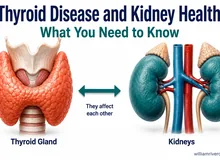
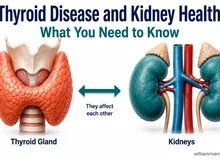
Use this interpreter when a CKD patient has a TSH result that needs clinical contextualization. TSH interpretation in CKD is complicated by several factors that do not apply to the general population: iodine retention, urinary TSH loss in nephrotic syndrome, euthyroid sick syndrome in hospitalized patients, and the blunted TRH response seen in advanced kidney disease.
Appropriate population
Adults with CKD G1–G5 or on dialysis who have a measured TSH result. Most useful when TSH is borderline (0.4–10 mIU/L), when there is clinical uncertainty about whether a low or mildly elevated TSH reflects true thyroid dysfunction or a non-thyroidal illness effect, and when deciding whether to proceed to Free T4 testing or initiate levothyroxine.
When NOT to rely on it alone
This tool does not replace Free T4 measurement, clinical examination, or full clinical judgment. TSH alone can be misleading in acute illness (euthyroid sick syndrome), immediately after amiodarone or iodinated contrast, and in central hypothyroidism (where TSH may be paradoxically low despite true hypothyroidism). Always interpret alongside Free T4 and the clinical picture.
Pearls & Pitfalls
Always check eGFR after starting levothyroxine
Treating hypothyroidism in CKD patients can improve eGFR by 5–10 mL/min/1.73 m² — enough to change CKD staging. Recheck serum creatinine and eGFR at 8–12 weeks after initiating or dose-adjusting levothyroxine. This improvement reflects reversal of the hemodynamic and metabolic effects of thyroid deficiency on the kidney.
Euthyroid sick syndrome is common in hospitalized CKD patients
Acute illness suppresses TSH and reduces T3 via non-thyroidal illness effect. TSH drawn during hospitalization — especially in ICU, post-operatively, or during sepsis — almost always needs to be repeated 4–6 weeks after recovery before thyroid dysfunction is diagnosed or treated. Initiating levothyroxine in the inpatient setting for a low TSH is almost never appropriate.
Pitfalls
(1) Do not treat subclinical hypothyroidism (TSH 4–10) in asymptomatic patients over 80 — the risk of over-replacement (atrial fibrillation, osteoporosis, falls) likely outweighs any benefit. (2) Start levothyroxine at low doses (25–50 mcg) in CKD G4–G5 and elderly patients — the half-life is prolonged and hyperthyroidism develops insidiously. (3) Nephrotic syndrome causes urinary loss of thyroxine-binding globulin, reducing total T4 and occasionally causing a low TSH artifact — always measure Free T4 alongside TSH in this population.
Why Use It
Hypothyroidism occurs in up to 21% of dialysis patients and approximately 10–15% of those with CKD G3–G5. Untreated hypothyroidism in CKD worsens dyslipidemia, hypertension, anemia, and fluid overload — and may reversibly reduce eGFR by 5–10 mL/min/1.73 m², meaning CKD may be incorrectly staged in hypothyroid patients. Conversely, over-treating subclinical hypothyroidism in elderly CKD patients risks atrial fibrillation, bone loss, and falls. Context-sensitive TSH interpretation is therefore essential and guideline-recommended.
TSH Interpreter for CKD
Enter the TSH value, CKD stage, and clinical context below. Press "Interpret TSH" to receive a guideline-informed interpretation and recommended next step.
Enter TSH value and clinical context. Receive an interpretation and recommended next step.
Next Steps
Use the result to support — not replace — clinical judgment.
- Interpret the value against the targets shown in the calculator and the Evidence section below, in the context of the full clinical picture.
- Trend serial measurements rather than acting on a single result; confirm abnormal or unexpected values before changing management.
- Apply the relevant KDIGO / specialty-guideline threshold and document the indication.
- Escalate or refer to nephrology when results are out of range, rapidly changing, or discordant with the clinical picture — and discuss the implications with the patient.
Evidence & References
Formula & Equations
| TSH Range (mIU/L) | Context Modifier | Output Category |
|---|---|---|
| Any value | Hospitalized / acutely ill | Euthyroid Sick Syndrome / Artifact — defer interpretation |
| <0.4 with nephrotic syndrome | Urinary TSH loss artifact | Euthyroid Sick Syndrome / Artifact — order Free T4, recheck after 4–6 weeks |
| >10 | Any | Overt Hypothyroidism — treat with levothyroxine |
| <0.4 | Any (non-acute) | Suppressed TSH — evaluate for hyperthyroidism (order Free T4 + Free T3) |
| 4–10 | Symptoms present | Subclinical Hypothyroidism — Symptomatic (consider treatment; use Decision Aid) |
| 4–10 | No symptoms | Subclinical Hypothyroidism — Asymptomatic (observe; recheck in 3 months) |
| 0.4–4.0 | Any | Normal TSH — continue annual monitoring per CKD stage |
The normal TSH reference range used is 0.4–4.0 mIU/L. Some assay upper limits of normal are 4.5–5.0 mIU/L; always compare against the reporting laboratory's own reference interval. In dialysis patients, mild TSH elevation (4–6 mIU/L) without symptoms may reflect a reset in the HPT axis rather than true hypothyroidism.
Evidence & References
Interpretation thresholds follow the ATA 2014 guidelines for hypothyroidism treatment and are adapted for the CKD population based on epidemiological and clinical studies documenting the high prevalence and unique confounders of thyroid dysfunction in kidney disease. The recommendation to treat TSH >10 mIU/L is consistent across major thyroid and nephrology guidelines.
- Jonklaas J, Bianco AC, Bauer AJ, et al. Guidelines for the treatment of hypothyroidism: prepared by the American Thyroid Association Task Force on Thyroid Hormone Replacement. Thyroid. 2014;24(12):1670–1751.
- Spahia N, Rroji M, Barbullushi M, et al. Thyroid dysfunction in chronic kidney disease — a review. Metab Syndr Relat Disord. 2023;21(5):256–263. PMID 37433213.
- Rhee CM, Kalantar-Zadeh K, Streja E, et al. The relationship between thyroid function and estimated glomerular filtration rate in patients with chronic kidney disease. Nephrol Dial Transplant. 2015;30(2):282–287.
- Lo JC, Chertow GM, Go AS, et al. Increased prevalence of subclinical and clinical hypothyroidism in persons with chronic kidney disease. Kidney Int. 2005;67(3):1047–1052.