- Select the patient's current CKD stage or dialysis/transplant status. For post-transplant patients, also select the time since transplantation — early (0–6 months), mid (7–12 months), or late (>12 months) post-transplant windows each carry different thyroid risk.
- Check any applicable additional risk factors: mTOR inhibitor or tacrolimus use, recent iodinated contrast (CT or angiography), female sex, type 2 diabetes, or autoimmune disease history.
- Click Get Screening Interval to receive the recommended TSH recheck interval — the tool takes the shortest interval across all applicable risk factors and explains each contributing reason.
- Record the interval and schedule the next TSH accordingly. If the TSH returns abnormal, switch to the TSH Interpreter tool for next steps.
All computation runs in your browser; no values are stored or transmitted.
When to Use
Use this tool at every CKD clinic visit when scheduling the patient's next TSH check. Thyroid dysfunction is underdiagnosed in CKD because screening is irregular and many nephrologists rely on general-population annual recommendations that are inadequate for higher-risk subgroups — particularly dialysis patients, transplant recipients on calcineurin inhibitors, and patients with multiple risk factors for thyroid disease.
Appropriate population
Adults with CKD G1–G5, on maintenance dialysis (hemodialysis or peritoneal dialysis), or post-kidney transplant who have a normal or previously managed TSH and need a next screening interval. Also applicable when starting a new medication known to affect thyroid function (mTOR inhibitors, tacrolimus) or after iodinated contrast exposure.
When NOT to use this tool alone
If the patient currently has an abnormal TSH, symptoms of thyroid dysfunction, or a known thyroid condition requiring active management, do not rely on a screening interval — use the TSH Interpreter or the Subclinical Hypothyroidism Decision Aid instead, and follow up as clinically indicated rather than by interval. This tool applies to patients with previously normal or stable thyroid status.
Pearls & Pitfalls
Screen at the first CKD visit and again at any stage transition
In addition to the interval returned by this tool, always check TSH at the initial diagnosis of CKD, whenever the patient advances to a new CKD stage (e.g., G3 to G4), when starting a new immunosuppressant (mTOR inhibitor, tacrolimus), and whenever unexplained anemia, bradycardia, fluid retention, or dyslipidemia worsens — all of which can represent thyroid dysfunction.
Iodinated contrast: recheck at 4–8 weeks
Iodinated contrast (CT, angiography, cardiac catheterization) causes transient TSH elevation in approximately 20–25% of CKD patients within 4–8 weeks due to iodine-induced thyroid dysfunction (Jod-Basedow or Wolf-Chaikoff effect). A TSH drawn within this window may be falsely elevated and should be repeated before initiating levothyroxine.
Pitfalls
(1) Do not rely on a once-yearly TSH for HD patients — the 21% prevalence and rapid disease change in this population warrant 6-monthly checks. (2) Post-transplant patients in the first 6 months need quarterly TSH because mTOR inhibitor de-novo thyroid disease peaks in months 3–6 post-initiation. (3) Symptoms are unreliable in CKD — fatigue, cold intolerance, and constipation are ubiquitous in kidney disease patients regardless of thyroid status. Serial TSH is a better guide to thyroid health than symptoms alone.
Why Use It
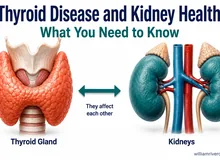
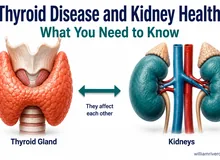
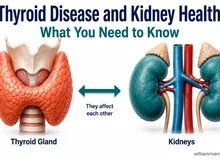
Hypothyroidism prevalence rises from approximately 3% in the general adult population to 7–15% in CKD G3–G5 and up to 21% in hemodialysis patients. Post-transplant patients on mTOR inhibitors (sirolimus, everolimus) have a particularly high incidence of de-novo thyroid dysfunction within the first 12 months, and calcineurin inhibitors (tacrolimus) independently alter thyroid hormone metabolism. Iodinated contrast causes transient TSH elevation in 20–25% of exposed patients. Systematically risk-stratifying the screening interval, rather than applying a uniform annual recommendation, ensures early detection without unnecessary testing.
Thyroid Screening Interval Recommender
Select the patient's CKD stage or dialysis modality and check any applicable risk factors, then click "Get Screening Interval" to receive the recommended TSH recheck interval in months with full rationale.
Calculates the recommended TSH recheck interval based on clinical profile.
Next Steps
Use the result to support — not replace — clinical judgment.
- Interpret the value against the targets shown in the calculator and the Evidence section below, in the context of the full clinical picture.
- Trend serial measurements rather than acting on a single result; confirm abnormal or unexpected values before changing management.
- Apply the relevant KDIGO / specialty-guideline threshold and document the indication.
- Escalate or refer to nephrology when results are out of range, rapidly changing, or discordant with the clinical picture — and discuss the implications with the patient.
Evidence & References
Formula & Equations
The tool selects the shortest applicable interval across all risk factors. The table below shows all base and modifier intervals.
| CKD Status / Risk Factor | Recommended Interval | Rationale |
|---|---|---|
| CKD G1–G3 (no additional risk factors) | 12 months | Annual screening — prevalence ~7%; low individual risk |
| CKD G4–G5 (pre-dialysis) | 6 months | Elevated prevalence, faster disease progression |
| Hemodialysis | 6 months | ~21% hypothyroidism prevalence; iodine retention |
| Peritoneal dialysis | 12 months | Lower iodine retention vs HD; annual screening sufficient |
| Post-transplant 0–6 months | 3 months | High-risk window; immunosuppression-induced thyroid changes most common early |
| Post-transplant 7–12 months | 6 months | Stabilization phase; continued mTOR/calcineurin monitoring |
| Post-transplant >12 months | 12 months | Annual monitoring once stable |
| On mTOR inhibitor or tacrolimus | 3 months | Drug-induced thyroid dysfunction risk; recheck 3 months after initiation |
| Recent iodinated contrast (<3 months) | 2 months | Iodine-induced thyroid changes peak at 4–8 weeks post-exposure |
| Autoimmune disease (Hashimoto's, lupus, RA) | 6 months | Higher thyroid autoimmunity prevalence and progression rate |
| Female + Type 2 diabetes | 6 months | Combined female sex and T2DM are dual independent risk factors for thyroid disease in CKD |
Evidence & References
Screening interval recommendations are synthesized from AACE/ATA clinical practice guidelines for hypothyroidism, nephrology-specific epidemiological studies documenting the CKD-stage-dependent prevalence of thyroid dysfunction, and pharmacological data on immunosuppressant-associated thyroid disease in transplant recipients. No single randomized trial directly addresses optimal TSH screening intervals in CKD; recommendations reflect expert consensus adapted from high-prevalence group data.
- Garber JR, Cobin RH, Gharib H, et al. Clinical Practice Guidelines for Hypothyroidism in Adults: AACE/ATA. Endocr Pract. 2012;18(6):988–1028.
- Rhee CM, Kalantar-Zadeh K, Streja E, et al. The relationship between thyroid function and estimated glomerular filtration rate in patients with chronic kidney disease. Nephrol Dial Transplant. 2015;30(2):282–287.
- Kala A, Haugen EN, Chandra SM, et al. Thyroid dysfunction in kidney transplant recipients: prevalence, risk factors, and outcomes. Clin Transplant. 2019;33(8):e13664.
- Spahia N, Rroji M, Barbullushi M, et al. Thyroid dysfunction in chronic kidney disease — a review. Metab Syndr Relat Disord. 2023;21(5):256–263. PMID 37433213.