- Enter the patient's baseline serum creatinine and current serum creatinine (mg/dL). The tool computes the SCr ratio (current ÷ baseline).
- Enter the urine output (mL/kg/h) and select the duration over which that rate was sustained.
- Check the boxes if there is complete loss of kidney function >4 weeks (Loss) or end-stage kidney disease >3 months (ESKD).
- The RIFLE class is assigned by the worst criterion met across the creatinine/GFR and urine output axes; Loss and ESKD outrank Failure.
All computation runs in your browser; no values are stored or transmitted.
When to Use
Use the RIFLE criteria to classify the severity of acute kidney injury in adult patients using the ADQI consensus categories — Risk, Injury, Failure, Loss, and End-Stage Kidney Disease. The class is determined by the worst of either the serum creatinine / GFR change criterion or the urine output criterion over a defined time window.
Appropriate population
Adults with suspected or established AKI in whom a known baseline creatinine is available and serum creatinine has been trended. Useful for severity grading, prognostication, cohort comparison, and research. The urine output criterion requires accurate, weight-based, timed urine measurement (ideally a urinary catheter).
Caveats & when not to rely on it
RIFLE has been largely superseded by KDIGO (and earlier AKIN) staging for routine clinical use — for contemporary staging prefer the AKI Staging (KDIGO) tool. RIFLE requires a known baseline creatinine; when baseline is unknown it must be estimated (e.g., back-calculated from an assumed GFR), which introduces error. The urine output criterion requires patient weight and accurate timed measurement, and is confounded by diuretics and volume status.
Pearls & Pitfalls
Use the worst of two axes
RIFLE class is whichever is more severe between the creatinine/GFR criterion and the urine output criterion. A patient with only a ×1.5 creatinine rise (Risk) but <0.3 mL/kg/h urine output for ≥24 h is in Failure. Always evaluate both axes — oliguria can identify severe AKI before creatinine has risen.
Failure has an alternate creatinine path
Besides a ×3 creatinine rise (or GFR fall >75%), the Failure class is also met by an absolute serum creatinine ≥ 4.0 mg/dL with an acute rise of ≥ 0.5 mg/dL. This captures patients with reduced baseline GFR who acutely worsen but whose ratio does not reach 3.0.
Pitfalls
(1) Loss and ESKD are outcome categories, not acute severity grades — Loss = persistent complete loss of function >4 weeks; ESKD = >3 months. They outrank Failure. (2) An unknown baseline creatinine inflates or deflates the ratio. (3) Urine output criteria are unreliable without accurate weight, timing, and catheter drainage, and are confounded by diuretics. (4) Creatinine lags injury by 24–48 h, so early severe AKI may be under-classified by the creatinine axis alone.
Why Use It
Before RIFLE, more than 30 different definitions of acute renal failure were in use, making studies impossible to compare and bedside communication imprecise. The 2004 ADQI RIFLE consensus introduced the first widely adopted, graded definition of AKI — combining serum creatinine/GFR change with urine output and adding outcome categories (Loss, ESKD). It demonstrated that even the mildest stage (Risk) carries increased mortality, and that risk rises monotonically through Injury and Failure. RIFLE laid the groundwork for the AKIN and KDIGO staging systems that followed, and it remains valuable for historical comparison, research, and as a conceptual framework for severity-graded AKI.
RIFLE Criteria — Acute Kidney Injury Classification
Enter the baseline and current creatinine, the urine output and its duration, and check the Loss / ESKD boxes if applicable. The SCr ratio, RIFLE class, and the criterion that drove it update automatically.
Outcome Categories (check if present)
⚕ Bellomo R, et al. (ADQI). Crit Care. 2004;8(4):R204–R212. RIFLE class is assigned by the worst of the creatinine/GFR or urine output criterion; Loss and ESKD are outcome categories that outrank Failure. KDIGO has largely superseded RIFLE for contemporary staging. For licensed clinicians; does not replace individualized assessment.
Next Steps
Use the RIFLE class to guide workup intensity and escalation.
- For No AKI by RIFLE: continue to trend creatinine and urine output; address reversible factors (volume, nephrotoxins, obstruction) if clinically suspected.
- For Risk: stop nephrotoxins, optimize volume status and perfusion, review medications and dosing, and recheck creatinine; even Risk-class AKI carries increased mortality.
- For Injury: pursue a structured AKI workup (pre-renal vs intrinsic vs post-renal), obtain urinalysis and renal ultrasound, and consider nephrology input.
- For Failure: nephrology consultation; assess for indications for renal replacement therapy (refractory hyperkalemia, acidosis, fluid overload, uremia); intensive monitoring.
- For Loss / ESKD: these are outcome categories — coordinate long-term renal replacement therapy planning, vascular access, and transplant evaluation as appropriate.
- Restage as creatinine and urine output evolve, and consider re-grading with the contemporary KDIGO system.
Evidence & References
RIFLE Classification
| Class | Serum creatinine / GFR | Urine output |
|---|---|---|
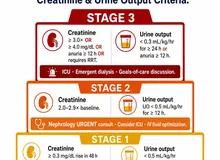
| Risk | SCr ×1.5 baseline, or GFR ↓ > 25% | < 0.5 mL/kg/h for ≥ 6 h |
| Injury | SCr ×2 baseline, or GFR ↓ > 50% | < 0.5 mL/kg/h for ≥ 12 h |
| Failure | SCr ×3 baseline, or GFR ↓ > 75%, or SCr ≥ 4.0 mg/dL with acute rise ≥ 0.5 mg/dL | < 0.3 mL/kg/h for ≥ 24 h, or anuria ≥ 12 h |
| Loss | Persistent complete loss of kidney function > 4 weeks | |
| ESKD | End-stage kidney disease > 3 months | |
Class is assigned by the worst of the creatinine/GFR and urine output criteria. Loss and ESKD are outcome categories and outrank Failure. GFR = glomerular filtration rate; SCr = serum creatinine.
References
- Bellomo R, Ronco C, Kellum JA, Mehta RL, Palevsky P; Acute Dialysis Quality Initiative workgroup. Acute renal failure – definition, outcome measures, animal models, fluid therapy and information technology needs: the Second International Consensus Conference of the Acute Dialysis Quality Initiative (ADQI) Group. Crit Care. 2004;8(4):R204–R212. doi:10.1186/cc2872.
- Kidney Disease: Improving Global Outcomes (KDIGO) AKI Work Group. KDIGO Clinical Practice Guideline for Acute Kidney Injury. Kidney Int Suppl. 2012;2(1):1–138.