CKD anemia content reviewed November 27, 2026 against KDIGO 2026. Iron eligibility uses the same rules as the TSAT & ferritin calculator; the iron deficit uses the same Ganzoni equation as the IV iron deficit calculator.
- Select the setting and, if available, ferritin and TSAT. The calculator checks KDIGO 2026 iron criteria first.
- Estimate the iron deficit with the Ganzoni equation, or enter a known deficit in mg.
- Choose the oral preparation (including Sideral Forte, Pelamis and Ferolip). Elemental iron per unit and the usual regimen fill in automatically; edit them to match the label and your prescription.
- Read the estimated absorbed iron per day, the time needed to cover the deficit, the units for the course, and the comparison across preparations. Example: 60 kg, Hb 8→11 g/dL, 500 mg storage (932 mg) on ferrous sulfate 65 mg three times daily, typical absorption: about 66 days.
When to use
Use after iron therapy has been judged appropriate, when oral iron is being considered or is already prescribed. The tool turns an iron deficit into a realistic oral course for a chosen preparation, and shows how long each preparation would take at its usual regimen.
- Adults with non-dialysis CKD (including G3b–G5), peritoneal dialysis, or a kidney transplant, and confirmed iron deficiency.
- In hemodialysis, KDIGO 2026 suggests IV rather than oral iron; the tool still runs for individual exceptions but flags the setting.
- Not for children, for deciding eligibility on its own, or for maintenance after stores are replete.
Interpretation and limitations
- Elemental iron, not salt weight: 325 mg ferrous sulfate can mean 65 mg (heptahydrate) or about 105 mg (dried) elemental iron. Ferrous fumarate is about 33% iron; gluconate about 12%. Always convert from the label.
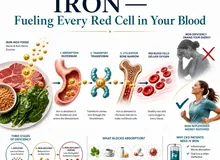
- Absorption is the real limit: only a fraction of each dose reaches the blood. All absorbed iron, heme or non-heme, leaves the gut cell through ferroportin, which hepcidin blocks. Inflammation and advanced CKD raise hepcidin, so no oral preparation fully escapes it.
- More is not proportionally better: a sixfold higher dose gave less than a threefold rise in absorbed iron, and a second dose the same day added little (Moretti 2015; Stoffel 2017). The calculator applies this dose response.
- Alternate-day dosing: each dose is absorbed about a third better and side effects are fewer, but fewer doses are taken, so the course takes longer. KDIGO 2026 lists the comparison as a research question.
- Absorption figures are planning assumptions: only ferrous salts have a CKD anchor (10–15%, as across this site). Values for polymaltose, sucrosomial, liposomal and heme iron are low-certainty estimates; edit them with “Custom” when you have better information.
- Ongoing losses: hemodialysis blood losses, menstrual, or gastrointestinal bleeding can exceed what oral iron can absorb. Enter them to see whether oral iron can keep pace.
Why use it
KDIGO 2026 lets the route outside hemodialysis follow severity, preference, tolerance, availability and cost, and asks clinicians to switch to IV iron if an optimal oral regimen has not worked after 1–3 months. That window only makes sense if the oral regimen could plausibly refill the deficit in that time. A typical adult deficit of 900–1,000 mg needs about 10–15 mg of absorbed iron a day to be covered in 3 months; at 10–15% absorption that means close to 200 mg of elemental iron a day, which is why KDIGO cites about 200 mg daily for conventional salts.
Low-dose products such as 30 mg sucrosomial or liposomal iron are better tolerated but deliver far less iron. In the CKD trial of 30 mg sucrosomial iron daily, hemoglobin rose, but iron stores refilled less than with IV iron and hemoglobin fell back after stopping (Pisani 2015). Seeing the expected time for each preparation side by side makes that trade-off explicit before the prescription is written.
Oral Iron Replacement Planner
Check eligibility, size the iron deficit, then plan an oral course for the chosen preparation.
1 · Eligibility (KDIGO 2026)
2 · Iron deficit
3 · Preparation and regimen
Deficit (mg) = weight (kg) × (target − actual Hb, g/dL) × 2.4 + storage iron (mg), as in the Ganzoni calculator. Absorbed iron per day = fractional absorption × elemental iron for daily totals up to 65 mg; above that, absorption rises with (daily iron ÷ 65)0.55, and a second dose the same day adds no extra absorption. Alternate-day dosing multiplies fractional absorption per dose by 1.34. Time = deficit ÷ (absorbed iron per day − ongoing losses). These are planning estimates, not measured absorption.
Next steps
- Prescribe in elemental iron and state it on the prescription (for example, “ferrous sulfate 325 mg [65 mg elemental iron], 1 tablet 3 times daily”).
- Take conventional salts between meals with water or a vitamin C source such as calamansi; separate from calcium, phosphate binders, antacids, proton pump inhibitors, tea and coffee by about 2 hours. Separate from levothyroxine, tetracyclines and fluoroquinolones as their labels direct.
- Recheck Hb, ferritin and TSAT. KDIGO 2026 advises every 3 months in non-dialysis CKD and PD, and every 1–3 months in HD, sooner if clinically indicated.
- Switch to IV iron if an optimal oral regimen has not worked after 1–3 months or is not tolerated (KDIGO 2026). Size the IV course with the Ganzoni IV iron calculator and review it with the IV iron start / continue / withhold tool.
- If Hb does not respond despite adequate iron, look for bleeding, inflammation and other causes, and assess ESA hyporesponsiveness (ERI calculator).
Evidence and clinical rules
| Population / decision | KDIGO 2026 guidance |
|---|---|
| Anemia + hemodialysis (HD): initiate iron | Ferritin ≤500 ng/mL and TSAT ≤30%. IV iron is suggested over oral iron (recommendation 2.2). |
| Anemia + non-dialysis CKD or peritoneal dialysis (PD): initiate iron | Ferritin <100 ng/mL and TSAT <40%, or ferritin ≥100 and <300 ng/mL and TSAT <25%. Oral or IV by values, preferences, severity, efficacy, tolerability, availability and cost (recommendation 2.4). |
| Choice of oral formulation | Guided by cost, preference, tolerability and efficacy (practice point 2.3). Conventional salts are typically prescribed to give about 200 mg elemental iron a day. |
| Switch oral to IV | If an optimal oral regimen is ineffective after 1–3 months or poorly tolerated (practice point 2.7). |
| Withhold routine iron | Ferritin >700 ng/mL or TSAT ≥40%. An elevated ferritin alone does not diagnose iron overload. |
| Systemic infection | Consider temporarily suspending iron (practice point 2.8). |
| Monitoring during iron treatment | Hb, ferritin, TSAT every 3 months in non-dialysis CKD/PD; every 1–3 months in HD (practice point 2.5). |
Oral preparations and the absorption assumptions used
| Group | Elemental iron (usual regimen) | Absorption per ~65 mg dose: reduced / typical / favorable | Basis and certainty |
|---|---|---|---|
| Ferrous salts (sulfate, fumarate, gluconate; bisglycinate planned the same) | Sulfate 325 mg = 65 mg (heptahydrate) or ~105 mg (dried); fumarate 325 mg = 106 mg; gluconate 300 mg = 35 mg (KDIGO 2026 Table 3) | 5% / 12% / 15% | Site-wide CKD figure of 10–15%, lower with inflammation. Moderate certainty for the direction, low for the exact value. |
| Iron polymaltose complex | 100 mg once or twice daily | 4% / 10% / 12% | Isotope studies in non-CKD adults: similar to ferrous salts at 100 mg, slightly lower at 50 mg (Jacobs 1984). No CKD absorption data. Low certainty. |
| Sucrosomial, liposomal or microencapsulated iron pyrophosphate (Sideral Forte, Pelamis, Ferolip) | 30 mg once daily (KDIGO 2026 Table 3; Pisani 2015) | 6% / 15% / 20% | Better tolerated; raised Hb in a CKD trial but refilled stores less than IV iron (Pisani 2015). With other 30 mg pyrophosphate capsules in non-dialysis CKD, Hb rose about a third as much as with IV iron sucrose (Bengelloun Zahr 2024), and in a 6-month single-arm study TSAT improved while ferritin and Hb did not change (Cesarano 2024). Claims of higher bioavailability lack CKD isotope data. Very low certainty. |
| Heme iron polypeptide | 12 mg 3–4 times daily (KDIGO 2026 Table 3) | 8% / 15% / 25% | Separate heme uptake pathway, but export still depends on ferroportin. Maintained Hb like IV iron over 6 months in non-dialysis CKD with lower ferritin (Nagaraju 2013). Very low certainty. |
| Dose and schedule | — | Daily totals above 65 mg: absorbed iron ∝ dose0.55; alternate days ×1.34 per dose | Stable-isotope trials in iron-depleted women (Moretti 2015; Stoffel 2017), cited by KDIGO 2026. Not tested in CKD. |
Ferric citrate and ferric maltol appear in KDIGO 2026 Table 3 but were not found in the FDA Philippines registry and are not listed. For ESA decisions, the adult maintenance Hb goal is below 11.5 g/dL (115 g/L); see the ESA dose calculator.
Source: KDIGO 2026 Anemia in CKD, recommendations 2.1–2.4, practice points 2.3, 2.5, 2.7 and 2.8, Tables 2 and 3. Product strengths from the FDA Philippines registry as held in the site’s drug index (Dosis). Reviewed November 27, 2026. Apply clinical judgment and the locally approved product label.