Emergency features override every result on this page
Hypoxemia or suspected alveolar hemorrhage (even without hemoptysis), pulmonary edema, hypertensive emergency, severe hyperkalemia or acidosis, uremic complications, or near-anuria with deterioration need emergency care and immediate nephrology involvement now. A rapidly rising creatinine with glomerular sediment needs same-day nephrology assessment. No field on this page has to be completed before you act, and no output here means it is safe to wait.
- Lab trajectory: choose the creatinine unit, enter a reference (baseline) value with its date and time, then each creatinine with its collection time. Proteinuria goes in its own table — one series per analyte and specimen type. Red flags default to “Unknown.”
- AKRiS: for biopsy-proven renal ANCA-associated vasculitis at presentation, enter creatinine at presentation, percent normal glomeruli (or counts), and interstitial fibrosis and tubular atrophy (IFTA).
- LN response: for biopsy-classified, treated lupus nephritis, enter baseline and follow-up proteinuria from the same method and a kidney-function measure at both times.
- PSGN follow-up: choose the documented anchor date for typical pediatric post-streptococcal glomerulonephritis under clinician care.
All computation runs in your browser. Nothing is stored, sent, or placed in the address bar. Do not enter names, hospital numbers, or free text about the patient; the copy button copies only the de-identified summary, and only when you press it.
When to Use
Use these tools alongside the work-up in Nephritic Syndrome: Recognize It, Act Fast, Find the Cause. The trajectory tool organizes serial results for a referral or handoff; AKRiS gives group-level prognosis after a biopsy; the lupus nephritis tracker summarizes response after treatment has started; the PSGN helper records a follow-up date.
What these tools do not do
None of them estimates the probability of glomerulonephritis, decides urgency, selects immunosuppression, plasma exchange or dialysis, or predicts an individual’s benefit from treatment. Negative microscopy or serology never makes a patient “safe.” Steady-state eGFR is not estimated during acute kidney injury (AKI), and eGFR decline is never used as an urgency gate.
Nephritic Lab Trajectory & Referral Snapshot
Plots serial creatinine against a reference value with elapsed time, absolute and percent change, and the ratio to reference, then checks the KDIGO 2012 creatinine criteria with their time windows (≥0.3 mg/dL within 48 hours; ≥1.5 times a reference known or presumed to be within the prior 7 days). The 2026 KDIGO AKI/AKD update was a public-review draft at the time of writing and is not applied.
Red flags (default Unknown — answer only what you know)
Creatinine
| Collected (date, time) | Creatinine |
|---|
Urine output (optional)
Proteinuria series
| Collected | Analyte / specimen | Value | Unit |
|---|
Pending tests
⚕ Change = current − reference; percent change = 100 × (current − reference) ÷ reference; ratio = current ÷ reference, at full precision. Only the creatinine criterion is staged; urine output is reported separately and the higher stage applies. This is a timeline and handoff aid, not an urgency score.
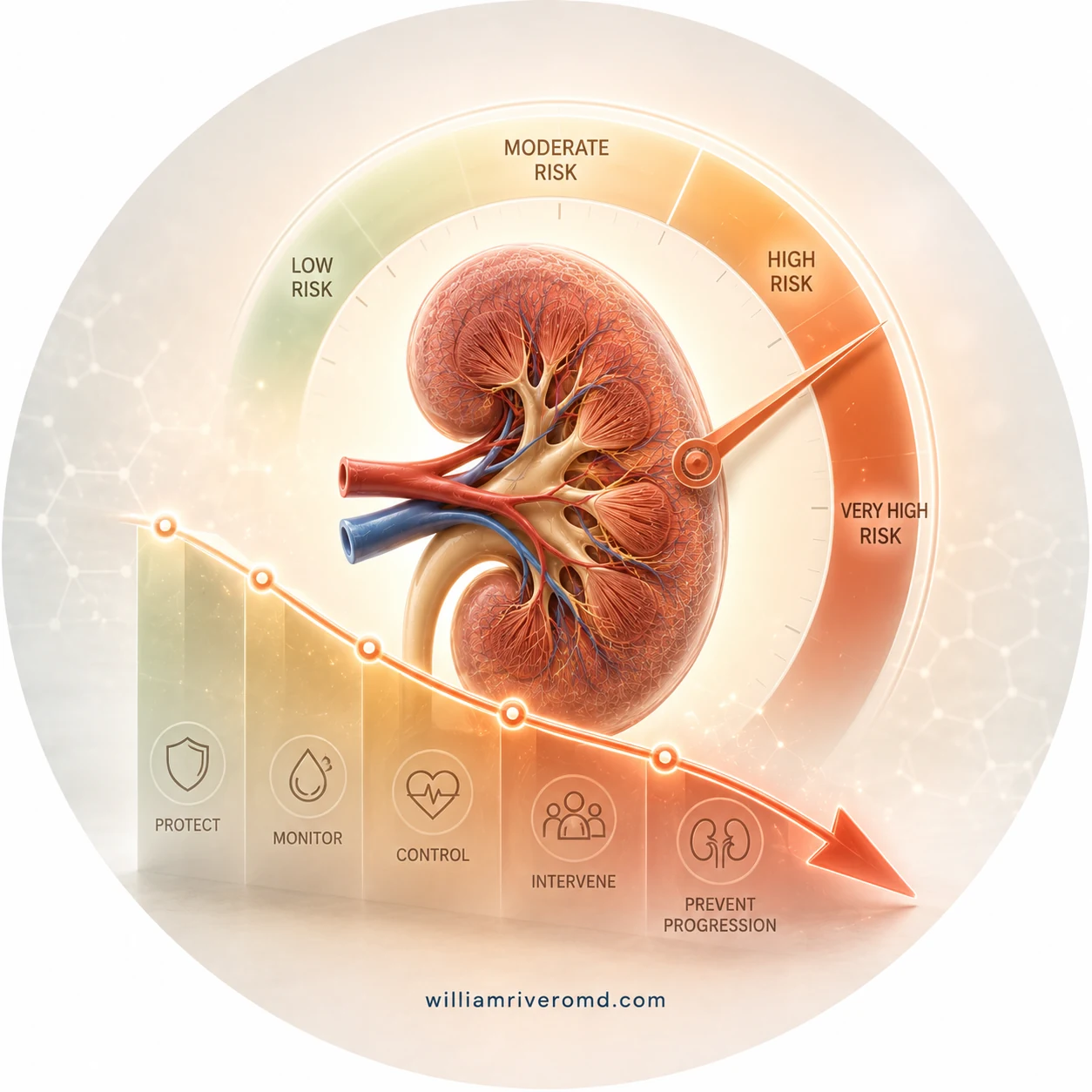
ANCA Kidney Risk Score (AKRiS, 2024)
The 2024 revision of the ANCA renal risk score (Bate et al.) replaced eGFR with serum creatinine, reweighted the percentage of normal glomeruli and IFTA, and added a fourth risk group. It applies to biopsy-proven renal ANCA-associated vasculitis at presentation. The original 2018 score lives on its own page; do not mix inputs between versions.
⚕ Points: creatinine <250 / 250–450 / >450 µmol/L → 0 / 4 / 11; normal glomeruli >25% / 10–25% / <10% → 0 / 4 / 7; IFTA <25% / ≥25% → 0 / 3. Groups: low 0–4, moderate 5–11, high 12–18, very high 21. The score is prognostic at group level; it cannot select dialysis, plasma exchange, or immunosuppression, or give an individual probability.
Lupus Nephritis Response Tracker
For biopsy-classified lupus nephritis after treatment has started. Shows proteinuria reduction and kidney-function change, then compares them with the commonly used clinical-trial response definitions in KDIGO 2024 (Figure 11). It does not diagnose a flare, assess histologic remission, or suggest a dose change.
⚕ Reduction = 100 × (baseline − follow-up) ÷ baseline. KDIGO 2024 Figure 11 (trial definitions): complete — proteinuria <0.5 g/g as PCR from a 24-hour urine and stable or improved kidney function (within 10–15% of baseline), usually assessed 6–12 months after starting therapy (can take longer); partial — ≥50% reduction and to <3 g/g, with stable or improved kidney function. Status is shown at both 10% and 15% tolerance for the clinician to adjudicate. REGENCY and ACR definitions differ and are not interchangeable.
PSGN 8-Week Follow-up Date
For typical pediatric post-streptococcal glomerulonephritis (PSGN) under clinician care, the Royal Children’s Hospital pathway rechecks C3 and kidney function at about 8 weeks. This helper records that date from a documented anchor. It is not a risk estimate and sends no reminders.
⚕ Recheck date = anchor + 56 calendar days. Interim blood pressure and urine checks are scheduled by the clinician. Rising creatinine, persistent hypertension, nephrotic-range proteinuria, an atypical course, or C3 still low at 8 weeks overrides the routine date and prompts reassessment, including biopsy consideration.
Formulae & Evidence
Formulae
| Quantity | Equation |
|---|---|
| Creatinine conversion | µmol/L = mg/dL × 88.4 |
| Change from reference | Δ = current − reference; %Δ = 100 × Δ ÷ reference; ratio = current ÷ reference |
| KDIGO creatinine criteria | Stage 1: ≥0.3 mg/dL (≥26.5 µmol/L) within 48 h, or 1.5–1.9 × reference within 7 days · Stage 2: 2.0–2.9 × · Stage 3: ≥3.0 ×, or rise to ≥4.0 mg/dL (≥353.6 µmol/L) |
| KDIGO urine output criteria | <0.5 mL/kg/h for 6–12 h (stage 1), ≥12 h (stage 2); <0.3 mL/kg/h ≥24 h or anuria ≥12 h (stage 3) |
| Same-analyte unit conversion | mg/g = mg/mmol × 8.84; g/g × 1000 = mg/g |
| LN proteinuria reduction | 100 × (baseline − follow-up) ÷ baseline |
| PSGN recheck | Anchor + 56 days |
Key numbers
- AKRiS development cohort (n = 959): 3-year kidney survival 96%, 79%, 54%, and 19% across low, moderate, high, and very high groups; C statistic 0.831 (validation 0.821, n = 480) (Bate et al., 2024).
- Urine microscopy: acanthocytes and/or red blood cell casts had 75% sensitivity and 86% specificity for glomerulonephritis in a biopsy-linked cohort — not a rule-out test, so it is not used in any calculation here (Stark et al., 2025).