WHO ICD-10 Lookup — 10,469 Codes
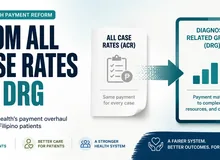
PhilHealth's DRG payment model groups admissions by ICD-10 diagnosis and procedure codes — the same WHO classification that underpins death certificates and most national disease registries. This tool searches the full WHO ICD-10 dataset that the Philippine DRG grouper is built on. Use Single search for a single term (a code prefix like N18, an abbreviation like CKD, or any keyword) or Batch mode to paste several diagnoses at once and get the top ranked candidates for each line. American spellings (anemia, edema, hemodialysis) and common abbreviations (CKD, ESRD, HF, MI, HTN, DM) are auto-translated to the British/WHO vocabulary the dataset uses.
⚕ The peso figures, codes, and rankings shown here are educational aids drawn from the WHO ICD-10 classification (10,469 codes). They are not a substitute for the official ICD-10-PH localization, your hospital's coding policies, or PhilHealth's authoritative DRG case-mix tables. Always confirm final coding against current ICD-10-PH guidance before claim submission. Source: WHO ICD-10 (International Classification of Diseases, 10th Revision).
How to Use This Tool
Two search modes, one shared dataset.
- Single search — type a single term and the result table filters live as you type. Useful for: looking up the canonical title of a specific code (
N18.6), finding all codes in a range (N18→ CKD family), or scanning by keyword (hyperkalemia →E87.5). - Batch mode — paste a list of diagnoses (one per line, or semicolon-separated, up to 30 at a time) and the tool returns the top 8 ranked candidate codes per line. Useful for prepping a discharge summary or auditing a case post-hoc.
- Spelling & abbreviation translation. WHO ICD-10 uses British medical spellings (anaemia, oedema, haemodialysis) and older terminology (chronic renal failure rather than chronic kidney disease). The widget translates American spellings and common abbreviations (CKD, ESRD, HF, MI, HTN, DM, HD, AKI, COPD, CHF, …) so a clinician's natural input matches the dataset's vocabulary.
- Ranking, in batch mode. Each candidate is scored on exact-match (highest), prefix match, normalized-phrase match, and token-AND coverage of the query — results are sorted so the most specific matches surface first.
About the Dataset & Limitations
What this is. A locally-hosted, English-only WHO ICD-10 dataset (10,469 codes, ~700 KB) covering all 21 ICD-10 chapters, lazy-loaded on first interaction so it does not slow page load. Search runs entirely in the browser — no codes leave your device.
What this is not. This is the WHO ICD-10 base classification, not the Philippine clinical modification (ICD-10-PH). It does not include:
- PhilHealth-specific code additions, exclusions, or grouping logic;
- the full case-mix grouper's combinatorial logic for major / minor complications;
- the granular sub-codes present in ICD-10-CM (the US clinical modification, ~70,000 codes) — the WHO base has roughly 10K codes and is the international foundation most national systems adapt;
- procedure codes from ICD-10-PCS, CPT, or local procedure code sets — only the diagnostic ICD-10 classification.
How to use it responsibly. This is a teaching reference for clinicians to practice the documentation-and-coding workflow that PhilHealth's DRG migration will reward. Final coding for live claims must always be confirmed against your hospital's official ICD-10-PH list and PhilHealth's current circulars.
For the policy context behind why honest clinical coding matters under DRG, see the companion guide: From All Case Rates to DRG — A Nephrologist's Perspective.