- Albumin trend: enter the switch date, then each predialysis albumin with its date, unit, assay and any flag. Rows before the switch form the baseline (median); rows after it are compared against that baseline.
- Budget & break-even: enter annual eligible sessions, the share you expect to switch, dialyzer prices in pesos, and any other incremental costs or reimbursement. All inputs are your own local quotes.
- β2M reduction ratio: enter paired pre- and post-session β2-microglobulin from the same assay; add pre/post weights to apply the extracellular-volume correction.
- HDF convection: choose the dilution mode and enter substitution plus net ultrafiltration, or a machine-reported total.
All computation runs in your browser; no values are stored or transmitted. Use synthetic or de-identified values when teaching.
When to Use
Use these tools when a unit is running or planning a selective expanded hemodialysis (HDx) pilot with medium cut-off (MCO) dialyzers, comparing it with high-volume online hemodiafiltration (HDF), or auditing delivered convection. They support the workflow in Expanded Hemodialysis (HDx).
What these tools do not do
None of them predicts survival, hospitalization or symptom benefit, or chooses a membrane. No validated HDx benefit score exists. Serum albumin and catalog sieving coefficients cannot estimate dialysate albumin loss; that needs measured effluent. Never import hospitalization savings from observational studies into the budget model.
Albumin Trend After a Dialyzer Switch
Follows the change in predialysis serum albumin concentration relative to a pre-switch baseline. Pooled trials show an average dip of about 0.1 g/dL in the first 24 weeks with MCO membranes, recovering thereafter; larger or persistent falls warrant a search for other causes.
| Date | Albumin | Unit | Phase | Assay | Flag |
|---|
⚕ Baseline = median of comparable pre-switch values. Change = current − baseline; percent change = 100 × (current − baseline) ÷ baseline. Values in g/L are divided by 10. Albumin concentration reflects synthesis, inflammation, dilution, intake and losses — this tool estimates concentration change only; interpretation belongs to the clinician and the unit's review pathway.
HDx Budget Impact and Break-even Price
Clinic perspective, one currency per scenario (Philippine peso by default). Separates clinic cost from payer reimbursement and patient charges. Enter only locally sourced, dated quotes.
⚕ N = sessions × adoption. Gross annual cost = N × (HDx price − comparator price + other variable cost) + fixed cost. Net clinic impact = gross − N × incremental reimbursement. Break-even HDx price = comparator price − other variable cost + incremental reimbursement − fixed cost ÷ N (N > 0). Negative impact = modeled saving. Hospitalization or survival effects are deliberately excluded.
β2-Microglobulin Reduction Ratio
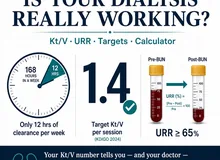
Session reduction ratio for paired pre- and post-dialysis β2-microglobulin (β2M) from the same assay and session, with optional correction of the post-dialysis value for extracellular-volume contraction (Bergström formula, extracellular volume ≈ 20% of post-dialysis weight).
⚕ RR% = 100 × (1 − Cpost ÷ Cpre). Corrected Cpost = Cpost ÷ [1 + (Wpre − Wpost) ÷ (0.2 × Wpost)]. A reduction ratio is a concentration change over one session; it is not clearance, mass removed or an adequacy target, and it ignores post-dialysis rebound.
HDF Delivered Convection Audit
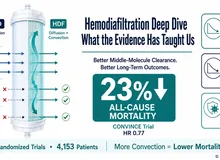
Total convection volume for a post-dilution online HDF session, compared with the ≥ 23 L/session eligibility threshold and 25.3 L mean delivered volume in the CONVINCE trial.
⚕ Total convection = delivered substitution + net ultrafiltration (same session, same machine definitions). The CONVINCE benchmark applies to post-dilution HDF in its studied population; pre- and mixed-dilution volumes are not comparable. Volume says nothing about HDx, access adequacy or filtration fraction — see the TMP & filtration fraction calculator.
Formulae & Evidence
Formulae
| Quantity | Equation |
|---|---|
| Albumin change | Δ = current − median(pre-switch); %Δ = 100 × Δ ÷ baseline |
| Switched sessions | N = eligible sessions × adoption fraction |
| Gross annual cost | N × (PHDx − Pcomp + Cvar) + Cfixed |
| Break-even HDx price | Pcomp − Cvar + R − Cfixed ÷ N |
| β2M reduction ratio | 100 × (1 − Cpost ÷ Cpre) |
| Volume-corrected Cpost | Cpost ÷ [1 + ΔW ÷ (0.2 × Wpost)] |
| HDF convection | Substitution volume + net UF (post-dilution) |
Key numbers
- MCO vs high-flux: dialysate albumin +2.31 g/session; predialysis albumin −0.12 g/dL in the first 24 weeks, −0.02 g/dL thereafter (Kandi et al., 2022).
- CONVINCE: participants able to reach ≥ 23 L/session; mean delivered 25.3 L; all-cause death HR 0.77 (Blankestijn et al., 2023).
- FRENCHIE post hoc analysis: post-dilution HDF median 23.2 L/session; β2M reduction ratio 69.6% vs 58.7% with high-flux HD, using Bergström-corrected post values (Canaud et al., 2025).