- Entry criterion: ≥1 episode of swelling, pain, or tenderness in a peripheral joint or bursa must be present.
- Sufficient criterion: If monosodium urate (MSU) crystals are identified in synovial fluid, tophus, or aspirate → classify as gout immediately (no scoring needed). Select this in Domain 6 below.
- If sufficient criterion not met → complete all domains below. Score ≥8 = classified as gout.
All computation runs in your browser; no values are stored or transmitted.
When to Use
Use this tool when evaluating a patient with suspected gout — particularly when crystal analysis is unavailable or not feasible. The 2015 ACR/EULAR criteria were designed for classification (research/epidemiological) but are widely applied for diagnostic decision support.
Appropriate population
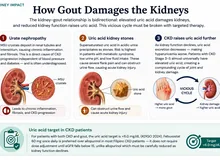
Adults presenting with acute arthritis of a peripheral joint or bursa. Especially useful in CKD patients — hyperuricemia is common in CKD, gout attacks may be more frequent and present atypically, and serum urate interpretation requires knowledge of renal function. Also useful to distinguish gout from pseudogout (CPPD), septic arthritis, reactive arthritis, or psoriatic arthritis.
When NOT to rely on it alone
These are classification criteria, not diagnostic criteria. When joint aspiration is feasible, polarized light microscopy for MSU crystals remains the gold standard. A score ≥8 supports gout but does not replace clinical judgment. Do not use in patients already confirmed to have another diagnosis that fully explains their presentation.
Pearls & Pitfalls
Serum urate timing matters
Serum urate may be normal or low during an acute gout attack due to the acute-phase response (urate redistribution). Ideally measure serum urate when the patient is not actively flaring, or at least 2 weeks after flare resolution. A low urate during a flare can falsely reduce the score — if clinically suspicious, retest during the intercritical period.
CKD-specific considerations
In CKD, urate-lowering therapy (allopurinol, febuxostat) requires dose adjustment based on eGFR. Allopurinol should be started at low doses (50–100 mg/day) and titrated slowly in CKD. Probenecid is generally ineffective when eGFR <30. Colchicine dose must be reduced in CKD; NSAIDs are contraindicated in advanced CKD. Target serum urate <6 mg/dL (<5 mg/dL if tophi present).
Imaging bonus points
Ultrasound double-contour sign and DECT urate aggregates each add 4 points — same weight as clinical tophus. A negative synovial crystal analysis by polarized microscopy subtracts 2 points. These imaging and lab findings can significantly shift the score.
Pitfalls
(1) Score 5–7 is intermediate — do not label or dismiss; repeat evaluation and consider aspiration. (2) Erythema, tenderness, and difficulty walking are common in septic arthritis — rule out infection first. (3) DECT and ultrasound are not widely available in all Philippine centers; a score based only on clinical data is still valid. (4) These criteria were validated primarily in research cohorts; performance may differ in specific populations.
Why Use It
Crystal analysis is not always available or feasible in primary care, community hospitals, or resource-limited settings. The 2015 ACR/EULAR criteria provide a validated, structured scoring approach with excellent sensitivity (92%) and specificity (89%) versus crystal analysis as the gold standard. In the Philippines — where gout is highly prevalent, CKD is common, and polarized microscopy is not universally available — this tool supports rational clinical decision-making at the point of care.
2015 ACR/EULAR Gout Classification Criteria
Complete each domain. The score and classification update automatically after each selection. Maximum possible score: 23. Score ≥8 = classified as gout.
Next Steps
Use the score to guide further evaluation and management.
- Score ≥8 or sufficient criterion met: Classify as gout. Start or optimize urate-lowering therapy. Target serum urate <6 mg/dL (or <5 mg/dL if tophi present). In CKD: adjust allopurinol dose based on eGFR; start at 50–100 mg/day and titrate slowly. Avoid NSAIDs in advanced CKD; colchicine dose adjustment required.
- Score 5–7 (intermediate): Possible gout but inconclusive. Re-measure serum urate during intercritical period (not during active flare). Consider joint aspiration for crystal analysis if feasible. Consider imaging (ultrasound for double-contour sign). Repeat clinical assessment at next visit.
- Score <5: Gout unlikely. Consider alternative diagnoses: calcium pyrophosphate deposition (CPPD/pseudogout), septic arthritis, reactive arthritis, psoriatic arthritis, or other crystal arthropathy. Joint aspiration and culture may be warranted to exclude septic arthritis.
Evidence & References
2015 ACR/EULAR Scoring Domains
| Domain | Category / Finding | Points |
|---|---|---|
| 1. Joint involvement | Not ankle/midfoot/1st MTP | 0 |
| Ankle or midfoot (not 1st MTP) | +1 | |
| 1st MTP (hallux) | +2 | |
| 2. Episode characteristics (count of 3 features) | 1 feature present | +1 |
| 2 features present | +2 | |
| All 3 features present | +3 | |
| 3. Time course | 1 typical episode | +1 |
| ≥2 recurrent typical episodes | +2 | |
| 4. Clinical tophus | Present (physician-confirmed) | +4 |
| 5. Serum urate (mg/dL) | <4 | −4 |
| ≥4 to <6 | 0 | |
| ≥6 to <8 | +2 | |
| ≥8 to <10 | +3 | |
| ≥10 | +4 | |
| 6. Synovial fluid analysis | MSU crystals NOT found | −2 |
| 7. Imaging | US/DECT: urate deposition | +4 |
| X-ray: gout erosions | +4 |
Maximum score: 23. Sufficient criterion (MSU crystals found): immediate classification as gout, no scoring needed. Score ≥8: classified as gout. Sensitivity 92%, specificity 89% vs. crystal analysis as gold standard (Neogi et al., 2015).
References
- Neogi T, Jansen TLTA, Dalbeth N, et al. 2015 Gout Classification Criteria: An American College of Rheumatology/European League Against Rheumatism Collaborative Initiative. Arthritis Rheumatol. 2015;67(10):2557–2568. doi:10.1002/art.39254.
- FitzGerald JD, Dalbeth N, Mikuls T, et al. 2020 American College of Rheumatology Guideline for the Management of Gout. Arthritis Care Res. 2020;72(6):744–760. doi:10.1002/acr.24180.
- Kidney Disease: Improving Global Outcomes (KDIGO). KDIGO 2024 Clinical Practice Guideline for the Evaluation and Management of Chronic Kidney Disease. Kidney Int. 2024;105(4S):S117–S314.