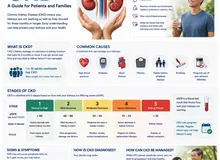
- Type a drug name in the search box and select it from the matching list, or click a suggestion, to add it to the patient's medication list.
- Add as many drugs as needed — each added drug appears as a removable chip above the search box.
- The checker automatically screens every pair of selected drugs against the interaction database and lists any matches below, grouped by severity.
- Each result shows the severity tier, the mechanism, and the recommended management.
- Remove a drug with its × or use Clear All to start over.
All computation runs in your browser; no medication list is stored or transmitted.
When to Use
Use this checker while reconciling or prescribing on top of a CKD, dialysis, or transplant patient's existing medication list, to screen quickly for the interactions that matter most in reduced renal function — hyperkalemia-prone RAAS/diuretic/potassium combinations, additive nephrotoxin stacking, calcineurin-inhibitor level changes, and renally-cleared drugs whose accumulation becomes dangerous once clearance is reduced.
Appropriate use
A quick screen of a nephrology, dialysis, or transplant patient's medication list for well-established, clinically significant drug-drug interactions before adding a new prescription, at a medication reconciliation, or when reviewing a referral's med list.
When NOT to rely on it
This is a curated subset of roughly 130 drugs (plus common herbal/OTC products) and their best-documented nephrology-relevant interactions — it is not a comprehensive interaction database like Lexicomp, Micromedex, or Medscape's checker, and it does not cover most oncology regimens or every drug on the market. A drug pair showing no result here has not been confirmed safe — it may simply be outside this tool's scope. The optional eGFR/potassium/dialysis/sick-day fields sharpen a handful of specific alerts (finerenone's eGFR cutoff, hyperkalemia severity, sick-day cautions) — they do not replace a full renal medication review. Always confirm against a full-database interaction checker or pharmacist review before acting on, or dismissing, any combination.
Pearls & Pitfalls
The "triple whammy"
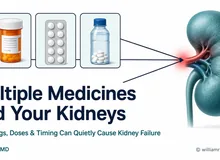
NSAID + ACE inhibitor/ARB + diuretic is the single most common preventable drug-induced AKI pattern in outpatients — each drug independently reduces renal perfusion or filtration, and together they can precipitate acute kidney injury within days, especially with volume depletion (fever, diarrhea, hot weather). The checker detects all three drugs together as one combined alert (not three separate pairwise flags) — counsel every CKD patient on this combination explicitly.
Hyperkalemia is additive, not binary
ACEi/ARB, aldosterone antagonists, potassium-sparing diuretics, NSAIDs, trimethoprim, and potassium supplements all raise serum potassium by different mechanisms. Two of these together is a caution; three or more — especially in CKD — is where most severe hyperkalemia happens. Check the whole list, not just the newest addition.
Star fruit (kamias/balimbing) is dangerous on its own
Unlike most entries here, star fruit and its juice are unsafe for anyone with CKD, dialysis, or a transplant regardless of what other medicines are on the list — the fruit's own neurotoxin (caramboxin) and potassium load are the danger, not just an interaction. The checker will flag it when paired with another potassium-raising drug, but the advice is the same either way: avoid it entirely.
Standard multivitamins are a hidden hazard in CKD5/ESRD
A routine drugstore multivitamin usually contains vitamin A, which the kidney normally clears — in ESRD it accumulates and can cause hypercalcemia, bone pain, liver toxicity, and pseudotumor cerebri — plus high-dose vitamin C, which metabolizes to oxalate that a dialysis patient cannot excrete, risking secondary oxalosis. This is true regardless of what else the patient is taking. Nephrology instead uses vitamin-A-free, low-vitamin-C "renal vitamin" formulations (e.g., Nephrocaps, Renax) that replace the water-soluble B vitamins and folate that dialysis removes, without the accumulation risk. This checker lists both separately — the standard multivitamin and the renal vitamin — so you can confirm which one is actually on the medication list.
Pitfalls
(1) The engine is pairwise by design, with one explicit exception (the NSAID+ACEi/ARB+diuretic "triple whammy," detected as a true three-drug combination) — beyond that, read multiple pairwise flags together, since three-or-more-drug additive effects (e.g., triple hyperkalemia risk from four potassium-raising drugs) are not separately modeled. (2) Severity here reflects typical risk in reduced renal function; the same pair may be lower-risk with normal kidney function. (3) A "no interactions found" result reflects this tool's limited drug list, not a guarantee of safety. (4) The optional patient-context fields (eGFR, potassium, dialysis, sick-day) sharpen specific alerts but do not verify every entry against them — always re-verify against current prescribing information and the actual lab values in the chart.
Drug Interaction Checker
Search and add every medicine — prescription, over-the-counter, or herbal/supplement — the patient is taking. Optionally add eGFR, potassium, dialysis status, and a sick-day flag to sharpen the alerts. The checker screens every pair automatically, detects the NSAID+ACEi/ARB+diuretic "triple whammy" as one combined alert, and lists what it finds below.
Clinical decision support, not a prescribing authority
This tool covers roughly 130 medicines and herbal/OTC products commonly relevant to Philippine outpatient, internal medicine, and nephrology prescribing. It is not exhaustive like Lexicomp, Micromedex, or Medscape's checker, and does not cover every drug, herbal product, dose, or timing effect. A combination showing no result has not been confirmed safe — it may simply be outside this tool's scope. Review clinically and correlate with the patient's status, labs, and current guidelines — always confirm with a doctor or pharmacist before starting, stopping, or combining any medicines.
Patient context (optional) — sharpens the alerts below
⚕ This checker screens curated drug-drug interactions relevant to CKD, dialysis, and transplant care — pairwise, plus one explicit three-drug rule (the NSAID+ACEi/ARB+diuretic "triple whammy"). It does not model every three-or-more-drug combination, exact dose, or timing, and it is clinical decision support, not a prescribing authority — review clinically and correlate with the patient's status, labs, and current guidelines. All computation runs in your browser; nothing you enter is stored or transmitted.
Drug Coverage
The checker's database groups medicines into the classes below. Search by generic name or a common brand name (Philippine market names included where relevant) — start typing and matching drugs appear as suggestions.
| Category | Examples in the database |
|---|---|
| RAAS agents | ACE inhibitors (incl. perindopril), ARBs, ARNI (sacubitril/valsartan), direct renin inhibitor (aliskiren) |
| Aldosterone antagonists & K-sparing diuretics | Spironolactone, eplerenone, finerenone, amiloride, triamterene |
| Loop & thiazide-type diuretics | Furosemide, torsemide, bumetanide, hydrochlorothiazide, chlorthalidone, indapamide, metolazone |
| NSAIDs & analgesics | Ibuprofen, naproxen, diclofenac, mefenamic acid (Ponstan), celecoxib, ketorolac, high-dose aspirin, paracetamol |
| OTC cold, allergy & GI products | Pseudoephedrine, phenylephrine cold/flu combos (Decolgen, Neozep, Bioflu, Sinutab), diphenhydramine, loperamide, antacids, H2 blockers, omeprazole/esomeprazole, potassium-based salt substitutes |
| Multivitamins | Standard multivitamin (contains vitamin A) vs. renal-specific vitamin (e.g., Nephrocaps, Renax) — see the Pearls & Pitfalls note above |
| GLP-1 receptor agonists & DPP-4 inhibitors | Semaglutide, dulaglutide, liraglutide, exenatide, lixisenatide, tirzepatide; sitagliptin, alogliptin, saxagliptin |
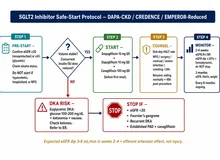
| SGLT2 inhibitors | Dapagliflozin, empagliflozin, canagliflozin |
| Neurology / antiviral / antibiotic renal-dosed agents | Gabapentin, pregabalin, levetiracetam, ciprofloxacin, levofloxacin, cefepime, acyclovir, valacyclovir, oseltamivir |
| Nephrotoxins & contrast | Iodinated contrast, aminoglycosides, vancomycin, amphotericin B, cisplatin, foscarnet, tenofovir, cidofovir |
| Transplant immunosuppressants | Tacrolimus, cyclosporine, sirolimus, mycophenolate, azathioprine |
| CYP3A4/P-gp modifiers | Azole antifungals, macrolides, non-dihydropyridine CCBs, rifampin, phenytoin, carbamazepine, ritonavir, St. John's wort |
| Anticoagulants & antiplatelets | Warfarin, apixaban, rivaroxaban, dabigatran, edoxaban, clopidogrel, aspirin |
| Cardiac & metabolic | Digoxin, amiodarone, lithium, methotrexate, colchicine, allopurinol, febuxostat, statins (simvastatin, atorvastatin, rosuvastatin, pravastatin), fibrates (gemfibrozil, fenofibrate), metformin, insulin, glimepiride |
| Herbal & supplement | St. John's wort, turmeric, ginkgo biloba, garlic, cranberry, licorice, noni juice, star fruit (kamias/balimbing), ginseng, high-dose vitamin E |
Evidence & References
Severity tiers
| Tier | Meaning |
|---|---|
| Contraindicated | Should not be combined — the risk of serious harm outweighs any benefit. |
| Serious — avoid or use an alternative | Significant risk; use a different drug where possible, or combine only with close monitoring and a specific plan. |
| Significant — monitor closely | Can be combined but needs a specific precaution — lab monitoring, dose adjustment, or patient counseling. |
| Minor — be aware | Low clinical significance for most patients, but worth knowing about. |
Severity reflects typical risk in reduced renal function, which is this tool's intended context — the same pair may carry lower risk with normal kidney function. The engine is pairwise, with the NSAID+ACEi/ARB+diuretic "triple whammy" detected as one explicit three-drug exception (see the pearl above) — other three-or-more-drug additive effects are not separately modeled. Entering eGFR, potassium, dialysis status, or a sick-day flag escalates or adds a small number of specific alerts (finerenone's eGFR cutoff, hyperkalemia severity, sick-day cautions, dialysis-relevant dosing notes) but does not re-verify the whole list against them.
Evidence & References
The interaction database draws on well-established pharmacology teaching (renal drug elimination, CYP3A4/P-glycoprotein metabolism, and additive nephrotoxicity) plus the specific trials, case reports, and reviews below for the higher-stakes flags — dual RAAS blockade, the NSAID/RAAS-agent/diuretic "triple whammy," azathioprine-allopurinol myelosuppression, colchicine with CYP3A4 inhibitors in renal impairment, St. John's wort with transplant drugs, star fruit nephrotoxicity, and metformin with iodinated contrast.
- Yusuf S, Teo KK, Pogue J, et al.; ONTARGET Investigators. Telmisartan, Ramipril, or Both in Patients at High Risk for Vascular Events. N Engl J Med. 2008;358(15):1547–1559. https://doi.org/10.1056/NEJMoa0801317
- Parving HH, Brenner BM, McMurray JJV, et al. Cardiorenal End Points in a Trial of Aliskiren for Type 2 Diabetes. N Engl J Med. 2012;367(23):2204–2213. https://doi.org/10.1056/NEJMoa1208799
- Calvo DM, Saiz LC, Leache L, et al. Effect of the Combination of Diuretics, Renin-Angiotensin-Aldosterone System Inhibitors, and Non-Steroidal Anti-Inflammatory Drugs or Metamizole (Triple Whammy) on Hospitalisation Due to Acute Kidney Injury: A Nested Case-Control Study. Pharmacoepidemiol Drug Saf. 2023;32(8):898–909. https://doi.org/10.1002/pds.5621
- Cummins D, Sekar M, Halil O, Banner N. Myelosuppression Associated With Azathioprine-Allopurinol Interaction After Heart and Lung Transplantation. Transplantation. 1996;61(11):1661–1662. https://doi.org/10.1097/00007890-199606150-00023
- Dogukan A, Oymak FS, Taskapan H, Güven M, Tokgoz B, Utas C. Acute Fatal Colchicine Intoxication in a Patient on Continuous Ambulatory Peritoneal Dialysis (CAPD). Possible Role of Clarithromycin Administration. Clin Nephrol. 2001;55(2):181–182.
- Nicolussi S, Drewe J, Butterweck V, Meyer Zu Schwabedissen HE. Clinical Relevance of St. John's Wort Drug Interactions Revisited. Br J Pharmacol. 2020;177(6):1212–1226. https://doi.org/10.1111/bph.14936
- Lakmal K, Yasawardene P, Jayarajah U, Seneviratne SL. Nutritional and Medicinal Properties of Star Fruit (Averrhoa carambola): A Review. Food Sci Nutr. 2021;9(3):1810–1823. https://doi.org/10.1002/fsn3.2135
- Khurana R, Malik IS. Metformin: Safety in Cardiac Patients. Heart. 2009;96(2):99–102. https://doi.org/10.1136/hrt.2009.173773
- Kidney Disease: Improving Global Outcomes (KDIGO) CKD Work Group. KDIGO 2024 Clinical Practice Guideline for the Evaluation and Management of Chronic Kidney Disease. Kidney Int. 2024;105(4S):S117–S314.