- Confirm anti-GBM disease (circulating anti-GBM antibody and/or linear IgG on kidney biopsy).
- Answer whether the patient required dialysis (kidney replacement therapy, KRT) at diagnosis.
- From the biopsy report, select the percentage of normal glomeruli and the extent of tubular atrophy / interstitial fibrosis (IFTA), and enter the estimated glomerular filtration rate (eGFR) at diagnosis.
- Optionally answer the three KDIGO questions (100% crescents, global glomerulosclerosis above 50%, pulmonary hemorrhage) to check the Recommendation 11.2.1 exception.
All computation runs in your browser; no values are stored or transmitted.
When to Use
Use at diagnosis in a patient with anti-GBM disease and a kidney biopsy, to frame prognosis and the conversation about how hard to treat when the patient is dialysis-dependent. The Floyd model needs only two inputs (dialysis at diagnosis and the 10% normal-glomeruli cut point); the Renal Risk Score (RRS) adds IFTA and eGFR.
When NOT to rely on it
Never delay plasma exchange and immunosuppression while waiting for a biopsy to score. Pulmonary hemorrhage is always an indication for full treatment regardless of the kidney result. The models were derived in a retrospective cohort and predict kidney survival, not patient survival; they have not been validated for Alport post-transplant, seronegative/atypical, or IgA-dominant disease.
Pearls & Pitfalls
Why normal glomeruli matter most
Anti-GBM crescents are usually of uniform age and scar within weeks. Only unaffected glomeruli can carry function after recovery, which is why the percentage of normal glomeruli was the best single predictor of recovery, with 10% as the best cut point (Floyd et al., 2023).
"Normal" means no crescent, no necrosis, no sclerosis
Count glomeruli without scarring, crescents, or necrosis within the tuft, as in the original ANCA score. A small sample (few glomeruli) makes the percentage unreliable.
Pitfalls
(1) Duration of dialysis matters and is not in the models: recovery is very rare after more than 7 days of dialysis before immunosuppression, but possible within about 72 hours (McAdoo & Pusey, 2025). (2) An alternative cause of the dialysis need (acute tubular injury, hyperkalemia rather than anuria) or co-existing ANCA improves the odds. (3) In crescentic biopsies, linear IgG can disappear from destroyed glomeruli; correlate with serology.
Anti-GBM Kidney Outcome Risk
Next Steps
- Not on dialysis (any glomerular group): full treatment with daily plasma exchange until antibody negative, oral cyclophosphamide 2–3 months, glucocorticoids tapered over about 6 months (KDIGO 2021, Recommendation 11.2.1, 1C).
- Dialysis with ≥10% normal glomeruli (about 42% 36-month kidney survival): treat intensively; recovery is realistic.
- Dialysis with <10% normal glomeruli (about 14%): individualize. If the KDIGO exception applies (100% crescents or >50% sclerosis, no lung hemorrhage), supportive care is reasonable; a short 2–4 week trial is reasonable in younger patients, with recent dialysis start, non-oliguria, or co-existing ANCA. Short-term immunosuppression may also speed antibody clearance toward transplant (antibody negative for at least 6 months first).
- Plan exchange volume with the Plasma Volume calculator; for double-positive disease see the ANCA Renal Risk Score; read the full anti-GBM disease guide.
Evidence
Floyd four-group model (36-month kidney survival)
| Dialysis at diagnosis | Normal glomeruli | 36-month kidney survival |
|---|---|---|
| No | ≥10% | 96.4% |
| No | <10% | 74.0% |
| Yes | ≥10% | 42.3% |
| Yes | <10% | 14.1% |
Renal Risk Score in anti-GBM disease
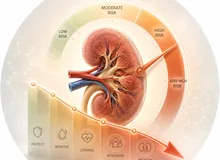
| Score | Group | 36-month kidney survival (Floyd cohort) |
|---|---|---|
| 0 | Low | 100% |
| 2–7 | Moderate | 62.4% |
| 8–11 | High | 20.7% |
RRS points (Brix et al., 2018): N1 = 4, N2 = 6; T1 = 2; G1 (eGFR ≤15) = 3. Dialysis at diagnosis and normal glomeruli were the independent predictors of end-stage kidney disease in the anti-GBM cohort.
KDIGO 2021 Recommendation 11.2.1 (1C)
Plasma exchange, cyclophosphamide, and glucocorticoids for all patients with anti-GBM glomerulonephritis except those who are dialysis-dependent at presentation and have 100% crescents or more than 50% global glomerulosclerosis in an adequate biopsy sample, and do not have pulmonary hemorrhage.