- Enter the baseline serum creatinine (most recent stable pre-event value) and the current / peak serum creatinine.
- Optionally enter the urine output (mL/kg/h) and select the duration over which it was observed.
- Check renal replacement therapy (RRT) initiated if dialysis has been started — this automatically assigns Stage 3.
- The AKIN stage updates automatically, reporting the worst of the creatinine and urine-output criteria.
Note: AKIN requires the change in creatinine to occur within a 48-hour window, assessed only after the patient has received adequate volume resuscitation and urinary-tract obstruction has been excluded. AKIN does not use eGFR/GFR. All computation runs in your browser; no values are stored or transmitted.
When to Use
Use the AKIN classification to stage acute kidney injury in hospitalized or acutely ill adults using the absolute or relative rise in serum creatinine within a 48-hour window or the urine output — assigning the stage from whichever of the two criteria is worse. The creatinine change is only applied after adequate volume resuscitation and after obstructive (post-renal) causes have been excluded.
Appropriate population
Adults with a known or estimable baseline creatinine and a documented acute rise over ≤ 48 hours, with or without oliguria. Particularly useful for inpatient, perioperative, and critical-care AKI surveillance where serial creatinine and hourly urine output are tracked.
Caveats & what AKIN does NOT do
- AKIN uses a strict 48-hour window and a known baseline; it does not use the 7-day/1.5× window or the GFR/RIFLE categories.
- AKIN does not use GFR or eGFR — staging is by creatinine change and urine output only.
- Initiation of renal replacement therapy automatically classifies the patient as Stage 3, regardless of creatinine.
- KDIGO has largely merged and superseded AKIN (and RIFLE). For most current practice prefer the AKI Staging (KDIGO) calculator, which harmonizes both systems and adds a 7-day creatinine window.
Pearls & Pitfalls
Stage by the worst criterion
Always compute both the creatinine stage and the urine-output stage and report the higher of the two. A patient with only a Stage 1 creatinine rise but anuria for ≥ 12 hours is Stage 3. The small absolute threshold (≥ 0.3 mg/dL rise) makes AKIN sensitive to early injury — even modest creatinine bumps over 48 hours qualify as Stage 1.
Establish a true baseline
Reliable staging needs a credible baseline creatinine and adequate volume resuscitation first — pre-renal azotemia from hypovolemia should correct with fluids and is not classified as AKIN AKI until resuscitation is adequate. Exclude obstruction. The Stage 3 "SCr ≥ 4.0 mg/dL" criterion additionally requires a documented acute rise of ≥ 0.5 mg/dL, so a chronically elevated stable creatinine does not by itself qualify.
Pitfalls
(1) Do not apply the creatinine criterion outside the 48-hour window — that is the KDIGO/RIFLE 7-day domain. (2) Creatinine lags injury; a stable creatinine does not exclude evolving AKI. (3) Urine-output criteria require an accurate weight and reliable hourly measurement (ideally catheterized). (4) AKIN was designed for diagnosis/staging, not for predicting recovery; it does not stratify by GFR. (5) Diuretic-augmented urine output can mask oliguric AKI.
Why Use It
The AKIN classification (Mehta et al., 2007) refined the earlier RIFLE criteria to improve the sensitivity and uniformity of AKI diagnosis. By adding a small absolute creatinine threshold (a rise of ≥ 0.3 mg/dL within 48 hours) and removing the GFR-based RIFLE categories, AKIN captures early, clinically meaningful injury that RIFLE could miss, and it standardizes staging across studies and institutions. Even modest, abrupt creatinine increases are independently associated with longer length of stay, higher mortality, and progression to CKD — so consistent AKIN staging supports early recognition, etiologic work-up, nephrotoxin avoidance, and timely escalation of care. AKIN's definitions were subsequently harmonized into the current KDIGO AKI guideline, which most centers now use; AKIN remains important for interpreting the large body of literature built on it and for settings that report it.
AKIN Classification — Acute Kidney Injury Staging
Enter the baseline and current serum creatinine, and optionally urine output and its duration. Check RRT if dialysis has begun. The AKIN stage updates automatically from the worst of the creatinine and urine-output criteria.
Override
⚕ Mehta RL, et al. (Acute Kidney Injury Network). Crit Care. 2007;11(2):R31. Staging requires a 48-hour window, adequate volume resuscitation, and exclusion of obstruction. AKIN does not use GFR; initiation of RRT automatically denotes Stage 3. This tool is for licensed clinicians and does not replace individualized assessment.
Next Steps
Use the AKIN stage to guide work-up, nephrotoxin avoidance, and escalation of care.
- No AKI by AKIN: continue surveillance with serial creatinine and urine output if risk factors persist; confirm adequate volume status and recheck.
- Stage 1: identify and treat the cause; ensure euvolemia; stop or dose-adjust nephrotoxins (NSAIDs, aminoglycosides, contrast); review medications; monitor creatinine and urine output closely.
- Stage 2: intensify the above; consider nephrology consultation; review fluid balance and acid–base/electrolyte status; avoid further renal insults; anticipate the need for renal support.
- Stage 3: nephrology involvement; assess for the urgent indications for dialysis (refractory hyperkalemia, acidosis, fluid overload, uremia); plan vascular access and renal replacement therapy as indicated.
- Re-stage using the worst current criterion whenever new creatinine or urine-output data become available, and consider the KDIGO system for harmonized current practice.
Evidence & References
AKIN Staging Criteria
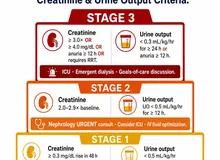
| Stage | Serum creatinine (within 48 h) | Urine output |
|---|---|---|
| Stage 1 | Increase ≥ 0.3 mg/dL or 1.5–2.0× baseline | < 0.5 mL/kg/h for ≥ 6 h |
| Stage 2 | > 2.0–3.0× baseline | < 0.5 mL/kg/h for ≥ 12 h |
| Stage 3 | > 3.0× baseline or SCr ≥ 4.0 mg/dL with an acute rise ≥ 0.5 mg/dL or initiation of RRT | < 0.3 mL/kg/h for ≥ 24 h or anuria ≥ 12 h |
Stage is assigned by the worst of the creatinine and urine-output criteria. The creatinine change must occur within 48 hours, after adequate volume resuscitation and exclusion of obstruction. AKIN does not include the GFR-based RIFLE categories.
References
- Mehta RL, Kellum JA, Shah SV, et al; Acute Kidney Injury Network. Acute Kidney Injury Network: report of an initiative to improve outcomes in acute kidney injury. Crit Care. 2007;11(2):R31. doi:10.1186/cc5713.
- Kidney Disease: Improving Global Outcomes (KDIGO) Acute Kidney Injury Work Group. KDIGO Clinical Practice Guideline for Acute Kidney Injury. Kidney Int Suppl. 2012;2(1):1–138.
- Bellomo R, Ronco C, Kellum JA, et al; Acute Dialysis Quality Initiative. Acute renal failure — definition, outcome measures, animal models, fluid therapy and information technology needs: the Second International Consensus Conference of the ADQI Group (RIFLE). Crit Care. 2004;8(4):R204–R212.