Company: GOODFELLOW PHARMA CORPORATIONLast updated:Audience: Licensed health professionals
Registered with the Philippine FDA as a FOOD SUPPLEMENT — no approved therapeutic claims. Not a substitute for prescribed treatment.
CKD · dialysis · transplant
Kidney notes
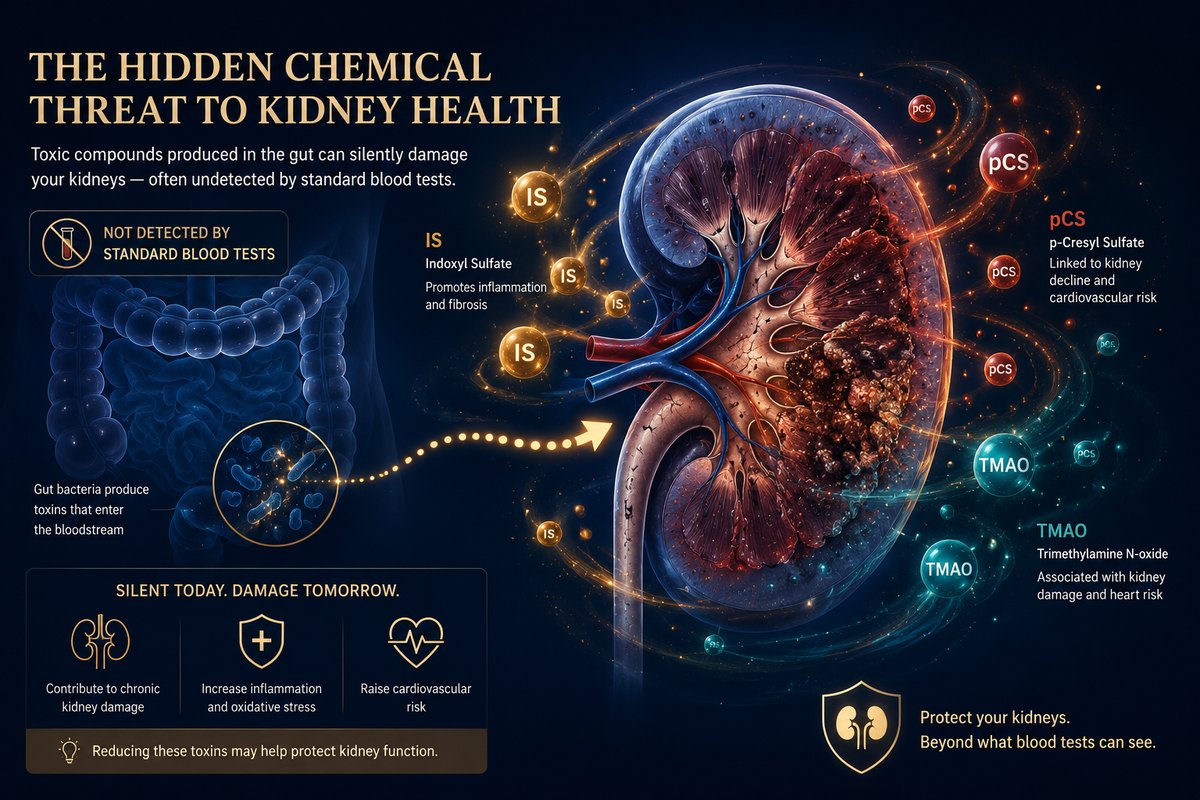
Renadyl is a three-strain probiotic (Streptococcus thermophilus, Lactobacillus acidophilus, Bifidobacterium longum) marketed for 'enteric dialysis', the idea that gut bacteria can metabolize urea and other nitrogenous waste. It is the only kidney-marketed supplement in this list with published trials of the product itself, all small and most sponsored or co-authored by its maker, Kibow Biotech.
Evidence
Ranganathan 2009 (Canada): 6-month double-blind, placebo-controlled crossover pilot in 16 patients with CKD stages 3 to 4 (13 completed). BUN fell during probiotic periods versus placebo (mean change -2.93 vs +4.52 mmol/L, p = 0.002); creatinine did not change significantly. Sponsor-authored.
Ranganathan 2010 (four countries): 6-month crossover pilot in 46 patients with CKD stages 3 to 4 at 90 billion CFU/day. BUN fell in 63% of patients; creatinine and uric acid changes were not significant. Authors note small size and inconsistencies. Sponsor-authored.
Natarajan 2014 (hemodialysis): double-blind crossover RCT, 22 of 28 completed. No statistically significant change in uremic toxins or quality of life; trends only for white cell count, CRP and indoxyl glucuronide. Safe over 2-month periods.
Kalidindi 2024 (India): open-label RCT, 60 patients with CKD stages 3 to 4, Renadyl versus another probiotic (Lobun Forte) for 6 months, no placebo arm. Both arms reported lower indoxyl sulfate, BUN and creatinine. Co-authored by the comparator's manufacturer.
Class evidence: a meta-analysis of 14 RCTs found microbiota-directed therapy lowered p-cresyl sulfate but not indoxyl sulfate, and probiotics alone did not lower either (Chen 2022); a meta-analysis of 12 RCTs in non-dialysis patients found no effect of prebiotics, probiotics or synbiotics on serum creatinine (Liu 2023).
Cautions in kidney disease
Probiotic organisms can enter the bloodstream: whole-genome sequencing has linked Lactobacillus bacteremia in ICU patients to the probiotic capsule they were given. Avoid in critically ill patients, those with a central venous catheter (including a tunneled hemodialysis catheter), recent bowel surgery or gut barrier injury, and in kidney transplant recipients or others on immunosuppression unless the treating team agrees. [Yelin 2019]
Trial outcomes were blood urea nitrogen (BUN), creatinine, uremic-toxin levels and quality-of-life scores; no trial reports kidney failure, dialysis start, cardiovascular events or death.
Registered as a food supplement with no approved therapeutic claims: viable count, strain identity and storage stability are not verified by the FDA the way drug content is.
It does not replace evidence-based CKD care (blood pressure and glucose control, RAAS blockade, SGLT2 inhibitors where indicated, diet).
Bottom line
Small, mostly sponsor-linked trials show changes in BUN or uremic toxins at best, with no evidence on kidney or patient outcomes. Reasonable to tolerate in a stable outpatient who wants it; avoid in transplant recipients, the immunosuppressed, the critically ill and patients with a dialysis catheter; never a substitute for proven CKD therapy.
Sources
Ranganathan, N., Friedman, E. A., Tam, P., Rao, V., Ranganathan, P., & Dheer, R. (2009). Probiotic dietary supplementation in patients with stage 3 and 4 chronic kidney disease: A 6-month pilot scale trial in Canada. Current Medical Research and Opinion, 25(8), 1919–1930. https://doi.org/10.1185/03007990903069249
Ranganathan, N., Ranganathan, P., Friedman, E. A., Joseph, A., Delano, B., Goldfarb, D. S., Tam, P., Rao, A. V., Anteyi, E., & Musso, C. G. (2010). Pilot study of probiotic dietary supplementation for promoting healthy kidney function in patients with chronic kidney disease. Advances in Therapy, 27(9), 634–647. https://doi.org/10.1007/s12325-010-0059-9
Natarajan, R., Pechenyak, B., Vyas, U., Ranganathan, P., Weinberg, A., Liang, P., Mallappallil, M. C., Norin, A. J., Friedman, E. A., & Saggi, S. J. (2014). Randomized controlled trial of strain-specific probiotic formulation (Renadyl) in dialysis patients. BioMed Research International, 2014, 568571. https://doi.org/10.1155/2014/568571
Kalidindi, R. K., Reddy, C. P., Pv, K., & Kompella, P. (2024). The efficacy and safety of probiotic combinations Lobun Forte® versus Renadyl® in patients with chronic kidney disease: A comparative, phase IV, randomized, open-label, active-controlled, parallel study. Cureus, 16(8), e67987. https://doi.org/10.7759/cureus.67987
Chen, L., Shi, J., Ma, X., Shi, D., & Qu, H. (2022). Effects of microbiota-driven therapy on circulating indoxyl sulfate and p-cresyl sulfate in patients with chronic kidney disease: A systematic review and meta-analysis of randomized controlled trials. Advances in Nutrition, 13(4), 1267–1278. https://doi.org/10.1093/advances/nmab149
Liu, F., Liu, Y., Lv, X., & Lun, H. (2023). Effects of prebiotics, probiotics and synbiotics on serum creatinine in non-dialysis patients: A meta-analysis of randomized controlled trials. Renal Failure, 45(1), 2152693. https://doi.org/10.1080/0886022X.2022.2152693
Yelin, I., Flett, K. B., Merakou, C., Mehrotra, P., Stam, J., Snesrud, E., Hinkle, M., Lesho, E., McGann, P., McAdam, A. J., Sandora, T. J., Kishony, R., & Priebe, G. P. (2019). Genomic and epidemiological evidence of bacterial transmission from probiotic capsule to blood in ICU patients. Nature Medicine, 25(11), 1728–1732. https://doi.org/10.1038/s41591-019-0626-9
Reviewed by William Gregory M. Rivero, MD, FPCP, DPSN on November 17, 2026. renalcarematters.com, reviewed
FDA Philippines registration
1 current food-supplement registration under the brand RENADYL. Registration status changes;
confirm a product's current status on the FDA verification portal using its FR number.
For health professionals. Data come from the FDA Philippines food-product
registration database and may lag behind the official record. A food-supplement registration means the product may be sold as food; it is not an approval of safety or efficacy for any disease. Not a substitute for clinical judgment.