Company: SYNERGEN PHARMA INCLast updated:Audience: Licensed health professionals
Registered with the Philippine FDA as a FOOD SUPPLEMENT — no approved therapeutic claims. Not a substitute for prescribed treatment.
CKD · dialysis · transplant
Kidney notes
Ferolip (SYNERGEN PHARMA INC) is an oral iron product registered with the Philippine FDA as a food supplement with no approved therapeutic claims, not as a drug. According to the manufacturer, each capsule or chewable tablet gives 30 mg of elemental iron as an iron pyrophosphate (diphosphate) salt, with folate and vitamin B12. No published study of Ferolip itself was found; the studies below are of other liposomal or pyrophosphate iron products.
What each variant is for
Ferolip Capsule (FR-4000008771058): per capsule, 30 mg elemental iron as microencapsulated iron pyrophosphate monohydrate, ascorbic acid (vitamin C) 70 mg, folic acid 200 mcg and cyanocobalamin (vitamin B12) 1.75 mcg. Other ingredients: microcrystalline cellulose, povidone K30, purified water, magnesium stearate, colloidal anhydrous silica, hard gelatin capsule.
Ferolip CT chewable tablet (FR-4000015316475): per tablet, 30 mg elemental iron as ferric di-phosphate, folate 50 mcg as (6S)-5-methyltetrahydrofolic acid (5-MTHF) glucosamine salt and vitamin B12 (cyanocobalamin) 0.9 mcg; vitamin C is not listed. Blackberry-flavored. Other ingredients: mannitol, isomalt, blackberry flavor, microcrystalline cellulose, citric acid anhydrous, talc, colloidal silicon dioxide, magnesium stearate, croscarmellose sodium, steviol glycoside.
Ferolip Chews (FR-4000010016413): registered as a ferric di-phosphate and folic acid food supplement tablet (brand name Ferolip Chews; valid until August 9, 2029). Its composition was not in the product information supplied by the company: read the label before prescribing.
How it fits the KDIGO 2026 anemia guideline
Hemodialysis: KDIGO 2026 suggests starting iron if ferritin is 500 ng/ml or less and transferrin saturation (TSAT) is 30% or less (Recommendation 2.1, 2D), and suggests intravenous (IV) rather than oral iron when starting (Recommendation 2.2, 2D), given proactively to keep iron status stable (Practice Point 2.1). An oral supplement is not the guideline's first choice on hemodialysis.
CKD not on dialysis or on peritoneal dialysis: KDIGO suggests starting iron if ferritin is below 100 ng/ml with TSAT below 40%, or ferritin 100 to below 300 ng/ml with TSAT below 25% (Recommendation 2.3, 2D). In people not on hemodialysis, oral or IV iron may be used, based on the person's values and preferences, the degree of anemia and iron deficiency, and the relative efficacy, tolerability, availability and cost of each (Recommendation 2.4, 2D).
Choice of oral product: guided by cost, patient preference, tolerability and efficacy (Practice Point 2.3). KDIGO Table 3 lists liposomal iron at 30 mg elemental iron per tablet, 1 tablet daily, with less gastrointestinal side effects and better bioavailability; the guideline text notes that oral iron is typically prescribed to provide about 200 mg of elemental iron daily and that head-to-head trial data on newer oral preparations are minimal. The manufacturer describes Ferolip's iron as microencapsulated iron pyrophosphate (capsule) or ferric di-phosphate (chewable), not as liposomal iron.
Monitoring: test hemoglobin, ferritin and TSAT every 3 months in CKD not on dialysis or on peritoneal dialysis, and every 1 to 3 months on hemodialysis (Practice Point 2.5). It is reasonable to withhold routine iron if ferritin is above 700 ng/ml or TSAT is 40% or more (Practice Point 2.2).
Switch from oral to IV iron if an optimal oral regimen has an insufficient effect after 1 to 3 months or tolerability is poor (Practice Point 2.7). Consider pausing iron during a systemic infection (Practice Point 2.8).
Evidence
No published study of Ferolip was found on PubMed (search November 17, 2026). The company-supplied studies below tested other liposomal iron products; none tested Ferolip.
Pisani 2015 (Italy, cited in KDIGO 2026): open-label randomized trial, 99 adults with CKD stages 3 to 5 not on dialysis and iron deficiency anemia, assigned 2:1 to oral liposomal iron 30 mg/day or IV ferric gluconate (125 mg weekly, 1000 mg total) for 3 months. Hemoglobin rose faster with IV iron (significant difference at month 1 only); the final rise was similar. After stopping, hemoglobin stayed stable with IV iron but returned to baseline with oral liposomal iron, and iron stores were replenished more with IV iron. Adverse events were fewer with oral iron (P < 0.001).
Bengelloun Zahr 2024 (Morocco): small randomized trial, 31 adults with CKD stages 3 to 5 not on dialysis randomized and 27 analyzed, comparing a liposomal iron pyrophosphate capsule of another brand (Lisofer 30 mg: 30 mg iron with 70 mg vitamin C; this matches the Ferolip Capsule's declared composition, but the two products have not been shown to be equivalent) daily with IV iron sucrose 100 mg weekly for 3 months. Hemoglobin rose 14.65% with IV iron and 4.78% with oral iron; ferritin and TSAT rose significantly only with IV iron. Adverse events: hypotension 4 of 13 on IV iron (1 of 14 oral); constipation 4 of 14 oral (2 of 13 IV); abdominal pain 3 of 14 oral. Despite its title, noninferiority was argued by comparison with other studies, not shown by a prespecified test.
Cesarano 2024 (Italy): single-arm pilot study, no comparator, 38 adults with CKD stages 1 to 5 not on dialysis and iron deficiency (34 analyzed), one 30 mg pill (with 19 mg vitamin C) twice daily for 1 month, then once daily for 5 months (as printed: '30 mg/day twice daily'). The share reaching TSAT of 20% or more rose from 11.8% to 50.0% (P = 0.002); ferritin and hemoglobin did not change significantly. Eight stopped treatment: 2 deaths, 2 switches to IV iron, 4 side effects.
Hegazy 2026 (Egypt, children; published online 2025): randomized trial, 60 children with CKD in a pediatric nephrology and hemodialysis unit, oral liposomal iron 30 mg/day versus IV iron dextran 50 mg three times weekly (given during hemodialysis) for 3 months. There was no significant difference between groups in hemoglobin, ferritin or other iron measures at 3 months; the authors' claim of higher efficacy rests on within-group before-and-after changes.
Sawires 2026 (Egypt, children; not company-supplied): randomized crossover study, 33 children with CKD and iron deficiency anemia, liposomal iron versus oral iron polymaltose complex for 3 months each. No significant difference between treatments in the change in hemoglobin, iron or TSAT (p > 0.05); in mixed-model analysis iron polymaltose gave higher hemoglobin and TSAT. Adverse effects: 3% on liposomal iron versus 36% on iron polymaltose. Iron polymaltose, but not liposomal iron, lowered serum phosphorus.
Taken together: small, mostly open-label studies of other liposomal iron products suggest better gastrointestinal tolerability, with a slower hemoglobin response and less replenishment of iron stores than IV iron. No study reports hard outcomes (transfusion, hospitalization, death), and none tested Ferolip.
Cautions in kidney disease
Registered as a food supplement with no approved therapeutic claims, not as a drug, and no Ferolip-specific study exists.
On hemodialysis, KDIGO suggests IV iron rather than oral iron when starting iron (Recommendation 2.2, 2D); do not let an oral supplement delay IV iron.
Check ferritin and TSAT before starting and during treatment; withhold if ferritin is above 700 ng/ml or TSAT is 40% or more, and switch to IV iron if there is no adequate response after 1 to 3 months (Practice Points 2.2, 2.5, 2.7).
One serving gives 30 mg elemental iron, well below the about 200 mg daily that KDIGO says oral iron is typically prescribed to provide (rationale for Practice Point 2.7); KDIGO Table 3 lists liposomal iron at 30 mg once daily.
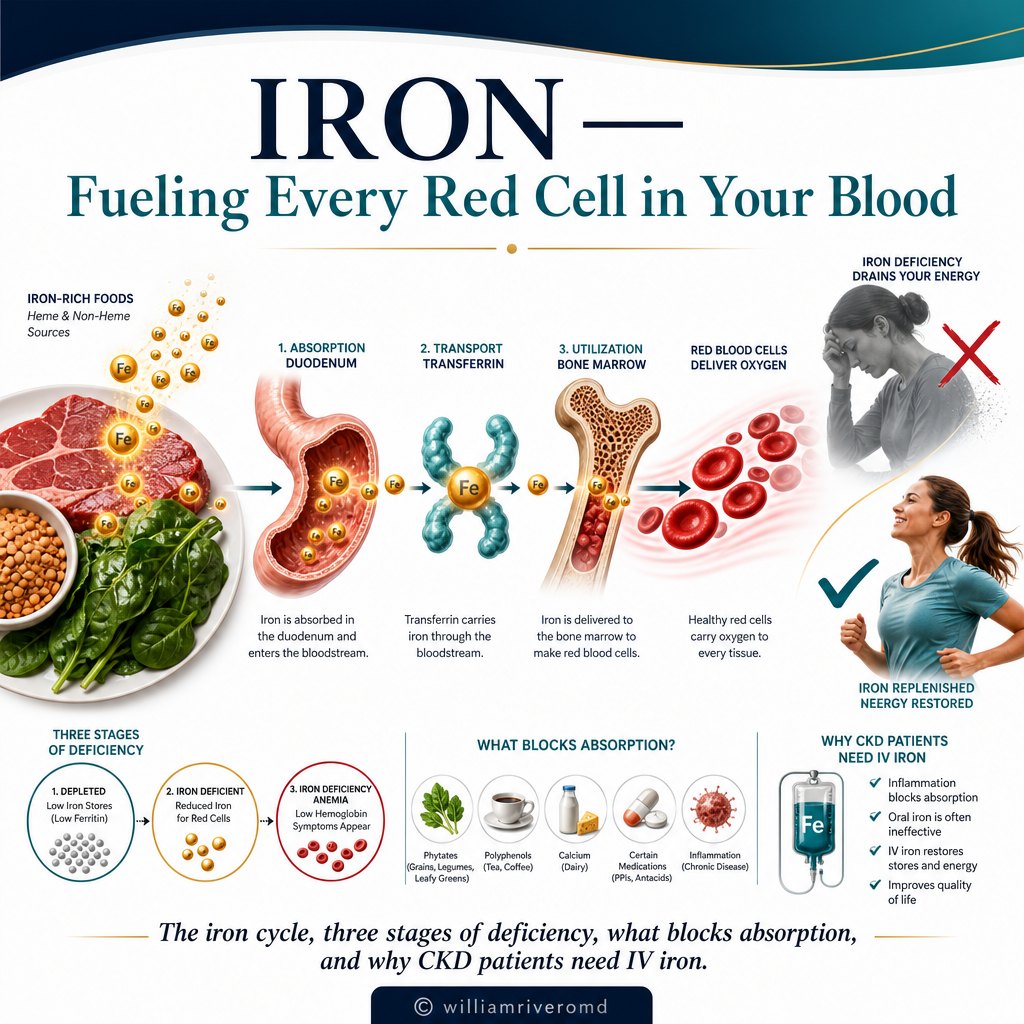
Absorption of oral iron in CKD can be impaired by inflammation, reduced gastric acid production or interactions with other medications (KDIGO 2026, rationale for Practice Point 2.7). In US-label drug-interaction studies, sevelamer did not alter the pharmacokinetics of iron (Renvela label). No source available to us gives a spacing interval between this product and calcium-based binders or antacids: flagged for review.
Iron lowers the absorption of some drugs that people with CKD may take. US labels advise: levothyroxine at least 4 hours apart from phosphate binders, a class the label lists with ferrous sulfate; ciprofloxacin at least 2 hours before or 6 hours after products containing calcium, iron or zinc and polymeric phosphate binders; levofloxacin at least 2 hours before or after metal cations such as iron; cefdinir at least 2 hours before or after iron supplements; dolutegravir 2 hours before or 6 hours after iron or calcium supplements, unless both are taken together with food.
Phosphate: both presentations use a pyrophosphate (diphosphate) iron salt, so each serving contains some phosphate. The manufacturer does not declare the amount and it is not quantified here.
No potassium-containing ingredient is listed for the capsule or the chewable tablet. The chewable tablet contains mannitol and isomalt (sugar alcohols) and croscarmellose sodium as excipients.
Keep out of reach of children: accidental overdose of iron-containing products is a leading cause of fatal poisoning in children under 6 (US ferrous sulfate label). The flavored chewable tablet needs particular care at home.
Bottom line
A 30 mg elemental iron food supplement with no Ferolip-specific studies and no approved therapeutic claims. In CKD not on hemodialysis it can be one oral option if the patient prefers oral iron or cannot tolerate other oral salts, with ferritin and TSAT checked and a switch to IV iron if the response is inadequate after 1 to 3 months. On hemodialysis, KDIGO 2026 suggests IV iron instead.
Sources
Synergen Pharma Inc. (2026). Ferolip® product information: Capsule and chewable tablet (CT) [Manufacturer product information supplied by email, November 17, 2026].
Philippine Food and Drug Administration. (2026). Food supplement registrations FR-4000008771058, FR-4000015316475 and FR-4000010016413 (registered as food supplements with no approved therapeutic claims) [Registry records].
Kidney Disease: Improving Global Outcomes (KDIGO) Anemia Work Group. (2026). KDIGO 2026 clinical practice guideline for the management of anemia in chronic kidney disease (CKD). Kidney International, 109(1S), S1–S99. https://doi.org/10.1016/j.kint.2025.06.006
Pisani, A., Riccio, E., Sabbatini, M., Andreucci, M., Del Rio, A., & Visciano, B. (2015). Effect of oral liposomal iron versus intravenous iron for treatment of iron deficiency anaemia in CKD patients: A randomized trial. Nephrology Dialysis Transplantation, 30(4), 645–652. https://doi.org/10.1093/ndt/gfu357
Bengelloun Zahr, S., Allata, Y., El Mansoury, M., Chouhani, B. A., Kabbali, N., El Bardai, G., & Sqalli Houssaini, T. (2024). Oral liposomal iron versus injectable iron sucrose for anemia treatment in non-dialysis chronic kidney disease patients: A non-inferiority study. Cureus, 16(9), e70114. https://doi.org/10.7759/cureus.70114
Cesarano, D., Borrelli, S., Campilongo, G., D'Ambra, A., Papadia, F., Garofalo, C., De Marco, A., Marzano, F., Ruotolo, C., Gesualdo, L., Cirillo, P., & Minutolo, R. (2024). Efficacy and safety of oral supplementation with liposomal iron in non-dialysis chronic kidney disease patients with iron deficiency. Nutrients, 16(9), 1255. https://doi.org/10.3390/nu16091255
Hegazy, S. K., Koura, M. S. E., & Elharoun, M. S. (2026). Liposomal iron dramatic effect on chronic kidney disease pediatric anemia: A randomized clinical trial. Pediatric Research, 99(4), 1541–1547. https://doi.org/10.1038/s41390-025-04418-x
Sawires, H., Abd Alazem, E. A., Atia, F., Salem, A., Samy, A., & Gamal, M. (2026). Oral liposomal iron vs. oral iron polymaltose in children with chronic kidney disease iron deficiency anemia: A cross-over study. Pediatric Nephrology, 41(6), 1803–1810. https://doi.org/10.1007/s00467-025-07138-w
Reviewed by William Gregory M. Rivero, MD, FPCP, DPSN on November 17, 2026. renalcarematters.com, reviewed
FDA Philippines registrations
3 current food-supplement registrations under the brand Ferolip. Registration status changes;
confirm a product's current status on the FDA verification portal using its FR number.
Registered drug products that share an ingredient with this supplement. A drug registration carries approved indications
and labeling; a food supplement does not, and its content and quality are not verified in the same way.
For health professionals. Data come from the FDA Philippines food-product
registration database and may lag behind the official record. A food-supplement registration means the product may be sold as food; it is not an approval of safety or efficacy for any disease. Not a substitute for clinical judgment.