Sodium & Salt Reduction Guide for CKD W.G.M. Rivero MD · FPCP · DPSN · · williamriveromd.com · 2026
Patient Education · Nephrology & Internal Medicine
Sodium & Salt Reduction
in CKD
Your most powerful daily choice for kidney protection — sodium targets, hidden salt in Filipino foods, and practical cooking swaps. Tailored for Filipino patients.
🧂
W.G.M. Rivero MD
FPCP · DPSN
Nephrologist
williamriveromd.com
< 2,300 mg
Daily Sodium Target
1 tsp
Salt Equivalent
80%
Filipinos Exceed Limit
↓ BP
Main Benefit in CKD
1Why Sodium Harms CKD Kidneys

In healthy kidneys, excess sodium is filtered and excreted in urine with no lasting effect. In CKD, this filtering capacity is reduced — so sodium accumulates in the bloodstream, pulling water with it. The result is a chain reaction: fluid retention → higher blood volume → elevated blood pressure → increased shear stress on glomeruli → faster kidney damage.

Sodium also directly stimulates the renin-angiotensin-aldosterone system (RAAS) — the very pathway that ACE inhibitors and ARBs block. A high-sodium diet partially overrides the benefit of these kidney-protecting medications. Reducing sodium amplifies their effect without changing your dose.

In proteinuric CKD, excess sodium increases urinary protein leakage — proteinuria is itself a driver of progression. Studies show sodium restriction can reduce proteinuria by 20–30% independently of blood pressure changes. In dialysis patients, high interdialytic sodium intake causes excessive fluid gain between sessions, raising the risk of pulmonary edema and cardiovascular death.

🩸 Blood Pressure
Sodium raises BP by expanding blood volume. Every 1 g reduction in daily sodium lowers systolic BP by ~2–3 mmHg in CKD patients — more than in the general population.
💧 Fluid Retention
1 g of sodium retains ~150 mL of water. A 3 g sodium excess = ~450 mL extra fluid — ankles swell, lungs become congested, dialysis sessions become harder.
🔬 Proteinuria Reduction
Low-sodium diet reduces urinary protein loss by 20–30% in proteinuric CKD — slowing the scarring that drives kidney function decline.
2Daily Sodium Targets by CKD Stage
CKD Stage eGFR Daily Sodium Limit Rationale
Stage 1–2> 60 mL/min< 2,300 mgBlood pressure control; preserve residual kidney function
Stage 330–59 mL/min< 2,000 mgProteinuria reduction; slow progression of kidney scarring
Stage 4–5 (pre-dialysis)15–29 mL/min1,500–2,000 mgFluid and BP control; reduce urgency for dialysis start
Hemodialysison HD1,500–2,000 mgMinimize interdialytic fluid gain between sessions
Peritoneal Dialysison PD1,500–2,300 mgUltrafiltration preservation; avoid high-strength glucose bags

⚠️ 1 Teaspoon of Table Salt = 2,300 mg Sodium — Your Entire Daily Limit

Most Filipino condiments deliver this in just 2–3 tablespoons: patis (fish sauce) has 1,190 mg per tablespoon; toyo (soy sauce) has 920 mg; bagoong (shrimp paste) has 1,600 mg. Many Filipinos consume 4,000–6,000 mg of sodium daily — 2–3× the CKD limit — primarily through condiments and processed foods used during cooking.

For educational use only. This guide does not replace individualized dietary advice from your physician or dietitian. References: KDIGO 2024 CKD Guidelines · WHO Sodium Guidelines 2023 · Philippine NKTI Dietary Recommendations · Saran et al., CJASN 2017. williamriveromd.com
Page 1 of 8 · williamriveromd.com/guides/sodium-salt-reduction-ckd
Sodium & Salt Reduction Guide for CKD W.G.M. Rivero MD · FPCP · DPSN · williamriveromd.com · 2026
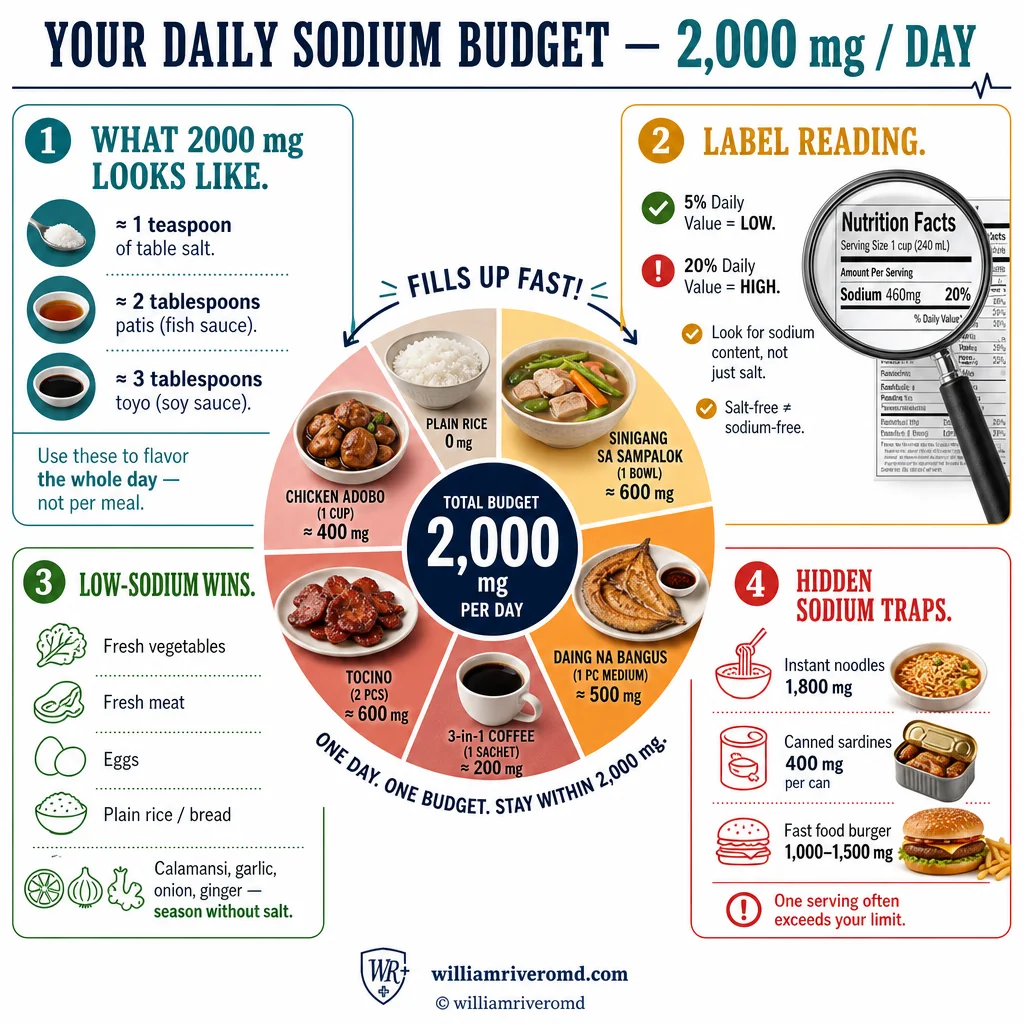
Daily Sodium Targets — Why They Matter in CKD
Daily sodium targets by CKD stage and the physiological reasons why sodium restriction matters
Fig. 1 — Daily sodium targets by CKD stage and the physiological reasons why sodium restriction matters: fluid retention, hypertension, proteinuria progression, and cardiovascular risk. As kidney function declines, the ability to excrete excess sodium diminishes — making dietary restriction increasingly important at every stage.
For educational use only · Not a substitute for individualized medical advice · williamriveromd.com williamriveromd.com
Page 2
Filipino Foods — Sodium Content Reference
Know Your Sodium Sources · All values per standard serving
Page 3 of 8 · williamriveromd.com
Food Serving Sodium Notes for CKD Patients
🔴 HIGH SODIUM — Avoid or severely limit (> 500 mg per serving)
Patis (fish sauce)1 tbsp (15 mL)1,190 mgMost used Filipino condiment — most dangerous source in CKD
Bagoong (shrimp paste)1 tbsp1,600 mgExtreme — avoid completely in CKD; also very high phosphorus
Instant mami / pancit canton1 pack1,800–2,200 mgEntire day's limit in one meal — never eat in CKD
Chicken / beef bouillon cube (Magic Sarap)1 cube950 mgHidden in most Filipino home cooking — major underestimated source
Toyo (soy sauce)1 tbsp920 mgSwitch to low-sodium soy sauce (Kikkoman Less Sodium: ~575 mg/tbsp)
Dried fish — tuyo, danggit, dilis1 piece / handful600–1,000 mgExtremely high — avoid in CKD; fresh fish is always the better choice
Spam / luncheon meat½ can (85 g)790 mgAlso very high in phosphorus additives — double threat in CKD
Hotdog / longganisa1 piece (60 g)500–700 mgProcessed meat — also high in phosphorus additives and saturated fat
Lechon / crispy pata100 g700–900 mgAlso high in potassium and phosphorus; avoid on feast days especially
🟡 MODERATE — Use carefully (100–500 mg per serving)
Oyster sauce1 tbsp490 mgUse sparingly; reduce other sodium sources on same meal
Canned sardines (undrained)½ can (55 g)380 mgRinse canned sardines 3× under water to reduce sodium by ~200 mg
Cheese — Eden, quick-melt (1 slice)1 slice (20 g)290 mgAlso high in phosphorus — limit in CKD 3–5
Instant oatmeal (flavored packet)1 pack250 mgUse plain unflavored oats — 0 mg sodium and much more kidney-friendly
Ketchup (banana ketchup)1 tbsp190 mgAlso high in sugar; use in moderation
White bread / pandesal1 piece160 mgHidden sodium — adds up quickly when eating 3–4 pieces at breakfast
🟢 LOW SODIUM — Safe choices (< 100 mg per serving)
Fresh bangus / tilapia (raw)100 g60–80 mgExcellent protein source — cook without added salt or patis
Fresh chicken (raw, no marinade)100 g75 mgAvoid pre-marinated commercial chicken (often ~400–600 mg sodium)
Fresh eggs1 large70 mgGood low-sodium protein; cook without added salt
Rice (cooked, plain)1 cup0 mgSodium-free staple — do not cook rice with salt
All fresh vegetables1 cup5–30 mgNaturally very low sodium — cook without salt, season with calamansi
Kamote, gabi, cassava1 serving (100 g)10–30 mgNaturally low sodium; boil without salt; check potassium in CKD 4–5
Sukang paombong (native vinegar)1 tbsp0 mgExcellent safe flavor substitute — use generously in dipping and cooking
Calamansi1 piece0 mgBest natural flavor enhancer in Filipino cooking — zero sodium
Garlic, onion, ginger (fresh)1 tsp0–2 mgUse generously as salt-free flavor base — the CKD cook's best friends
Sources: FNRI Philippine Food Composition Tables 2023 · USDA FoodData Central · Philippine FDA Nutrition Label Database 2024. All values are approximates per standard Philippine serving size.
FNRI Philippine Food Composition Tables 2023 · USDA FoodData Central · KDIGO CKD Guidelines 2024 · Educational use only. williamriveromd.com · Page 3 of 8
Sodium & Salt Reduction Guide for CKD W.G.M. Rivero MD · FPCP · DPSN · williamriveromd.com · 2026
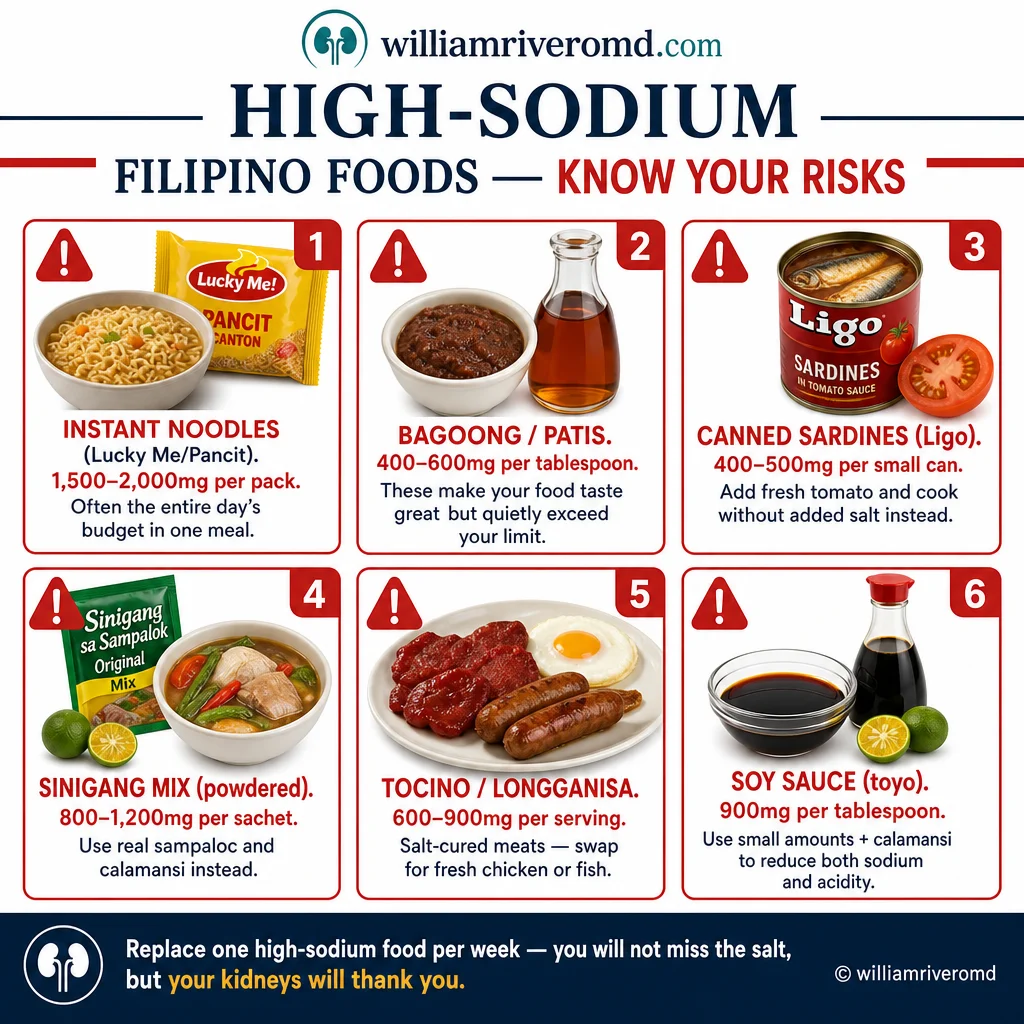
Filipino Foods — Sodium Content Map
Filipino foods ranked by sodium content per standard serving, color-coded by CKD safety
Fig. 2 — Filipino foods ranked by sodium content per standard serving, color-coded by CKD safety. Red = avoid, yellow = limit carefully, green = safe choices. Patis, bagoong, and instant noodles are the biggest sodium threats in the Filipino diet — often used together in a single meal, pushing sodium intake to 3× the daily CKD limit. Fresh fish, eggs, rice, and vegetables are naturally very low in sodium.
For educational use only · Not a substitute for individualized medical advice · williamriveromd.com williamriveromd.com
Page 4
Smart Cooking Swaps · Hidden Sodium Sources
Replace, Not Remove — Keeping Filipino Food Flavorful Without Salt
Page 5 of 8 · williamriveromd.com
🔄 Sodium-Saving Cooking Swaps
Instead of → Use This Sodium Saved
Patis (1 tbsp · 1,190 mg)Calamansi + garlic + black pepper~1,190 mg
Toyo / soy sauce (1 tbsp · 920 mg)Low-sodium soy sauce, ½ tbsp (Kikkoman)~630 mg
Magic Sarap / chicken cube (1 cube · 950 mg)Homemade ginger-garlic-onion broth base~900 mg
Instant mami / pancit canton (1 pack · 2,000 mg)Home-cooked bihon with fresh ingredients, no cube~1,600 mg
Bagoong (1 tbsp · 1,600 mg)Tiny sautéed shrimp with garlic + calamansi~1,400 mg
Table salt (1 tsp · 2,300 mg)Tanglad (lemongrass), dahon ng laurel, pandan, herbs~2,300 mg
Canned sardines undrained (380 mg)Rinse canned sardines 3× under cold water~200 mg
Processed cheese / Eden (290 mg/slice)Avocado (in moderation) or fresh coconut cream~250 mg
Oyster sauce (1 tbsp · 490 mg)Diluted low-sodium soy sauce + a drop of sesame oil~350 mg
🔍 Hidden Sodium Sources

⚠️ The Sneaky Sources Most CKD Patients Never Suspect

Instant coffee (Kopiko 3-in-1): 120 mg per sachet — drinking 3 cups = 360 mg before food.  |  Pandesal: 160 mg each — 4 pieces for breakfast = 640 mg.  |  Commercial kakanin (puto, suman, bibingka): 100–300 mg per piece from baking powder and salt.  |  Powdered juice drinks (Tang, Zesto): 30–80 mg per glass.  |  Restaurant meals: Jollibee palabok ~2,100 mg · McDonald's burger ~800 mg · carinderia nilaga (commercial broth base) ~1,200 mg.  |  Bread / tasty: 190 mg per slice — a baon sandwich = 380 mg before fillings.

🍽️ Eating Out — Sodium Survival Guide
🍗 Jollibee / Fast Food
  • Order: plain rice + grilled chicken (no sauce) + side salad (dressing on side)
  • Avoid: palabok, spaghetti, gravy, burgers, fries (all > 800 mg)
  • Ask for: sauce served separately; no salt on fries
  • Drink: water or plain iced tea — NOT softdrinks (some have sodium)
🥘 Carinderia / Turo-Turo
  • Order: plain rice + fried fish (not marinated) + pinakbet (without bagoong if possible)
  • Avoid: adobo (very high soy sauce), kare-kare with bagoong, sinigang (ask for less patis)
  • Ask for: no patis in your dish; calamansi instead
  • Best choice: tinola (ginger broth, low sodium if no cube used)
🍱 Home Cooking Tips
  • Cook: Use garlic, ginger, onion, calamansi, and vinegar as primary flavor builders
  • Replace: every recipe calling for 1 cube = use fresh aromatics + tiny pinch of low-sodium soy
  • Taste last: season at the very end — you use far less when added at the end
  • Remove: salt shaker from the dining table permanently
KDIGO CKD Nutrition Guidelines 2024 · WHO Global Sodium Guidelines 2023 · FNRI Philippine Food Composition Tables 2023 · Educational use only. williamriveromd.com · Page 5 of 8
Sodium & Salt Reduction Guide for CKD W.G.M. Rivero MD · FPCP · DPSN · williamriveromd.com · 2026
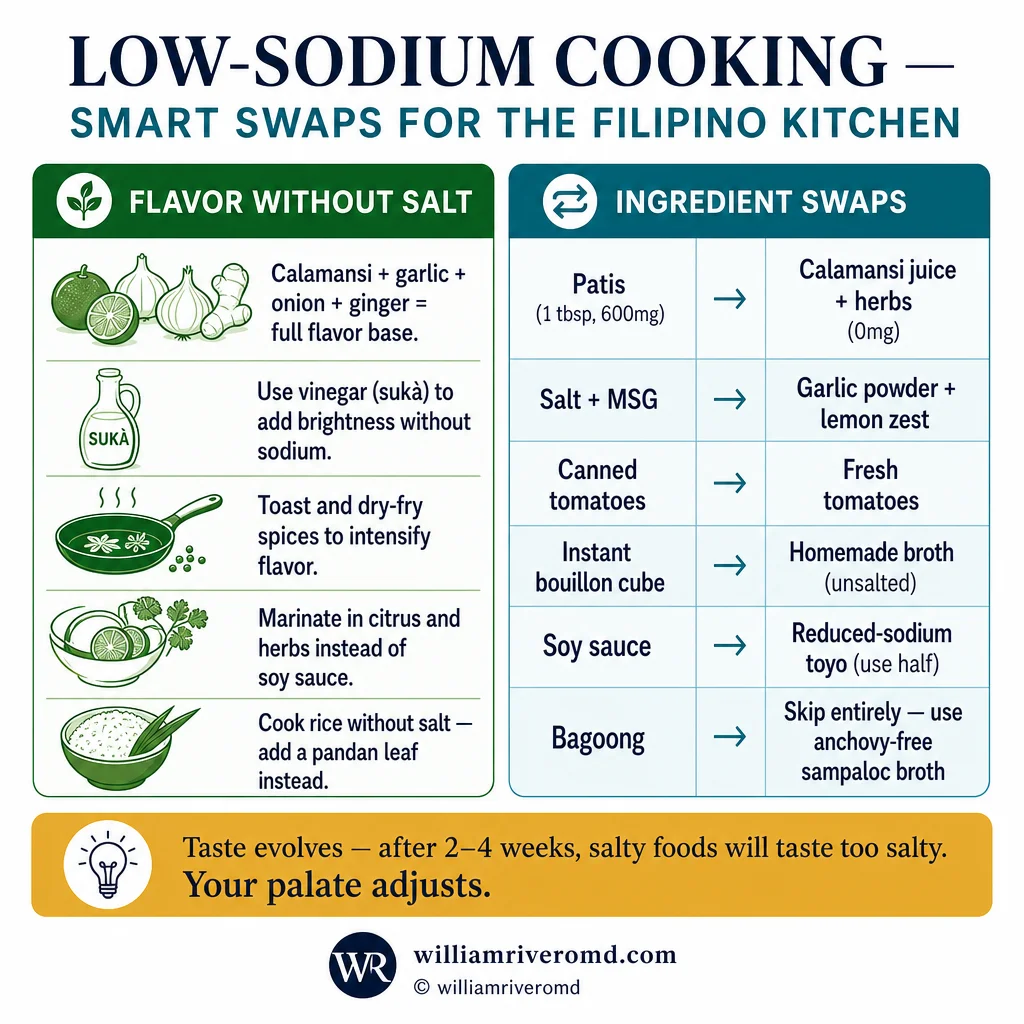
Smart Cooking Swaps — Keeping Filipino Food Flavorful
Practical cooking swaps that preserve Filipino food flavor while dramatically reducing sodium
Fig. 3 — Practical cooking swaps that preserve Filipino food flavor while dramatically reducing sodium. Calamansi, garlic, ginger, sukang paombong (native vinegar), tanglad (lemongrass), and fresh herbs are your best tools. The goal is not a bland diet — it is a flavorful diet built on aromatics rather than salt. Filipino cuisine has an incredibly rich aromatic tradition; sodium is a crutch, not a requirement.
For educational use only · Not a substitute for individualized medical advice · williamriveromd.com williamriveromd.com
Page 6
Sodium & Salt Reduction Guide for CKD W.G.M. Rivero MD · FPCP · DPSN · williamriveromd.com · 2026
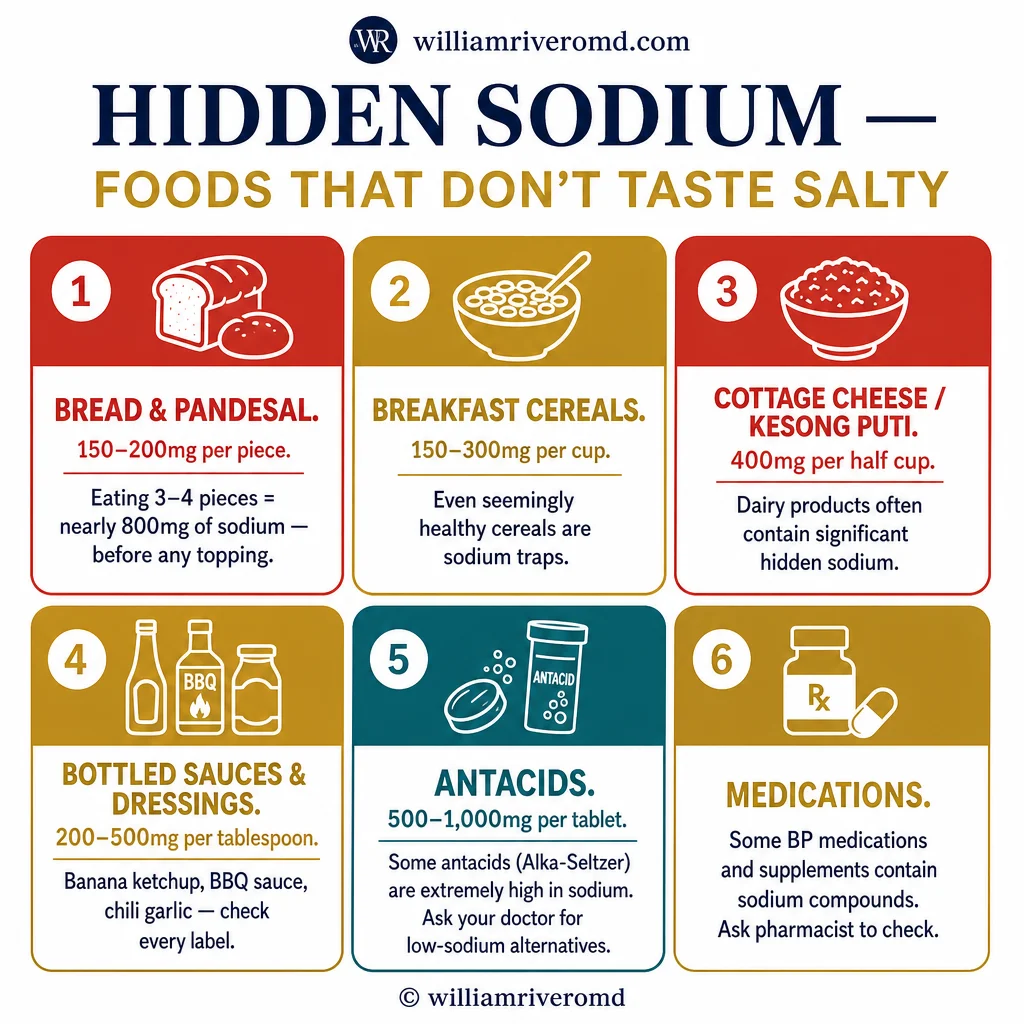
Hidden Sodium Sources — The Ones Patients Miss
Hidden sodium sources in the Filipino diet — instant coffee, bread, kakanin, powdered drinks, condiments
Fig. 4 — Hidden sodium sources in the Filipino diet that patients rarely suspect — instant coffee sachets, pandesal, commercial kakanin (puto, suman), powdered juice drinks, and condiments used as cooking bases rather than table condiments. Reading labels for "sodium" (not just "salt") is essential. Sodium is added to bread, instant drinks, and even kakanin as a preservative and flavor enhancer, making it invisible to patients who think they are "not adding salt."
For educational use only · Not a substitute for individualized medical advice · williamriveromd.com williamriveromd.com
Page 7
7-Day Reduction Plan · Label Reading · Salt Substitutes Warning
Start Today — One Change per Day · Reading Labels · Critical Safety Warnings
Page 8 of 8 · williamriveromd.com
📅 7-Day Sodium Reduction Plan — One Change per Day
Day Goal Action
1Remove salt shaker from tableReplace with calamansi halves + freshly ground black pepper at every meal. Taste food before reaching for any seasoning.
2No patis todayFlavor all food with fresh garlic, ginger, calamansi, and sukang paombong. Notice how much flavor is already in properly cooked food.
3Switch to low-sodium soy sauceBuy Kikkoman Less Sodium or similar. Use only ½ tablespoon maximum per dish. Keep the regular toyo out of reach.
4Cook sabaw / soup without bouillon cubeUse a ginger-garlic-onion broth base: simmer aromatics in water 20 minutes for full flavor. No Magic Sarap, no Knorr cube today.
5Check every label for sodiumRead every packaged food: target < 200 mg per serving. Calculate how many servings you actually eat — often 2–3× the label serving.
6No instant noodles — cook bihon insteadHome-cook bihon with fresh vegetables, a little chicken, garlic-onion base, and low-sodium soy. Saves ~1,600 mg of sodium.
7Family sodium auditReview the week with your family: which change was hardest? Which tasted surprisingly good? Plan which swaps to keep permanently.
🔖 Reading Nutrition Labels — 3 Things to Check
① Sodium per serving
Always check sodium per 100 g for honest comparison between products. A "low sodium" label means < 120 mg per 100 g. "Reduced sodium" means 25% less than the original product — which may still be very high.
② What counts as one serving?
Philippine food labels often list a "serving size" that is smaller than what people actually eat. A pack of instant noodles may say "2 servings" — but most Filipinos eat the whole pack. Always multiply the sodium value by actual servings consumed.
③ Look for hidden names
Sodium hides under many names: monosodium glutamate (MSG), sodium bicarbonate (baking soda), sodium benzoate (preservative), disodium phosphate. All count toward your daily limit. If sodium appears in the first 5 ingredients, the food is high in sodium.
⚠️ Critical Safety Warnings

⚠️ Salt Substitutes (KCl) Are Dangerous in CKD — Do NOT Use Without Nephrologist Approval

Products like NuSalt, NoSalt, and local potassium chloride (KCl) salt substitutes replace sodium with potassium. In CKD patients — especially stages 4–5 and dialysis — impaired potassium excretion means this extra potassium accumulates rapidly in the blood, potentially causing life-threatening hyperkalemia (high potassium): irregular heartbeat, cardiac arrest, and death. Do NOT use any salt substitute without explicit approval from your nephrologist. This warning applies even if you see them sold in health food stores or recommended for "heart health."

⚠️ MSG (Vetsin / Ajinomoto) Is NOT a Safe Sodium Substitute in CKD

MSG contains approximately 12% sodium by weight — compare to table salt at 39% sodium. While MSG allows you to use less salt for the same flavor intensity, 1 teaspoon of MSG still contributes approximately 492 mg sodium. It is not a free flavor enhancer in CKD. Some recipes use both salt AND MSG together, dramatically exceeding sodium limits. Use fresh aromatics (garlic, ginger, calamansi, tanglad) instead — these have zero sodium and superior flavor complexity.

For educational use only. This guide does not replace your nephrologist's or dietitian's individualized advice. Sodium targets vary by kidney function, medications, fluid status, and comorbidities. References: KDIGO 2024 · WHO Sodium Guidelines 2023 · Philippine NKTI Dietary Recommendations · Saran et al., CJASN 2017 · McMahon et al., JASN 2013. williamriveromd.com
Page 8 of 8 · williamriveromd.com/guides/sodium-salt-reduction-ckd