Potassium & Hyperkalemia Guide for CKD W.G.M. Rivero MD · FPCP · DPSN · · williamriveromd.com · 2026
Patient Education · Nephrology
Potassium & Hyperkalemia
in CKD
Why potassium rises in kidney disease, how to recognize danger levels, and which Filipino foods are safe — with emergency guidance and medication warnings. Covers all CKD stages, hemodialysis, and peritoneal dialysis.
🍌
W.G.M. Rivero MD
FPCP · DPSN
Nephrologist
williamriveromd.com
3.5–5.0
mEq/L Normal Range
>5.5
mEq/L Danger Zone
↑ Risk
Cardiac Arrhythmia
↓ Intake
Primary Treatment
Hyperkalemia (high blood potassium) is one of the most dangerous complications of CKD — and one of the most preventable with the right diet and monitoring.
1Why High Potassium Is Dangerous in CKD

Healthy kidneys filter excess potassium from the blood every day. When kidneys are damaged, potassium builds up — a condition called hyperkalemia. Even a small rise above normal can disturb the electrical signals that keep your heart beating regularly. At levels above 6.0 mEq/L, the risk of sudden cardiac arrest rises sharply.

❤️ Cardiac Effects of Hyperkalemia
  • Slows electrical conduction in heart muscle
  • Causes peaked T-waves on ECG (early sign)
  • Widens QRS complex → irregular heartbeat
  • Can progress to ventricular fibrillation
  • Sudden cardiac arrest — may have NO warning
⚠️ Symptoms Patients May Notice
  • Muscle weakness or heaviness in legs and arms
  • Palpitations or irregular heartbeat
  • Numbness or tingling in hands/feet
  • Nausea or stomach discomfort
  • Shortness of breath
  • Often NO symptoms at all — most dangerous
2Potassium Targets by CKD Stage
CKD Stage Target Serum K+ Dietary K+ Limit Key Note
Stage 1–2 (eGFR >60)3.5–5.0 mEq/LNo restriction neededMonitor annually; no limit unless K+ is elevated
Stage 3 (eGFR 30–59)3.5–5.0 mEq/L2,000–3,000 mg/dayModerate vigilance; avoid high-K foods if trending up
Stage 4–5 (eGFR <30)3.5–5.0 mEq/L1,500–2,000 mg/dayStrict restriction; leach all vegetables; frequent monitoring
Hemodialysis (HD)3.5–5.5 mEq/L2,000–2,500 mg/dayK+ rises between sessions; most dangerous the day before dialysis
Peritoneal Dialysis (PD)3.5–5.5 mEq/L2,500–3,000 mg/dayContinuous dialysis allows slightly more; monitor monthly

🚨 Critical Warning — Hyperkalemia Can Be Silent

Hyperkalemia can cause sudden cardiac arrest — it may have no warning symptoms at all. Many patients feel completely normal right up to the moment of a dangerous arrhythmia. Never skip lab monitoring. If your nephrologist orders a potassium check, it is not optional.

For educational use only. This guide does not replace individualized dietary advice from your physician or dietitian. References: KDIGO CKD 2024 · NKF KDOQI Nutrition 2020 · FNRI Philippine Food Composition Tables 2023. williamriveromd.com
Page 1 of 6 · williamriveromd.com/guides/potassium-hyperkalemia-ckd
Potassium & Hyperkalemia Guide for CKD W.G.M. Rivero MD · FPCP · DPSN · williamriveromd.com · 2026
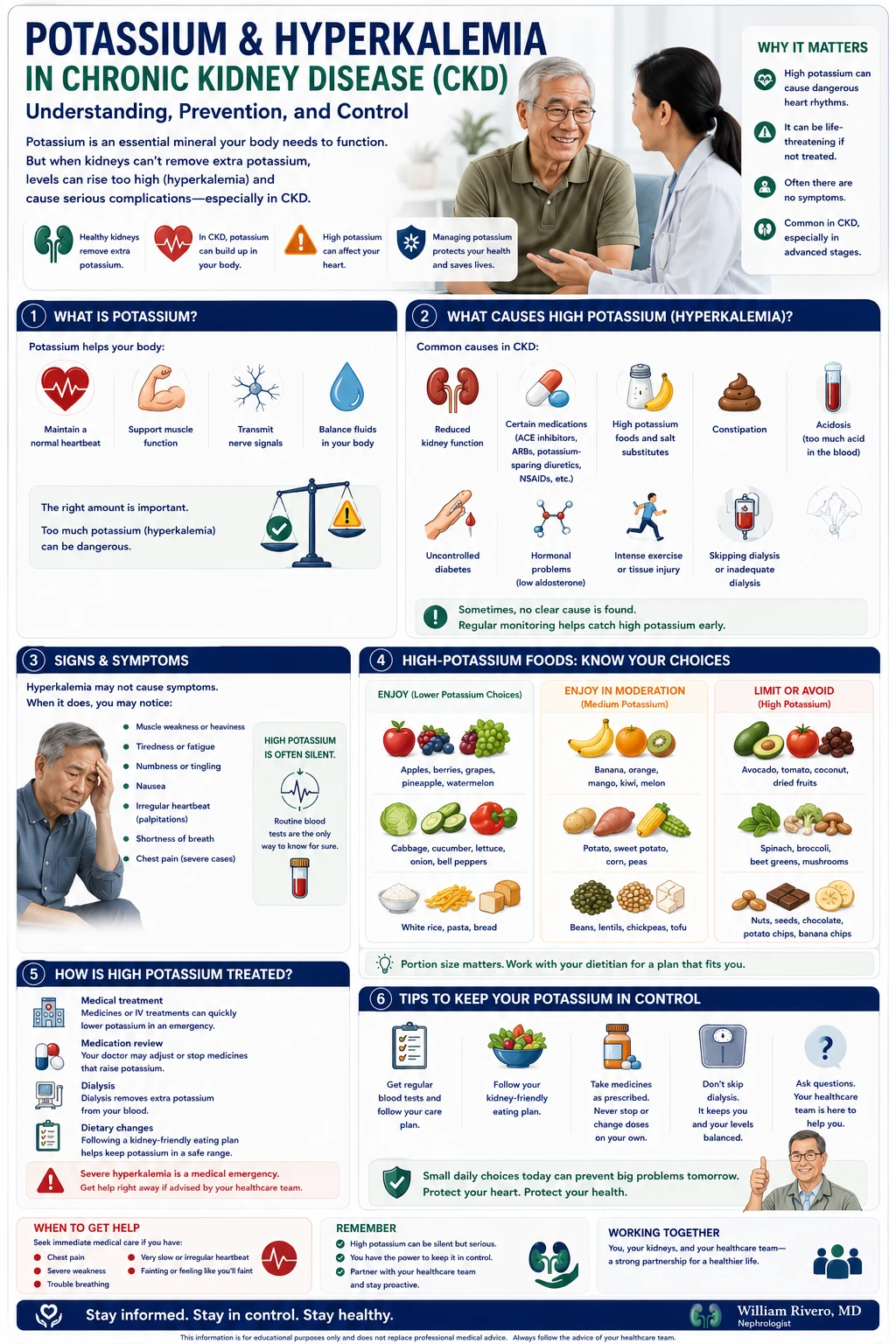
Hyperkalemia: Mechanism & Cardiac Risk in CKD
Hyperkalemia overview infographic — how potassium rises in CKD and its cardiac effects
Fig. 1 — In healthy kidneys, excess potassium from food is filtered and excreted in urine. When kidney function declines, this filtration fails and potassium accumulates in the bloodstream. As serum potassium rises above 5.5 mEq/L, the electrical balance across heart muscle cells is disrupted — leading to ECG changes (peaked T-waves, widened QRS), arrhythmias, and at levels above 6.5–7.0 mEq/L, potentially fatal ventricular fibrillation. Dietary restriction, potassium binders, and dialysis are the three pillars of treatment.
For educational use only · Not a substitute for individualized medical advice · williamriveromd.com williamriveromd.com
Page 2 of 6
Filipino Foods — Potassium Content Reference
Color-coded by potassium level · All values per standard serving · FNRI Philippine Food Composition Tables 2023
Page 3 of 6 · williamriveromd.com
Food (Filipino name) Standard Serving K+ (mg) Recommendation for CKD
🔴 HIGH POTASSIUM — >300 mg per serving · LIMIT SEVERELY in CKD 4–5 and Dialysis
Kamote tops / talbos ng kamote1 cup cooked950 mgAvoid entirely in CKD 4–5 and dialysis — extremely high K+
Buko water / coconut water1 cup (240 mL)600 mgAvoid — marketed as "healthy" but very high potassium; dangerous in CKD
Kalabasa / squash (cooked)1 cup cooked500 mgAvoid in CKD 4–5; small amounts (¼ cup) if leached in CKD 3
Avocado / abokado (½ fruit)½ medium487 mgAvoid in CKD 4–5 and dialysis; very high K+ per serving
Banana / lakatan (ripe)1 medium422 mgAvoid in CKD 4–5 and dialysis — one of the highest-K+ fruits available locally
Saging na saba (ripe, boiled)1 piece450 mgAvoid in CKD 4–5; 1 small unripe piece may be OK in CKD 3 with monitoring
Monggo / mung beans (boiled)½ cup cooked400 mgLeach before cooking; limit to ¼ cup in CKD 4–5; discuss with dietitian
Kamote / sweet potato (boiled)1 medium (150 g)400 mgLeach (peel, dice, soak 2 h, boil in fresh water) — reduces K+ 30–50%; avoid baked
Kangkong / water spinach (cooked)1 cup cooked350 mgLeach and boil; discard cooking water; limit portion to ½ cup in CKD 4–5
Calamansi juice (fresh, 1 cup)1 cup (240 mL)300 mgLimit to small amounts (¼ cup) as condiment only; avoid drinking by the glass
Tomato (fresh, medium)1 medium290 mgLimit — 1 slice OK as garnish; avoid tomato sauce, ketchup, and tomato soup
🟡 MODERATE POTASSIUM — 150–300 mg per serving · USE CAREFULLY in CKD 4–5
Ampalaya / bitter melon (cooked)1 cup cooked270 mgLeach before cooking; limit to ½ cup per meal in CKD 4–5
Bangus / milkfish (steamed)100 g280 mgGood protein source; prefer steamed/boiled over fried; discard cooking water
Gabi / taro (boiled)1 cup cooked250 mgPeel and leach; boil in fresh water; limit to ½ cup in CKD 4–5
Okra (cooked)1 cup cooked220 mgGenerally safe in CKD 1–3; limit to ½ cup in CKD 4–5; low phosphorus bonus
Sayote / chayote (cooked)1 cup cooked200 mgModerate K+; safe at 1 cup in CKD 1–3; reduce to ½ cup in CKD 4–5
Pechay / bok choy (cooked)1 cup cooked200 mgModerate — boil and discard water; limit to ½ cup in CKD 4–5
Egg (large, boiled)1 large70 mgGood low-K protein source; 1–2 eggs/day generally safe in most CKD stages
🟢 LOW POTASSIUM — <150 mg per serving · GENERALLY SAFE for CKD
White rice (kanin, cooked)1 cup cooked55 mgSafest staple — very low K+ and phosphorus; ideal base for a kidney diet
Cassava / kamoteng kahoy (boiled)1 cup boiled75 mgLow K+ when boiled and drained; good kamote substitute for CKD patients
Upo / bottle gourd (cooked)1 cup cooked100 mgExcellent low-K vegetable; safe for all CKD stages; good in sinigang and soups
Alugbati / Malabar spinach (cooked)1 cup cooked140 mgLower K+ than kangkong; good leafy green alternative for CKD; boil and drain
Sago (cooked, plain)1 cup0 mgZero potassium; good calorie source for CKD; avoid sweetened versions with milk
Cooking oil (canola, corn)1 tbsp0 mgNo potassium; prefer canola or olive oil; limit total fat per physician's advice
K+ values are approximate per serving. Cooking method greatly affects final potassium content — boiling and discarding cooking water reduces K+ by 30–50%. Sources: FNRI Philippine Food Composition Tables 2023 · USDA FoodData Central · NKF KDOQI Nutrition 2020.
FNRI Philippine Food Composition Tables 2023 · KDIGO CKD 2024 · NKF KDOQI Nutrition 2020 · Educational use only. williamriveromd.com · Page 3 of 6
Reducing Potassium Through Cooking · Daily Meal Planning
Leaching technique · Food swaps · Sample low-potassium Filipino day
Page 4 of 6 · williamriveromd.com
🍳 The Leaching Technique — How to Reduce Potassium in Vegetables
Peel & Cut Small
Peel vegetables and cut into small thin pieces. More surface area = more potassium released into water.
Soak 2+ Hours
Soak in a large amount of water (10:1 ratio). Change the water at least once during soaking.
Drain & Rinse
Drain completely and rinse well with fresh water. Discard all soak water — it is now loaded with potassium.
Boil in Fresh Water
Boil in a new large pot of water. Discard the cooking water too — do not use as broth or soup base.
30–50% Reduction
Leaching reduces potassium by 30–50% depending on the food. Best for root crops and leafy vegetables.

⚠️ Important: Leaching Limits

Leaching works best for root crops (kamote, gabi, cassava) and leafy vegetables (kangkong, pechay, ampalaya). It does NOT work well for fruits — avoid high-potassium fruits entirely if your potassium level is elevated. Leaching also reduces some vitamins — compensate by eating a varied diet of approved low-K foods.

🔄 Food Swap Guide — High-K Foods → Lower-K Alternatives
Instead of (High K+) K+ (mg) Choose This (Lower K+) K+ (mg) Notes
Saging na saba (1 piece)450Cassava / kamoteng kahoy (boiled, 1 cup)75Good carb swap; boil and drain thoroughly
Avocado (½ fruit)487Papaya (small serving, ½ cup)~180Papaya is still moderate-K; limit to ½ cup in CKD 4–5
Kamote tops / talbos (1 cup)950Upo / bottle gourd (1 cup cooked)100Excellent low-K leafy substitute; safe for all CKD stages
Buko water (1 cup)600Plain water or tap water0Buko water is NOT safe for CKD — avoid completely
Monggo soup (½ cup cooked)400Sayote + tofu (½ cup each, leached)~200Lower K+ protein-vegetable combo; leach sayote before use
Banana / lakatan (1 medium)422Canned fruit in own juice (drained, ½ cup)~100Draining canned fruit removes additional K+; avoid syrup packs
🍽 Sample Low-Potassium Filipino Day — For CKD Stage 4–5 / Hemodialysis
Meal Food K+ (est.) CKD Notes
Breakfast1 cup white rice + 1 boiled egg + sautéed upo (½ cup, boiled and drained) + water~200 mgVery low K+; excellent kidney-safe breakfast
SnackSago (½ cup, plain, unsweetened) + plain water~5 mgZero K+ snack; good calorie source without potassium burden
Lunch1 cup white rice + grilled bangus (100 g) + leached sayote (½ cup boiled) + pechay (½ cup, boiled, water discarded)~500 mgModerate — acceptable at lunch; leach all vegetables
AfternoonCanned fruit (drained, ½ cup) in own juice — not syrup~100 mgDraining canned fruit removes K+; avoid heavy syrup packs
Dinner1 cup white rice + steamed tilapia or galunggong (100 g) + stir-fried alugbati (½ cup, boiled first, water discarded)~400 mgLow-K dinner; always discard all cooking water
TOTALFull day — kidney-safe low-potassium Filipino menu~1,205 mgWell within 1,500–2,000 mg limit for CKD 4–5

🩺 Individualized Restriction — Do Not Self-Restrict Unnecessarily

Potassium restriction is individualized — your nephrologist sets your limit based on your current serum K+ level and CKD stage. Do not restrict severely if your potassium is normal (3.5–5.0 mEq/L). Too-low potassium (hypokalemia) is also dangerous. Always follow your doctor's specific dietary instructions.

NKF KDOQI Nutrition 2020 · KDIGO CKD 2024 · FNRI 2023 · Educational use only. williamriveromd.com · Page 4 of 6
Recognizing Hyperkalemia · When to Seek Help · Medications
Symptoms · Emergency thresholds · Drugs that raise or lower potassium
Page 5 of 6 · williamriveromd.com
⚠️ Symptoms of Hyperkalemia — Know the Warning Signs
💪
Muscle Weakness / Fatigue
Heavy, weak feeling in arms and legs — especially thighs. May feel like you cannot stand or climb stairs. Often the earliest symptom patients notice.
💓
Palpitations / Irregular Heartbeat
Fluttering, pounding, or skipping sensations in the chest. Irregular heartbeat (arrhythmia) — may feel like the heart is "jumping." Seek care immediately.
🖐️
Numbness / Tingling
Pins-and-needles sensation in hands, feet, and around the mouth. High potassium disrupts nerve signal transmission throughout the body.
🤢
Nausea
Stomach discomfort, nausea, or vomiting — non-specific but often accompanies elevated potassium, especially in acute rises.
😮‍💨
Difficulty Breathing
Shortness of breath at rest or with minimal activity — can indicate severe hyperkalemia affecting respiratory muscles. Seek emergency care immediately.
NO SYMPTOMS — Most Dangerous
Many patients with K+ above 6.0 mEq/L feel completely normal. Sudden cardiac arrest can occur without any warning. This is why lab monitoring is non-negotiable.

🚑 Go to the Emergency Room Immediately If:

  • Chest pain or pressure
  • Irregular heartbeat or palpitations that do not stop
  • Severe or sudden muscle weakness — cannot move legs/arms normally
  • Difficulty breathing at rest
  • Serum K+ >6.0 mEq/L on home or clinic monitoring
  • You missed a dialysis session and feel any of the above symptoms
💊 Medications & Potassium — What Raises and What Lowers K+
🔴 Drugs That RAISE Potassium — Monitor Carefully
Drug (Generic Name) Filipino Brand / Note
ACE inhibitors
enalapril, lisinopril, captopril
Vasotec, Zestril, Capoten — essential for CKD but block K+ excretion; monitor K+ monthly
ARBs
losartan, valsartan, telmisartan
Cozaar, Diovan — similar to ACE inhibitors; never combine ACEi + ARB in CKD
Potassium-sparing diuretics
spironolactone, eplerenone
Aldactone — blocks aldosterone; use with extreme caution in CKD 4–5
NSAIDs
mefenamic acid, ibuprofen, naproxen
Ponstan, Advil — reduce kidney K+ excretion AND worsen kidney function; avoid in CKD
Trimethoprim
(in co-trimoxazole / Bactrim)
Blocks K+ excretion like a diuretic; monitor K+ during use
Potassium supplements
KCl oral tablets/solutions
Kalium Durules — never self-supplement in CKD; only take if prescribed
🟢 Treatments That LOWER Potassium — Only as Prescribed
Treatment Notes
Sodium polystyrene sulfonate
(Kayexalate)
Oldest binder; exchanges sodium for K+ in gut; available locally; take with water; not for long-term use
Patiromer
(Veltassa)
Newer K+ binder; exchange resin; well-tolerated; limited availability in Philippines
Sodium zirconium cyclosilicate
(Lokelma)
Newer zirconium-based binder; fast-acting; once daily; limited availability locally
Loop diuretics
furosemide, torsemide
Lasix — increases K+ excretion via urine; used in CKD with residual kidney function
Sodium bicarbonateCorrects acidosis which causes K+ to shift out of cells; used in CKD with metabolic acidosis
Dialysis (HD or PD)Most effective K+ removal — HD removes 40–80 mEq per session; never miss sessions

🔑 Key Medication Rule for CKD Patients

Never stop a prescribed ACE inhibitor or ARB on your own — they protect your kidneys even though they raise potassium slightly. Instead, manage potassium through diet and discuss with your nephrologist whether a potassium binder is needed. Never take NSAIDs (mefenamic acid, ibuprofen) without your doctor's approval — they worsen kidney function AND raise potassium simultaneously.

KDIGO CKD 2024 · NKF KDOQI Nutrition 2020 · MIMS Philippines 2025 · Kovesdy CP et al. JASN 2022 · Educational use only. Medication advice must be individualized by your physician. williamriveromd.com
Page 5 of 6 · williamriveromd.com/guides/potassium-hyperkalemia-ckd
Quick Reference · Key Takeaways · When to Call Your Doctor
Summary card · Most important rules · Monitoring schedule
Page 6 of 6 · williamriveromd.com
🚦 Quick Reference — Potassium Level Action Guide
Serum K+ Level Status What to Do
3.5–5.0 mEq/L✅ NormalContinue current diet. Recheck as scheduled (every 1–3 months in CKD).
5.1–5.5 mEq/L⚠️ Mild HighTighten dietary restriction. Review all medications. Recheck in 1–2 weeks. Call your nephrologist.
5.6–6.0 mEq/L🔶 ModerateContact nephrologist same day. Strict dietary restriction. May need potassium binder. ECG monitoring.
>6.0 mEq/L🚨 DangerGo to the EMERGENCY ROOM immediately. Risk of sudden cardiac arrest. Call for help — do not drive alone.
>6.5 mEq/L🚑 Life-threateningMedical emergency. IV calcium gluconate, IV insulin + glucose, emergency dialysis may be needed.
✅ Key Takeaways — The Most Important Rules

🍌 The "Banana Rule" for CKD Patients

Bananas, buko water, and kamote tops are the three most common potassium mistakes Filipino CKD patients make — all are perceived as "healthy" but are among the highest-K+ foods available. Avoid all three if your potassium is elevated. Also avoid sports drinks (Gatorade, Pocari Sweat) and salt substitutes — both contain potassium.

⚠️ Never Miss Dialysis

For dialysis patients, skipping even one session allows potassium to accumulate to dangerous levels — especially over the Monday–Wednesday gap (3 days off). Restrict potassium most strictly during the longest inter-dialytic gap. The day before dialysis is the highest-risk period.

🧂 Hidden Potassium Sources

  • Salt substitutes (NoSalt, Nu-Salt) — contain potassium chloride; dangerous in CKD
  • Sports drinks (Gatorade, Pocari Sweat) — contain added K+
  • Fruit juices and smoothies — concentrated K+ from multiple fruits
  • Herbal supplements and "natural" health drinks — may contain high K+

🌾 Safest Filipino Staples for CKD

  • White rice — lowest K+ of all staples; ideal base food for any CKD stage
  • Upo / bottle gourd — excellent low-K vegetable; good for soups
  • Cassava (boiled and drained) — good carbohydrate alternative to kamote
  • Sago (plain, unsweetened) — zero K+; good calorie source
  • Alugbati — safer leafy green alternative to kangkong
  • Eggs (1–2 daily) — low-K protein; generally safe in most CKD stages
  • White fish (steamed or boiled) — moderate K+; always discard cooking water

📅 Monitoring Schedule

  • CKD Stage 1–3: Serum K+ every 3–6 months
  • CKD Stage 4–5: Serum K+ every 1–3 months
  • Hemodialysis: Pre-dialysis K+ every session (3× per week)
  • Peritoneal Dialysis: Serum K+ every 1–2 months
  • If K+ was recently elevated: recheck in 1–2 weeks
  • After changing diet or medications: recheck in 2–4 weeks

📞 Call Your Nephrologist If:

  • K+ result is above 5.5 mEq/L on any lab result
  • New muscle weakness or palpitations develop
  • You started a new medication (especially ACEi/ARB or NSAID)
  • You are unsure if a food or supplement is safe to eat
  • You have had severe vomiting, diarrhea, or inability to eat
Dr. W.G.M. Rivero MD · FPCP · DPSN ·
Nephrology & Internal Medicine · williamriveromd.com
This guide is for patient education only. Potassium targets and dietary limits are individualized — always follow your nephrologist's specific instructions. References: KDIGO CKD 2024 · NKF KDOQI Nutrition 2020 · Kovesdy CP et al. JASN 2022 · FNRI Philippine Food Composition Tables 2023 · MIMS Philippines 2025.
For educational use only. This guide does not replace individualized care from your nephrologist or dietitian. Potassium targets, medication decisions, and dietary limits must be set by your physician based on your lab results. References: KDIGO CKD 2024 · NKF KDOQI Nutrition 2020 · FNRI 2023. williamriveromd.com
Page 6 of 6 · williamriveromd.com/guides/potassium-hyperkalemia-ckd