Fiber-Rich Filipino Food Guide W.G.M. Rivero MD · FPCP · DPSN · · williamriveromd.com · 2026
Patient Education Guide · Nephrology & Internal Medicine
Fiber-Rich Filipino
Food Guide
Why fiber is your most powerful food tool — and how to get enough of it from everyday Filipino meals. Covers kidney disease, diabetes, constipation, gout, and more.
🌱
W.G.M. Rivero MD
FPCP · DPSN
Nephrologist
williamriveromd.com
25 g
Women target / day
38 g
Men target / day
14–18 g
Average Filipino gets
~30%
↓ Heart disease risk
14 g
= 1,000 kcal rule of thumb
Most Filipinos get only 14–18 g/day — roughly half the recommended target. Adding monggo soup 3× a week can close that gap.
1The Two Types of Fiber — and What Each One Does
💧 Soluble Fiber
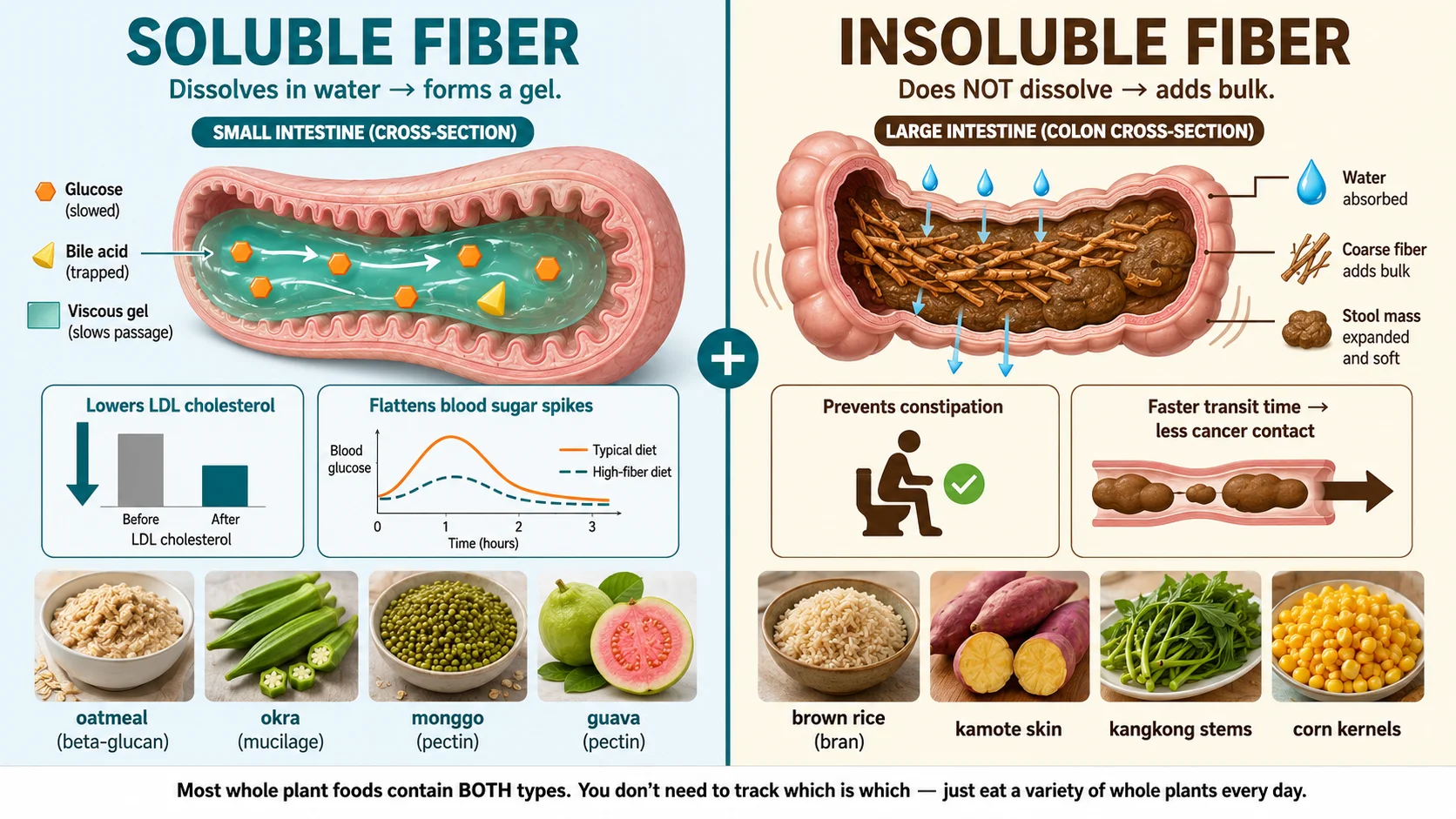
Dissolves in water → forms a thick gel in your gut
How it works: the gel slows stomach emptying, traps bile acids (cholesterol), and buffers glucose absorption.
✓ Lowers LDL cholesterol — traps bile acids so the liver must pull LDL from blood to make new ones.
✓ Flattens blood sugar spikes — slows carb absorption after every meal.
✓ Feeds gut bacteria → they produce short-chain fatty acids (butyrate, propionate) that reduce inflammation.
Filipino sources: oatmeal (beta-glucan), okra (mucilage), monggo / beans (pectin), guava (pectin), chia seeds, psyllium
🌾 Insoluble Fiber
Does NOT dissolve → adds bulk and speed to stool
How it works: absorbs water like a sponge, expands stool, and speeds transit through the colon.
✓ Prevents and treats constipation — softens stool, reduces straining.
✓ Reduces colon cancer risk — faster transit = less time for carcinogens to contact the colon wall.
✓ Reduces uremic toxin load — in CKD, faster transit reduces p-cresol and indoxyl sulfate production by gut bacteria.
Filipino sources: brown rice (bran), kamote skin, kangkong stems, corn kernels, whole wheat, sitaw, talong skin

Most whole Filipino foods contain both types. You don't need to track which is which — just eat a variety of whole plants every day. Whole prunes and psyllium husk contain both types in useful proportions.

2Fiber's Three Jobs in Your Body
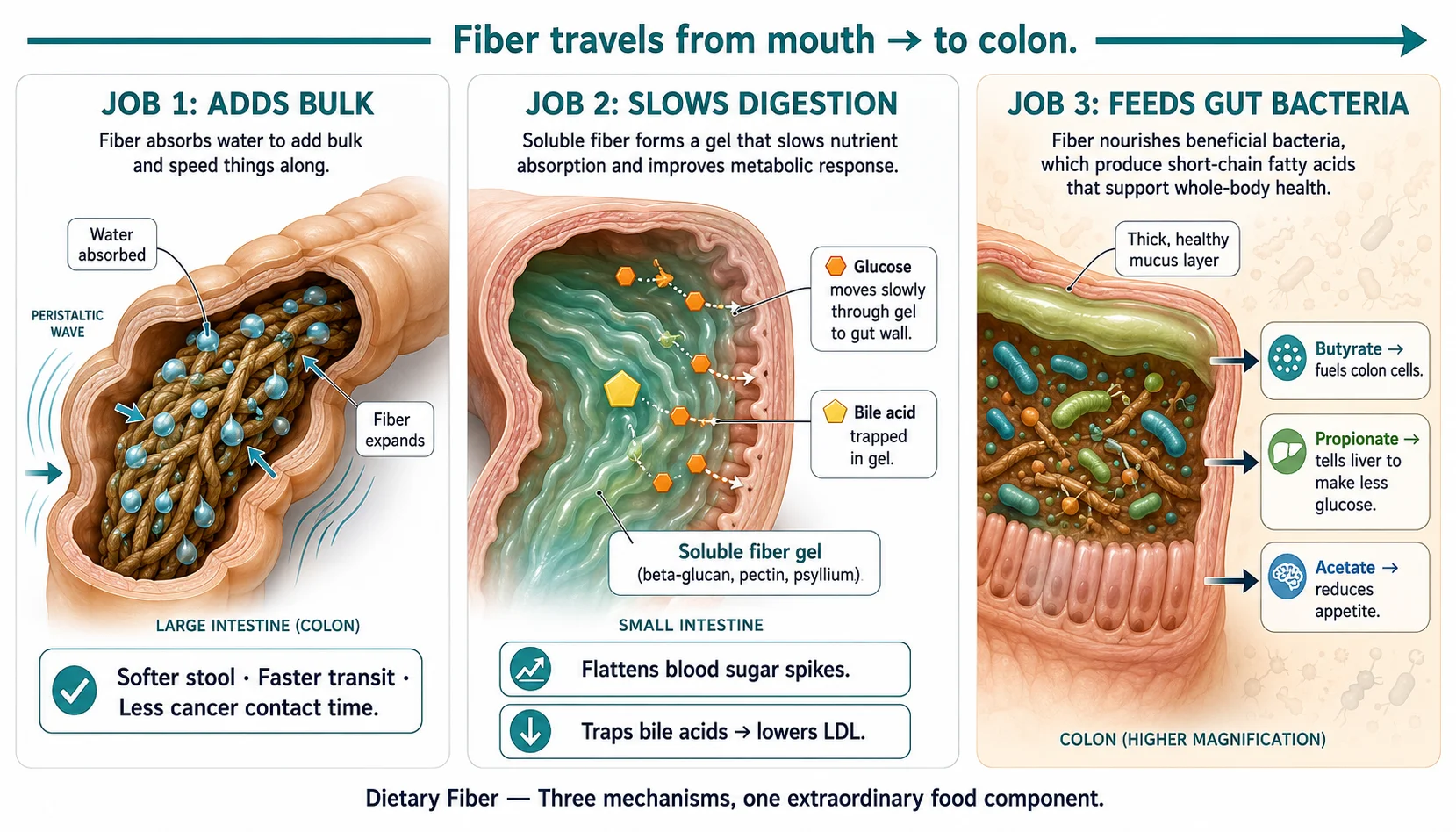
Adds Bulk & Speeds Transit
Insoluble fiber absorbs water in the large intestine, expanding stool and triggering peristaltic waves. Stool moves faster → less time for toxins to sit against the colon wall.
✓ Softer stool · Faster transit · Less cancer contact time
Slows Digestion & Absorption
Soluble fiber gel slows gastric emptying. Glucose enters the bloodstream more gradually → lower post-meal spikes. Bile acids get trapped in the gel → excreted instead of reabsorbed → liver pulls LDL from blood.
✓ Flattens blood sugar · ↓ LDL cholesterol
Feeds Gut Bacteria (Prebiotics)
Fiber ferments in the colon, feeding beneficial bacteria. They produce short-chain fatty acids: butyrate (fuels colon cells, reduces inflammation), propionate (tells liver to make less glucose), acetate (reduces appetite).
✓ Healthy gut lining · ↓ Inflammation · ↓ Toxins in CKD
3Proven Health Benefits — What the Evidence Shows
Condition What fiber does Evidence Best fiber source
Heart disease↓ LDL 5–10% per 5–10 g soluble fiber/day; lowers blood pressureStrong ✓✓✓Oats, monggo, okra, psyllium
Type 2 Diabetes↓ post-meal glucose spikes; improves insulin sensitivity over time; ↓ HbA1c 0.5–1%Strong ✓✓✓Oats, chia, monggo, okra, sitaw
Chronic Kidney Disease↓ uremic toxins (p-cresol, indoxyl sulfate); slows CKD progression; ↓ inflammationModerate ✓✓Oats, okra, psyllium, white rice + psyllium
Colon cancer↓ risk ~10% per 10 g/day; faster transit = less carcinogen contact timeStrong ✓✓✓Brown rice, kamote, whole vegetables
ConstipationSoftens stool; reduces straining; more effective than stool softeners aloneStrong ✓✓✓Psyllium (C-Lium), prunes, oats + water
Weight / obesityIncreases satiety; reduces total caloric intake; ↓ visceral fat over timeModerate ✓✓Any high-fiber whole food; chia in water
Mortality (all-cause)Highest fiber intake quartile → ~15–20% lower all-cause mortality vs. lowest quartileStrong ✓✓✓Whole grains + legumes + vegetables daily
For educational use only. This guide does not replace individualized dietary advice from your physician or dietitian. References: ADA Standards of Care 2025 · KDIGO 2024 CKD Guidelines · Reynolds et al., Lancet 2019 · Baxter et al., Am J Clin Nutr 2019 · FNRI Philippine Food Composition Tables 2023. williamriveromd.com
Page 1 of 4 · williamriveromd.com/guides/fiber-patient-education
Fiber-Rich Filipino Food Guide W.G.M. Rivero MD · FPCP · DPSN · williamriveromd.com · 2026
The Two Types of Fiber — Soluble vs Insoluble
Soluble vs insoluble fiber: sources, what they do, and kidney-safe Filipino food examples
Fig. 1 — Soluble fiber (oats, monggo, okra) dissolves in water to form a gel that slows glucose absorption and lowers cholesterol. Insoluble fiber (kangkong, pechay, kamote skin) adds bulk and speeds gut transit. Most Filipino foods contain both — eat a variety for full benefit.
For educational use only · Not a substitute for individualized medical advice · williamriveromd.com williamriveromd.com
Page 2
Fiber-Rich Filipino Food Guide W.G.M. Rivero MD · FPCP · DPSN · williamriveromd.com · 2026
Fiber's Three Jobs in Your Body
Fiber's three jobs: slow glucose, lower cholesterol, improve bowel regularity
Fig. 2 — Fiber's three primary mechanisms: (1) slowing glucose absorption to reduce post-meal blood sugar spikes, (2) binding cholesterol in the gut to lower LDL, and (3) adding bulk to stool to prevent constipation — a common problem in CKD and dialysis patients.
For educational use only · Not a substitute for individualized medical advice · williamriveromd.com williamriveromd.com
Page 3
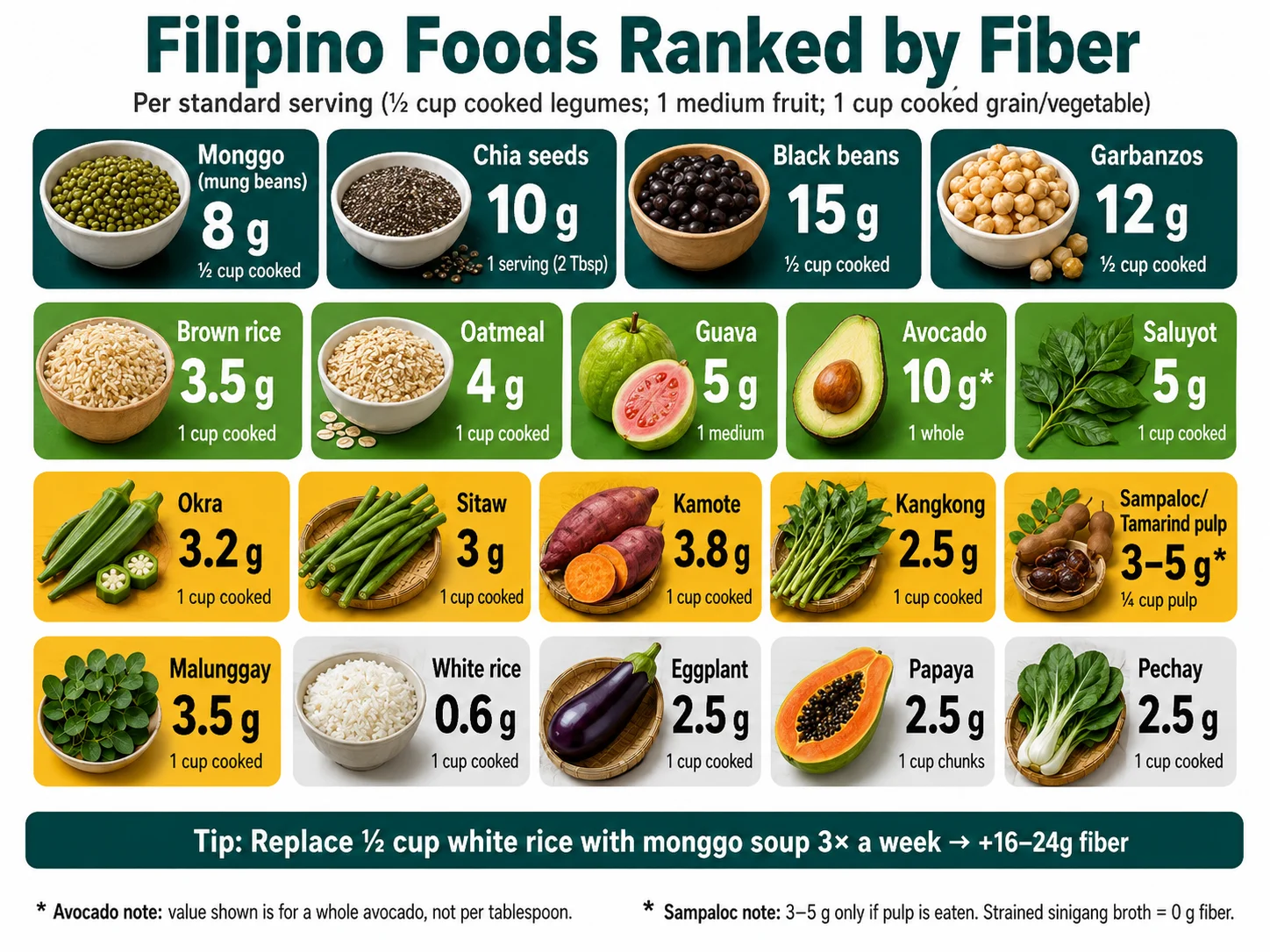
Filipino Foods Ranked by Fiber Content
With CKD / Dialysis Safety Notes · All values per standard serving
Page 2 of 4 · williamriveromd.com
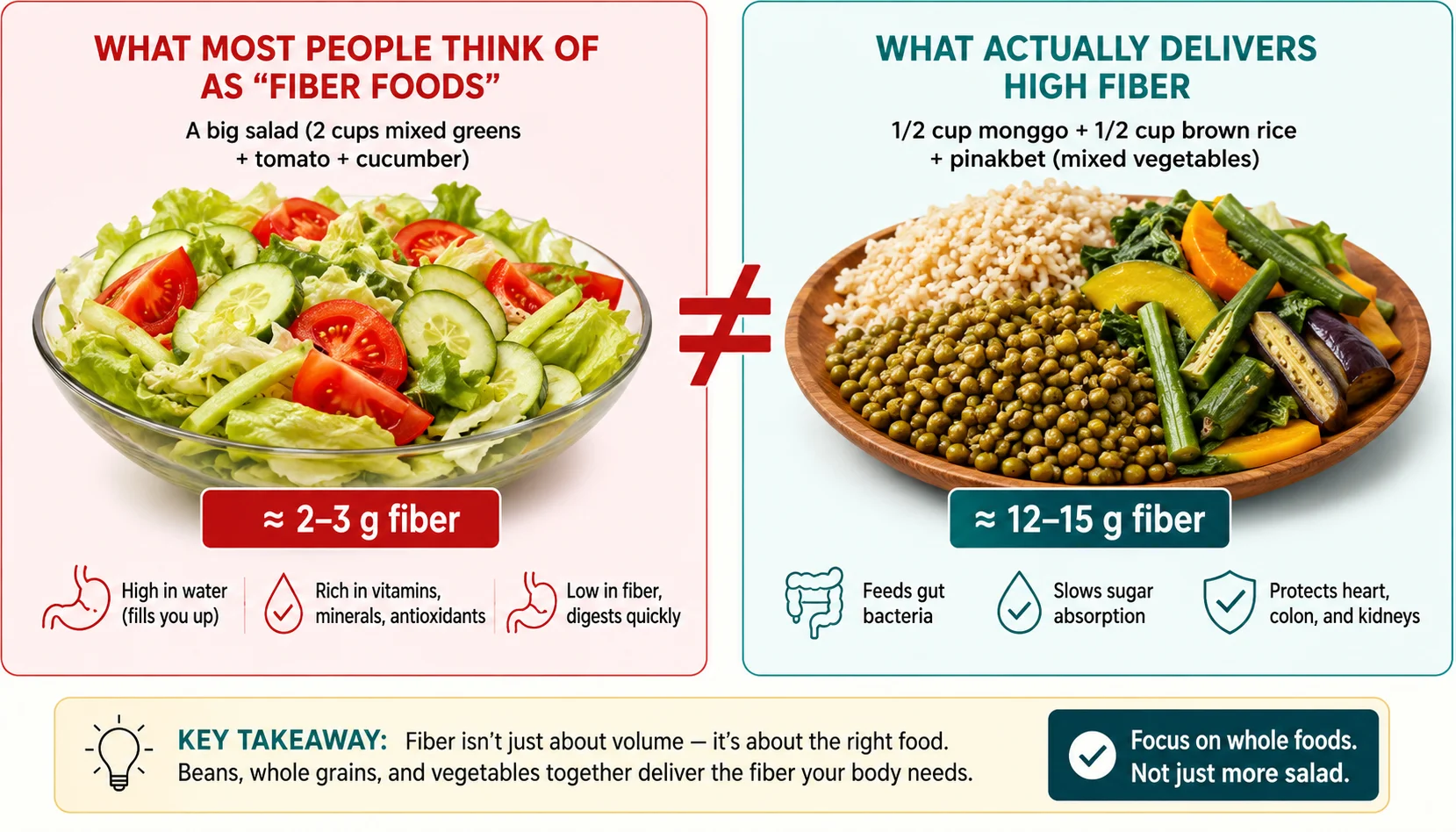
The Fiber Myth — What Most Patients Get Wrong
"A big green salad ≈ 2–3 g fiber.  ½ cup monggo soup ≈ 8 g fiber.   1 medium guava ≈ 5 g fiber.   Fiber ≠ volume of vegetables eaten."
Food (Filipino name) Standard Serving Fiber K level P level CKD / Dialysis Note
🟢 VERY HIGH — ≥ 8 g fiber per serving · Powerhouse choices
Black beans (itim na beans, boiled)½ cup cooked15 gHIGHHIGHCKD 4–5 / dialysis: Limit — leach before cooking, discuss amount with dietitian
Garbanzos / chickpeas (boiled)½ cup cooked12 gHIGHHIGHCKD 4–5 / dialysis: Limit — high K and P; OK in small portions in earlier CKD
Chia seeds2 tbsp (28 g)10 gLOWMODGenerally kidney-friendly in 1–2 tbsp doses; stir into lugaw, water, or oatmeal
Avocado / abokado (whole fruit)1 whole10 gVERY HIGHLOWCKD 4–5 / dialysis: limit to ½ avocado — very high potassium despite low phosphorus
Monggo / mung beans (boiled)½ cup cooked8 gMODMODCKD 4–5 / dialysis: limit portion; leach by boiling in fresh water; OK 2× / week
Prunes / dried plums5–6 pieces (100 g)7 gHIGHMODCKD 4–5 / dialysis: limit to 2–3 pieces — high potassium; good constipation remedy for earlier CKD
🟡 HIGH — 4–7 g fiber per serving · Excellent everyday choices
Guava / bayabas (with skin)1 medium5 gMODLOWCKD 4–5 / dialysis: moderate K — limit to ½ guava; earlier CKD: excellent daily fruit
Saluyot / jute leaves (cooked)1 cup cooked5 gLOWLOWVery kidney-friendly — low K and P; excellent leafy green for dialysis patients
Oatmeal / rolled oats (cooked)1 cup cooked4 gLOWLOWBest staple carb for CKD + diabetes; beta-glucan lowers LDL; kidney-safe at 1 cup/day
Oat bran½ cup cooked6–8 gLOWLOWHighest beta-glucan per gram; use in porridge or mix with oatmeal; kidney-friendly
Flaxseed / linseed (ground)2 tbsp5–6 gLOWMODUse ground form for absorption; omega-3 bonus; safe in CKD 1–3; limit in CKD 4–5
Brown rice1 cup cooked3.5 gLOWSLIGHTLY ↑CKD: slightly more P than white rice; OK in CKD 1–3; white rice + psyllium preferred in CKD 4–5
🟠 MODERATE — 2–4 g fiber per serving · Good contributors to daily total
Okra (steamed or in sinigang)1 cup cooked3.2 gLOWLOWSafest high-fiber vegetable for CKD/dialysis; viscous mucilage also lowers blood sugar
Kamote / sweet potato (boiled)1 medium (150 g)3.8 gMOD–HIGHLOWBoil and drain; leach in large water — reduces K by 30–50%; baking raises K; OK in CKD 1–3
Saba banana (boiled, slightly unripe)1 medium3.5 gMODLOWCKD 4–5: limit 1 piece; unripe = higher resistant starch + lower sugar + lower K than ripe
Malunggay / moringa leaves (cooked)1 cup3.5 gLOWLOWLow K and P; anti-inflammatory; excellent in tinola, sinigang, and monggo; safe for CKD/dialysis
Sitaw / yard-long beans (cooked)1 cup cooked3 gLOWLOWLow K and P; kidney-safe; pairs well with fish and rice; good everyday vegetable
Sampaloc / tamarind pulp (eaten)¼ cup pulp3–5 gHIGHLOWOnly if pulp is eaten — strained sinigang broth = 0 g fiber. High K in pulp; limit in CKD 4–5
Kangkong / water spinach (ginisa)1 cup cooked2.5 gLOWLOWSafe for CKD/dialysis; good daily leafy green; sauté in small canola oil + garlic
Pako / fern salad1 cup2.5 gLOWLOWLow K; generally safe; eat with vinegar-garlic dressing (no bagoong in CKD)
⬜ LOW — < 2 g fiber per serving · Count these as bonuses, not main sources
Eggplant / talong (cooked)1 cup cooked2.5 gLOWLOWLow K and P; kidney-safe; good in pinakbet and kare-kare
Pechay / bok choy (cooked)1 cup cooked2.5 gLOWLOWLow K and P; very kidney-safe; good in sinigang and soups
Papaya / hinog na papaya1 cup chunks2.5 gLOW–MODLOWLow K; enzyme papain may aid digestion; OK for most CKD stages in normal portions
Pineapple / pinya (fresh)1 cup chunks2.3 gLOWLOWLow K; bromelain enzyme; OK for CKD in moderation; avoid canned in syrup
Psyllium husk (C-Lium)1 tsp in water3–5 gNONENONEBest supplement for CKD/dialysis — zero K and P; take with 250 mL water at mealtime
White rice (kanin)1 cup cooked0.6 gLOWESTLOWESTLowest K and P of all staples — dialysis-safe; add psyllium or eat with monggo for fiber boost
K = potassium · P = phosphorus · Avocado value is for whole fruit · Sampaloc: 3–5 g only if pulp is eaten — strained sinigang broth = 0 g fiber · Leaching: boil in large volume water, discard water, repeat once — reduces potassium 30–50%.
GI · GL values from Atkinson et al., Am J Clin Nutr 2021 · FNRI Philippine Food Composition Tables 2023 · KDIGO CKD Guidelines 2024 · Educational use only. williamriveromd.com · Page 2 of 4
Fiber-Rich Filipino Food Guide W.G.M. Rivero MD · FPCP · DPSN · williamriveromd.com · 2026
Fiber vs Vegetables — Why They Are Not the Same Thing
Comparison showing fiber content of vegetables vs other high-fiber foods — debunking the salad myth
Fig. 3 — Many patients assume eating vegetables is enough to meet fiber targets — it is not. Leafy vegetables like kangkong and pechay are low in fiber per serving. High-fiber foods include legumes (monggo), root crops (kamote, gabi), and fruits with edible skins. For CKD patients, choose kidney-safe options with manageable potassium loads.
For educational use only · Not a substitute for individualized medical advice · williamriveromd.com williamriveromd.com
Page 5
Fiber-Rich Filipino Food Guide W.G.M. Rivero MD · FPCP · DPSN · williamriveromd.com · 2026
Filipino High-Fiber Foods Matrix — Fiber Content & CKD Suitability
Filipino food matrix showing fiber content per serving, CKD/dialysis suitability, and best daily choices
Fig. 4 — Fiber content per standard serving for common Filipino foods, color-coded by CKD/dialysis suitability. Green = safe for most CKD patients. Yellow = use with caution (moderate potassium or phosphorus). Red = limit or avoid in advanced CKD or dialysis. Always confirm with your nephrologist.
For educational use only · Not a substitute for individualized medical advice · williamriveromd.com williamriveromd.com
Page 6
Fiber for Your Medical Condition — Specific Guidance
Chronic Kidney Disease · Diabetes · Constipation · Gout · Diverticulosis · Kidney Stones
Page 3 of 4 · williamriveromd.com
Fiber IS Recommended
🫘 Chronic Kidney Disease (CKD)

Fiber reduces uremic toxins p-cresol and indoxyl sulfate — produced when gut bacteria ferment undigested protein. These toxins accelerate CKD progression and worsen cardiovascular risk.

  • CKD Stage 1–3: Eat normally from the full fiber table. Aim for 25–38 g/day. Monggo, okra, oats, and saluyot are excellent.
  • CKD Stage 4–5 / Pre-dialysis: Check potassium. Low-K fiber options: oats, psyllium husk (C-Lium), okra, kangkong, white rice + psyllium, pechay, saluyot. Limit monggo, avocado, guava portions.
  • On Dialysis: Same low-K rules. Psyllium and shirataki rice are ideal — zero potassium, zero phosphorus. Leach all vegetables before cooking.
  • How to leach: Peel, slice thin, boil in large volume of water 15 min, drain, cook normally. Reduces K by 30–50%.
Best Dietary Tool for DM
🩸 Type 2 Diabetes

Soluble fiber is your single most powerful food tool. It slows carb absorption at every meal, flattening the glucose curve. Every gram counts.

  • Before or during meals: oats, monggo, okra, chia — eaten before rice for maximum blunting effect.
  • 3 g of beta-glucan/day (≈ 1 cup cooked oatmeal + ½ cup okra) is recognized for cholesterol reduction and glucose modulation.
  • High-fiber meals reduce insulin resistance over time — this is above and beyond the per-meal spike reduction.
  • Chia seeds: 1 tbsp stirred into water 30 min before a meal → slows gastric emptying → blunts post-meal glucose rise.
  • Do NOT count fruit juice as fiber — even fresh juice removes the fiber. Eat whole fruit.
Fiber + Water = Solution
🚽 Constipation
  • Best remedy: psyllium husk (1 tsp in 250 mL water, 1–2× daily) — works as well as prescription laxatives in clinical trials. Must drink adequate water.
  • Whole prunes (5–6 pieces): 7 g fiber + sorbitol → draws water into colon. As effective as psyllium. CKD 4–5: limit to 2–3 pieces (high K).
  • Prune juice: only partly works — 2–3 g fiber, no sorbitol effect. Do NOT count toward daily fiber target.
  • Melon milk (pakwan + gatas): NOT a remedy — melon is 90% water with <1 g fiber per cup. Adding milk gives protein, not fiber. Will not relieve constipation.
  • Always increase fiber slowly (+5 g/week) and drink 8+ glasses of water/day. Going too fast causes bloating.
Legumes Are Safe — Keep Eating Them
🦶 Gout

MYTH: "Avoid monggo and beans — they cause gout."

FACT: Dietary purines in legumes have minimal effect on uric acid versus alcohol, fructose, and red meat. Large studies show legume intake does NOT significantly raise serum uric acid or gout attack rates.

  • Monggo, beans, chickpeas — keep eating them for their fiber and protein benefits.
  • True gout triggers to reduce: beer/alcohol, sweetened drinks (fructose), organ meats (liver, kidney), shellfish, red meat in excess.
  • Higher fiber intake is associated with lower uric acid levels — possibly via improved insulin sensitivity and gut microbiome effects.
Fiber Prevents New Pockets
🔴 Diverticulosis / Diverticulitis

MYTH: "Avoid nuts and seeds if you have diverticulosis."

FACT: Old advice — now reversed. High fiber intake actually prevents new diverticula and reduces flare-up risk. Seeds and nuts are fine during remission.

  • During an acute flare (diverticulitis): temporarily reduce insoluble fiber until inflammation settles, then gradually reintroduce.
  • Long-term: aim for 25–38 g/day. Brown rice, whole vegetables, and oats are ideal maintenance foods.
Insoluble Fiber Helps
🪨 Kidney Stones (Calcium Oxalate)

Insoluble fiber binds oxalate in the gut before it is absorbed — reducing urinary oxalate, the main building block of calcium oxalate stones.

  • Whole grains (brown rice, kamote) and non-starchy vegetables eaten with meals reduce oxalate absorption.
  • Do NOT restrict calcium — calcium in food also binds gut oxalate. Low calcium intake paradoxically increases stone risk.
  • Avoid spinach, kamote leaves, and star fruit (balimbing) — very high oxalate content regardless of fiber.
  • Drink 2.5–3 L water/day — more important than fiber alone for stone prevention.
📈 How to Safely Increase Your Fiber Intake — The 5-Step Plan
Add 5 g per week
Never jump from 14 g to 38 g overnight. Add one new fiber source per week. Gut bacteria need 2–4 weeks to adapt. Too fast = bloating and gas.
Drink 8+ glasses water
Fiber without water can cause constipation, not relieve it. Every gram of fiber needs water to do its job. Always increase both together.
Start with oats + okra
The easiest pair for most Filipinos: ½ cup oatmeal (4 g) + 1 cup okra in sinigang (3 g) = 7 g before lunch — kidney-safe for all CKD stages.
Swap rice 3× / week
Replace ½ cup white rice with ½ cup monggo soup 3× per week: adds 16–24 g fiber per week without changing the rest of your diet.
Add psyllium at meals
1 tsp C-Lium (psyllium) stirred into a glass of water at each meal adds 3–5 g soluble fiber per dose — zero potassium, safe for dialysis.
Reynolds et al., Lancet 2019 · KDIGO CKD 2024 · ADA Standards of Care 2025 · Sonnenburg & Sonnenburg, Cell 2021 · FNRI 2023 · Educational use only. williamriveromd.com · Page 3 of 4
Your Fiber Day — Sample Meal Plan · Fiber Supplements · Key Takeaways
Built from Filipino Food · Kidney-Safe Options Highlighted · Start low, increase gradually
Page 4 of 4 · williamriveromd.com
🍽 Sample Filipino Fiber Day — How 25–38 g Looks in Real Meals
Meal Food Fiber Running total CKD Safe?
Breakfast½ cup rolled oats cooked with water (lugaw-style, no condensed milk) + 1 boiled egg + black barako coffee4 g4 g✓ All CKD
Mid-morning1 medium guava (eaten with skin) + water5 g9 g⚠ CKD4–5: ½ only
Lunch½ cup monggo guisado + ½ cup brown rice + 1 cup kangkong ginisa (canola oil, no bagoong)14 g23 g⚠ CKD4–5: limit monggo, use white rice + psyllium instead
Afternoon1 tbsp chia seeds stirred into water or calamansi juice (unsweetened)5 g28 g ✓W✓ All CKD (small dose)
DinnerSautéed okra + sitaw with grilled galunggong + ½ cup corn (nilagang mais)8 g36 g ✓M✓ All CKD
✓W = Women's target met (25 g)   ✓M = Men's target met (38 g)   ⚠ CKD 4–5 / Dialysis: swap monggo for okra + psyllium; swap guava for pechay or saluyot; use white rice + 1 tsp psyllium in water instead of brown rice.
💊 Fiber Supplements — When Food Alone Is Not Enough
Supplement Fiber / dose Fiber type CKD / Dialysis How to use · Key notes
Psyllium husk (C-Lium Fiber)3–5 g / 1 tspSoluble + insoluble✓ Safe ALL stagesBest all-round supplement. Stir 1 tsp in 250 mL water at meals. Evidence base: lowers LDL, treats constipation, helps CKD uremic toxins. Must drink adequate water.
Chia seeds10 g / 2 tbspSoluble + insoluble⚠ ≤1 tbsp in CKD4–5Stir into lugaw, water, or oatmeal. Omega-3 bonus. Soak for 15 min first — forms gel. Some phosphorus — limit dose in dialysis.
Oat bran6–8 g / ½ cupSoluble (beta-glucan)✓ Safe all CKDHighest beta-glucan per gram. Cook as porridge or mix into oatmeal. 3 g beta-glucan/day recognized for LDL reduction. Low K and P.
Flaxseed (ground)5–6 g / 2 tbspSoluble + insoluble⚠ Limit in CKD 4–5Use ground — whole seeds pass undigested. Omega-3 (ALA) bonus. Store in fridge to prevent rancidity. Moderate phosphorus.
Shirataki (konjac) rice~1 g / cupGlucomannan (soluble)✓ Ideal for dialysisNear-zero K and P. Good rice substitute for dialysis patients. Rinse thoroughly. Very filling. Lowers post-meal glucose significantly.
✅ Key Takeaways — What to Remember

🎯 Your 5 Most Important Foods

These 5 foods alone can get most Filipinos to their fiber target: oats · guava · monggo · chia seeds · okra. Add one per day and build from there.

💡 The Biggest Insight

A big green salad = 2–3 g fiber. Half cup of monggo soup = 8 g fiber. Fiber is about the right foods — not the volume of vegetables eaten. Focus on beans, legumes, and whole grains.

🫘 Replace, Don't Add

The easiest change: replace ½ cup white rice with ½ cup monggo soup 3× per week. This one swap adds 16–24 g fiber per week — enough to meaningfully change your health outcomes.

⚠ CKD and Dialysis Patients — Safe Fiber First

  • Best options (low K, low P): psyllium husk (C-Lium), oats, okra, saluyot, kangkong, pechay, white rice + psyllium, shirataki rice.
  • Limit (check with dietitian): monggo, avocado, guava, kamote, saba banana — all moderately high in potassium.
  • Avoid in CKD 4–5: black beans (large portions), prunes (more than 2–3 pieces), full avocado.
  • Leach all vegetables: boil in large water 15 min, drain, cook normally — reduces K 30–50%.

🚫 Constipation Myths Debunked

  • Melon milk: melon is 90% water — NOT a fiber remedy. Will not relieve constipation.
  • Prune juice: only partly works. Most fiber removed during juicing. Do not count toward daily fiber target.
  • What actually works: whole prunes (5–6 pieces) or psyllium husk (1 tsp in water) — both supported by clinical trials. Always with 8+ glasses water daily.
For educational use only. This guide does not replace your physician's or dietitian's advice. Fiber targets and food restrictions are individualized by kidney function, medications, and medical condition. References: ADA 2025 · KDIGO 2024 · Reynolds et al. Lancet 2019 · FNRI Philippine Food Composition Tables 2023. williamriveromd.com
Page 4 of 4 · williamriveromd.com/guides/fiber-patient-education