After this module you should be able to
- Validate adequacy sampling and distinguish the prescribed treatment from the treatment delivered.
- Calculate the urea reduction ratio from valid data and interpret it alongside Kt/V, time and the patient's condition.
- Coordinate review of recurrent fluid and treatment-tolerance problems without changing the prescription.
- Integrate nutrition, symptoms and patient goals into a monthly outcome review.
Time plan. 3 h study · 2 h workshop · 4 h supervised practice. The supervised hours are arranged by your unit and recorded in its own competency system; this page records self-study only.
What was ordered, and what the patient received
Think of a prescription for a four-hour drive at a set speed. The planned distance is the prescription. The distance actually covered depends on traffic, stops, a flat tire, and whether the driver turned back early. Dialysis adequacy is about the distance actually covered: how much cleaning and fluid removal the patient really received, compared with what was planned.
The picture has a limit. A car's odometer is direct. Dialysis adequacy is measured indirectly, through urea in two blood samples, and a wrongly timed sample can make a short or recirculating treatment look excellent. And adequacy is not only urea: a patient can have a good number and still feel terrible, be breathless before every session, cramp every time, and end early. The adequacy nurse checks that the numbers are valid, compares the plan with what happened, and brings tolerance and symptoms to the same table as Kt/V.
Start with whether the data are valid
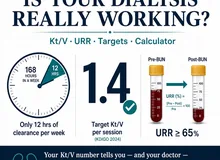
Why urea. Urea is a small, easily measured waste product made from protein breakdown. It is not especially toxic itself; it stands in for the many small solutes dialysis removes. The urea reduction ratio (URR) is the percentage fall in blood urea during one session: URR = (pre − post) ÷ pre × 100. Kt/V adds the dialyzer's clearance (K), time (t) and the patient's urea distribution volume (V); single-pool Kt/V is commonly calculated with the second-generation Daugirdas formula, which also accounts for urea removed with ultrafiltration and urea generated during the session.1
Why the post sample is so sensitive. At the end of treatment, blood in the arterial line may be mixed with cleaned blood returning from the venous needle (access recirculation), and blood throughout the body is still re-equilibrating. A post sample drawn at full blood flow, or several minutes late, gives a falsely low or falsely high urea. Units use a standard method, either slowing the blood pump or stopping it for a defined interval, then drawing from the arterial line at a fixed time.2 Whichever method your unit uses, the same method must be used every time.
| Sampling error | Effect on the result |
|---|---|
| Pre sample drawn after saline or heparin entered the line | Pre urea diluted: URR falsely low |
| Post sample drawn at full flow with recirculation | Post urea falsely low: URR falsely high |
| Post sample drawn late after rebound | Post urea higher: URR falsely low |
| Tubes mislabeled pre and post, or wrong patient | Meaningless result |
Mrs. Erlinda Pascual's urea reduction ratio is usually 66 to 68 percent. This month it reads 81 percent: pre-dialysis urea 140 mg/dL, post-dialysis 27 mg/dL. Nothing in her prescription changed.
Nurse Mae, the adequacy nurse, checks how the post sample was drawn. A float nurse took it from the venous line after rinse-back had started, so saline had diluted the sample. A falsely low post value makes the URR look higher than the treatment delivered. Mae marks the result as an invalid sample, tells the physician, and asks that the next sample be drawn by the unit's slow-flow method (blood pump slowed per protocol, sample from the arterial line before rinse-back). The repeat URR is 67 percent.
She also adds the sampling steps to the float nurse orientation sheet.
What this shows. A sudden improvement with no change in treatment usually points to the sample, not the patient. Check how the number was made before celebrating it.

URR depends on correctly timed samples; recirculation or a late sample distorts the result.
- URR
- Urea reduction ratio
Adequacy is a floor, not a dial
Too little is associated with harm. In 13,473 United States hemodialysis patients, a URR below 60 percent was associated with a higher risk of death than 65 to 69 percent (odds ratios 1.28 for 55 to 59 percent, 1.39 below 55 percent). In the same analysis, low serum albumin was a far stronger predictor of death than URR.3 This was observational: patients with low URR differed in other ways.
More than enough did not help. The Hemodialysis Study (HEMO) trial randomly assigned 1,846 patients on thrice-weekly dialysis to a standard dose (single-pool Kt/V about 1.32) or a high dose (about 1.71). Mortality was not significantly different (relative risk 0.96, 95 percent confidence interval 0.84 to 1.10).4 So once the dose reaches the floor, pushing urea clearance higher does not reliably buy survival.
The guideline. The Kidney Disease Outcomes Quality Initiative (KDOQI) 2015 adequacy update sets a target single-pool Kt/V of 1.4 per thrice-weekly session, with a minimum delivered dose of 1.2.5 Kt/V and URR are surrogate measures: they describe small-solute removal, not how the patient feels or lives.
Time and fluid removal matter beyond urea. In the international Dialysis Outcomes and Practice Patterns Study (DOPPS) cohort of 22,000 patients, treatment time longer than 240 minutes was associated with lower mortality (relative risk 0.81), and an ultrafiltration rate above 10 mL/kg/h with more intradialytic hypotension and higher mortality.6 In an analysis of HEMO participants, ultrafiltration rates above 13 mL/kg/h were associated with higher all-cause mortality (adjusted hazard ratio 1.59) and cardiovascular mortality (1.71).7 These are associations, but they fit the physiology: removing fluid faster than it can refill the blood vessels from the tissues causes low blood pressure, and repeated drops in heart blood flow can stun heart muscle.

Too little dialysis is associated with harm, more than the standard did not help, and treatment time and fluid removal rate matter beyond urea.
- URR
- Urea reduction ratio
- UFR
- Ultrafiltration rate
- KDOQI
- Kidney Disease Outcomes Quality Initiative
- DOPPS
- Dialysis Outcomes and Practice Patterns Study
- HEMO
- Hemodialysis Study
Compare the prescription with what was delivered
When adequacy falls, the cause is usually in delivery, not in the prescription. Check the common contributors before anyone changes the order.
Mr. Rodel Santos is prescribed 4 hours (240 minutes) three times a week. Over 12 sessions this month, the machine logs show an average of 214 minutes: four late starts after transport delays (average 20 minutes lost), three early terminations for cramps (average 30 minutes), and one stop for a machine alarm (35 minutes).
Nurse Mae brings the sum and its causes to the monthly review rather than only the Kt/V. The physician reviews his prescription and target weight; the social worker looks into transport; Mae flags the cramps pattern for review alongside his fluid gains. She does not add minutes, raise the blood flow or change the ultrafiltration herself.
What this shows. Lost minutes are invisible session by session and obvious when added up. Each cause has a different owner.
Treat volume and tolerance as clinical questions
During ultrafiltration, fluid is removed from the blood. The blood volume is kept up by fluid moving in from the tissues (plasma refill). If removal outpaces refill, blood volume falls, blood pressure drops, and the patient cramps, feels faint or vomits. The usual drivers are a large weight gain between sessions (so more must come off), a short session (so it must come off faster), a target weight set too low, heart disease, and blood pressure medicines taken before dialysis.
Recurrent cramps, hypotension and early terminations are signals for a team review, not for pushing harder. Things the physician may consider include reviewing the target weight, the timing of blood pressure medicines, longer or extra sessions, dialysate settings and salt intake. Your part is to bring the data: weights, gains, ultrafiltration rates, blood pressures, symptoms, early endings and their reasons, and the patient's own account.
Aling Myrna's spKt/V is 1.45. But in the past month she ended early six times because of cramps, and twice she arrived breathless with ankle swelling. Staff suggest raising the ultrafiltration rate so she "finishes the fluid in time."
Nurse Rico pulls her month together: average weight gain 3.6 kilograms, ultrafiltration rates of 14 to 17 mL/kg/h, six early endings, and an amlodipine dose she takes in the morning before dialysis. He presents it to Dr. Reyes and the dietitian. The physician reviews her target weight and medicine timing, adds a longer session once a week, and the dietitian works with her on salt.
What this shows. The Kt/V was fine. The problem was volume and tolerance, and it was solved by a team review, not by faster fluid removal.

When fluid is removed faster than tissues can refill the blood vessels, blood pressure falls and the heart can be stunned; the fix is a team review, not faster removal.
Build an integrated monthly review
Bring the measures together once a month for each patient, so that urea numbers sit beside the things patients feel.
- ValidityWas the sample pair valid? Repeat if not.
- DeliveryMinutes delivered versus prescribed; blood flow; missed sessions.
- AdequacyURR and Kt/V by the unit's method.
- VolumeWeight gains, ultrafiltration rates, blood pressure, edema, breathlessness.
- ToleranceCramps, hypotension, early endings, post-dialysis fatigue.
- Nutrition and boneAlbumin trend, appetite, referral to the dietitian; chronic kidney disease (CKD)–mineral and bone disorder results flagged for the physician.
- GoalsWhat the patient wants from treatment; residual urine output.
- ActionsOwner and date for each, reviewed next month.
Albumin is a marker, not a diagnosis: a low albumin can reflect inflammation, fluid overload or protein loss as well as poor intake, so it prompts a dietitian and physician review rather than a nutrition diagnosis by the nurse.
Case: The adequate patient who keeps leaving early
Monthly review. Mr. Ben Soriano, 52, has a spKt/V of 1.42 this month. In the same month he ended treatment early seven times (average 25 minutes short) because of cramps, and arrived breathless before two Monday sessions. His average weight gain is 3.8 kilograms on a target of 58 kilograms.
Today's post-dialysis sample was drawn by a new nurse at full blood flow, not by the unit's slow-flow method. A colleague proposes raising his ultrafiltration rate "so he finishes the fluid before he cramps." Mr. Soriano says he hates the cramps and is thinking of skipping Saturdays.
Before reading on, decide what you would assess, whom you would contact and what you would say, what you would teach, and what would make you escalate. Then compare with the debrief below.
Assess
Communicate
Teach
Escalate
The repeated sample gave a spKt/V of 1.31, still above the minimum but lower than reported. The physician extended his Monday session, reviewed his target weight and blood pressure medicines, and the dietitian worked on salt. Over six weeks his early endings fell to one a month and he kept his Saturday sessions.
Submit: A short summary for the physician that explains why a good URR does not answer these new findings, and what data you would bring.
Check your understanding
Each visit draws 5 questions at random from this module’s 15-question bank, in a shuffled order. Choose the single best answer for each, then select Check answers; a rationale appears under every option. Select New set of questions for a different mix. Nothing you select is sent anywhere; scoring happens in your browser and records self-study only.
What this module builds
| Code | The learner can | Course evidence |
|---|---|---|
| S2 | Turn a bedside finding (access, infection, anemia trend, water or equipment status, adequacy data) into the right urgency and the right person. | Focused assessment and Situation, Background, Assessment, Recommendation (SBAR) in simulation; observed escalation |
| S5 | Define a measure with an honest numerator, denominator and exclusions, show it over time, and run a small test of change. | Measure specification, run chart and Plan-Do-Study-Act (PDSA) log |
Performance evidence for this module: Five valid sample pairs drawn by the unit method under observation, and three integrated monthly reviews presented to the physician.
- Patient code, month, prescription (time, blood flow, dialyzer, target weight)
- Sample pair valid (method, time, labels): yes/no
- URR and Kt/V by unit method
- Delivered versus prescribed minutes; early endings and reasons
- Missed or shortened sessions
- Weight gains; ultrafiltration rates; blood pressure; edema or breathlessness
- Cramps, hypotension, post-dialysis fatigue
- Albumin trend; dietitian referral
- Patient goals; residual urine
- Actions: owner, date
Print it or copy it into your unit’s own form. Use it with fictional data here; real entries belong only in the facility’s approved records.
Portfolio measure. Eligible sessions delivering the prescribed duration, divided by eligible sessions reviewed, with documented clinical exceptions; balanced by hypotension, cramps, symptom burden and patient goals.
With your preceptor
Sampling is learned on patients under direct supervision; calculations can be practiced with fictional data. These are prompts for supervised learning, not a procedure. Use your center’s own protocols, contacts and forms; your preceptor observes and signs off each item on the facility’s competency record.
- Draw five pre and post sample pairs by your unit's method under observation.
- Calculate URR and ultrafiltration rate for ten fictional sessions and check with the calculators.
- Compare prescribed and delivered minutes for all patients for one week and list reasons for shortfalls.
- Prepare and present three integrated monthly reviews to the physician.
- Review one patient's month with the dietitian, linking weight gain, salt and symptoms.
Read next on this site
- Dialysis Adequacy: Is Your Dialysis Really Working?Dialysis adequacy explained.
- Finding Your True Dry WeightHow target weight is determined.
- Leg Cramps and Skin Changes on DialysisCramps during dialysis.
- Hemodialysis Nurse Module 6: Principles, prescription and adequacyRelated Renal Care Academy module.
Back to the Special Dialysis Nurse Roles home · the Hemodialysis Nurse core course.