After this module you should be able to
- Identify the clinical and practical risks that rise during transitions of care.
- Reconcile dialysis orders, access, laboratory results and medicines after a hospital stay, and escalate every discrepancy.
- Build one interdisciplinary plan with named owners and dated follow-up.
- Support patient goals and supportive-care referrals within nursing scope.
Time plan. 2 h study · 2 h workshop · 4 h supervised practice. The supervised hours are arranged by your unit and recorded in its own competency system; this page records self-study only.
The patient crosses the gaps between services
Picture a relay race in which the baton is not one stick but a bundle: a dialysis prescription, a target weight, an access plan, a medicine list, laboratory results, a referral, a family's understanding. Every time the patient moves (from dialysis unit to emergency room, ward, rehabilitation, home and back), the bundle is handed over. Something usually falls out.
The picture has a limit. In a relay race the runners know a handover is happening. In real care, nobody may realize the patient has crossed a gap: the hospital assumes the unit will pick up the new orders, the unit assumes nothing changed, and the patient assumes everybody talks to each other. The care coordinator is the person who notices every crossing and checks the bundle before the next treatment.
Why changes made elsewhere can hurt at the next session
Hospitals change things that matter at the dialysis chair.
| What changed in hospital | Why it matters at the next session | What the nurse checks |
|---|---|---|
| Target weight | Illness and poor appetite reduce muscle and fat; the old target may now remove too much fluid and cause hypotension, or the new one may leave fluid on | Which target is current, who set it, and whether the physician has confirmed it for the unit |
| Antibiotics | Many are removed by dialysis and must be timed after the session; some need dose adjustment in kidney failure | Drug, dose, timing relative to dialysis, end date, who gives it |
| Blood pressure medicines | Doses may be stopped or changed; restarting old doses can cause intradialytic hypotension | Current list versus unit list |
| Anticoagulants | A new anticoagulant changes heparin needs and bleeding risk at needle sites | Order for heparin in the circuit, physician confirmation |
| Access | A new catheter, a procedure, a clotted fistula | Access type, site, plan, and the access map (Module 2) |
| Laboratory results | Potassium, hemoglobin, cultures pending | Who follows the pending results |
Medication reconciliation is recognized as a core care-coordination activity in dialysis; United States facility measure sets, for example, include documented medication reconciliation as a reportable measure.1 The nurse's part is to find and present discrepancies. Deciding which version is correct belongs to the physician and, for medicines, the pharmacist, a division of roles that renal programs elsewhere also write down explicitly.2

Hospitals change target weights, medicines, access and antibiotics; every difference must be decided before the next treatment.
Find the gap between services
A coordinator cannot follow every patient equally. Keep a short list of patients at higher risk and review them each week. Typical flags: a hospital stay or emergency visit in the past 30 days; new catheter or access problem; three or more prescribers; new diagnosis (cancer, heart failure, stroke); missed sessions; financial or transport barriers; living alone or new caregiver; cognitive decline; a goals-of-care conversation in progress.
Mr. Danilo Reyes, 66, was admitted to another hospital for pneumonia and discharged on Saturday. On Monday he arrives for dialysis with a plastic bag of new medicines and a discharge summary nobody in the unit has seen. The machine is set to his old target weight, 3 kilograms lower than the weight on his discharge summary. His antibiotic sheet says "give after hemodialysis."
Nurse Coordinator Jen asks the charge nurse to hold connection for ten minutes, lays the discharge summary beside the unit chart and the medicine bag, and lists four differences. She calls Dr. Reyes with an Situation, Background, Assessment, Recommendation (SBAR), and he confirms a new target weight and the antibiotic timing before the session starts.
What this shows. Ten minutes of reconciliation at the door prevented a fluid removal plan built on an outdated target.
Reconcile the return from hospital
- GatherDischarge summary, medicine bag or photos of labels, new orders, pending results, the patient's and family's account.
- CompareSide by side with the unit chart: prescription, target weight, access, heparin, medicines, laboratory results.
- List differencesEvery one, even if it looks intentional.
- EscalateSBAR to the physician before the next treatment; pharmacist for medicine questions.
- Record decisionsWhat was decided, by whom, when; update the unit chart only on a written or verbal order per policy.
- TeachTell the patient and caregiver what changed and check with teach-back (Module 5).
The best possible medication history. Ask what the patient actually takes, not only what is written: "Show me what you took yesterday." Include over-the-counter medicines, herbal products and supplements, which patients often do not mention unless asked, and medicines from other doctors. Many interactions and duplications are found this way.

After any hospital stay, gather documents, compare, escalate every difference and record the decisions before connecting.
- SBAR
- Situation, Background, Assessment, Recommendation
Create one plan with several accountable owners
A coordinated plan fits on one page and answers: what problems are open, who owns each, what happens next, and when. Owners are named roles or people: the nephrologist for the prescription, the dietitian for diet, the social worker or Philippine Health Insurance Corporation (PhilHealth) liaison for coverage and transport, the access coordinator for the fistula referral, the patient and family for their part.
Social barriers are clinical. A patient who cannot afford transport misses sessions; a patient who cannot pay for antibiotics stops them. Ask directly and refer to the people and programs that can help: the hospital's social service, the local government unit, the Malasakit Center where available, and the unit's PhilHealth liaison (Module 11). Do not promise benefits; confirm current eligibility with the people who decide it.
Support continuity when goals change
Some transitions are not about medicines but about direction: a patient who says, after a long admission, "I am tired of dialysis," or a family asking what happens if he stops. These conversations need time, the physician, and often the family. The coordinator's role is to notice, listen, document the patient's words, and make sure a goals-of-care conversation is scheduled with the physician, with symptom review and supportive-care referral where appropriate. The decision to continue, reduce or stop dialysis is made by the patient and physician together, never by the nurse alone, and never through silence.
After her third admission this year, Lola Pacita, 84, tells Nurse Jen quietly, "Ayoko na. I'm tired." Her daughter, in the waiting room, has not heard this.
Jen sits with her, asks what tired means to her (pain, breathlessness, the trips, feeling like a burden), and writes her words in the chart. She informs Dr. Reyes the same day and asks for a family meeting. She does not argue, promise or decide; she makes sure the conversation happens with the right people.
What this shows. Noticing and documenting a change in goals is coordination. Deciding the treatment is not the nurse's role.
Case: Back from the hospital on Monday
Monday, 6:15 a.m. Mrs. Corazon Villanueva, 61, returns after a week in another hospital for a catheter-related bloodstream infection. Her fistula was not used during the stay; a new tunneled catheter was placed. The discharge summary lists vancomycin "post-hemodialysis (HD)" until next Friday, a new target weight 2.5 kilograms higher than the unit's, amlodipine stopped, and a pending repeat blood culture.
The unit chart still shows the old target weight, amlodipine, and her fistula as the access. She tells you she cannot afford the tricycle and bus fare to the hospital's follow-up clinic on Thursday.
Before reading on, decide what you would assess, whom you would contact and what you would say, what you would teach, and what would make you escalate. Then compare with the debrief below.
Assess
Communicate
Teach
Escalate
The physician confirmed the new target weight and vancomycin schedule, kept amlodipine stopped, and asked for the fistula to be reassessed by the access coordinator. Social service arranged transport support for the clinic visit. The repeat culture, followed by the coordinator, came back negative on Wednesday, and the result reached the physician the same day.
Submit: An SBAR to your unit's physician and a plan for who receives the new order, who gives the first dose and when, and how the patient is informed.
Check your understanding
Each visit draws 5 questions at random from this module’s 15-question bank, in a shuffled order. Choose the single best answer for each, then select Check answers; a rationale appears under every option. Select New set of questions for a different mix. Nothing you select is sent anywhere; scoring happens in your browser and records self-study only.
What this module builds
| Code | The learner can | Course evidence |
|---|---|---|
| S4 | Close a loop: referral sent, received, acted on, returned and documented, with one named owner per action. | Referral tracker and transition reconciliation record |
Performance evidence for this module: Two transition reconciliations completed before the next treatment, each with every discrepancy escalated and decided.
- Patient code; where from (hospital, ER, other unit); dates
- Documents received (discharge summary, orders, medicine labels)
- Dialysis prescription: unit versus discharge
- Target weight: unit versus discharge; decided by, date
- Access: type, site, plan; access map updated
- Heparin or anticoagulant orders
- Medicines: added, stopped, changed (each listed)
- Pending results and who follows them
- Practical barriers found and referral made
- Patient and caregiver taught; teach-back result
Print it or copy it into your unit’s own form. Use it with fictional data here; real entries belong only in the facility’s approved records.
Portfolio measure. Transitions with documented reconciliation decided by the physician before the next treatment, divided by eligible transitions sampled; also unresolved discrepancies at 7 days and patient-reported burden.
With your preceptor
Use de-identified discharge summaries with permission, or the fictional case. These are prompts for supervised learning, not a procedure. Use your center’s own protocols, contacts and forms; your preceptor observes and signs off each item on the facility’s competency record.
- Complete three transition reconciliations under supervision and present the discrepancies to the physician.
- Take a best possible medication history from two patients, including over-the-counter and herbal products.
- Build a weekly high-risk list and review it with the head nurse.
- Write one one-page coordinated plan with named owners and dates.
- Map the referral routes for transport, financial and social support available to your patients.
Read next on this site
- The chronic kidney disease (CKD) Prescriber's PlaybookPractical medication guidance.
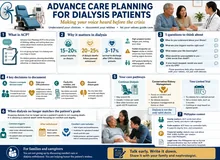
- Advance Care Planning for Dialysis PatientsAdvance care planning for people on dialysis.
- Hemodialysis Transfer Guide: How to Change Dialysis Centers or Nephrologists SafelyTransferring between dialysis units.
- Hemodialysis Nurse Module 16: Supportive and palliative kidney careRelated Renal Care Academy module.
Back to the Special Dialysis Nurse Roles home · the Hemodialysis Nurse core course.