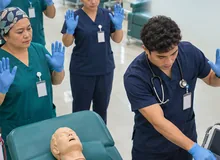
Flattening the recliner, compressions that work, the defibrillator at the chair, bag-mask ventilation by two rescuers, and choking.
PublishedNailathalaGipatikPepalwal:ReferencesMga SanggunianMga TinubdanReng Reperensya:2Audience: Every member of the dialysis shift team: hemodialysis nurses, charge and head nurses, physicians-on-duty, attending nephrologists, dialysis and biomedical technicians, nurse assistants and support staff · pediatric dialysis teams for Part 4Read timeOras ng pagbasaOras sa pagbasaOras ning pamamasa:
This module is study material for dialysis teams. It explains the reasoning behind resuscitation decisions; it is not a unit protocol, an order set, or certification. Doses and energies are quoted from the 2025 American Heart Association (AHA) guidelines and the European Resuscitation Council (ERC) where named, so you can recognize them; give medicines only within your license and your unit’s approved protocol. Escalation always follows your unit protocol, and you always ask the attending nephrologist for guidance. Every case, name, and identifier is fictional.
Learning objectives
After this module you should be able to
Flatten a dialysis recliner and start compressions within seconds, using a firm surface only when it causes no delay.
Deliver compressions at 100 to 120 a minute and a depth of 5 to 6 cm, with full recoil and pauses under 10 seconds.
Apply the defibrillator pads at the chair and resume compressions immediately after a shock.
Ventilate with a bag-valve-mask using a two-person technique, giving just enough volume for visible chest rise.
Relieve severe choking in an adult with the 2025 sequence of back blows and abdominal thrusts.
Classroom 1 hSkills lab 1 hSupervised placement 1 h
Pre-testBefore you read, answer the 5 self-assessment questions and note your score. After the module, select New set of questions and compare. The difference is what you learned; the questions you still miss are what to reread.
Start here
The big picture, in plain words
In plain wordsDuring cardiac arrest, compressions are the heart. Each push squeezes the heart between the breastbone and the spine and sends a small amount of blood to the brain and the heart muscle. Each time you stop, that flow falls to zero almost at once, and it takes several compressions to build it back up.
The picture has a limit. Compressions do not simply squeeze the heart like a hand on a sponge; they also change the pressure in the whole chest, which moves blood forward. The practical lesson is the same. Blood flow during cardiopulmonary resuscitation (CPR) depends on depth, rate, full recoil (the chest must refill), and above all on not stopping. Most of the quality of CPR is lost in pauses: for the pulse check, for the machine, for the ventilation, for the next person to take over.
This module is for everyone on the floor: nurses, physicians, technicians, assistants and support staff. Basic Life Support (BLS) is the part of resuscitation that anyone can start, and in dialysis clinics it is the part most strongly associated with survival.1
Figure 1 · Key terms for this module
Chest compression fraction (CCF)The share of the arrest time spent compressing.
RecoilLetting the chest rise fully between compressions so the heart can refill.
Bag-valve-mask (BVM)A self-inflating bag and mask used to give breaths.
Automated external defibrillator (AED)A defibrillator that analyzes the rhythm and prompts a shock.
Two-person ventilationOne person seals the mask with both hands; another squeezes the bag.
Severe chokingThe person cannot speak, cough or breathe because of an obstruction.
Opening case · fictional
Case: The chair that would not recline
At 7:05 a.m., Mrs. Lorna Castillo, 64, collapses forward in her chair at a dialysis unit in Quezon City, ten minutes after connection. Nurse assistant Mr. Jomar Villanueva is passing the station. She does not answer, she is gasping, and he feels no pulse.
He shouts for help and pulls the recliner lever. The backrest goes only halfway down; the mechanism sticks. Mrs. Castillo weighs about 85 kg. Two nurses arrive with the crash cart 40 seconds later. One says, “Let us move her to the floor.”
Before reading on, decide:
What should Mr. Villanueva do in the first 20 seconds?
Should the team move Mrs. Castillo to the floor? What would decide it?
When the defibrillator arrives, what happens to compressions?
Keep your answers in mind. The lesson gives you what you need, and the case review near the end shows one sound response.
Lesson · part 1
Flatten the recliner, and start
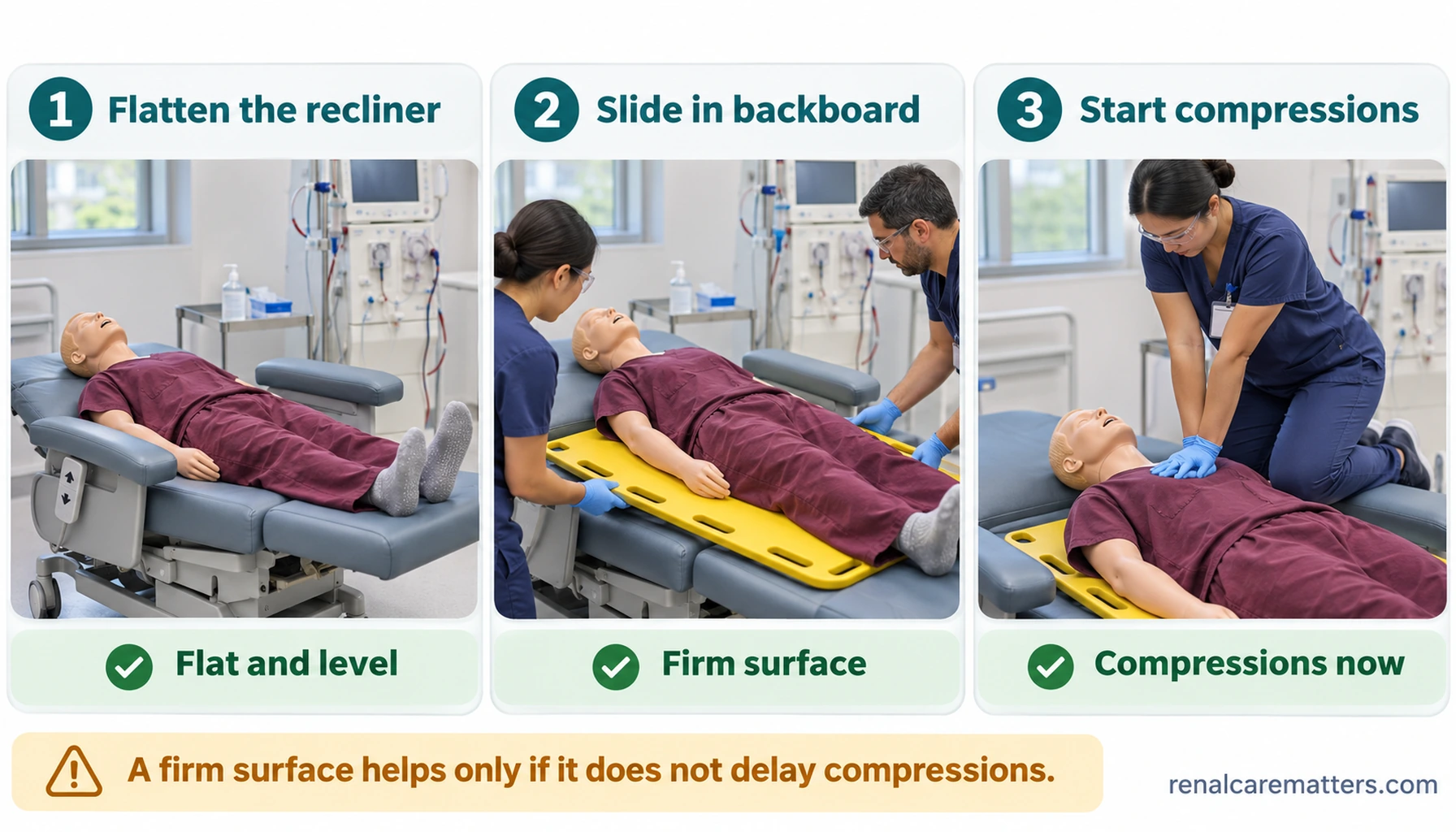
Dialysis recliners are designed for a sitting patient, not for CPR. Most can be tilted back flat or into a head-down position with a lever or a button; some have a CPR release. Know your unit’s chairs before you need them, because the American Heart Association (AHA) preference for a firm surface is conditional: a firm surface, supine when feasible, is preferred if it does not delay compressions (Class of Recommendation (COR) 2a, Level of Evidence (LOE) C-LD). For adults with obesity, consider how moving the patient to a firm surface may delay compressions (COR 2a, LOE C-LD).2
Figure 2. Flatten the recliner and start. A firm surface helps only if it does not delay compressions.
Situation
What to do
Why
Recliner flattens normally
Flatten fully; start compressions; slide a backboard under when a second person is free
A firm, flat surface with no delay
Recliner sticks halfway
Start compressions in the chair as flat as it goes; a second person works the mechanism or prepares to move
Compressions now; a better surface later
Chair cannot be flattened at all, patient light
Move to the floor with enough hands, after clamping per the circuit nurse
Floor is firm; brief interruption
Heavy patient, chair partly flat
Compress where the patient is; reposition only with enough people and a plan
Moving a heavy patient can cost a minute of no flow
Moving a patient who is still connected to the circuit can pull out the needles or the catheter. Before any move, the circuit nurse stops the blood pump and clamps, or disconnects per protocol (Module 7). Kneeling on the chair edge or using a step stool gives a short compressor the height to lock the elbows.
RememberCompressions start where the patient is. Improve the surface only when it costs no time, and never move a connected patient until the circuit nurse says the lines are safe.
Lesson · part 2
Compressions that move blood
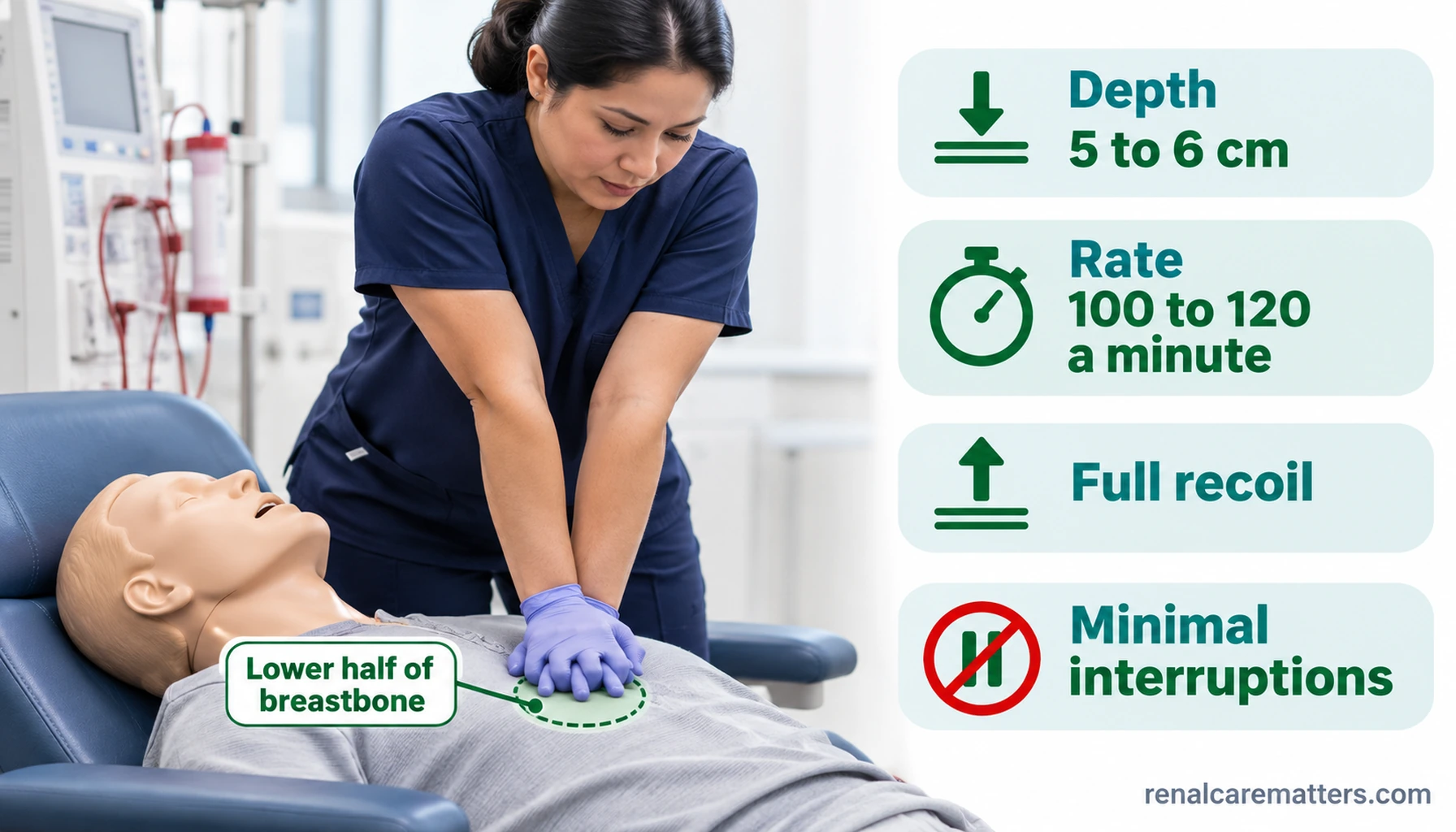
The 2025 AHA adult BLS guideline sets the targets.2
Figure 3. High-quality compressions: depth, rate, recoil, and as few pauses as possible.
Element
AHA 2025 recommendation
Grade
Why it matters
Rate
100 to 120 a minute
COR 2a, LOE B-NR
Too slow moves too little blood; too fast leaves no time to refill
Depth
At least 5 cm; avoid more than 6 cm
COR 1, LOE B-NR
Shallow compressions move little blood; very deep ones cause injury
Recoil
Allow full chest recoil; do not lean
COR 2a, LOE C-LD
The heart refills during recoil
Compression fraction
At least 60% may be reasonable
COR 2b, LOE C-LD
Every pause drops flow to near zero
Pulse check
No more than 10 seconds
COR 1, LOE C-LD
Long checks are long pauses
Ratio (no advanced airway)
30 compressions to 2 breaths
COR 2a, LOE B-NR
Balances oxygen and flow
Compressors tire within about two minutes, and their depth falls before they notice. Swap at every two-minute rhythm check, or sooner if the compressor is tiring, with the next person ready beside the chair so the swap takes a second or two. The recorder or a feedback device calls out the rate. The 60% fraction in the guideline is a floor, not a goal; in this course’s drills the team aims higher, which is an Academy teaching choice, not a guideline number. The CPR interruption analyzer computes the fraction from timed pauses.
RememberPush 5 to 6 cm deep, 100 to 120 a minute, let the chest rise fully, swap every two minutes, and protect every second of compression time.
Lesson · part 3
The defibrillator at the chair
Compressions continue until the defibrillator or AED is applied (COR 1, LOE C-LD). Pads go anterolateral (right upper chest and left side under the armpit) or anteroposterior (front and back) (COR 2a, LOE C-LD), placed clear of a chest-wall catheter exit site and any wet dressing. When a monitored patient goes into ventricular fibrillation (VF) with pads already on, defibrillate immediately (COR 2a, LOE C-LD). After a shock, resume compressions immediately rather than pausing to check the rhythm (COR 2a, LOE B-R), and keep the pauses before and after a shock as short as possible (COR 1, LOE C-LD).2
Step
Who
What is said
Pads on while compressions continue
Defibrillator person
“Pads on.”
Analyze (AED) or rhythm check (manual), under 10 seconds
Leader
“Stop compressions. Rhythm check.”
If shockable: compress again while charging (manual)
An AED is designed for any trained staff member, including a technician or assistant. In a dialysis unit, the specific hazards are fluid on the chair or floor and hands on the blood lines or the machine during a shock (Module 7).
RememberCompress until the pads are on, pause only to analyze and shock, and compress again immediately after the shock.
Lesson · part 4
Bag-mask breaths, oxygen, and choking
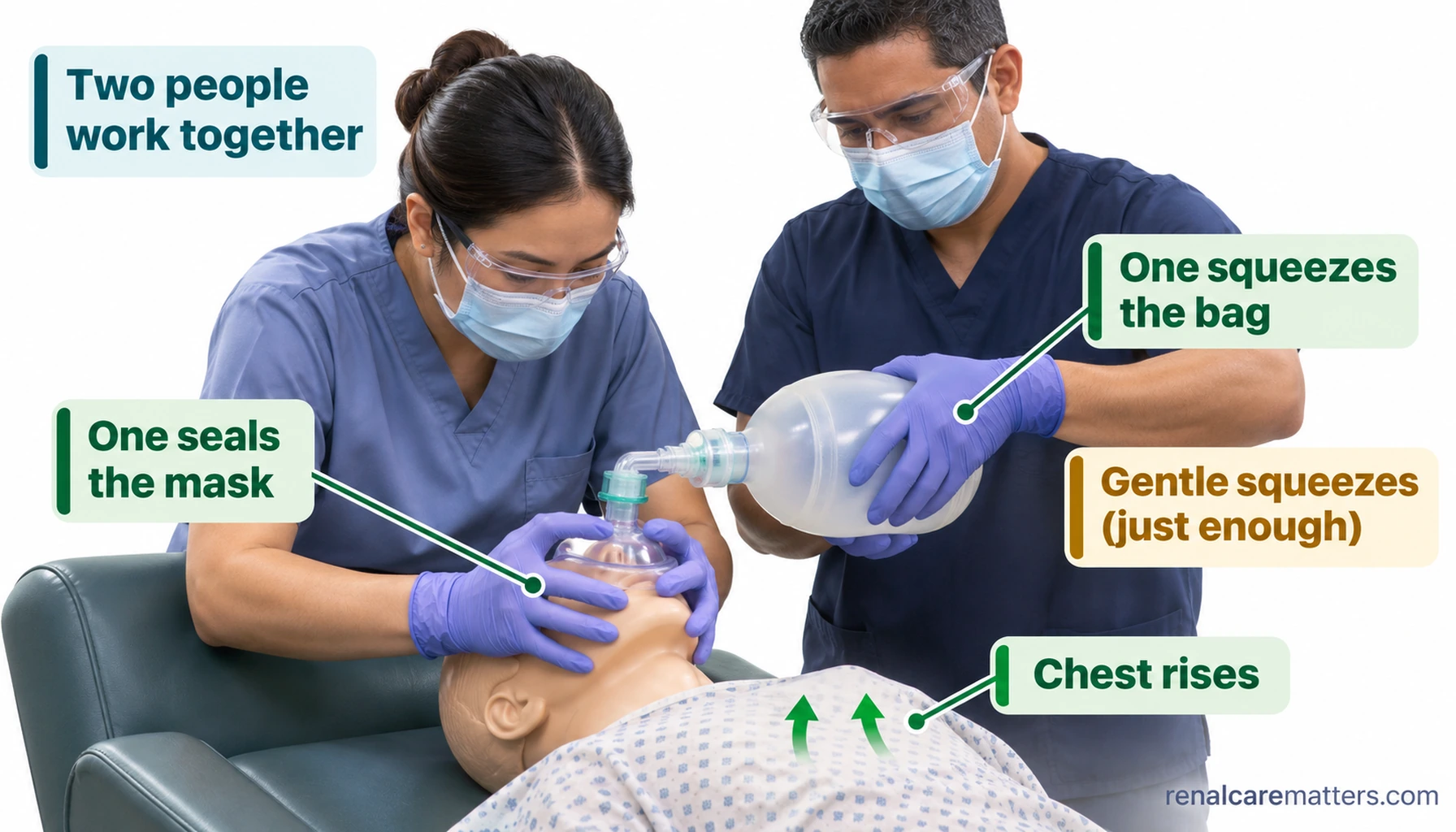
In a dialysis unit without an anesthetist, the bag-valve-mask is the airway. It works well with two people: one holds the mask with both hands, lifting the jaw into the mask; the other squeezes the bag slowly over about one second, just enough to see the chest rise. Ventilate with visible chest rise (COR 2a, LOE C-LD).2 Large, fast breaths push air into the stomach and raise chest pressure, which reduces blood returning to the heart.
Figure 4. Bag-mask ventilation works best with two people: one seals, one squeezes, just enough for the chest to rise.
Problem
Likely cause
Fix
Chest does not rise
Poor seal or tongue blocking the throat
Two-hand seal; head tilt and jaw lift; oral airway in an unresponsive patient
Stomach swells
Breaths too large or too fast
Smaller, slower breaths
Vomit in the airway
Common in arrest
Turn the head if safe, suction, continue
Dentures loose
Poor fit
Leave well-fitting dentures in for a seal; remove loose ones
Choking
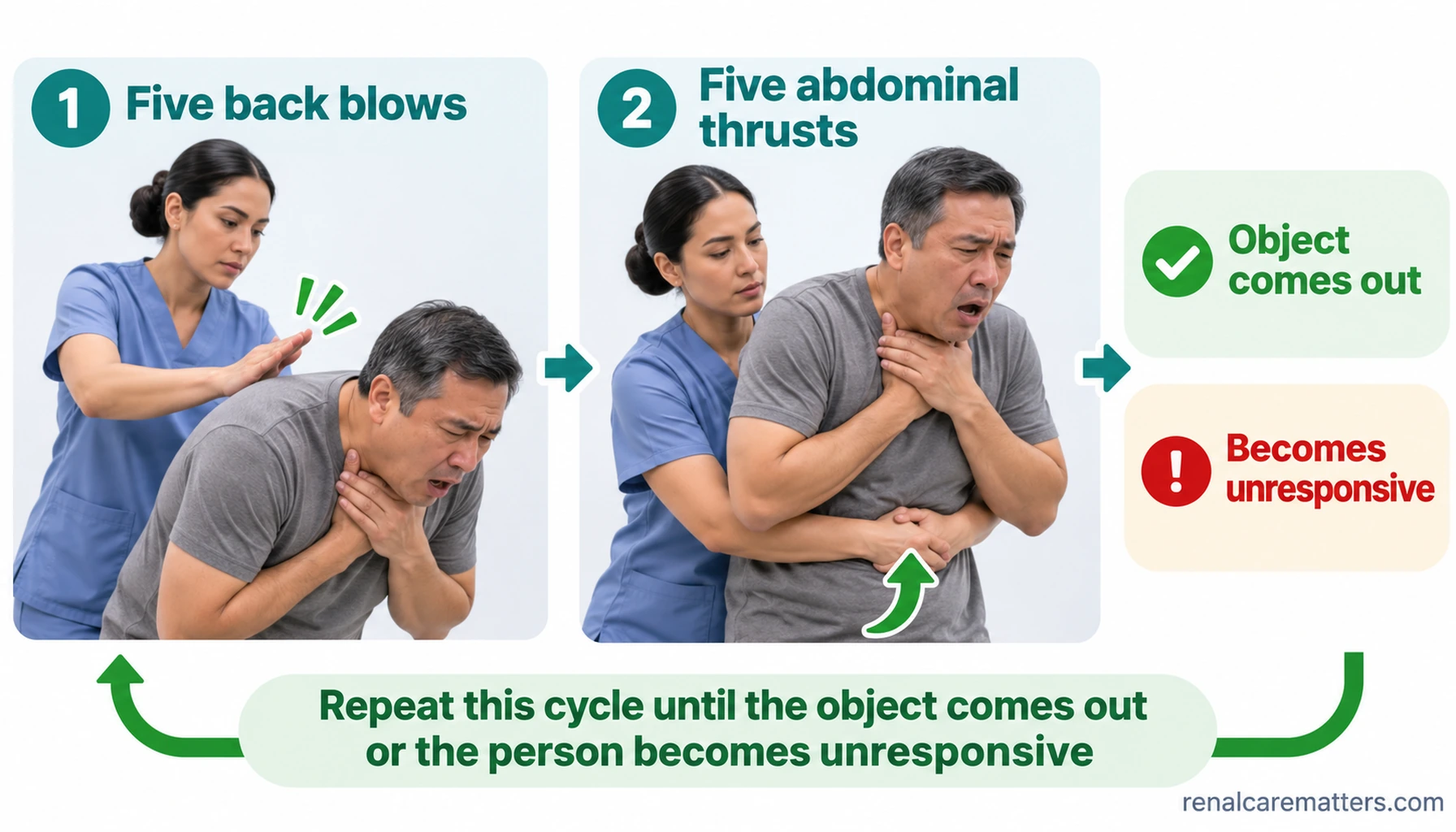
Choking happens in dialysis units too: at meal times, with hard candy for a dry mouth, or with a tablet. The 2025 AHA sequence for an adult with severe foreign-body airway obstruction is repeated cycles of five back blows followed by five abdominal thrusts until the object comes out or the person becomes unresponsive (COR 1, LOE B-NR). If you cannot encircle the abdomen, or in late pregnancy, use five back blows followed by five chest thrusts. If the person becomes unresponsive, start CPR with compressions. Do not perform blind finger sweeps (COR 3: Harm, LOE C-LD).2 A patient connected to a circuit is choking in a chair: stop the blood pump and clamp before standing them up for thrusts.
Figure 5. Adult choking, 2025 sequence: five back blows, then five abdominal thrusts, repeated until the object comes out or the person becomes unresponsive.
RememberTwo people, two hands on the mask, just enough breath to see the chest rise. For choking: five back blows, five abdominal thrusts, repeat.
On the floor
Real situations: problems and solutions
These are fictional but typical. For each one, cover the answer, decide what you would do, then compare. Where a step depends on local rules, your unit’s procedure and your supervisor’s direction come first.
The polite compressor
What you see
A small nurse compresses on a high chair with bent elbows and shallow pushes.
What is likely going on
Poor height and posture.
What to do
Use a step stool or kneel on the chair edge; lock the elbows; swap with a taller colleague if needed.
Why it matters
Depth comes from body weight over straight arms, not arm strength.
Pause for the machine
What you see
Compressions stop while the circuit nurse asks everyone to step back so she can reach the clamps.
What is likely going on
Circuit work interrupted CPR.
What to do
The circuit nurse works from the machine side without crossing the compressor; compressions never stop for the circuit.
Why it matters
Every pause drops blood flow to near zero.
The candy
What you see
A patient sucking hard candy for a dry mouth starts coughing hard but can speak.
What is likely going on
Mild obstruction; the airway is still working.
What to do
Encourage coughing and stay with the patient; act with back blows and thrusts only if the cough stops working.
Why it matters
A forceful cough clears more than any maneuver.
Field notes
Practice the CPR position of your own unit’s chairs until it takes under five seconds.
Keep a step stool near the crash cart.
Case review
Back to the case: The chair that would not recline
The first 20 seconds. Mr. Villanueva has recognized arrest correctly: unresponsive, gasping, no pulse. He shouts for help and starts compressions in the chair as flat as it goes. He does not wait for the chair to work.
The floor? Mrs. Castillo weighs 85 kg and is still connected. Moving her now would interrupt compressions and risk pulling out the needles. The better plan: keep compressing in the half-flat chair, have one nurse work the lever or the CPR release, and slide a backboard behind her if the chair stays upright. If the team decides to move her, the circuit nurse first stops the pump and clamps, four people lift on a count, and compressions restart within seconds on the floor. The AHA’s firm-surface preference applies only if it does not delay compressions.
When the defibrillator arrives. Compressions continue while the pads go on. The team pauses only to analyze, shocks if advised with everyone clear of the patient, chair, lines and machine, and resumes compressions immediately after the shock.
The stuck lever is a system finding. After the event, the chair is tagged out, and every recliner’s CPR position is checked in the next morning’s round.
Interactive case · fictional
Interactive case: The chair that would not recline
Work through a shift one decision at a time. The panel at the top changes with what you choose. After each choice you see why it is, or is not, the best move; after a weaker one you can try again or carry on and see where it leads. Your first choice at each step is scored. The score stays on this device and nothing is sent anywhere. In real practice, your unit’s protocol and the people responsible for each decision come first.
🚨 Emergency quick card:Code during hemodialysis. One screen each, saved for use with no signal. Print a copy for the crash cart.
Skills lab · with your preceptor
Skills checklist: BLS at the dialysis chair
On a manikin in a dialysis recliner, with a feedback device if available, perform two minutes of CPR and an AED sequence while a supervisor observes. Your preceptor rates each step as satisfactory, needs practice, or not observed. Steps marked Critical must all be satisfactory before sign-off. This checklist supports supervised learning; your unit’s own procedure and competency form are the authority. A printable version of every checklist is on the trainer page.
CriticalRecognizes arrest (unresponsive, not breathing normally, no definite pulse in 10 seconds) and shouts for help.
CriticalFlattens the recliner or starts compressions where the patient is, without delay.
CriticalCompresses at 100 to 120 a minute, 5 to 6 cm deep, with full recoil.
Keeps every pause under 10 seconds and swaps compressors at two minutes.
Applies pads in the correct positions, clear of the catheter exit site and wet dressings.
CriticalCalls “clear” for patient, chair, lines and machine before the shock, and resumes compressions immediately.
Ventilates with a two-person bag-mask technique with visible chest rise.
Demonstrates the adult choking sequence on a trainer.
Placement activity. Test the CPR position of every recliner in your unit with the biomedical technician and tag any that fail.
Self-assessment
Check your understanding
Each visit draws 5 questions at random from this module’s 10-question bank. Choose the single best answer for each, then select Check answers; an explanation appears under the best answer. Select New set of questions for a different mix. A good target is 4 of 5 on two different sets. Nothing you select is sent anywhere; scoring happens in your browser.
Pun, P. H., Dupre, M. E., Starks, M. A., Tyson, C., Vellano, K., Svetkey, L. P., Hansen, S., Frizzelle, B. G., McNally, B., Jollis, J. G., Al-Khatib, S. M., & Granger, C. B. (2019). Outcomes for hemodialysis patients given cardiopulmonary resuscitation for cardiac arrest at outpatient dialysis clinics. Journal of the American Society of Nephrology, 30(3), 461–470. https://doi.org/10.1681/ASN.2018090911
Kleinman, M. E., Buick, J. E., Huber, N., Idris, A. H., Levy, M., Morgan, S. G., Nassal, M. M. J., Neth, M. R., Norii, T., Nunnally, M. E., Rodriguez, A. J., Walsh, B. K., & Drennan, I. R. (2025). Part 7: Adult basic life support: 2025 American Heart Association guidelines for cardiopulmonary resuscitation and emergency cardiovascular care. Circulation, 152(16_suppl_2), S448–S478. https://doi.org/10.1161/CIR.0000000000001369
Educational reviewer and practice resource for dialysis teams. It is not an American Heart Association (AHA) course, it is not BLS, ACLS or PALS certification, and online completion does not establish hands-on competence. Staff certify through an authorized training center. Your unit’s approved protocol, crash-cart stock and machine manufacturer’s instructions govern every real event.