Why dialysis units see arrests, the single chain of survival, the morning defibrillator and cart check, and the realities of freestanding units and ambulance transfer.
PublishedNailathalaGipatikPepalwal:ReferencesMga SanggunianMga TinubdanReng Reperensya:8Audience: Every member of the dialysis shift team: hemodialysis nurses, charge and head nurses, physicians-on-duty, attending nephrologists, dialysis and biomedical technicians, nurse assistants and support staff · pediatric dialysis teams for Part 4Read timeOras ng pagbasaOras sa pagbasaOras ning pamamasa:
This module is study material for dialysis teams. It explains the reasoning behind resuscitation decisions; it is not a unit protocol, an order set, or certification. Doses and energies are quoted from the 2025 American Heart Association (AHA) guidelines and the European Resuscitation Council (ERC) where named, so you can recognize them; give medicines only within your license and your unit’s approved protocol. Escalation always follows your unit protocol, and you always ask the attending nephrologist for guidance. Every case, name, and identifier is fictional.
Learning objectives
After this module you should be able to
Explain why cardiac arrest clusters in dialysis units, including the Monday session, low-potassium dialysis fluid, and large fluid removal.
Describe the single chain of survival and name the person who owns each link on your shift.
Complete a daily defibrillator, oxygen, suction and crash-cart check, and act on a failed item before the first patient connects.
Compare what a freestanding and a hospital-based dialysis unit can do in the first ten minutes, and plan the ambulance call and transfer.
Assign resuscitation roles at the start of the shift from the real roster, including a watcher for the other patients.
Classroom 1 hSkills lab 1 hSupervised placement 1 h
Pre-testBefore you read, answer the 5 self-assessment questions and note your score. After the module, select New set of questions and compare. The difference is what you learned; the questions you still miss are what to reread.
Start here
The big picture, in plain words
In plain wordsThink of a fire drill in a building that already has smoke detectors. The detectors are your monitors and your trained staff. The drill is not about the fire; it is about whether the extinguisher is where everyone thinks it is, whether the door opens, and whether each person knows their job. Most deaths in a fire come from the minutes lost before anyone acts.
The picture has a limit. A fire does not stay connected to a machine that holds a few hundred milliliters of the patient’s blood. In a dialysis unit, the “building” is also part of the emergency: the circuit, the chair, the water on the floor, and twelve other patients still dialyzing. Readiness here means the equipment works, the roles are named, and the team has already decided what happens to the machine before anyone needs to.
Your work in this module is simple to state. Know why arrests happen in your unit. Check the equipment every morning as if today were the day. Name the roles before the first patient connects. And know exactly how help arrives and how long it takes.
Figure 1 · Key terms for this module
Cardiac arrestThe heart stops pumping effectively; the person is unresponsive, not breathing normally (gasping counts as not normal), and has no pulse.
Chain of survivalThe linked actions that together give the best chance of survival, from recognition to recovery.
Automated external defibrillator (AED)A device that analyzes the rhythm and tells the rescuer whether to shock.
Manual defibrillatorA defibrillator with a screen on which a trained clinician reads the rhythm and chooses the energy.
Crash cartThe mobile cart holding the defibrillator, airway equipment, suction and resuscitation drugs.
WatcherThe staff member who keeps every other connected patient safe while the team works on the arrest.
Opening case · fictional
Case: The 5:40 a.m. check
It is Monday, 5:40 a.m., at a freestanding 18-station hemodialysis unit in Caloocan. The first shift connects at 6:00. Charge nurse Ms. Rowena Dizon opens the crash cart with technician Mr. Paolo Ramos. The defibrillator’s self-test screen shows a battery warning. The adult pads in the cart expired last month. The oxygen cylinder gauge reads about a quarter full. The suction unit works.
The physician-on-duty, Dr. Kim Salonga, is on her way and will arrive at 6:20. Today’s list includes Mr. Ernesto Bautista, 67, who missed Friday’s session after a hospital stay, and two patients dialyzing on a 1.0 mEq/L potassium bath. The nearest hospital emergency room is 15 minutes away in normal traffic; the unit relies on the city ambulance or a private ambulance on call.
Before reading on, decide:
Which failed item matters most, and can the first shift start?
What does today’s patient list add to your readiness plan?
Whom do you assign to each code role before 6:00, and who watches the other patients?
Keep your answers in mind. The lesson gives you what you need, and the case review near the end shows one sound response.
Lesson · part 1
Why arrests happen on the dialysis floor
Cardiac arrest is the most feared complication of hemodialysis, and its pattern is predictable. In a review of 400 arrests across more than 5.7 million hemodialysis sessions in the United States, the rate was 7 per 100,000 sessions. Arrests were more frequent on Mondays. Patients who arrested were nearly twice as likely to have been dialyzed against a potassium bath of 0 or 1.0 mEq/L on that day (17.1% compared with 8.8%), and 37% had been in hospital in the previous 30 days. Sixty percent died within 48 hours.1 A later case-control study of 502 arrests in clinics caring for 43,200 patients found arrest associated with dialysis fluid potassium below 2 mEq/L, larger fluid removal volumes, and low-calcium dialysis fluid, whatever the pre-dialysis potassium.2
The physiology explains the pattern. Over the long weekend gap, potassium, fluid and acid build up. The first session then removes them fastest. A heart thickened by years of high blood pressure and kidney disease is electrically unstable when potassium swings from high to low within hours and when fluid removal lowers the pressure that feeds the coronary arteries. The long two-day gap itself is associated with more deaths and cardiac events on the day after it.3 All of these studies are observational, so they identify risk, not proof of cause; but they tell you which patients deserve a second look on a Monday morning.
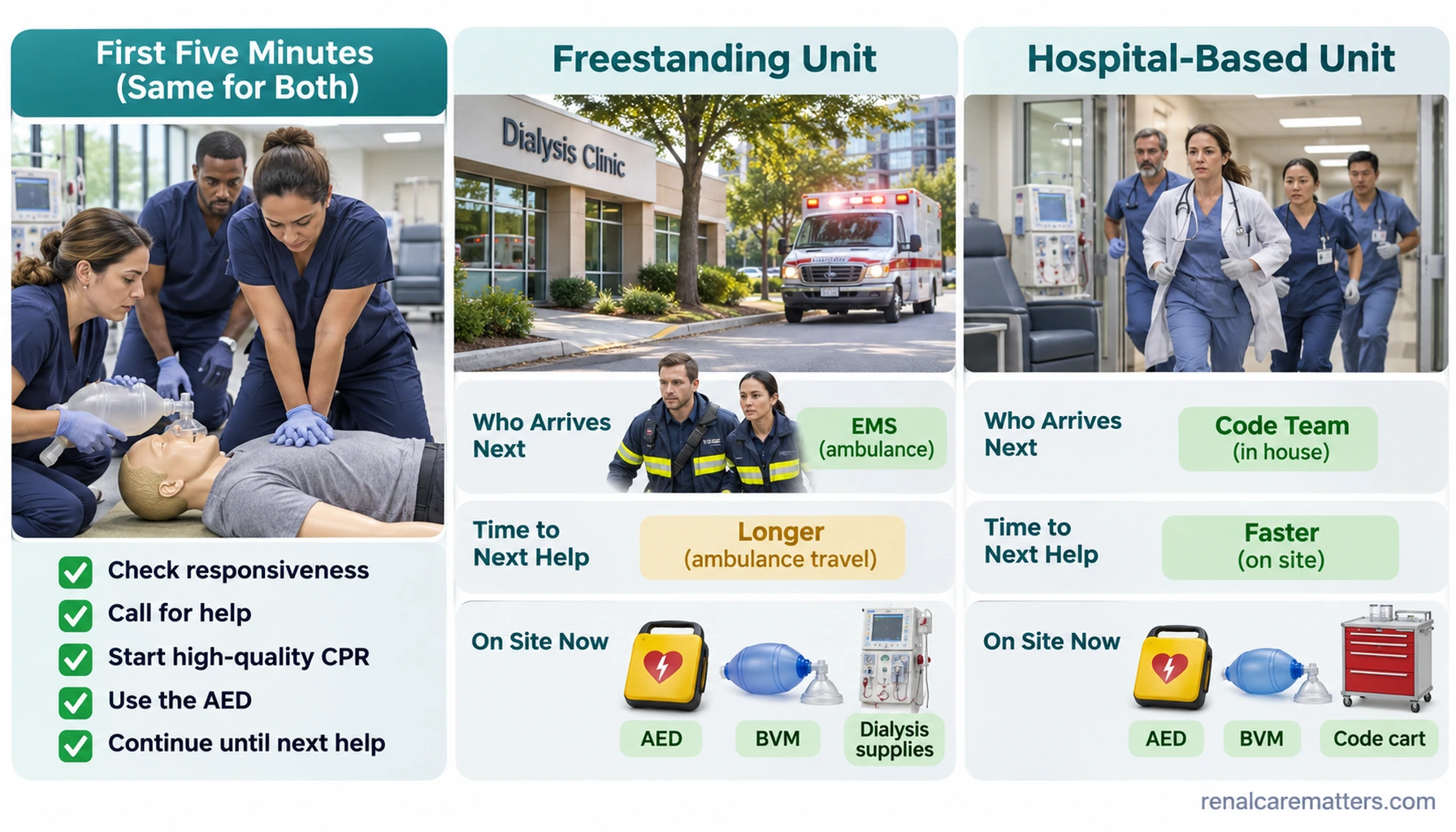
Figure 2. Freestanding and hospital-based units start the same first five minutes. They differ in who arrives next and how long it takes.
Risk signal
Why it matters
What readiness looks like
Monday or the first session after a missed one
Highest potassium and fluid load of the week
Monitor attached early; potassium checked per protocol; seat near the station with the best view
Potassium bath of 0 to 1 mEq/L
Rapid fall in potassium during the session
Prescription reviewed by the physician; extra rhythm watch late in the session
Recent hospital discharge
Sicker patient; prescription may no longer fit
Fresh review of the dialysis order before connection
Large fluid removal goal
Low pressure and coronary underfilling
Blood pressure trend watched; fluid removal reduced per order if pressure falls
Drop in systolic pressure of 30 mm Hg or more
Seen before 16% of arrests in one series
Treat as a warning sign, not a routine low pressure (Card 3)
RememberMonday, missed sessions, low-potassium baths, recent discharge and big fluid removal are the arrest-risk flags. Read the list at 5:40 a.m. with those flags in mind.
Lesson · part 2
One chain, drawn for the dialysis floor
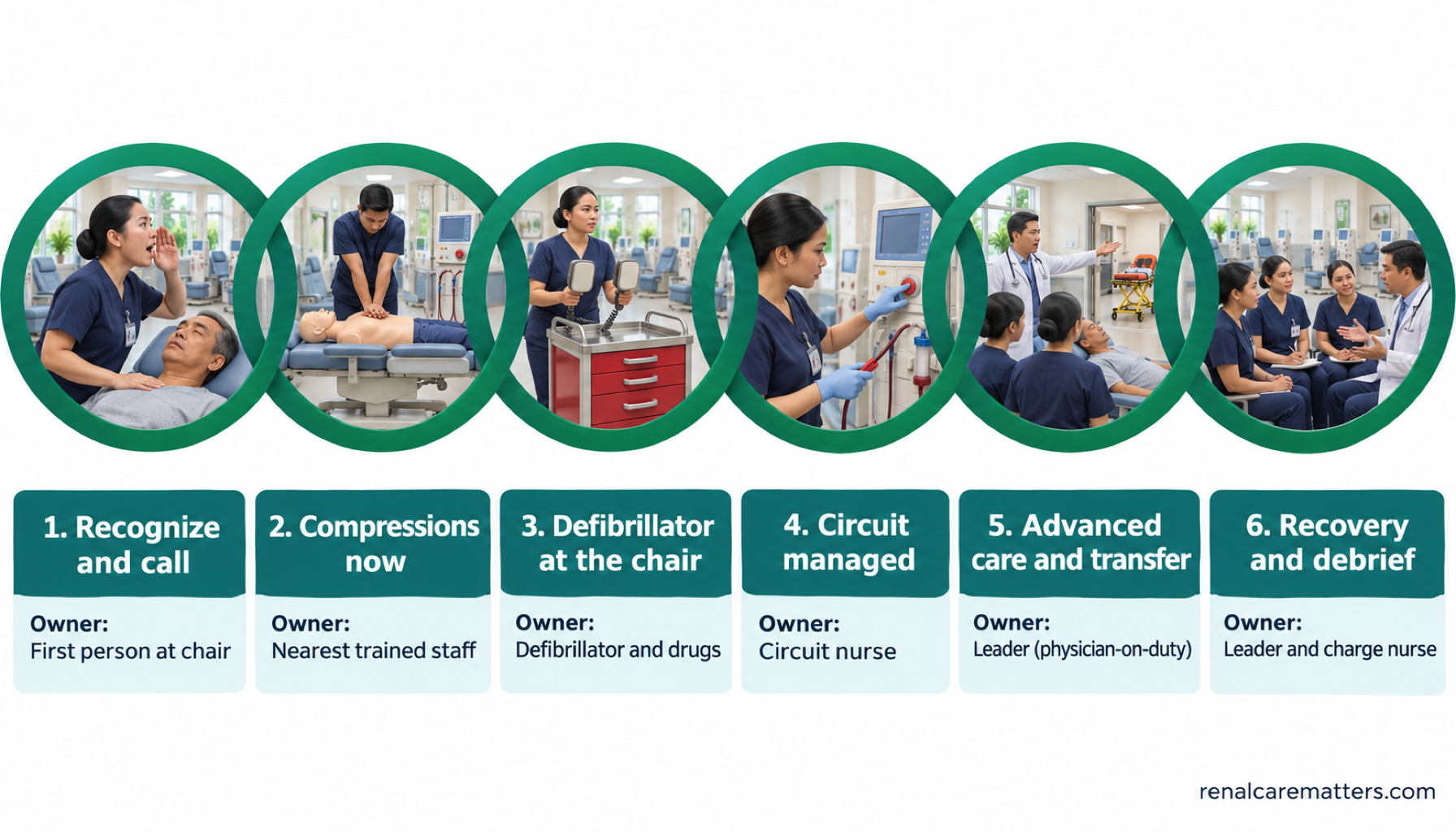
The 2025 American Heart Association (AHA) guidelines use a single chain of survival for adults and children, in and out of hospital.4 In a dialysis unit, every link happens in one room within minutes, which is both the advantage and the danger: everyone is close, so everyone assumes someone else is doing the next step.
Figure 3. One chain of survival, drawn for the dialysis floor. Every link has a named owner on every shift.
Link
On the dialysis floor
Owner on your shift
Recognize and call
Unresponsive, not breathing normally, no pulse in 10 seconds: shout, call the code
The first person at the chair
Compressions now
Recliner flat, compressions within seconds
The nearest trained staff; swap every 2 minutes
Defibrillator at the chair
Pads on as soon as it arrives; rhythm decides
The defibrillator and drugs person
Circuit managed
Fluid removal stopped, blood decision made and announced
The circuit nurse
Advanced care and transfer
Drugs, airway, reversible causes, ambulance called early
The leader (usually the physician-on-duty)
Recovery and debrief
Handover, family, documentation, team debrief
The leader and the charge nurse
The chain has one link the general guidelines do not draw: the other patients. When five staff gather around Station 7, the circuits at Stations 1 to 18 are still running. A named watcher stays outside the arrest and keeps every other patient safe. That person never joins compressions.
RememberEvery link has one named owner before the shift starts, and the watcher is never pulled into the arrest.
Lesson · part 3
The morning check: equipment that works today
The defibrillator and the crash cart are only as good as their last check. In one cohort of 729 in-clinic arrests, simply having a defibrillator on site was not associated with better survival after adjustment for patient differences.5 The device matters when it works, is brought to the chair at once, and is used by someone who is ready. In a later registry, staff applied a defibrillator before the ambulance arrived in only 52.3% of clinic arrests.6
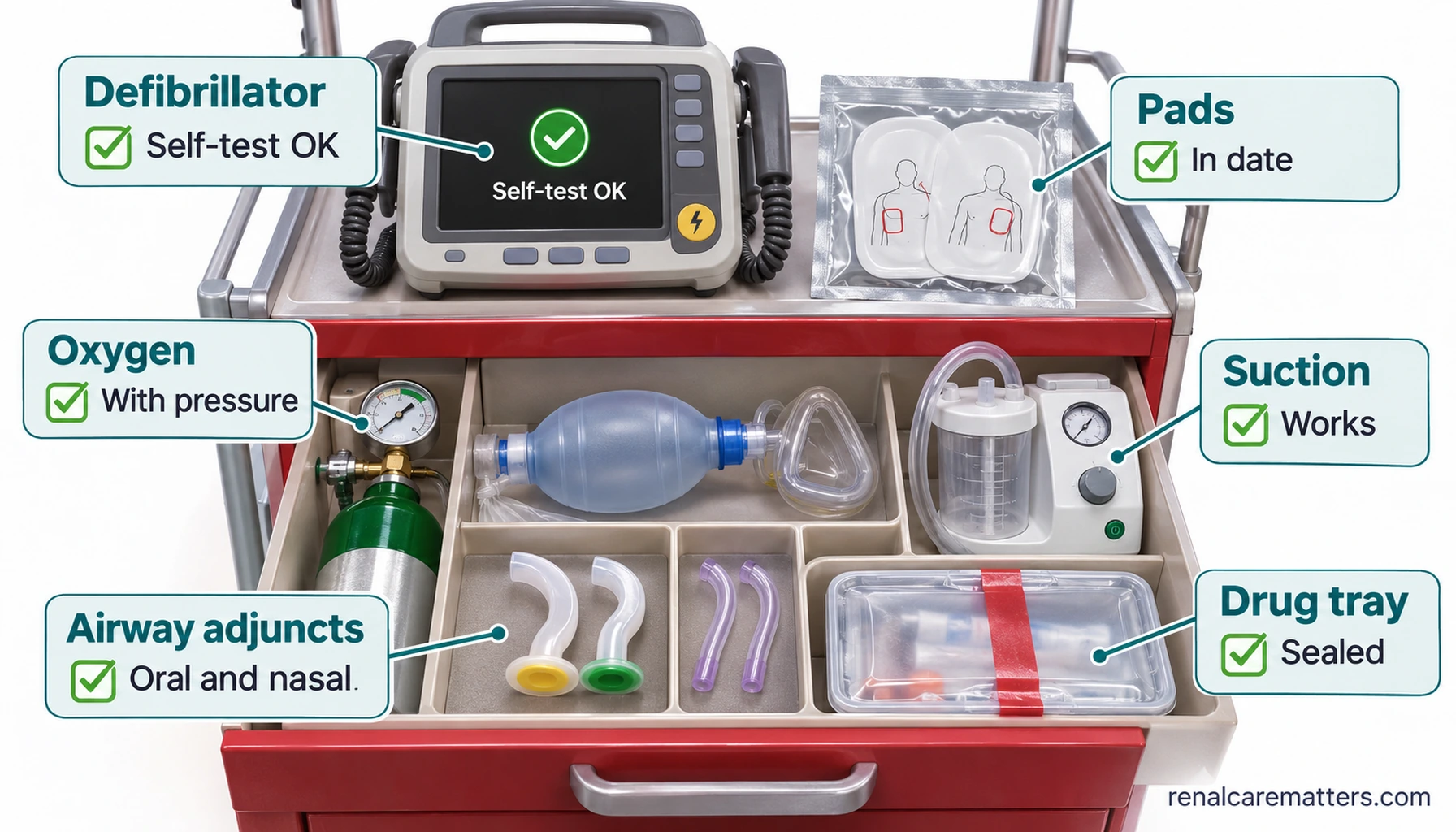
Figure 4. The morning check. The defibrillator self-test, pads in date, oxygen with pressure, suction that works, and a sealed drug tray.
Figure 5 · A five-minute morning check
DefibrillatorSelf-test passed; battery charged; adult pads (and pediatric pads where children dialyze) in date and sealed; spare pads; paper or memory working.
Airway and oxygenBag-valve-mask with adult masks in sizes; oxygen cylinder with enough pressure for transfer; tubing and masks; oral and nasal airways.
SuctionUnit switched on and tested; tubing and a rigid tip present.
Drugs and fluidsSealed tray with the unit’s list; expiry dates; saline bags and flushes; glucose meter with strips.
Paper and phonesCode record sheet, a working clock, and the ambulance and receiving hospital numbers posted where the runner will look.
A failed item is not a note in the log; it is a decision. In the case, the defibrillator battery warning and expired pads mean the unit has no reliable defibrillator. The first shift should not connect high-risk patients until a charged device and in-date pads are at hand, from a charging dock, a spare battery, or a sister unit, and the Medical Director or Dialysis Clinical Head should hear it before 6:00. The low oxygen cylinder must be swapped before it is needed for a transfer. The exact rule for what blocks a shift is your unit’s policy; write it down before the morning you need it.
RememberA failed defibrillator, pads or oxygen check is a stop-and-fix item before the first high-risk patient connects, and the clinical head hears about it the same morning.
Stop and callDefibrillator fails its self-test, pads are missing or expired, or oxygen will not last a transfer: tell the charge nurse and the Dialysis Clinical Head before the first connection, and follow your unit protocol for which patients may start. Always ask the attending nephrologist for guidance on any high-risk patient whose session is delayed.
Lesson · part 4
Roles on the roster, and how help arrives
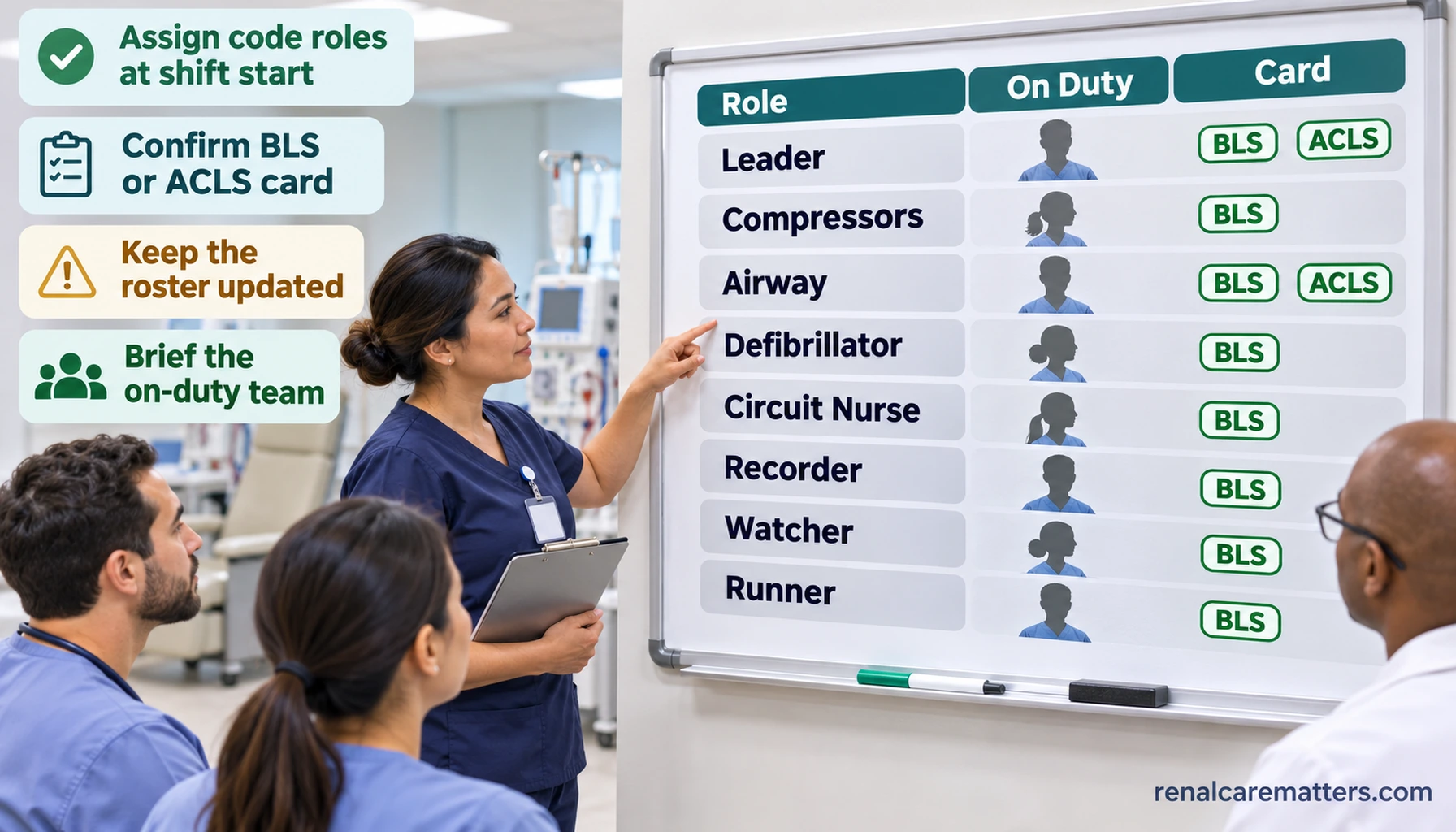
Philippine rules set the minimum: dialysis nurses hold a current Basic Life Support (BLS) certificate; the physician-on-duty holds current Advanced Cardiovascular Life Support (ACLS) from a Department of Health (DOH)-accredited provider; and at least one nurse on every shift holds an updated ACLS certificate.7,8 A roster can have enough nurses and still leave a shift without a current ACLS holder, so the charge nurse checks names, not headcount.
Figure 6. Assign the code roles at the start of the shift, and know who on the roster holds a current BLS or ACLS card.
Role
Who usually holds it
Combine with (small team)
Leader
Physician-on-duty; the ACLS-current nurse until the physician arrives
Defibrillator and drugs, if only three staff
Compressor 1 and 2
Any BLS-trained staff, including technicians and assistants
Airway (swap every 2 minutes)
Airway
Nurse or physician
Compressor 2
Defibrillator and drugs
ACLS-current nurse
Leader
Circuit nurse
The patient’s dialysis nurse
Recorder, once the circuit is safe
Recorder and timer
Any staff who can write and keep time
Runner
Watcher
A nurse who stays with the other patients
Never combined with the arrest
Runner
Technician, assistant or clerk
Recorder
Freestanding and hospital-based units
A hospital-based unit can call a code team that arrives in minutes. A freestanding unit is, for practical purposes, an out-of-hospital arrest site: registries count clinic arrests as out-of-hospital events.6 Help means an ambulance, and the minutes until it arrives belong to your team. Post the ambulance numbers, know the realistic travel time at 6:00 a.m. and at 5:00 p.m., and agree with the receiving emergency room in advance what you will send with the patient. Call the ambulance early: the runner calls as soon as the code is called, not after the first rhythm check.
RememberName the code roles at the start of every shift from the real roster, confirm an ACLS-current nurse is present, and call the ambulance at the moment the code is called.
On the floor · Two-minute huddle
At 5:55 a.m., charge nurse Ms. Dizon reads the roles aloud: “Leader until Dr. Salonga arrives: Joy. Compressors: Paolo and Ben. Circuit: the patient’s own nurse. Recorder: Liza. Watcher: Grace. Runner and ambulance: Mang Tony.” She adds, “Mr. Bautista is at Station 2, right in front of the cart.”
The huddle took two minutes. Nobody will have to ask “who does what?” during an arrest today.
Illustrative scenario. Names and details are invented.
On the floor
Real situations: problems and solutions
These are fictional but typical. For each one, cover the answer, decide what you would do, then compare. Where a step depends on local rules, your unit’s procedure and your supervisor’s direction come first.
The cart that moved
What you see
During a drill, the crash cart is not at its marked spot; it was moved to make room for a wheelchair.
What is likely going on
The cart has no fixed, protected place, so it drifts.
What to do
Mark the floor, keep the space clear, and make “cart in place” part of the morning check.
Why it matters
Seconds lost searching for the cart are seconds without compressions or a shock.
Saturday staffing
What you see
On a Saturday afternoon shift, the only ACLS-certified nurse calls in sick.
What is likely going on
The roster has enough nurses but no current ACLS holder.
What to do
Tell the head nurse at once; swap a nurse in from another shift or unit per policy, and record the gap.
Why it matters
The rule is at least one ACLS-updated nurse per shift; the headcount alone does not meet it.
“Ambulance is coming”
What you see
In a drill, the runner says the ambulance is coming, but nobody knows when it was called.
What is likely going on
The call time was never recorded, so the team cannot judge the delay.
What to do
The recorder writes the time of the ambulance call, and the runner reports the expected arrival.
Why it matters
Transfer planning depends on real times, not impressions.
Field notes
Post the ambulance and receiving hospital numbers inside the crash cart lid and beside the phone.
Seat the highest-risk Monday patients where the cart and the nurses’ station can see them.
Case review
Back to the case: The 5:40 a.m. check
What matters most. The defibrillator. A battery warning plus expired pads means the unit cannot reliably shock a shockable rhythm today. Ms. Dizon puts the device on charge, sends Mr. Ramos for a spare battery or a loaned device and fresh pads, and calls the Dialysis Clinical Head before 6:00. The oxygen cylinder is swapped for a full one. Suction works.
Can the shift start? That is a unit policy decision made in advance, not improvised at 5:45. A sensible policy delays the highest-risk patients until a working defibrillator is at hand and records who decided. Mr. Bautista (missed session, recent discharge) should not connect before then, and the physician-on-duty should review his order and potassium when she arrives. The two patients on a 1.0 mEq/L bath are flagged for the physician to review.
Roles. A leader until the physician arrives (the ACLS-current nurse), two compressors, a circuit nurse, a recorder, a runner who also calls the ambulance, and a watcher who never joins the arrest. Mr. Bautista sits in the station with the clearest view and closest to the cart.
None of this needed a guideline grade. It needed a check done as if today were the day.
Interactive case · fictional
Interactive case: The 5:40 a.m. check
Work through a shift one decision at a time. The panel at the top changes with what you choose. After each choice you see why it is, or is not, the best move; after a weaker one you can try again or carry on and see where it leads. Your first choice at each step is scored. The score stays on this device and nothing is sent anywhere. In real practice, your unit’s protocol and the people responsible for each decision come first.
Skills lab · with your preceptor
Skills checklist: A morning readiness check and a role huddle
Using your own unit’s cart and defibrillator (in training mode), complete the check and run a two-minute role huddle while a supervisor observes. Your preceptor rates each step as satisfactory, needs practice, or not observed. Steps marked Critical must all be satisfactory before sign-off. This checklist supports supervised learning; your unit’s own procedure and competency form are the authority. A printable version of every checklist is on the trainer page.
CriticalConfirms the defibrillator self-test, battery and pad expiry, and names the action for any failure.
CriticalChecks the bag-valve-mask, masks, oxygen pressure, tubing, airways and suction, and tests the suction.
Checks the drug tray seal and expiry dates against the unit list, and the glucose meter.
CriticalEscalates a failed defibrillator or oxygen check to the charge nurse and clinical head before the first connection.
Reads the day’s list for risk flags (Monday, missed session, low-potassium bath, recent discharge, large fluid goal).
CriticalAssigns every code role from the real roster, including a watcher who will not join the arrest.
States the ambulance number, the realistic travel time, and when the runner calls it.
Placement activity. For one week, do the morning check with the charge nurse and record every item that was missing or failed. Present the list at the next staff meeting.
Self-assessment
Check your understanding
Each visit draws 5 questions at random from this module’s 10-question bank. Choose the single best answer for each, then select Check answers; an explanation appears under the best answer. Select New set of questions for a different mix. A good target is 4 of 5 on two different sets. Nothing you select is sent anywhere; scoring happens in your browser.
Karnik, J. A., Young, B. S., Lew, N. L., Herget, M., Dubinsky, C., Lazarus, J. M., & Chertow, G. M. (2001). Cardiac arrest and sudden death in dialysis units. Kidney International, 60(1), 350–357. https://doi.org/10.1046/j.1523-1755.2001.00806.x
Pun, P. H., Lehrich, R. W., Honeycutt, E. F., Herzog, C. A., & Middleton, J. P. (2011). Modifiable risk factors associated with sudden cardiac arrest within hemodialysis clinics. Kidney International, 79(2), 218–227. https://doi.org/10.1038/ki.2010.315
Foley, R. N., Gilbertson, D. T., Murray, T., & Collins, A. J. (2011). Long interdialytic interval and mortality among patients receiving hemodialysis. New England Journal of Medicine, 365(12), 1099–1107. https://doi.org/10.1056/NEJMoa1103313
Dezfulian, C., Cabañas, J. G., Buckley, J. R., Cash, R. E., Crowe, R. P., Drennan, I. R., Mahgoub, M., Mannarino, C. N., May, T., Salcido, D. D., Uzendu, A. I., Vogelsong, M. A., Worth, J. A., & Girotra, S. (2025). Part 4: Systems of care: 2025 American Heart Association guidelines for cardiopulmonary resuscitation and emergency cardiovascular care. Circulation, 152(16_suppl_2), S353–S384. https://doi.org/10.1161/CIR.0000000000001378
Lehrich, R. W., Pun, P. H., Tanenbaum, N. D., Smith, S. R., & Middleton, J. P. (2007). Automated external defibrillators and survival from cardiac arrest in the outpatient hemodialysis clinic. Journal of the American Society of Nephrology, 18(1), 312–320. https://doi.org/10.1681/ASN.2006040392
Pun, P. H., Dupre, M. E., Starks, M. A., Tyson, C., Vellano, K., Svetkey, L. P., Hansen, S., Frizzelle, B. G., McNally, B., Jollis, J. G., Al-Khatib, S. M., & Granger, C. B. (2019). Outcomes for hemodialysis patients given cardiopulmonary resuscitation for cardiac arrest at outpatient dialysis clinics. Journal of the American Society of Nephrology, 30(3), 461–470. https://doi.org/10.1681/ASN.2018090911
Educational reviewer and practice resource for dialysis teams. It is not an American Heart Association (AHA) course, it is not BLS, ACLS or PALS certification, and online completion does not establish hands-on competence. Staff certify through an authorized training center. Your unit’s approved protocol, crash-cart stock and machine manufacturer’s instructions govern every real event.