Staging chronic kidney disease, triaging a referral, working within the RND scope, and escalating a critical result with a closed-loop handoff.
PublishedNailathalaGipatikPepalwal:ReferencesMga SanggunianMga TinubdanReng Reperensya:5Audience: Registered nutritionist-dietitians entering adult kidney care · renal RND preceptors, nephrologists, and head nurses who orient themRead timeOras ng pagbasaOras sa pagbasaOras ning pamamasa:
This module is study material for dietitians in adult kidney care. It explains the reasoning behind common decisions; it is not a protocol. In practice, follow your facility’s policy and the responsible physician’s orders. Targets and cut-off values are set by your unit and the attending nephrologist. Every case is fictional.
Learning objectives
After this module you should be able to
Confirm chronic kidney disease (CKD) from two results at least three months apart, and classify it by cause, glomerular filtration rate category, and albuminuria category.
Sort a nutrition referral into routine, expedited, or urgent, and say what makes it so.
State what a registered nutritionist-dietitian (RND) decides, and what belongs to the physician, nurse, and pharmacist.
Collect the six things every first renal consult needs before any advice is given.
Escalate a critical result with a structured, closed-loop handoff and document who accepted it.
Explain why renal diets are now individualized instead of fixed lists of forbidden foods.
Pre-testBefore you read, answer the 8 self-assessment questions and note your score. After the module, select New set of questions and compare. The difference is what you learned; the questions you still miss are what to reread.
Start here
The big picture, in plain words
In plain wordsThink of the kidneys as the household’s waste collector and water meter in one. When collection slows, the family does not stop eating; it sorts what it brings home so less waste piles up between pickups. Your job is to help each family sort, using what the kidney can still do today. The picture is useful but incomplete: the kidney also makes hormones and balances acid, which is why diet touches bone, blood, and muscle too.
Figure 1 · Key terms for this module
Chronic kidney disease (CKD)Abnormal kidney structure or function for at least three months, with implications for health.
Estimated glomerular filtration rate (eGFR)An estimate, from a blood test, of how much blood the kidneys filter each minute.
Urine albumin-to-creatinine ratio (UACR)The amount of albumin in a spot urine sample, corrected for how concentrated the urine is.
Medical nutrition therapy (MNT)Assessment, a nutrition prescription, counseling, and follow-up given by a dietitian for a medical condition.
Nutrition Care Process (NCP)The four-step method of assessment, diagnosis, intervention, and monitoring that Philippine hospitals are required to document.
Critical resultA laboratory value that the laboratory or unit policy says must be reported to a clinician at once.
Closed-loop handoffA report in which the receiver repeats the message back and accepts responsibility, and you record that they did.
Figure 2 · Three habits this module teaches
Stage before you adviseKnow the cause, the eGFR category, and the albuminuria category, with dates.
Triage before you teachDecide whether this referral is routine, expedited, or urgent.
Hand off, then documentA warning that nobody accepted has not been delivered.
Opening case · fictional
Case: The label-reading referral
Mrs. Dela Cruz, 59, is referred for “label reading and a low-salt diet.” Her record shows an eGFR of 36 mL/min/1.73 m² in July and 34 in November, with a UACR of 420 mg/g. She takes losartan and, since last month, spironolactone.
You telephone to confirm tomorrow’s appointment. She says she has felt weak since yesterday and that her heart is “skipping.” While you are speaking, the laboratory posts today’s potassium and flags it as critical.
Before reading on, decide:
How would you classify her kidney disease, and what makes it chronic?
Is this still a routine referral?
Exactly what will you say, to whom, and what will you write down?
Keep your answers in mind. The lesson gives you what you need, and the case review near the end shows one sound response.
Lesson · part 1
Read the kidney history before the diet history
A nutrition prescription depends on how much kidney function is left and how fast it is changing, so the first task is to stage the disease. Chronic kidney disease (CKD) is defined as abnormal kidney structure or function, present for at least three months, with implications for health.1 One low result is not CKD. Dehydration, an infection, or a new medicine can lower the estimated glomerular filtration rate (eGFR) for a few days.
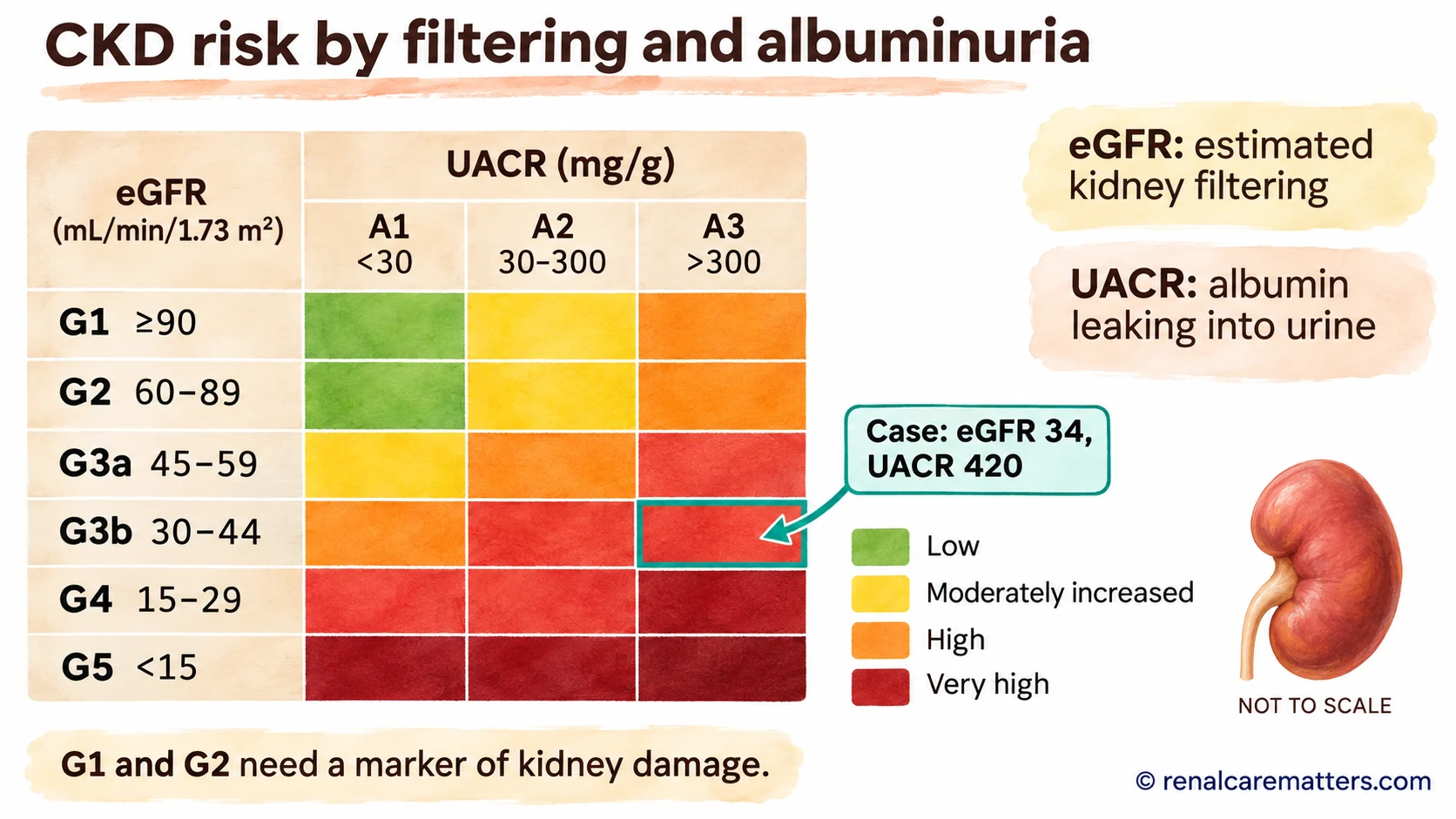
Kidney Disease: Improving Global Outcomes (KDIGO) classifies CKD by Cause, GFR category, and Albuminuria category, the “cause, GFR category, and albuminuria category (CGA)” system.1 The two numbers answer different questions. The eGFR says how much filtering is left. The urine albumin-to-creatinine ratio (UACR) says how leaky the filter is, and it predicts progression and heart disease at every level of eGFR.
GFR category
eGFR (mL/min/1.73 m²)
Albuminuria category
UACR (mg/g)
G1
90 or higher
A1
Below 30
G2
60 to 89
A2
30 to 300
G3a
45 to 59
A3
Above 300
G3b
30 to 44
G4
15 to 29
G5
Below 15
G1 and G2 count as CKD only when there is another marker of kidney damage, such as albuminuria or an abnormal ultrasound.1 Two cautions matter to a dietitian. First, eGFR from creatinine depends on muscle: a frail patient with little muscle can have a reassuring eGFR and poor kidney function, and a high cooked-meat meal or a creatine supplement can lower it for a day. Second, when kidney function is changing quickly, as in acute illness, eGFR formulas are unreliable and should not be used to stage.
Figure 3. The CGA grid. Risk rises down the rows as filtering falls and across the columns as albuminuria rises.
RememberWrite the stage the way the nephrologist does: cause, G category, A category, and the dates of the two results that prove it is chronic. “Diabetic kidney disease, G3b A3, eGFR 36 in July and 34 in November.”
Lesson · part 2
Sort the referral: routine, expedited, or urgent
A referral slip tells you what the sender was thinking on the day it was written. The patient may have changed since. Before you plan a teaching session, collect six things: the referral question, the kidney stage or dialysis modality, recent hospital stays, the trend in weight and intake, the latest potassium, bicarbonate, phosphorus, and glucose with their dates, and the current medicine list including supplements and herbal products.
Figure 4 · Three levels of referral
RoutineStable patient, steady intake and weight, no safety signal. Example: a first visit for G3a CKD with normal potassium. See at the next scheduled clinic.
Expedited (days)Intake has fallen clearly, weight is dropping without intention, a new dialysis start, a new tube feeding, or discharge after a long admission. See within the week and tell the referring clinician.
Urgent (now)A critical laboratory result, new weakness, palpitations, confusion, breathlessness at rest, a low glucose that is not responding, cloudy peritoneal dialysis fluid, or a missed dialysis session with symptoms. Stop teaching and activate the unit’s urgent pathway.
The Academy of Nutrition and Dietetics and National Kidney Foundation standards describe this sorting as part of competent nephrology practice: the dietitian screens, sets priorities, and communicates concerns to the team.2 The reason is physiological. A patient with G4 CKD who starts a potassium-sparing medicine can go from a normal to a dangerous potassium within weeks, and the first person to hear about the weakness is often the one who telephones about the diet.
Stop and reportA critical result with symptoms is a medical emergency, not a nutrition problem. Do not start diet teaching, do not ask the patient to “avoid bananas and come tomorrow,” and do not wait for the clinic day. Call the responsible physician or follow the emergency pathway now.
Lesson · part 3
What is yours to decide
In the Philippines, the practice of nutrition and dietetics is regulated by Republic Act No. 10862, and hospitals are required by the Department of Health to document nutrition care using the Nutrition Care Process (NCP): assessment, diagnosis, intervention, and monitoring and evaluation.3,4 Within that process the dietitian owns the nutrition assessment, the nutrition diagnosis, the nutrition prescription within the diet order, counseling, and follow-up.
Decision
Who decides
The dietitian’s part
Energy and protein targets, meal plan, food choices
Dietitian, within the physician’s diet order
Calculate, document the guideline and weight used, counsel, review
Phosphate binder, potassium binder, insulin, diuretic, vitamin D doses
Physician
Report intake, timing problems, and adherence barriers; reinforce the written instructions
Dry weight, dialysis time, dialysis fluid
Nephrologist
Report weight history, intake, and fluid sources
Oral nutrition supplement
Facility policy; often dietitian recommends, physician orders
Select the product and amount, monitor response
Tube feeding or parenteral nutrition
Physician with the nutrition support team
Assess, recommend formula and rate, monitor delivery and tolerance
Emergency treatment
Physician and nurse
Recognize, call, hand off, document
The line between “reinforcing” and “changing” a medicine is where new dietitians slip. Telling a patient to take the binder with the first bite of a meal, when that is what the label says, is reinforcement. Telling her to take two instead of one because the meal is large is a dose change, and it belongs to the prescriber.
Old renal diets were built as lists of forbidden foods. Two findings changed that. Restriction often lowered total intake and muscle mass, and many high laboratory values turned out to have causes other than food. The Kidney Disease Outcomes Quality Initiative (KDOQI) 2020 guideline therefore recommends adjusting potassium and phosphorus intake to keep serum levels in the normal range for that patient, not restricting everyone.5 Individualizing is harder than handing out a list. It is the reason a trained dietitian is on the team.
Lesson · part 4
Escalate with a closed loop
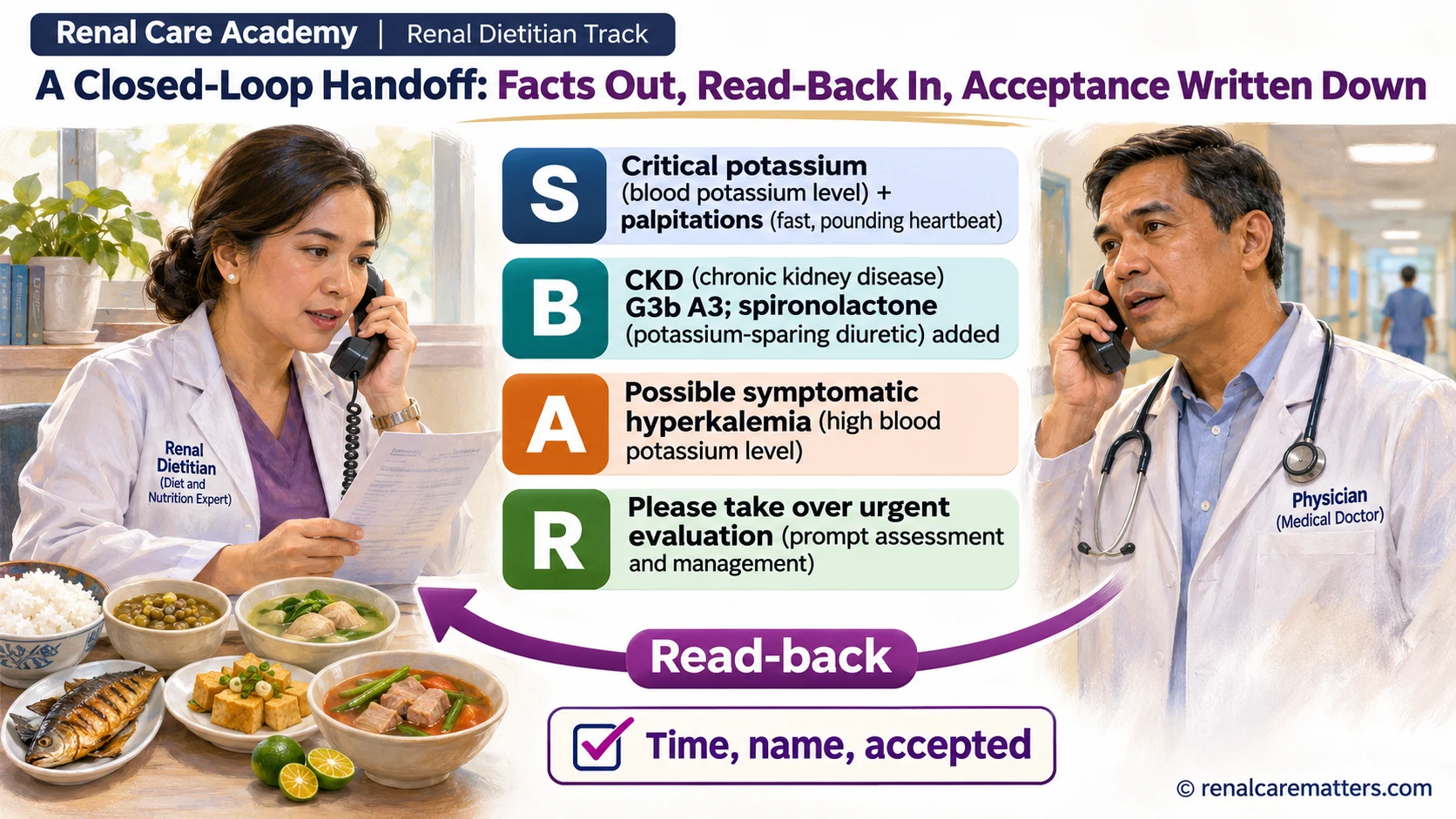
A handoff is closed when three things have happened: you gave the facts, the receiver repeated them back, and the receiver accepted responsibility. Use a fixed structure so nothing is left out under pressure. Many units use Situation, Background, Assessment, Recommendation (SBAR).
Figure 5 · A 20-second critical-result handoff
Situation“I am the dietitian. Mrs. Dela Cruz, 59, has a potassium flagged critical today and new palpitations and weakness.”
Background“CKD G3b A3. On losartan; spironolactone was added last month.”
Assessment“I am concerned this is symptomatic hyperkalemia. I have not given diet advice.”
Recommendation“Please take over urgent evaluation now. Where should she go, and who will call her?”
Read-backThe receiver repeats the name, the result, and the plan. You record the time and the name.
Figure 6. A closed-loop handoff: facts out, read-back in, acceptance written down.
Then document: the value and its units, the time it was posted, the symptoms in the patient’s words, whom you called and when, what they directed, and that they accepted. If you cannot reach the first person within the time your policy allows, go to the next name on the escalation list. Resume nutrition education only after the team says the patient is stable.
RememberYour handoff does not need a diagnosis. It needs the result, the symptoms, the medicines that changed, and a clear request.
On the floor
Real situations: problems and solutions
These are fictional but typical. For each one, cover the answer, decide what you would do, then compare. Where a step depends on local rules, your unit’s procedure and your supervisor’s direction come first.
The referral with no question
What you see
A slip says only “Diet, CKD.” No stage, no results, no reason.
What is likely going on
The sender wanted help but did not say what kind.
What to do
Look up the kidney results and medicines yourself, then call or message the sender: “What would you most like me to help with?” Triage from what you find.
Why it matters
A clear question gets a useful answer. A vague one gets a generic handout.
The nurse who says “just give her the list”
What you see
A busy nurse asks for the standard low-potassium sheet for a patient you have not met.
What is likely going on
The unit is used to lists, and the nurse is trying to help.
What to do
Thank her, and ask for ten minutes with the patient first. Check the potassium trend and medicines, then decide whether any restriction is needed.
Why it matters
A list given without assessment can cut intake for no benefit. Showing the team why you assess builds trust.
Field notes
Carry a card with the critical-result policy and the escalation list.
Write every kidney result with its date. An undated eGFR cannot prove chronicity.
Case review
Back to the case: The label-reading referral
How would you classify her kidney disease? As CKD G3b A3. An eGFR of 34 falls in G3b, and a UACR of 420 mg/g is above 300, so A3. Two results below 60, four months apart, make it chronic. Write the cause as “to be confirmed with the nephrologist” until someone has confirmed it.
Is this still a routine referral? No. It was routine when it was written. A critical potassium with palpitations and weakness makes it urgent today. Notice the medicine list: spironolactone added to losartan in G3b CKD is a well-known cause of a rising potassium. Food is unlikely to be the main cause, and a diet sheet is not the treatment.
What will you say, and what will you write? Tell Mrs. Dela Cruz not to wait for tomorrow, and follow your unit’s pathway to get her seen now. Then call the responsible physician with the handoff in this module: the result, her symptoms, the medicine that changed, and a clear request. Ask for a read-back. Write down the value, the time it was posted, her symptoms in her own words, whom you called and when, what they told you, and that they accepted.
And the label reading? It can wait until she is safe. When you do see her, the potassium history will shape what you teach. A dietitian is often the first person to hear a patient say “I feel weak.” Part of your job is to make sure that sentence reaches a physician the same hour.
Skills lab · with your preceptor
Skills checklist: First-consult triage and critical-result handoff
Use a fictional record. The preceptor plays the patient and then the physician on the telephone. Your preceptor rates each step as satisfactory, needs practice, or not observed. Steps marked Critical must all be satisfactory before sign-off. This checklist supports supervised learning; your unit’s own procedure and competency form are the authority. A printable version of every checklist is on the trainer page.
Finds two kidney results at least three months apart and states the cause, G category, and A category with dates and units.
Collects the six first-consult items: referral question, stage or modality, recent admissions, weight and intake trend, key laboratory results with dates, and medicines including supplements.
Classifies the referral as routine, expedited, or urgent and gives the reason.
CriticalOn a simulated critical result with symptoms, stops teaching and activates the urgent pathway without giving diet advice first.
CriticalDelivers a structured handoff in under 30 seconds and obtains a read-back.
CriticalDocuments value, units, time, symptoms, recipient, directions, and acceptance.
States one decision that belongs to the physician and how the dietitian contributes to it.
Uses the escalation list when the first contact does not answer.
Placement activity. During your first week, find your unit’s critical-result policy and escalation list, and write the names and numbers on a card you carry.
Self-assessment
Check your understanding
Each visit draws 8 questions at random from this module’s 15-question bank. Choose the single best answer for each, then select Check answers; an explanation appears under the best answer. Select New set of questions for a different mix. A good target is 7 of 8 on two different sets. Nothing you select is sent anywhere; scoring happens in your browser.
Kidney Disease: Improving Global Outcomes (KDIGO) CKD Work Group. (2024). KDIGO 2024 clinical practice guideline for the evaluation and management of chronic kidney disease. Kidney International, 105(4S), S117–S314. https://doi.org/10.1016/j.kint.2023.10.018
Pace, R. C., & Kirk, J. (2021). Academy of Nutrition and Dietetics and National Kidney Foundation: Revised 2020 Standards of Practice and Standards of Professional Performance for registered dietitian nutritionists (competent, proficient, and expert) in nephrology nutrition. Journal of Renal Nutrition, 31(2), 100–115.e41. https://doi.org/10.1053/j.jrn.2020.12.001
Ikizler, T. A., Burrowes, J. D., Byham-Gray, L. D., Campbell, K. L., Carrero, J. J., Chan, W., Fouque, D., Friedman, A. N., Ghaddar, S., Goldstein-Fuchs, D. J., Kaysen, G. A., Kopple, J. D., Teta, D., Yee-Moon Wang, A., & Cuppari, L. (2020). KDOQI clinical practice guideline for nutrition in CKD: 2020 update. American Journal of Kidney Diseases, 76(3, Suppl. 1), S1–S107. https://doi.org/10.1053/j.ajkd.2020.05.006
Educational study material for registered nutritionist-dietitians. Does not replace the nephrologist’s orders, facility policy, the Nutrition Care Process documentation required by the Department of Health, or supervised practice.