Maintenance hemodialysis, emergency sessions, acute kidney injury, peritoneal dialysis, and transplant, and a handoff that closes the loop.
PublishedNailathalaGipatikPepalwal:ReferencesMga SanggunianMga TinubdanReng Reperensya:5Audience: PhilHealth liaisons, claims officers, and claims clerks in freestanding dialysis centers and hospital dialysis units · billing and finance staff · head nurses and unit managers who supervise the claims deskRead timeOras ng pagbasaOras sa pagbasaOras ning pamamasa:
Training track for the staff who keep dialysis claims honest, complete, and on time
This module is study material for dialysis claims staff. PhilHealth rules change by circular and advisory: confirm every rate, date, and form against the current issuance and your PhilHealth Regional Office before you rely on it. Clinical decisions belong to the treating team. Every case, name, and identifier here is fictional; never use real patient data in training.
Learning objectives
After this module you should be able to
Explain in plain words why acute kidney injury and chronic kidney disease stage 5 lead to different benefits.
Route a case by the clinician-documented diagnosis and modality: maintenance hemodialysis, emergency hemodialysis, acute kidney injury, peritoneal dialysis, or transplant.
Describe the Z benefits for peritoneal dialysis and transplantation at the level a liaison needs, with their contracting requirements.
Close the loop on a referral with an owner, an acknowledgment, and a callback time.
Distinguish verified coverage from a pending determination when talking to a family.
Pre-testBefore you read, answer the 8 self-assessment questions and note your score. After the module, select New set of questions and compare. The difference is what you learned; the questions you still miss are what to reread.
Start here
The big picture, in plain words
In plain wordsThe same two kidneys can fail in two very different ways. Acute kidney injury is a sudden injury, like a sprained ankle: dialysis is a crutch while the kidney may heal. Chronic kidney disease stage 5 is a lasting loss, like a lost limb: dialysis or a transplant replaces what will not come back.
The picture has a limit: some patients with acute injury do not recover and move on to chronic disease, and only the nephrologist can say which is happening. That is why the documented diagnosis, not the machine or the room, decides which benefit a session belongs to, and why claims staff never route a case by convenience.
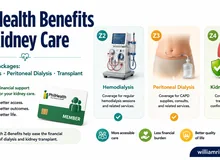
Figure 1. Same kidneys, different pathways. The documented diagnosis decides the route; peritoneal dialysis and transplant are Z benefits delivered by contracted providers.
Figure 2 · Key terms for this module
Acute kidney injury (AKI)A sudden, possibly reversible fall in kidney function.
Maintenance hemodialysisRegular sessions, usually three a week, for chronic kidney disease stage 5.
Peritoneal dialysis (PD)Dialysis using the lining of the abdomen, done at home.
Z benefitsPhilippine Health Insurance Corporation (PhilHealth) packages for high-cost conditions, delivered by contracted facilities.
Contracted providerA facility under contract with PhilHealth for a specific Z benefit.
CallbackAn agreed time when a named person will contact the patient with the next step.
Opening case · fictional
Case: Three requests at one desk
In one afternoon the liaison, Ms. Carla Mendoza, receives three requests. A hospital asks how to file for a patient discharged after temporary dialysis for acute kidney injury. Ms. Grace Lim (fictional, SIM-10), 28, on maintenance hemodialysis, asks to be evaluated for a kidney transplant and says a friend told her “PhilHealth pays for everything at any hospital.” And a stage 5 patient of the unit received emergency hemodialysis during a three-day confinement for pneumonia.
Before reading on, decide:
Who owns each request, and which pathway does each follow?
What do you tell Ms. Lim about the transplant benefit, and what is the next step?
What does your unit record about the emergency session?
Keep your answers in mind. The lesson gives you what you need, and the case review near the end shows one sound response.
Lesson · part 1
Route by the documented diagnosis
Situation
Documentation that triggers it
Route and owner
Chronic kidney disease stage 5 on maintenance hemodialysis
Hemodialysis package, filed by the rendering facility; counts toward the 156 (Module 4)
Dialysis for acute kidney injury
Clinician-documented acute injury
Hospital coding and claims review, under the applicable case rate
Peritoneal dialysis
Stage 5, PDD registration, contracted provider
Z benefit for peritoneal dialysis
Kidney transplant and aftercare
Transplant evaluation by a contracted center
Z benefit for kidney transplantation and post-transplant services
A facility accredited for hemodialysis may need a separate contract to deliver a Z benefit. Verify contracting, any pre-authorization, forms, and deadlines with the receiving service before the patient is told anything definite.
Lesson · part 2
Peritoneal dialysis and transplant benefits
PhilHealth’s Z benefit for peritoneal dialysis, effective January 1, 2025, covers continuous ambulatory peritoneal dialysis for adults and both continuous ambulatory and automated peritoneal dialysis for children, with automated dialysis in children first piloted at named sites. Patients must be registered in the PDD.1,2 PhilHealth announced annual coverage of up to about 1.2 million pesos for pediatric automated peritoneal dialysis, with adult coverage depending on the daily solution prescription.3
The kidney transplant Z benefit was raised under PhilHealth Circular 2024-0035, and post-transplant services were added under Circular 2025-0011.4,5 Amounts differ by donor type and induction medicine; quote them only from the current circular, through the contracted center.
RememberA liaison explains which door a patient should knock on and helps them get there. The contracted service decides eligibility and amounts.
Lesson · part 3
A handoff that closes the loop
Use the patient’s preferred language and agree an owner and a callback time. Separate what is verified (“your eligibility is confirmed”) from what is pending (“the transplant center will tell us whether you qualify”). If the patient has an urgent clinical concern, hand over directly to nursing or the treating team. Route possible financial help to the facility’s social service.
Handoff field
Example (fictional)
Verified status
Eligible; PDD registered; 98 sessions used this year
Last treatment
Wednesday, completed
Open questions
Transplant evaluation pathway and pre-authorization
Authorized receiver
Transplant coordinator, contracted center
Next action and callback
Referral acknowledged by Friday; callback to patient before 3 preventive maintenance (PM) Friday
A callback line in Filipino: “Tatawagan ko po kayo bukas bago mag-alas tres para sabihin ang susunod na hakbang.” (“I will call you tomorrow before three o’clock to tell you the next step.”)
On the floor
Real situations: problems and solutions
These are fictional but typical. For each one, cover the answer, decide what you would do, then compare. Where a step depends on local rules, your unit’s procedure and your supervisor’s direction come first.
The AKI patient who keeps coming
What you see
A patient dialyzed for acute kidney injury still needs dialysis six weeks after discharge.
What is likely going on
Possible progression to chronic disease.
What to do
Ask the nephrologist to document the current diagnosis before routing any claim.
Why it matters
The diagnosis decides the pathway.
The cousin’s advice
What you see
A family heard that peritoneal dialysis is “free anywhere.”
What is likely going on
A misunderstanding of the Z benefit.
What to do
Explain that it is delivered by contracted providers, and refer to the clinical team and a contracted PD coordinator.
Why it matters
Wrong expectations become complaints.
The referral that vanished
What you see
A transplant referral was sent three weeks ago and nobody heard back.
What is likely going on
An open loop.
What to do
Confirm receipt with the coordinator, set a callback, and record the acknowledgment.
Why it matters
A referral sent is not a referral received.
Field notes
Separate verified coverage from pending decisions in every conversation.
Agree a callback time before the patient leaves.
Route funding questions to social service, not to your own judgment.
Case review
Back to the case: Three requests at one desk
Owners and routes. The acute kidney injury discharge goes to the hospital’s own coding and claims review under the applicable case rate, not the maintenance hemodialysis package. Ms. Lim’s request goes to her nephrologist and the contracted transplant center’s coordinator. The emergency session during the pneumonia stay is a hemodialysis-package session filed by the hospital.
What to tell Ms. Lim. That PhilHealth has a Z benefit for kidney transplantation, delivered only through contracted centers, and that the center will assess whether she qualifies and explain the coverage. Record her request, contact the nephrologist and coordinator, confirm the referral is received, and agree a callback time.
The emergency session. Record it in the ledger as consumed (#n of 156), keep the hospital’s claim reference, and do not bill that date. The hospital codes and files its confinement claim, with a Claim Form 5 (CF5) attached if the discharge is on or after August 1, 2026 (Module 5).
Skills lab · with your preceptor
Skills checklist: Routing and closed-loop handoff
Route five fictional requests and complete one handoff, including the callback, with a supervisor playing the patient. Your preceptor rates each step as satisfactory, needs practice, or not observed. Steps marked Critical must all be satisfactory before sign-off. This checklist supports supervised learning; your unit’s own procedure and competency form are the authority. A printable version of every checklist is on the trainer page.
CriticalRoutes each case by the clinician-documented diagnosis and modality.
Verifies contracting and pre-authorization before giving definite answers about a Z benefit.
Separates verified coverage from pending determinations in plain language.
CriticalHands over urgent clinical concerns directly to nursing.
Closes the loop with an owner, an acknowledgment, and a callback time.
Placement activity. Follow one transfer or referral at your unit from request to acknowledgment.
Self-assessment
Check your understanding
Each visit draws 8 questions at random from this module’s 15-question bank. Choose the single best answer for each, then select Check answers; an explanation appears under the best answer. Select New set of questions for a different mix. A good target is 7 of 8 on two different sets. Nothing you select is sent anywhere; scoring happens in your browser.
Glossary & abbreviationsTalahulugan at mga daglatTalaan sa mga pulong ug daglatTalatinigan ampo reng daglatterms used on this page
Abbreviations
AKI
Acute kidney injury.
CF5
Claim Form 5 — Inpatient clinical data for diagnosis-related group shadow billing; mandatory for inpatient discharges from August 1, 2026.
CKD
Chronic kidney disease.
HD
Hemodialysis.
PD
Peritoneal dialysis.
PDD
PhilHealth Dialysis Database — The registry of patients with chronic kidney disease stage 5 on dialysis; registration is required for the dialysis benefits.
PhilHealth
Philippine Health Insurance Corporation.
PM
Preventive maintenance — Scheduled service done before something breaks.
Terms in plain words
Acute kidney injury
A sudden, possibly reversible fall in kidney function (AKI).
Maintenance hemodialysis
Regular sessions for chronic kidney disease stage 5.
Peritoneal dialysis
Dialysis using the lining of the abdomen (PD).
Z benefits
PhilHealth packages for high-cost conditions, delivered by contracted facilities.
Contracted provider
A facility under contract with PhilHealth for a specific Z benefit.
Callback
An agreed time when a named person will contact the patient.
Philippine Health Insurance Corporation. (2025). PhilHealth Advisory No. 2025-0074 [Pilot implementation of the Z benefits package for peritoneal dialysis covering automated PD in children]. https://www.philhealth.gov.ph/advisories/2025/PA2025-0074.pdf
Educational material for dialysis claims staff. Completing it is an Academy learning record only. It is not a PhilHealth certification, it does not grant system access or signing authority, and it does not replace current PhilHealth issuances, written guidance from your PhilHealth Regional Office, or your facility’s approved procedures.