The Claim Packet, Codes, and Diagnosis-Related Groups
The manifest, per-session agreement forms, the electronic statement of account, diagnosis and procedure codes, and what case rates and diagnosis-related groups mean for you.
PublishedNailathalaGipatikPepalwal:ReferencesMga SanggunianMga TinubdanReng Reperensya:13Audience: PhilHealth liaisons, claims officers, and claims clerks in freestanding dialysis centers and hospital dialysis units · billing and finance staff · head nurses and unit managers who supervise the claims deskRead timeOras ng pagbasaOras sa pagbasaOras ning pamamasa:
Training track for the staff who keep dialysis claims honest, complete, and on time
This module is study material for dialysis claims staff. PhilHealth rules change by circular and advisory: confirm every rate, date, and form against the current issuance and your PhilHealth Regional Office before you rely on it. Clinical decisions belong to the treating team. Every case, name, and identifier here is fictional; never use real patient data in training.
Learning objectives
After this module you should be able to
Build an indexed packet manifest with each item’s applicability, source, owner, version, and status.
Check that sessions, dates, signatures, and identifiers agree across Claim Form 2 (CF2), Claim Form 4 (CF4), the agreement forms, and the bill.
Explain why the statement of account must be Extensible Markup Language (XML) and what happens to a Portable Document Format (PDF).
Tell an International Classification of Diseases, 10th Revision (ICD-10) diagnosis code from a Relative Value Scale (RVS) procedure code, and avoid the US-code trap.
Explain in plain words how case rates differ from diagnosis-related groups, and what the Claim Form 5 (CF5) rule changes today.
Pre-testBefore you read, answer the 8 self-assessment questions and note your score. After the module, select New set of questions and compare. The difference is what you learned; the questions you still miss are what to reread.
Start here
The big picture, in plain words
In plain wordsA claim packet is a folder in which every page points back to where it came from. A reviewer should be able to pick any field, the patient’s name, a session date, a total, and follow a thread to the one record it was copied from.
The picture has a limit: threads can be copied, but they cannot be invented. If a source is missing, the right response is to hold the packet and recover the source, not to fill the field. That is why a missing per-session agreement form stops a whole claim, and why a code chosen to fit a package, instead of the documentation, is a misrepresentation.
Figure 1. Every field traces to a source. A missing per-session agreement breaks the chain and holds the packet; a PDF statement of account is returned.
Figure 2 · Key terms for this module
ManifestThe packet’s table of contents: each item, whether it applies, its source, owner, version, and status.
CF2Claim Form 2, with provider and service information, the codes, and hemodialysis consumption in Part III.
CF4Claim Form 4, the clinical information form, where required.
electronic statement of account (eSOA)Electronic statement of account, the bill sent as XML data.
ICD-10The diagnosis code set Philippine Health Insurance Corporation (PhilHealth) uses, with Philippine modifications.
RVSRelative Value Scale, PhilHealth’s procedure codes.
Opening case · fictional
Case: Two sessions, one agreement, and a PDF
The claim for Mr. Ramil Aquino (fictional, SIM-05) groups two completed sessions. The manifest shows one signed agreement form; the second is unsigned. The CF4 end date is one day later than the last session on CF2. The billing system produced only a PDF statement.
A new clerk has also typed “N18.6 — end stage renal disease” into the draft CF2, copied from a free coding website, because it “sounded more correct” for a patient on dialysis.
Before reading on, decide:
What three corrections does this packet need, and who owns each?
Can the second agreement form be signed today with the session date?
What is wrong with N18.6, and what does the clerk need to learn?
Keep your answers in mind. The lesson gives you what you need, and the case review near the end shows one sound response.
Lesson · part 1
Building the packet
List every item with its applicability, source, owner, version, and status. Check current official forms and your approved submission requirements. Claim Form 1 (CF1) or the Claim Signature Form (CSF) and the PhilHealth Benefit Eligibility Form (PBEF) support membership, eligibility, and attestations as your workflow prescribes. CF2 captures provider and service information, including hemodialysis consumption in Part III. CF4 records clinical information where required.1
For repetitive procedures, the general CF4 guidance allows one CF4 for a grouped filing, with dates consistent across CF4 and CF2; confirm the current package rules and exclusions first. Grouping never removes the per-session agreement form: Circular 2024-0023 calls for one for each treatment session.2
Item
Applies?
Source
Owner
Version or date
Status
CF1 or CSF
Yes
Intake record
Clerk
Current form
Complete
CF2 (Part III consumption)
Yes
Session ledger
Claims officer
Current form
Check dates
CF4
As required
Clinical record
Clinician or coder
Current form
Date conflict
Agreement form, session 1
Yes
Signed at session
Liaison or nurse
Annex A
Signed
Agreement form, session 2
Yes
Signed at session
Liaison or nurse
Annex A
Unsigned: hold
eSOA
Yes
Billing system
Billing
XML
PDF only: hold
Lesson · part 2
Why the bill must be XML
Structured data lets PhilHealth check claims automatically, field by field. The electronic statement of account has been required for case-rate claims with admission dates from May 31, 2025, and under eClaims 3.0 it must be XML.3,4 PhilHealth Advisory 2026-0022 states that a PDF statement of account is no longer accepted and the claim is returned to the facility for completion.5
The package rate and the statement total measure different things: the rate is what PhilHealth pays per session; the statement itemizes what the session cost. Confirm that the patient, dates, totals, deductions, and approved charges in the XML match the authoritative billing record, and review any line-level difference with billing. A PDF may still help local review; it is not the submission.
RememberNever backdate. A record signed today carries today’s date, and the correction trail shows when and by whom it was completed.
Lesson · part 3
Diagnosis codes and procedure codes
PhilHealth identifies medical conditions with the International Classification of Diseases, 10th Revision (ICD-10), and procedures with the Relative Value Scale (RVS).6 On a maintenance hemodialysis claim, the diagnosis is ICD-10 N18.5 (chronic kidney disease, stage 5) and the procedure is RVS 90935 (hemodialysis). They sit in different fields and are never interchangeable.
The US-code trap. Many free coding websites use the United States version, ICD-10-CM, in which stage 5 disease that needs chronic dialysis is moved out of N18.5 into N18.6, “end stage renal disease.” PhilHealth’s code set works the other way. PhilHealth deleted the old N18.0 “end stage renal disease” in the Philippine modifications, and end-stage kidney disease, including on dialysis, is coded N18.5.7 PhilHealth applies the updated ICD-10 list to claims, and claims with outdated codes are returned to the facility.8
Code
Meaning
Where you see it
N18.5
Chronic kidney disease, stage 5, including end-stage kidney disease on dialysis
Every maintenance and emergency stage 5 hemodialysis claim
Encounter coding in some hospital records; confirm local use
Z99.2
Dependence on renal dialysis
A status code on admissions of dialysis patients
Z94.0
Kidney transplant status
Transplant recipients (Module 10)
E11.2 / I12 family
Diabetes with kidney complications; hypertensive kidney disease
Common causes listed beside N18.5, sequenced by the coder
Stop and callTake codes only from the governing circular, your facility’s approved code list, or the coder. Never copy a code from a US website or a vendor’s free-text search, and never choose a code to fit a package.
Lesson · part 4
From case rates to diagnosis-related groups
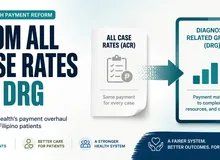
Under All Case Rates, PhilHealth pays a fixed amount for each specific illness or procedure, covering facility and professional fees.9 Two patients with the same case-rate code receive the same payment, even if one was far sicker. That is simple and predictable, but it can underpay complex cases and overpay simple ones.
PhilHealth is moving its inpatient payment from case rates to Philippine diagnosis-related groups (DRG). A DRG system sorts hospital cases into groups by the principal diagnosis, the other diagnoses, the procedures, and factors such as age, sex, and length of stay. A program called a grouper assigns each case to a group, and each group carries a relative weight. In DRG systems generally, payment is a base rate multiplied by the group’s weight, and complications or other diagnoses can move a case into a heavier group. PhilHealth adopted its grouping algorithm from the Thai DRG.10,11
Figure 3. From case rates to diagnosis-related groups. For now PhilHealth still pays case rates while it tests the groups; hospitals attach Claim Form 5 for inpatient discharges from August 1, 2026; the outpatient hemodialysis package is unchanged.
Setting
What changes now
What stays the same
Freestanding hemodialysis center
Nothing in outpatient filing. The liaison should know that a patient’s hospital confinement claim now needs a CF5, filed by the hospital.
Per-session package, CF2 with N18.5 and 90935, eSOA XML, per-session agreement form
Hospital unit, outpatient sessions
Same as freestanding
Same as freestanding
Hospital, inpatient cases
CF5 attached for every discharge from August 1, 2026; complete secondary diagnoses matter more
An emergency stage 5 session still counts toward the 156 and is coded per the circular
Where it stands on November 24, 2026: hospitals are still paid by case rates, while their codes run through the grouper in parallel (shadow billing).10 For infirmaries and Level 1 to 3 hospitals, CF5 is a mandatory attachment for every patient discharged from August 1, 2026, and claims without a valid CF5 are not accepted.12 CF5 and the eSOA together supply the clinical and cost data used to build the group weights.13 The outpatient hemodialysis package is still paid per session; treat any change to it as unannounced until PhilHealth issues a circular.
On the floor
Real situations: problems and solutions
These are fictional but typical. For each one, cover the answer, decide what you would do, then compare. Where a step depends on local rules, your unit’s procedure and your supervisor’s direction come first.
The helpful website
What you see
A coding site suggests N18.6 for dialysis patients.
What is likely going on
A US ICD-10-CM code.
What to do
Use N18.5 from PhilHealth’s code set; route any doubt to the coder.
Why it matters
US codes cause returns here.
The PDF that slipped through
What you see
A batch of five claims has PDF statements attached.
What is likely going on
A billing-system setting or a habit from before eClaims 3.0.
What to do
Hold the batch, regenerate XML from the approved system, and ask the vendor to block PDF attachments.
Why it matters
PhilHealth returns PDF statements.
The hospital that asks for help
What you see
A partner hospital asks your clerk to fill in its CF5.
What is likely going on
A request outside your facility’s authority.
What to do
Decline politely; each facility completes its own forms from its own documentation. Share verified facts through the liaison.
Why it matters
Coding another facility’s claim can misrepresent its record.
Field notes
Keep one approved code list at the desk and remove all others.
Check that every field traces to one named source.
Remember: the outpatient hemodialysis (HD) package is unchanged by the CF5 rule.
Case review
Back to the case: Two sessions, one agreement, and a PDF
Three corrections. The clinician or coder verifies the CF4 end date against the source record and corrects it if needed. The authorized owner resolves the unsigned agreement form for session 2. Billing produces and validates the eSOA as XML from the approved system. Then compare the corrected packet with the session ledger before release.
No backdating. If the agreement was not signed at the session, it is completed now with today’s date and a note explaining the late completion, following your standard operating procedure (SOP). A form signed today and dated last week misrepresents the record.
N18.6. It belongs to the US ICD-10-CM. In PhilHealth’s code set, end-stage kidney disease on dialysis is N18.5. Hold the draft, route the code to the coder, log the error for training, and take the website off the desk’s reference list.
Skills lab · with your preceptor
Skills checklist: Packet manifest and code check
Build the manifest for a fictional two-session claim with three planted defects, including one US code. Your preceptor rates each step as satisfactory, needs practice, or not observed. Steps marked Critical must all be satisfactory before sign-off. This checklist supports supervised learning; your unit’s own procedure and competency form are the authority. A printable version of every checklist is on the trainer page.
Lists each item with applicability, source, owner, version, and status.
CriticalRequires one agreement form per session, even in a grouped claim.
Compares sessions, dates, signatures, and identifiers across CF2, CF4, agreements, and the bill.
Rejects a PDF as the eSOA and requests XML from the approved system.
Distinguishes the ICD-10 diagnosis code from the RVS procedure code.
CriticalIdentifies N18.6 as a US code and routes the correction to the coder.
Explains case rates, DRG, and the CF5 rule in two plain sentences each.
Placement activity. Audit three released packets at your unit for traceability and report any field you could not trace.
Self-assessment
Check your understanding
Each visit draws 8 questions at random from this module’s 15-question bank. Choose the single best answer for each, then select Check answers; an explanation appears under the best answer. Select New set of questions for a different mix. A good target is 7 of 8 on two different sets. Nothing you select is sent anywhere; scoring happens in your browser.
Glossary & abbreviationsTalahulugan at mga daglatTalaan sa mga pulong ug daglatTalatinigan ampo reng daglatterms used on this page
Abbreviations
CF1
Claim Form 1 — Member and patient information for a claim.
CF2
Claim Form 2 — Provider and service information, including the diagnosis and procedure codes and hemodialysis consumption.
CF4
Claim Form 4 — Clinical information for the claim, where required.
CF5
Claim Form 5 — Inpatient clinical data for diagnosis-related group shadow billing; mandatory for inpatient discharges from August 1, 2026.
CSF
Claim Signature Form — The form that carries the member’s or patient’s signature and consent for a claim.
DRG
Diagnosis-related group — A payment group assigned from a hospital case’s full set of diagnosis and procedure codes.
eSOA
Electronic statement of account — The bill for a claim, sent to PhilHealth as structured XML data.
HD
Hemodialysis.
HDF
Hemodiafiltration — A form of dialysis that adds large-volume convection to diffusion.
ICD-10
International Classification of Diseases, 10th Revision — The diagnosis code set PhilHealth uses, with Philippine modifications.
PBEF
PhilHealth Benefit Eligibility Form — The printed result of an eligibility check, when the facility workflow uses it.
PDD
PhilHealth Dialysis Database — The registry of patients with chronic kidney disease stage 5 on dialysis; registration is required for the dialysis benefits.
PDF
Portable Document Format — A file that looks like a printed page; PhilHealth no longer accepts it as the statement of account.
PhilHealth
Philippine Health Insurance Corporation.
PIN
PhilHealth Identification Number — The member’s permanent PhilHealth number.
RVS
Relative Value Scale — PhilHealth’s procedure codes; 90935 is hemodialysis.
SOP
Standard operating procedure — The unit’s approved written steps for a task.
XML
Extensible Markup Language — A structured file format computers can check field by field.
Terms in plain words
Manifest
The packet’s table of contents with source, owner, version, and status.
CF2
Claim Form 2.
CF4
Claim Form 4.
CF5
Claim Form 5, for inpatient DRG shadow billing.
eSOA
Electronic statement of account, sent as XML.
ICD-10
The diagnosis code set PhilHealth uses.
RVS
Relative Value Scale, the procedure codes.
DRG
Diagnosis-related group.
Grouper
The program that assigns a hospital case to a DRG.
Shadow billing
Filing under case rates while DRG grouping is tested in parallel.
Philippine Health Insurance Corporation. (2025). PhilHealth Advisory No. 2025-0040: Processing of claims of health facilities in compliance to the submission of electronic statement of account (eSOA) for all case rates claims and identified PhilHealth benefits. https://www.philhealth.gov.ph/advisories/2025/PA2025-0040.pdf
Philippine Health Insurance Corporation. (2013). PhilHealth Circular No. 31, s. 2013: All case rates (ACR) policy no. 1 [Governing policies in the shift of provider payment to case rates]. https://www.philhealth.gov.ph/circulars/2013/circ31_2013.pdf
Philippine Health Insurance Corporation. (2026). PhilHealth Circular No. 2026-0012: Implementation of shadow billing for the transition to diagnosis-related groups (DRG) (Revision 2). https://www.philhealth.gov.ph/circulars/2026/PC-2026-0012.pdf
Philippine Health Insurance Corporation. (2026). PhilHealth Advisory No. 2026-0010: Call for participation in shadow billing (submission of Claim Form 5 and electronic statement of account through eClaims 3.0). https://www.philhealth.gov.ph/advisories/2026/PA2026-0010.pdf
Educational material for dialysis claims staff. Completing it is an Academy learning record only. It is not a PhilHealth certification, it does not grant system access or signing authority, and it does not replace current PhilHealth issuances, written guidance from your PhilHealth Regional Office, or your facility’s approved procedures.