Nephrology Nursing · Specialization · Module 20 of 20

Philippine Requirements, Records, Quality and Capstone

Who governs a Philippine pediatric dialysis service, honest records, infection-rate arithmetic, and the capstone.

PublishedNailathalaGipatikPepalwal: ReferencesMga SanggunianMga TinubdanReng Reperensya: 13 Audience: Philippine-licensed registered nurses entering pediatric peritoneal dialysis or hemodialysis · pediatric dialysis nurse educators and preceptors Read timeOras ng pagbasaOras sa pagbasaOras ning pamamasa:
Philippine Requirements, Records, Quality and Capstone
Renal Care Academy›Nephrology Nursing›Pediatric Dialysis Nurse›Module 20 of 20 Nephrology Nursing specialty subtrack for pediatric dialysis
🧸

Nephrology Nursing specialty subtrack for pediatric dialysis

This module is study material for registered nurses in pediatric dialysis. It explains the reasoning behind common nursing decisions; it is not a procedure. Exact steps follow your unit’s pediatric protocol and the device instructions; treatment parameters follow the written order of the pediatric nephrologist. Nurses assess, verify, teach, document and escalate; they do not prescribe, choose antibiotics, change doses or adjust anticoagulation. Every case is fictional and every value in a case is illustrative. Pending review by a pediatric nephrologist and a senior pediatric dialysis nurse.

After this module you should be able to

Classroom 3 hSkills lab 2 hSupervised placement 4 h
Pre-testBefore you read, answer the 5 self-assessment questions and note your score. After the module, select New set of questions and compare. The difference is what you learned; the questions you still miss are what to reread.

The big picture, in plain words

A pediatric dialysis service sits under several authorities at once, and each asks a different question. Nurses meet these rules in forms, audits and claims, often without seeing the whole map. The map matters: it tells you which rule a document serves, and which office can answer a question about it.

Your work in this module is to know the map, to keep records that tell the truth, to count infections correctly, and to finish the track with a portfolio that shows what you can do.

In plain wordsThink of the rules as different keys on one ring. The Professional Regulation Commission (PRC) key opens your practice, the Department of Health key opens the facility, the Philippine Health Insurance Corporation (PhilHealth) key opens payment, and the hospital’s key opens your unit. Each key opens one door only.

The picture has a limit. Keys do not change; rules do. Circulars are amended, pilots expire and checklists are revised. Every rule you rely on needs its issuer and date checked, and a copy saved with the date you checked it.

Figure 1 · Key terms for this module

IssuerThe body that wrote a rule and can interpret it.
Effective dateWhen a rule took effect, and when it ends if it is a pilot.
Delivered treatmentWhat actually happened, as opposed to what was prescribed.
RateEvents divided by time at risk, such as episodes per patient-year.
Improvement aimA specific, measurable target with a date.

Case: The rate that doubled

A small pediatric peritoneal dialysis (PD) program has eight children. Last year it had 2 peritonitis episodes; this year it had 4, and a manager says “our infection rate doubled; the nurses must be careless”. Nurse Liza, the program’s PD nurse, is asked to present the numbers. The children spent a total of 90 patient-months on PD this year.

Before reading on, decide:

Keep your answers in mind. The lesson gives you what you need, and the case review near the end shows one sound response.

Who governs what

Read every rule for its issuer, its scope and its date.
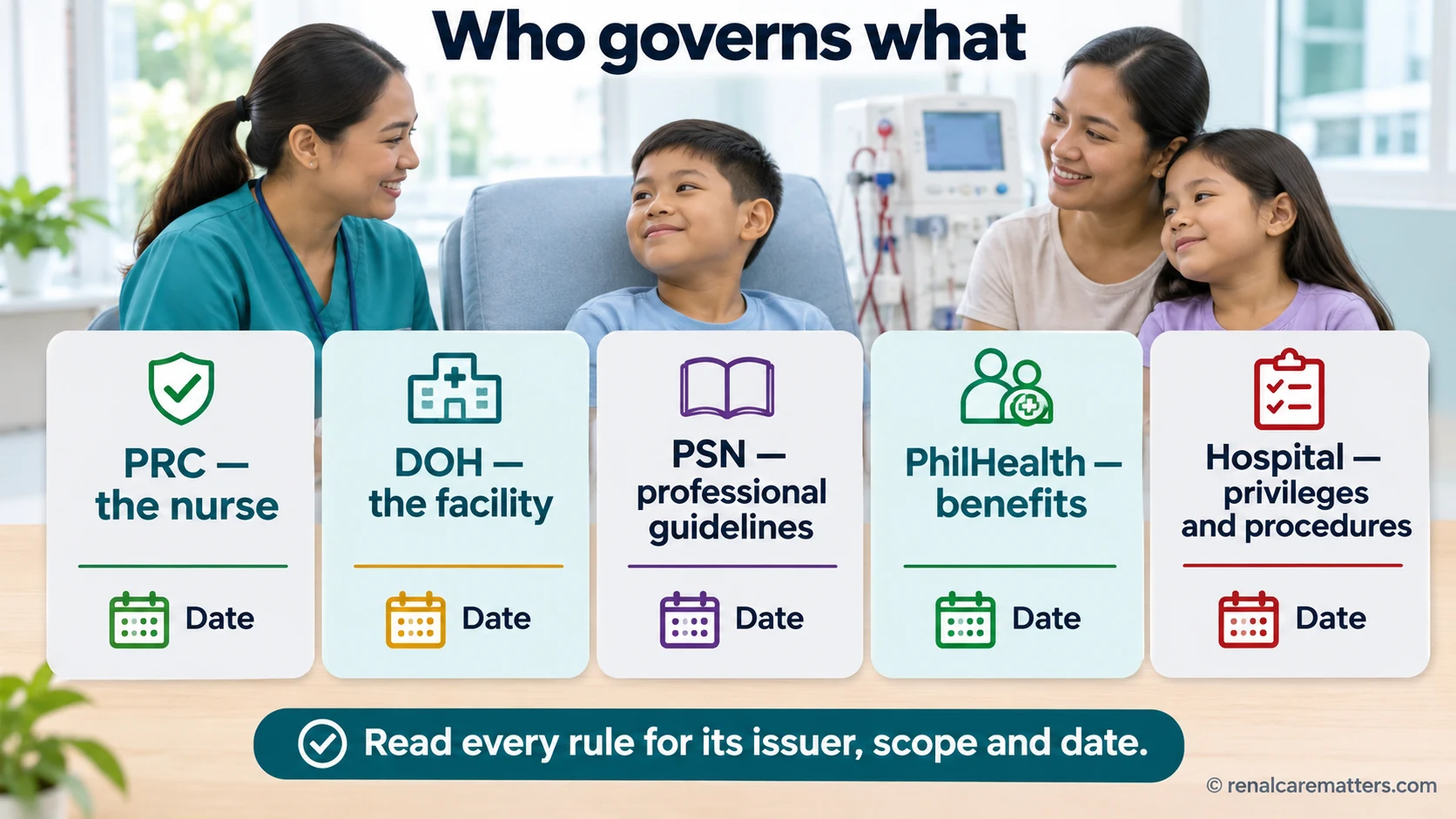
Five labeled cards: PRC (the nurse), DOH (the facility license), PSN (professional guidelines), PhilHealth (benefits) and the hospital (privileges and procedures), each with a small date stamp.
Figure 2. Who governs what. Read every rule for its issuer, its scope and its date.
IssuerGovernsExamples
Professional Regulation Commission and Board of NursingThe nurse’s license and scopePhilippine Nursing Act of 2002 (Republic Act (RA) 9173)1
Department of HealthThe facility’s license, staffing and wateradministrative order (AO) 2012-0001 on dialysis facilities; AO 2013-0003 on dialysis water2,3
Philippine Society of NephrologyProfessional guidelinesHemodialysis guidelines for nephrologists, 20244
PhilHealthBenefits and provider contractingPD Z-benefit Circular 2024-0036; PD First self-assessment tool; pediatric automated PD pilot advisories 2025-0074 and 2026-0013; pediatric post-transplant Z benefit Circular 2025-00115,6,7,8,9
National Privacy CommissionPersonal and health dataData Privacy Act of 2012 (RA 10173)10
Congress (child protection)Protection of childrenRA 761011
The hospitalPrivileges, procedures and competency recordsUnit policies and job descriptions

The review behind this track, in November 2026, found no separate pediatric dialysis nurse license or pediatric nurse-to-patient ratio, and could not verify the status of the pediatric automated PD pilot after July 31, 2026. These are bounded findings; check for later issuances.

RememberEvery rule has an issuer and a date. Save the version you checked and the date you checked it.

Records that tell the truth

A dialysis record is a clinical, legal and financial document. In pediatrics it must show the child’s size as well as the treatment.

RememberWrite what happened, when, to which size of child. A record that matches the order perfectly every time is a record to question.

Measuring quality honestly

The ISPD 2024 pediatric benchmark for overall peritonitis is no more than 0.4 episodes per year at risk, with culture-negative peritonitis under 15% and post-insertion peritonitis within 30 days after fewer than 5% of insertions (not graded).12 For hemodialysis catheters, the Standardizing Care to Improve Outcomes in Pediatric End-Stage Kidney Disease collaborative (SCOPE) collaborative reported infections per 100 patient-months.13
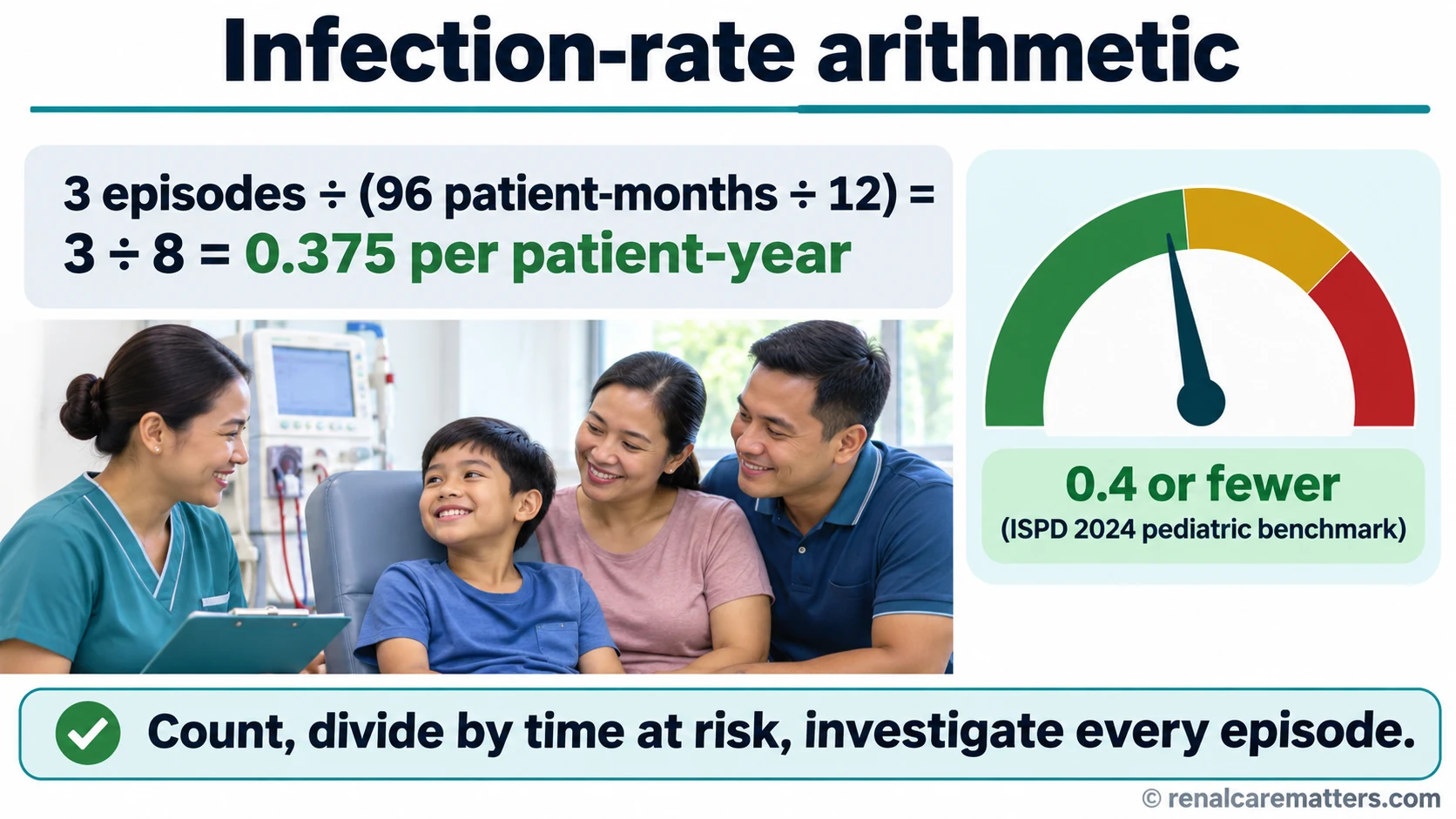
A worked example card: 3 peritonitis episodes over 96 patient-months at risk equals 8 patient-years, so 0.375 episodes per patient-year, beside the ISPD 2024 pediatric benchmark of 0.4 or fewer.
Figure 3. Infection-rate arithmetic. Count episodes, divide by time at risk in years, and compare with the benchmark of 0.4 or fewer.
Peritonitis rate = episodes ÷ (patient-months at risk ÷ 12)
This year: 4 ÷ (90 ÷ 12) = 4 ÷ 7.5 = 0.53 per patient-year
catheter-associated bloodstream infection (CA-BSI) per 100 patient-months = episodes ÷ catheter patient-months × 100

Small programs have small denominators. With eight children, one or two extra episodes move the rate a great deal, and a confidence interval around 0.53 would be wide. Compare rates over several years or as a run chart, look at each episode’s apparent cause, and interpret infections with case mix in mind: infants, ostomies and new caregivers carry more risk. Do not use small-number infection rates to rank individual nurses.

RememberRates need time at risk in the denominator. In a small program, look at causes and trends, not one year’s number.

The capstone

The capstone brings the track together. Your portfolio, assessed by a nurse educator, contains:

The eight simulation stations on the trainer page are assessed separately, and facility authorization remains the facility’s decision. Completing the Academy track is an educational record only.

On the floor · Liza presents the numbers

Liza shows that this year’s rate is 4 ÷ 7.5 = 0.53 per patient-year, above the 0.4 benchmark; last year’s was 2 episodes over a similar number of months. She explains that with eight children, two extra episodes double the count. Her apparent cause analyses show three of the four episodes followed a new substitute caregiver. She proposes an aim: every new caregiver completes a return demonstration before independent exchanges, from next month, measured monthly.

Turn a frightening number into a cause and a testable change.

Illustrative scenario. Names and details are invented.

RememberFinish with evidence of what you can do and one change you will test. Study is the start of authorization, never the end.

Real situations: problems and solutions

These are fictional but typical. For each one, cover the answer, decide what you would do, then compare. Where a step depends on local rules, your unit’s procedure and your supervisor’s direction come first.

Old circular

What you see
A form cites a superseded PhilHealth circular.
What is likely going on
Rules changed.
What to do
Check the current issuance and date; update with the liaison.
Why it matters
Outdated rules cause denied claims.

Perfect records

What you see
Every session record matches the order exactly.
What is likely going on
Copy-forward documentation.
What to do
Audit against machine data and correct practice.
Why it matters
Records must show delivered care.

Ranking nurses

What you see
A manager ranks nurses by infection rates.
What is likely going on
Small numbers misused.
What to do
Present rates with denominators, case mix and causes.
Why it matters
Blame hides problems.
Field notes
  • Save the date you checked each rule.
  • Use run charts, not single years.

Back to the case: The rate that doubled

The rate. 4 episodes ÷ (90 ÷ 12) = 0.53 per patient-year, above the ISPD 2024 pediatric benchmark of 0.4.

“Doubled.” In a program of eight children, a change from 2 to 4 episodes is within the range that chance and case mix can produce. It deserves investigation, not blame.

Instead of blame. Apparent cause analysis of each episode, a run chart over several years, and one measurable improvement aim tied to the cause found, here verified training of every new caregiver.

Skills checklist: Records, rates and the capstone

Use fictional program data. Your preceptor rates each step as satisfactory, needs practice, or not observed. Steps marked Critical must all be satisfactory before sign-off. This checklist supports supervised learning; your unit’s own procedure and competency form are the authority. A printable version of every checklist is on the trainer page.

Placement activity. Assemble the capstone portfolio and present it to your nurse educator.

Check your understanding

Each visit draws 5 questions at random from this module’s 15-question bank. Choose the single best answer for each, then select Check answers; an explanation appears under the best answer. Select New set of questions for a different mix. A good target is 4 of 5 on two different sets. Nothing you select is sent anywhere; scoring happens in your browser.

Question 1 of 15Which body governs the nurse’s license?
Question 2 of 15DOH AO 2012-0001 governs:
Question 3 of 15Which issuance covers the pediatric automated PD pilot extension?
Question 4 of 15Health data under the Data Privacy Act are:
Question 5 of 15Why record delivered as well as prescribed treatment?
Question 6 of 15How is a record error corrected?
Question 7 of 154 episodes over 90 patient-months equals:
Question 8 of 15The ISPD 2024 pediatric peritonitis benchmark is:
Question 9 of 15SCOPE reported HD catheter infections per:
Question 10 of 15In a program of eight children, a rise from 2 to 4 episodes:
Question 11 of 15Infection rates should not be used to:
Question 12 of 15An improvement aim must be:
Question 13 of 15Completing the Academy track gives:
Question 14 of 15A record that matches the order perfectly every time should be:
Question 15 of 15Why save the version and date of each rule you rely on?

Read next on this site

Glossary & abbreviationsTalahulugan at mga daglatTalaan sa mga pulong ug daglatTalatinigan ampo reng daglat terms used on this page

Abbreviations

AO
Administrative order — A numbered DOH issuance with rules.
BSA
Body surface area.
CA-BSI
Catheter-associated bloodstream infection.
DOH
Department of Health — Philippines.
HD
Hemodialysis.
ISPD
International Society for Peritoneal Dialysis — Publishes peritoneal dialysis and peritonitis guidelines.
PD
Peritoneal dialysis.
PhilHealth
Philippine Health Insurance Corporation.
PRC
Professional Regulation Commission.
PSN
Philippine Society of Nephrology.
RA
Republic Act — A Philippine law.
SBAR
Situation, Background, Assessment, Recommendation — A structured way to hand over a concern.
SCOPE
Standardizing Care to Improve Outcomes in Pediatric End-Stage Kidney Disease collaborative.

Terms in plain words

Issuer
The body that wrote a rule and can interpret it.
Effective date
When a rule took effect or ends.
Delivered treatment
What actually happened, compared with what was prescribed.
Patient-year at risk
Time patients were on the therapy and at risk of the event, in years.
Run chart
A chart of a measure over time used to see trends.
Apparent cause analysis
A structured review of how an event probably happened.
ReferencesMga SanggunianMga TinubdanReng Reperensya 13 sources
  1. Republic of the Philippines. (2002). Republic Act No. 9173: Philippine Nursing Act of 2002. https://lawphil.net/statutes/repacts/ra2002/ra_9173_2002.html
  2. Department of Health (DOH). (2012). Administrative Order No. 2012-0001: New rules and regulations governing the licensure and regulation of dialysis facilities in the Philippines. https://hfsrb.doh.gov.ph/wp-content/uploads/2021/05/AO-2012-0001.pdf
  3. Department of Health. (2013). Implementing guidelines in the analysis, monitoring and maintenance of water used in dialysis facilities pursuant to Administrative Order No. 2012-0001 (Administrative Order No. 2013-0003). https://elibrary.judiciary.gov.ph/thebookshelf/showdocs/10/69036
  4. Philippine Society of Nephrology (PSN) Committee on Hemodialysis. (2024). Guidelines for nephrologists in the operation of hemodialysis clinics in the Philippines. https://psn.org.ph/wp-content/uploads/2024/03/HD-Guidelines-for-Nephrologists-Final-Revision-3.14.24.pdf
  5. Philippine Health Insurance Corporation. (2024). PhilHealth Circular No. 2024-0036 [Peritoneal dialysis Z benefit contracting]. https://www.philhealth.gov.ph/circulars/2024/PC2024-0036.pdf
  6. Philippine Health Insurance Corporation. (n.d.). Self-assessment tool: PD First. https://www.philhealth.gov.ph/downloads/accreditation/SAT_PDFirst.pdf
  7. Philippine Health Insurance Corporation. (2025). PhilHealth Advisory No. 2025-0074 [Pilot implementation of the Z benefits package for peritoneal dialysis covering automated PD in children]. https://www.philhealth.gov.ph/advisories/2025/PA2025-0074.pdf
  8. Philippine Health Insurance Corporation. (2026). PhilHealth Advisory No. 2026-0013 [Extension of the pediatric automated peritoneal dialysis pilot]. https://www.philhealth.gov.ph/advisories/2026/PA2026-0013.pdf
  9. Philippine Health Insurance Corporation. (2025). Z Benefits Package for Post-Kidney Transplantation Services in Children (PhilHealth Circular No. 2025-0011). https://www.philhealth.gov.ph/circulars/2025/PC2025-0011.pdf
  10. Republic of the Philippines. (2012). Republic Act No. 10173: Data Privacy Act of 2012. https://privacy.gov.ph/data-privacy-act/
  11. Republic of the Philippines. (1992). Republic Act No. 7610: Special Protection of Children Against Abuse, Exploitation and Discrimination Act. https://lawphil.net/statutes/repacts/ra1992/ra_7610_1992.html
  12. Warady, B. A., Same, R., Borzych-Duzalka, D., Neu, A. M., El Mikati, I., Mustafa, R. A., Begin, B., Nourse, P., Bakkaloglu, S. A., Chadha, V., Cano, F., Yap, H. K., Shen, Q., Newland, J., Verrina, E., Wirtz, A. L., Smith, V., & Schaefer, F. (2024). Clinical practice guideline for the prevention and management of peritoneal dialysis associated infections in children: 2024 update. Peritoneal Dialysis International, 44(5), 303–364. https://doi.org/10.1177/08968608241274096
  13. Marsenic, O., Rodean, J., Richardson, T., Swartz, S., Claes, D., Day, J. C., Warady, B., & Neu, A. (2020). Tunneled hemodialysis catheter care practices and blood stream infection rate in children: Results from the SCOPE collaborative. Pediatric Nephrology, 35(1), 135–143. https://doi.org/10.1007/s00467-019-04384-7
Dr. William Gregory M. Rivero, MD

William Gregory Rivero, MD, FPCP, DPSN

Internal Medicine · Nephrology · Nutrition · Philippines · PRC 0105184

Educational material for registered nurses. Completing it is an Academy learning record only. It does not confer CPD units, PSN or National Kidney and Transplant Institute (NKTI) training recognition, PhilHealth staffing credit, or clinical privileges, and it does not replace your facility’s protocols, device instructions, or written orders.

QR code — scan to save Dr. Rivero's contact info

Scan and save