Nephrology Nursing specialty subtrack for pediatric dialysis
This module is study material for registered nurses in pediatric dialysis. It explains the reasoning behind common nursing decisions; it is not a procedure. Exact steps follow your unit’s pediatric protocol and the device instructions; treatment parameters follow the written order of the pediatric nephrologist. Nurses assess, verify, teach, document and escalate; they do not prescribe, choose antibiotics, change doses or adjust anticoagulation. Every case is fictional and every value in a case is illustrative. Pending review by a pediatric nephrologist and a senior pediatric dialysis nurse.
Learning objectives
After this module you should be able to
Apply the 2024 International Society for Peritoneal Dialysis (ISPD) pediatric and 2025 ISPD teaching recommendations to caregiver training.
Judge readiness by return demonstration and teach-back, not by hours completed.
Plan retraining after triggers such as peritonitis, a new caregiver or a change of equipment.
Build a home emergency plan for typhoons, floods and power outages with the family.
Classroom 2 hSkills lab 2 hSupervised placement 4 h
Pre-testBefore you read, answer the 5 self-assessment questions and note your score. After the module, select New set of questions and compare. The difference is what you learned; the questions you still miss are what to reread.
Start here
The big picture, in plain words
For a child on home peritoneal dialysis (PD), the most important clinician is usually a parent or grandparent. They do hundreds of exchanges a year, alone, often at night, while also working and caring for siblings. The quality of their training shows up years later as the child’s infection rate.
Your work in this module is to teach adults who are tired, frightened and sometimes unsure of their reading, until they can do the work safely and know when to call.
In plain wordsThink of teaching like coaching a swimmer. You can explain strokes for hours, but you know someone can swim only when you watch them swim the length of the pool, more than once, in deep water.
The picture has a limit. A swimmer who passed once can still panic in a storm. Caregivers forget steps over months, change jobs, hand tasks to relatives, or face a typhoon. Readiness is not a single test; it is checked again whenever life changes.
Figure 1 · Key terms for this module
Return demonstrationThe learner performs the skill while the nurse observes against a checklist.
Teach-backThe learner explains in their own words what to do and why.
Retraining triggerAn event that calls for reassessment, such as peritonitis or a new caregiver.
Health literacyThe ability to find, understand and use health information.
Home emergency planA written plan for supplies, contacts, power and transport during a disaster.
Opening case · fictional
Case: The grandmother who signs with a thumbmark
Lola Remedios, 68, will do PD for her granddaughter Ayesha, 6, because Ayesha’s mother works abroad. Lola Remedios reads very little and signs documents with a thumbmark. After the standard teaching days she has watched many exchanges. In her first independent return demonstration, she touches the connector tip while talking. Typhoon season starts next month, and their barangay often loses power.
Before reading on, decide:
Is Lola Remedios ready? What evidence decides?
How should the teaching change for her?
What should the family’s typhoon plan include?
Keep your answers in mind. The lesson gives you what you need, and the case review near the end shows one sound response.
Lesson · part 1
How caregivers learn
Adults learn best when the content solves their immediate problem, when they practice rather than listen, and when they are respected. Fear and fatigue block learning; so does shame about reading.
The 2024 ISPD pediatric guideline says PD training should use a formalized teaching program with clear content and objectives (not graded), suggests longer total training rather than shorter whenever possible (2D), formal assessment, and regular retraining and reassessment of all children on PD and their caregivers (2D).1 The 2025 ISPD position paper on teaching PD and the earlier ISPD syllabus give the structure for content and methods.2,3
Teach in the caregiver’s language, with pictures and demonstrations, not leaflets alone.
Short sessions, one skill at a time, practiced until smooth.
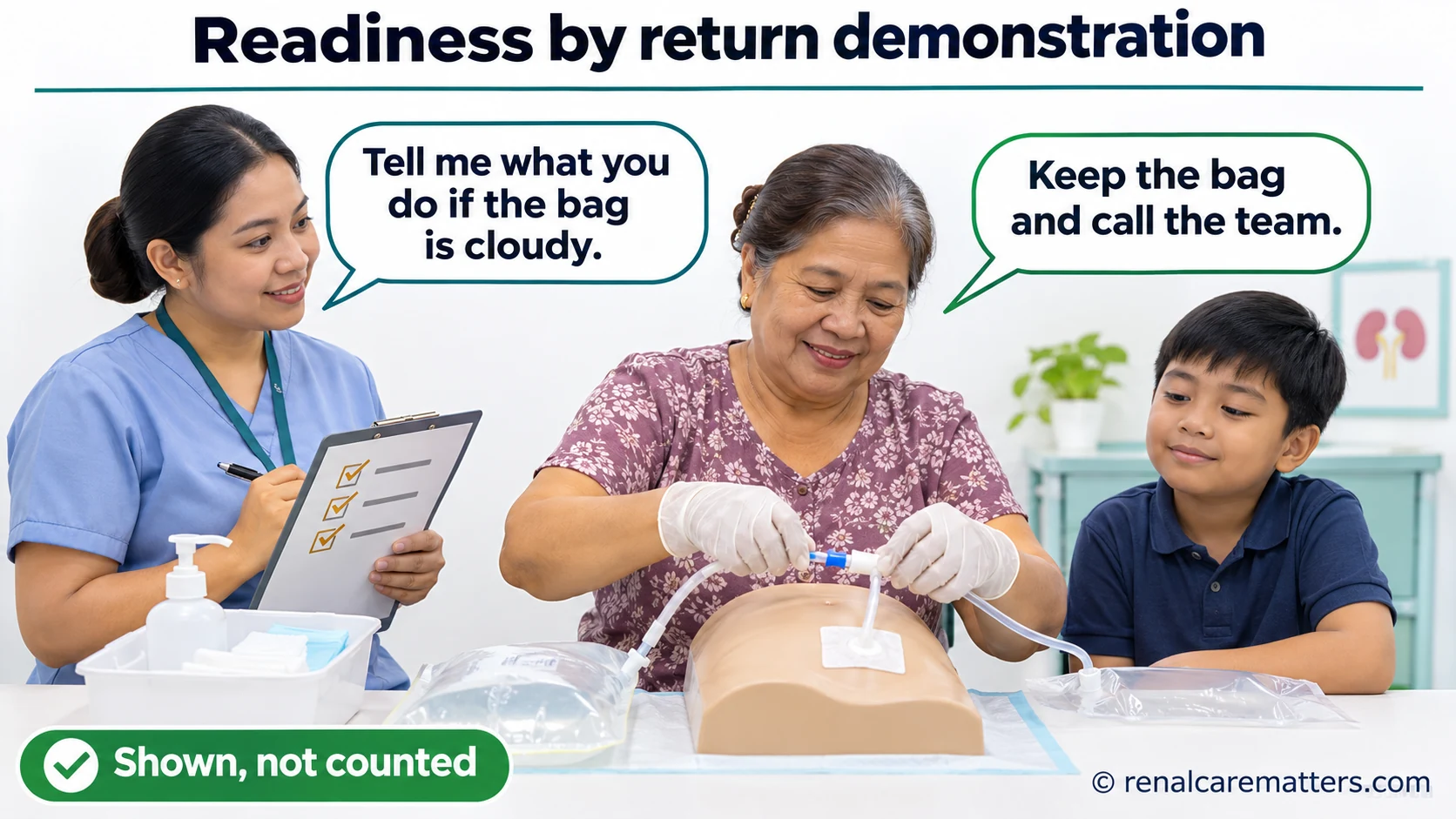
Use teach-back: “Tell me what you will do if the bag is cloudy.” A systematic review found teach-back improved disease knowledge and self-care in chronic illness.4
Train at least two caregivers, so the child is never dependent on one person.
RememberTeach one skill at a time, in the caregiver’s language, and train a second caregiver.
Lesson · part 2
Readiness by return demonstration
Hours of teaching do not prove readiness; watching the caregiver do the whole task safely does. Readiness means independent, clean return demonstrations on separate occasions, correct teach-back on what to do in common problems, and a home that is ready.
Figure 2. Readiness by return demonstration. Caregivers are ready when they show it safely, not when the hours are done.
Retraining trigger
Why
Peritonitis or exit-site infection
Technique may have drifted
A new or substitute caregiver
The skill was never verified in that person
A change of equipment, connector or cycler
Steps and alarms change
A long hospital stay or time away from PD
Skills fade
A contamination event
A chance to correct technique without blame
Withholding a readiness sign-off after an unsafe step is not a failure of the caregiver; it is the training working. Say what went well, name the one step to fix, practice it, and reassess.
RememberReadiness is shown, not counted. An unsafe step means more practice, then reassessment.
Lesson · part 3
Home support and disaster plans
The Philippines faces typhoons, floods and power outages every year. A family on home PD needs a plan made in good weather.
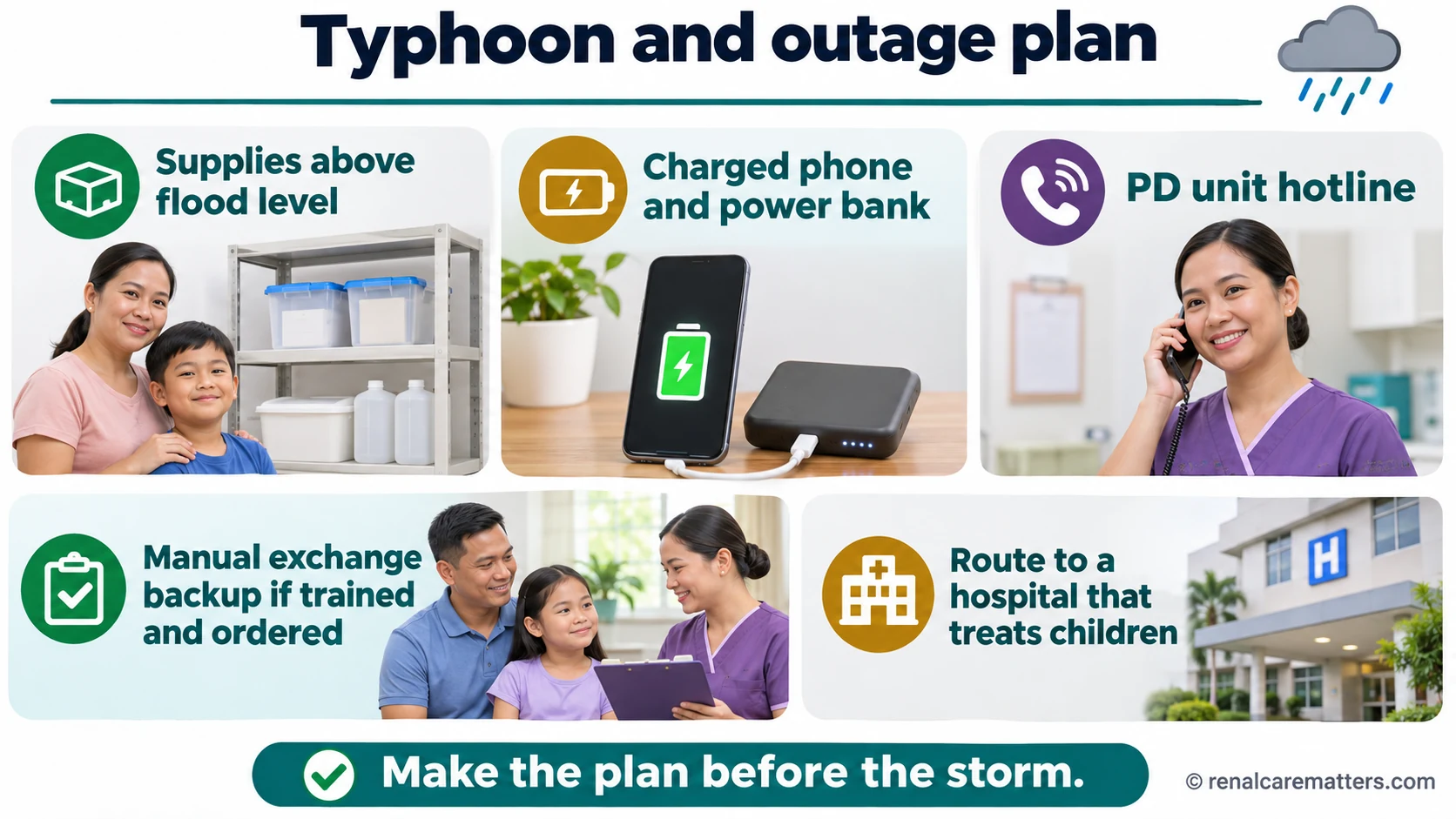
Figure 3. Typhoon and outage plan. Agree on the plan in good weather, and check it before every storm season.
Supplies: several days of bags and consumables stored above flood level, rotated by expiry date.
Power: what to do if the cycler cannot run (manual exchanges, if trained and ordered); a charged phone and power bank.
Contacts: the PD unit hotline, the nephrologist, the nearest hospital that can treat children, and the barangay health office.
Transport: how to reach care if roads flood; when to evacuate early.
Information: a printed summary of the child’s diagnosis, prescription, medicines and allergies in a waterproof bag.
Home support also means practical help: transport costs, school arrangements, respite for exhausted caregivers. Refer to the social worker early (Module 19).
On the floor · Teaching Lola Remedios
Nurse Grace does not sign readiness after the touched connector. She thanks Lola Remedios, practices the connection five times with her in silence (“no talking while the cap is off”), and uses a picture card with the steps instead of a written list. Ayesha’s aunt next door begins training as second caregiver. Before typhoon season, Grace and the family write a plan with a manual-exchange backup for outages.
Adapt the method to the learner; never lower the standard.
Illustrative scenario. Names and details are invented.
RememberMake the disaster plan before the storm, check it every season, and train a second caregiver.
On the floor
Real situations: problems and solutions
These are fictional but typical. For each one, cover the answer, decide what you would do, then compare. Where a step depends on local rules, your unit’s procedure and your supervisor’s direction come first.
Hours done, skill not
What you see
A caregiver completed training days but contaminates in return demonstration.
What is likely going on
Time counted instead of skill.
What to do
Withhold readiness, practice the step, reassess.
Why it matters
Readiness is shown.
The substitute aunt
What you see
An aunt starts doing exchanges when the mother travels.
What is likely going on
Untrained caregiver.
What to do
Train and verify the aunt before independent exchanges.
Why it matters
A new caregiver is a retraining trigger.
Supplies on the floor
What you see
PD boxes stored on the floor in a flood-prone house.
What is likely going on
No disaster plan.
What to do
Move supplies above flood level; write the plan.
Why it matters
Floods destroy supplies.
Field notes
Train two caregivers.
Use picture cards for low literacy.
Case review
Back to the case: The grandmother who signs with a thumbmark
Ready? Not yet. Touching the connector tip is an unsafe step. Readiness is decided by clean, independent return demonstrations on separate occasions and correct teach-back.
Adapting the teaching. Picture cards, demonstration, one step at a time, a “no talking with the cap off” rule, teach-back in her language, and a second caregiver in training. The standard stays the same.
Typhoon plan. Supplies above flood level, a manual-exchange backup if trained and ordered, a charged phone and power bank, contacts including the nearest hospital that treats children, an evacuation trigger and a waterproof summary.
Skills lab · with your preceptor
Skills checklist: Teaching to readiness
Practice with role-players, including one with limited reading. Your preceptor rates each step as satisfactory, needs practice, or not observed. Steps marked Critical must all be satisfactory before sign-off. This checklist supports supervised learning; your unit’s own procedure and competency form are the authority. A printable version of every checklist is on the trainer page.
Teaches one skill at a time using demonstration and pictures in the caregiver’s language
CriticalUses teach-back for cloudy fluid, poor drain, fever and contamination
CriticalWithholds readiness sign-off after an unsafe step and plans retraining
Identifies retraining triggers from a record
Completes a home emergency plan with the family
Self-assessment
Check your understanding
Each visit draws 5 questions at random from this module’s 15-question bank. Choose the single best answer for each, then select Check answers; an explanation appears under the best answer. Select New set of questions for a different mix. A good target is 4 of 5 on two different sets. Nothing you select is sent anywhere; scoring happens in your browser.
Warady, B. A., Same, R., Borzych-Duzalka, D., Neu, A. M., El Mikati, I., Mustafa, R. A., Begin, B., Nourse, P., Bakkaloglu, S. A., Chadha, V., Cano, F., Yap, H. K., Shen, Q., Newland, J., Verrina, E., Wirtz, A. L., Smith, V., & Schaefer, F. (2024). Clinical practice guideline for the prevention and management of peritoneal dialysis associated infections in children: 2024 update. Peritoneal Dialysis International, 44(5), 303–364. https://doi.org/10.1177/08968608241274096
Chow, J. S. F., Brunier, G., Figueiredo, A. E., Hurst, H., Moran, D. P., Neumann, J. L., Mehrotra, R., Mushahar, L., Fuge, T., Avesani, C. M., Yee Chow, N., & Johnson, D. W. (2025). Teaching peritoneal dialysis: A position paper for the International Society for Peritoneal Dialysis. Peritoneal Dialysis International, 45(6), 327–343. https://doi.org/10.1177/08968608251375512
Figueiredo, A. E., Bernardini, J., Bowes, E., Hiramatsu, M., Price, V., Su, C., Walker, R., & Brunier, G. (2016). A syllabus for teaching peritoneal dialysis to patients and caregivers. Peritoneal Dialysis International, 36(6), 592–605. https://doi.org/10.3747/pdi.2015.00277
Ha Dinh, T. T., Bonner, A., Clark, R., Ramsbotham, J., & Hines, S. (2016). The effectiveness of the teach-back method on adherence and self-management in health education for people with chronic disease: a systematic review. JBI Database of Systematic Reviews and Implementation Reports, 14(1), 210–247. https://doi.org/10.11124/jbisrir-2016-2296
Educational material for registered nurses. Completing it is an Academy learning record only. It does not confer CPD units, PSN or National Kidney and Transplant Institute (NKTI) training recognition, PhilHealth staffing credit, or clinical privileges, and it does not replace your facility’s protocols, device instructions, or written orders.