Missing flushes
- What you see
- A pediatric intensive care unit (PICU) balance omits drug flushes.
- What is likely going on
- Hidden intake.
- What to do
- Add all flushes and diluents; recalculate %FO.
- Why it matters
- Accurate counts guide decisions.
AKI in critically ill children, percent fluid overload, acute PD where machines are scarce, and orientation to CKRT.

This module is study material for registered nurses in pediatric dialysis. It explains the reasoning behind common nursing decisions; it is not a procedure. Exact steps follow your unit’s pediatric protocol and the device instructions; treatment parameters follow the written order of the pediatric nephrologist. Nurses assess, verify, teach, document and escalate; they do not prescribe, choose antibiotics, change doses or adjust anticoagulation. Every case is fictional and every value in a case is illustrative. Pending review by a pediatric nephrologist and a senior pediatric dialysis nurse.
AKI in a critically ill child develops over hours, often alongside sepsis, heart surgery, dehydration or infections such as leptospirosis. Fluid given to keep the child alive accumulates when the kidneys stop excreting it, and the extra water stiffens the lungs and swells the tissues.
Your work in this module is orientation, not authorization. You will learn to count fluid overload, to support acute PD where it is the available therapy, and to know when a child needs a team with intensive care and CKRT expertise.
The picture has a limit. In the boat, more water is always worse. In a child in shock, fluid can be life-saving in the first hours; the problem is fluid that keeps accumulating after it has done its job. The timing and goal belong to the intensive care and nephrology team.
Figure 1 · Key terms for this module
Nonoy Aguilar, 9, 25 kilograms, is admitted to a provincial hospital after floodwater exposure, with leptospirosis, oliguria and rising creatinine. Over 48 hours he has received 3.8 liters and passed 1.3 liters; he now has crackles in both lungs. The hospital has no CKRT and two adult hemodialysis machines, both in use. The pediatric nephrologist inserts an acute PD catheter. Nurse Hazel, from the outpatient PD unit, is called to help the ward nurses.
Before reading on, decide:
Keep your answers in mind. The lesson gives you what you need, and the case review near the end shows one sound response.
The Assessment of Worldwide Acute Kidney Injury, Renal Angina, and Epidemiology (AWARE) study screened 4,683 children and young adults in 32 pediatric intensive care units. AKI developed in 26.9% and severe AKI in 11.6%. Death by day 28 occurred in 11.0% of those with severe AKI versus 2.5% without it, an adjusted odds ratio of 1.77. Creatinine alone missed AKI in 67.2% of the patients with low urine output.1
That last finding is a nursing finding. Hourly urine output, measured accurately and expressed in mL/kg/h, detects AKI that the laboratory misses. A Philippine series of children with leptospirosis found 62% oliguric at presentation, with PD started in 36% of them.2
In the prospective pediatric continuous kidney replacement therapy (CRRT) registry, fluid overload was defined as (fluid in minus fluid out, in liters) divided by the intensive care admission weight in kilograms, times 100. Among 297 children, mortality was 29.4% with less than 10% overload, 43.1% with 10% to 20%, and 65.6% with 20% or more; each 1% increase was associated with about 3% higher odds of death after adjustment.3
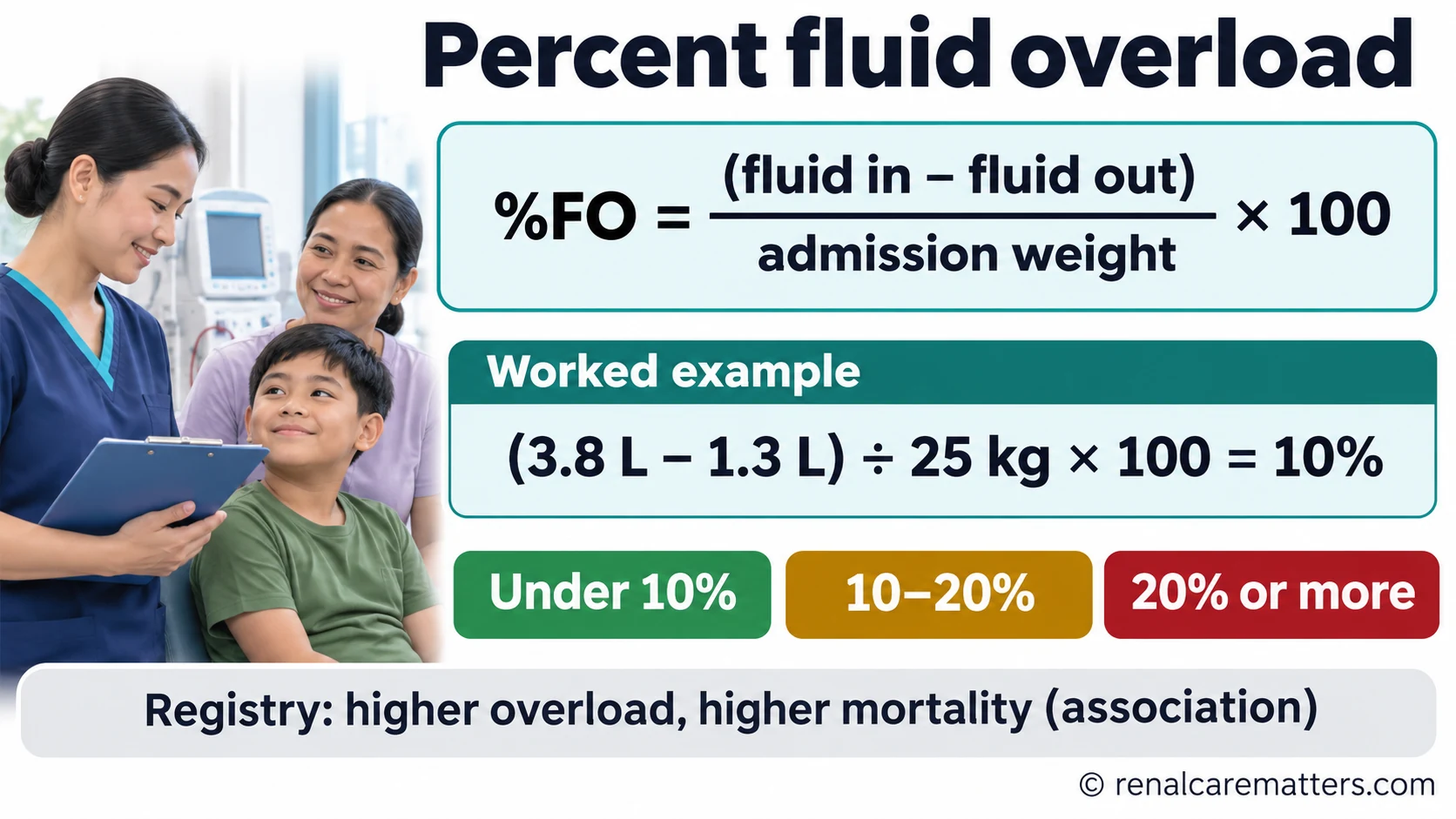
The registry was observational. Sicker children receive more fluid and also die more often, so the association does not prove that removing fluid earlier saves lives; the authors say so. What it does show is that the percentage is worth tracking, and the nurse is the person who keeps the numbers honest: every infusion, flush, drug and feed in; every urine, drain and dialysis removal out.
The 2020 ISPD pediatric guideline on PD in AKI grades PD as suitable for AKI in children (1C), recommends prophylactic antibiotics before catheter insertion (1B) and a closed delivery system with a Y connection (1A), and notes that automated PD is suitable except in newborns, whose fill volumes are too small for current machines (1D).4 Acute PD matters most where hemodialysis and CKRT are scarce, which describes many Philippine provincial hospitals.
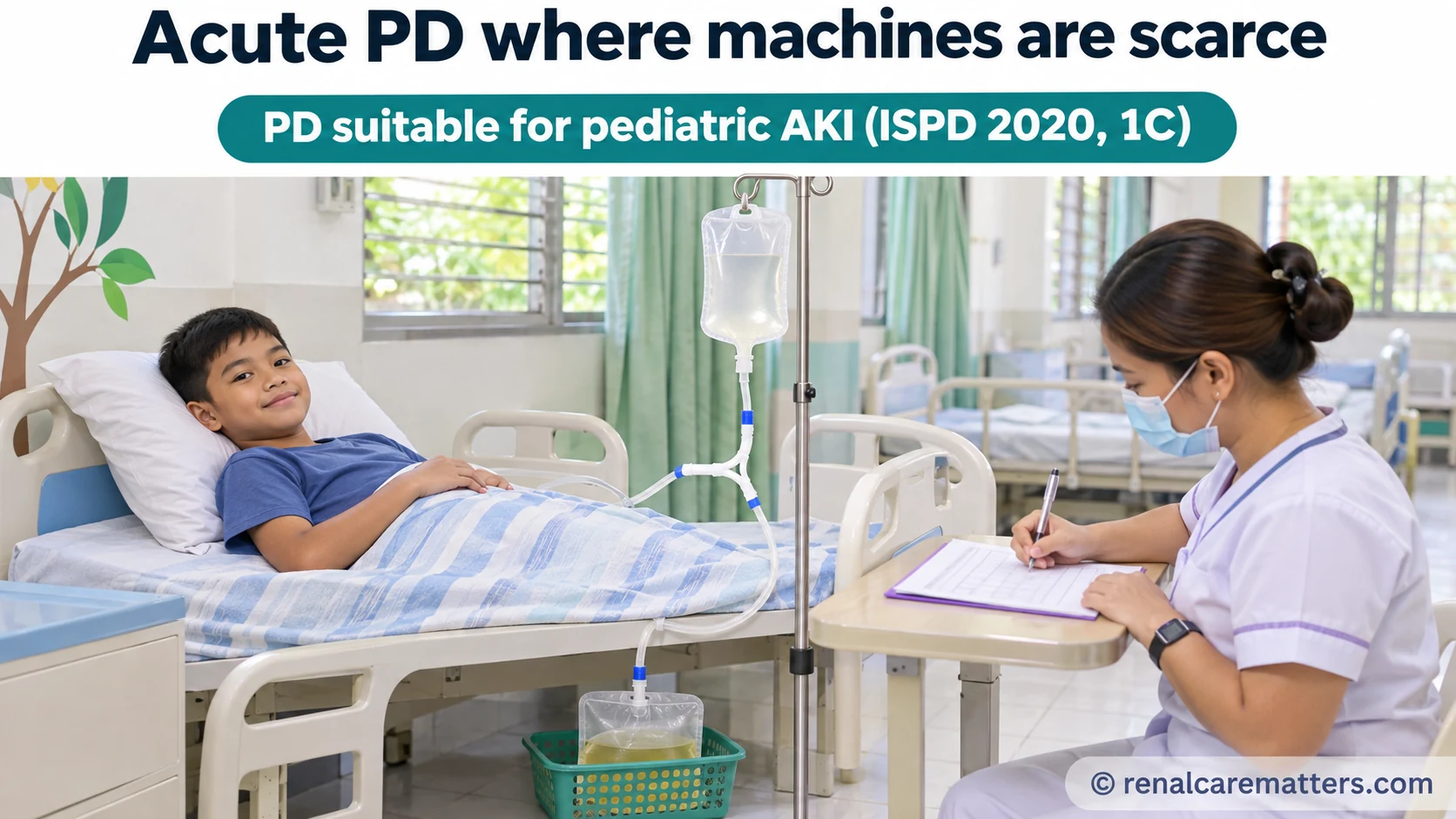
Acute PD in an unstable child changes fast. Fill volumes usually start small and rise as tolerated; dwells are short; potassium, glucose, sodium, acid–base status and blood pressure can change within hours. The nephrologist sets and revises the prescription. The PD nurse’s contribution in a ward new to PD is to teach the closed-system exchange, set up an hourly balance sheet, make sure ordered laboratory tests happen on time, and agree with the ward on who calls whom for what.
Hazel calculates Nonoy’s overload at 10%. She shows two ward nurses the closed-system exchange with a Y set, writes a one-page bedside guide, and sets up an hourly sheet: fill, drain, net balance, urine, intake, blood pressure, breathing rate. She agrees with the nephrologist on call thresholds and stays for the first two exchanges of each shift.
In acute PD, communication and counting matter as much as technique.
Illustrative scenario. Names and details are invented.
CKRT runs slowly around the clock through a blood circuit and is used in intensive care for unstable children. The circuit-size problem of Module 13 is sharper still in infants. Machines designed for neonates have reduced it: the CARPEDIEM device, first used in a 2.9 kg newborn, has a circuit prime of under 30 mL.5 That report described a single patient, so it shows feasibility, not general outcomes.
This module does not prepare you to run CKRT, prime neonatal circuits, manage citrate or heparin anticoagulation, or care for children on extracorporeal membrane oxygenation. Those need a separate pediatric intensive care pathway with device-specific training and authorization. What you can do now is understand the language, keep fluid records exact, and recognize when a child on your ward needs that team.
These are fictional but typical. For each one, cover the answer, decide what you would do, then compare. Where a step depends on local rules, your unit’s procedure and your supervisor’s direction come first.
The percentage. (3.8 − 1.3) L ÷ 25 kg × 100 = 10%, with crackles in both lungs.
Is PD reasonable? Yes. The 2020 ISPD pediatric guideline grades PD as suitable for pediatric AKI (1C), and it is the available therapy here. A closed Y system (1A) and antibiotic prophylaxis before insertion (1B) are recommended.
Hazel’s role. Teach the exchange, set up hourly balances, make sure ordered tests and call thresholds are in place, and support the ward. She does not set or change the prescription, and she escalates to transfer if Nonoy deteriorates beyond what the ward can provide.
Use fictional PICU and ward charts. Your preceptor rates each step as satisfactory, needs practice, or not observed. Steps marked Critical must all be satisfactory before sign-off. This checklist supports supervised learning; your unit’s own procedure and competency form are the authority. A printable version of every checklist is on the trainer page.
Each visit draws 5 questions at random from this module’s 15-question bank. Choose the single best answer for each, then select Check answers; an explanation appears under the best answer. Select New set of questions for a different mix. A good target is 4 of 5 on two different sets. Nothing you select is sent anywhere; scoring happens in your browser.
Module 16 of 204 modules to go

Internal Medicine · Nephrology · Nutrition · Philippines · PRC 0105184
Educational material for registered nurses. Completing it is an Academy learning record only. It does not confer CPD units, PSN or National Kidney and Transplant Institute (NKTI) training recognition, PhilHealth staffing credit, or clinical privileges, and it does not replace your facility’s protocols, device instructions, or written orders.

Scan and save