Nephrology Nursing specialty subtrack for pediatric dialysis
This module is study material for registered nurses in pediatric dialysis. It explains the reasoning behind common nursing decisions; it is not a procedure. Exact steps follow your unit’s pediatric protocol and the device instructions; treatment parameters follow the written order of the pediatric nephrologist. Nurses assess, verify, teach, document and escalate; they do not prescribe, choose antibiotics, change doses or adjust anticoagulation. Every case is fictional and every value in a case is illustrative. Pending review by a pediatric nephrologist and a senior pediatric dialysis nurse.
Learning objectives
After this module you should be able to
Apply the 2024 International Society for Peritoneal Dialysis (ISPD) pediatric criteria for an empiric diagnosis of peritonitis, including the dwell-time rule for children on automated peritoneal dialysis (APD).
Run the first hour after a cloudy bag: sepsis screen, specimen, escalation and antibiotics as ordered without delay.
Recognize exit-site and tunnel infection and their treatment durations, and what the nurse monitors.
Calculate a program peritonitis rate and compare it with the ISPD 2024 pediatric benchmarks.
Classroom 2 hSkills lab 2 hSupervised placement 4 h
Pre-testBefore you read, answer the 5 self-assessment questions and note your score. After the module, select New set of questions and compare. The difference is what you learned; the questions you still miss are what to reread.
Start here
The big picture, in plain words
Peritonitis is infection of the peritoneum, usually from organisms that entered through a connection, the exit site and tunnel, or the bowel. It is the main reason children leave peritoneal dialysis (PD). It is also one of the most treatable emergencies in dialysis, if it is recognized and treated quickly.
Your work in this module is to recognize peritonitis early, get a good specimen, start the ordered antibiotics without delay, and keep the family calm and informed.
In plain wordsThink of the effluent bag as a window into the abdomen. Clear fluid is a clean window. Cloudy fluid is the window fogging up: white blood cells have rushed into the abdomen because something is wrong.
The picture has a limit. A clean window does not prove a clean room. A child on cycler therapy with short night dwells and a dry day may have so little dwell time that white cells have not accumulated. That is why the guideline asks for an adequate dwell before sampling, and why pain or fever with clear fluid still needs a call.
Figure 1 · Key terms for this module
PeritonitisInfection or inflammation of the peritoneum.
Effluent cell countWhite blood cells per mm³ in the drained fluid, with the share that are neutrophils.
Intraperitoneal (IP) antibioticAn antibiotic added to the dialysate.
Refractory peritonitisPeritonitis that has not cleared after 5 days of appropriate antibiotics.
Culture-negative peritonitisPeritonitis in which no organism grows.
Opening case · fictional
Case: Cloudy on a school morning
At 6:30 a.m., Mrs. Joy Castillo calls the PD hotline: the first drain of her son Paolo, 8, 24 kilograms, looks cloudy, and he says his tummy hurts. He is on APD with a dry day. He feels warm. They live 40 minutes from the hospital by tricycle and jeepney. Nurse Rina answers.
Before reading on, decide:
What does Rina ask first, and why?
What should happen to the bag, and when should a sample be taken?
How fast should antibiotics start, and who orders them?
Keep your answers in mind. The lesson gives you what you need, and the case review near the end shows one sound response.
Lesson · part 1
Recognizing peritonitis in a child
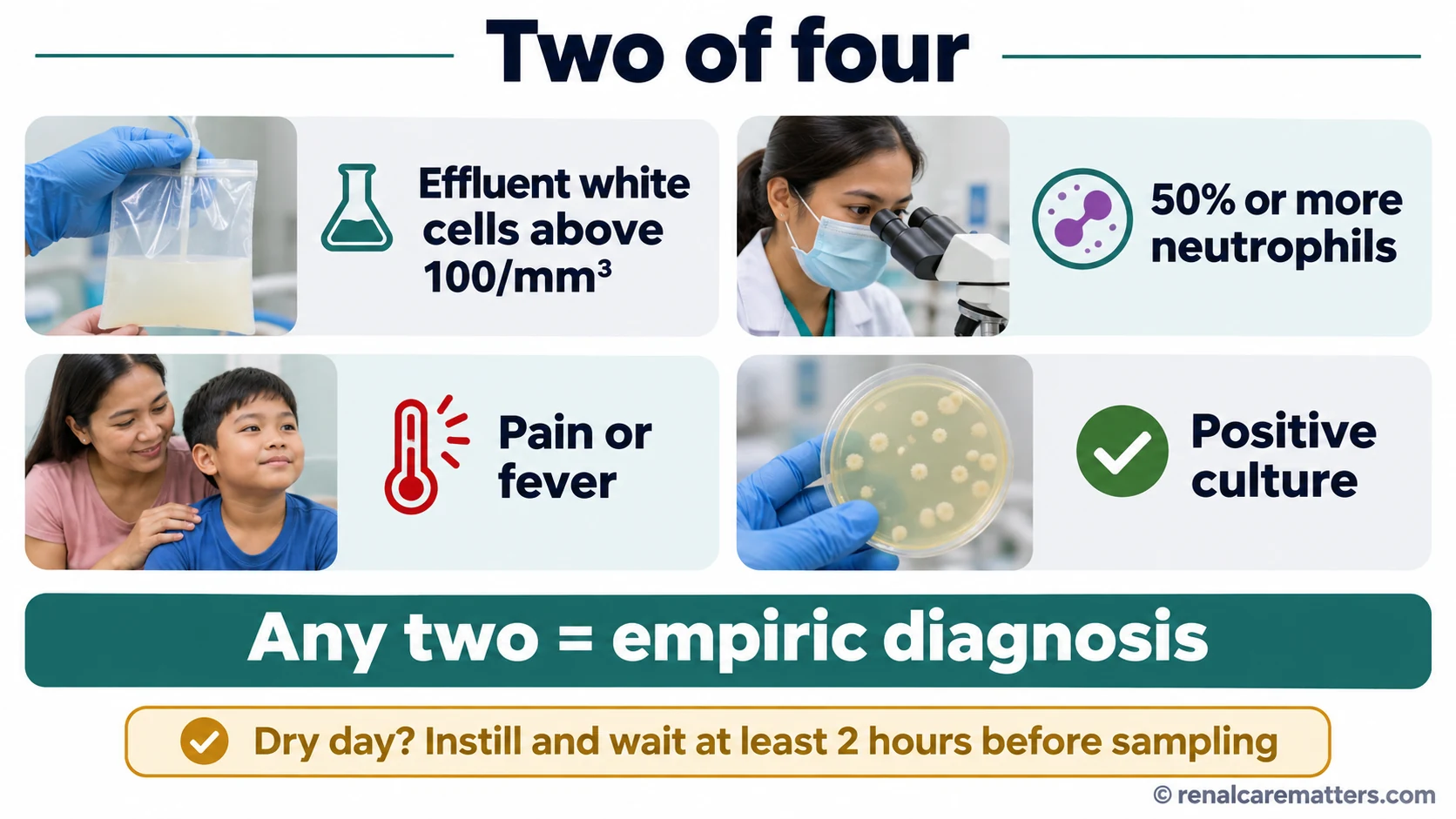
The 2024 ISPD pediatric guideline makes an empiric diagnosis when at least two of the following are present: effluent white cell count above 100/mm³, at least 50% neutrophils (polymorphonuclear cells), clinical signs such as abdominal pain or fever, and growth on culture (statement 8.2, not graded).1
Figure 2. Two of four. The 2024 pediatric guideline makes an empiric diagnosis when at least two are present (not graded).
For a child on APD without a daytime dwell, the guideline’s rationale says the fill volume should be instilled for at least 2 hours before the sample is taken, so that cells have time to collect. Obtaining the sample correctly and using proper culture technique are described as crucial for diagnosis and for choosing antibiotics (8.3).1
Young children may not say “my tummy hurts”. Look for irritability, refusing to be held, vomiting, poor feeding, a tense abdomen, or a child who will not walk. Fever may be absent.
RememberCloudy fluid, pain or fever: any one is a call. Two of the four criteria make the empiric diagnosis.
Lesson · part 2
The first hour
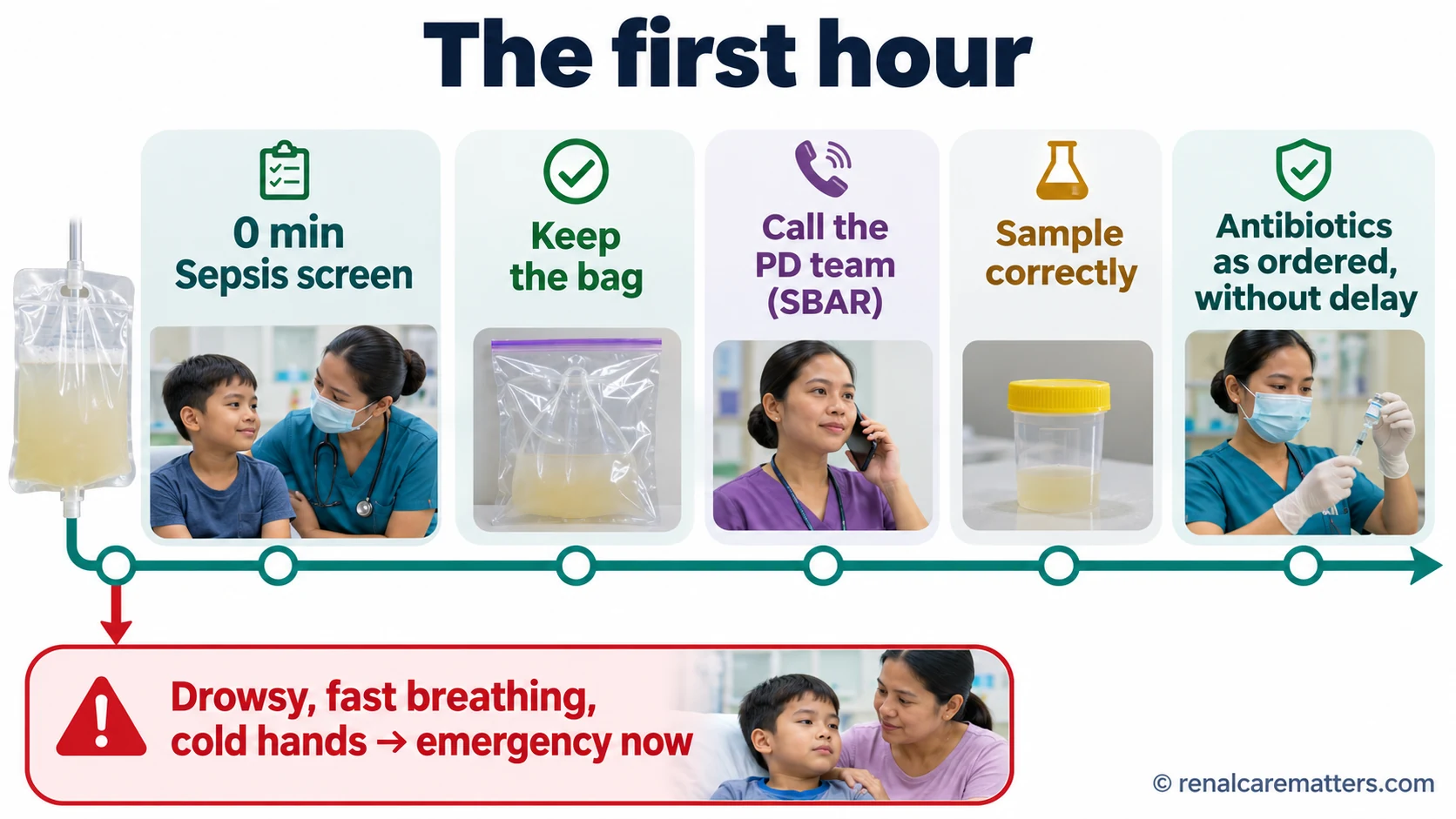
Antibiotics should start as soon as possible after the right specimens are obtained (9.1, not graded); the rationale notes that adult data link delays with more catheter removal, PD discontinuation and death.1
Figure 3. The first hour. Antibiotics start as soon as possible after the specimens are taken.
Minute
Action
0–5
Sepsis screen by phone: is the child drowsy, floppy, breathing fast, cold, mottled, vomiting repeatedly, or not passing urine? If yes, emergency transport now.
5–10
Keep the cloudy bag, closed, cool, upright; bring it. Note the time it was drained.
10–15
Call the PD nephrologist with SBAR (situation, background, assessment, recommendation); agree on where the child is seen.
On arrival
Sample per protocol (after an adequate dwell if the abdomen was dry); cell count, differential, Gram stain and culture; blood cultures if septic
Then
Ordered antibiotics started without waiting for culture results
The guideline suggests empiric therapy with either intraperitoneal cefepime alone, or gram-positive coverage plus gram-negative coverage with ceftazidime preferred or an aminoglycoside if ceftazidime is unavailable (9.3, 2D). Children with features of sepsis should receive intravenous antibiotics. The intraperitoneal route is preferred when drug compatibility and stability allow (10.3, not graded). It also suggests nystatin or fluconazole prophylaxis while a child on PD receives antibiotics (7.1, 2D).1 The nephrologist chooses agents and doses; you prepare and give them exactly as ordered and record the time of the first dose.
RememberScreen for sepsis, keep the bag, sample correctly, then antibiotics without delay. Time the first dose and write it down.
Lesson · part 3
Exit-site and tunnel infection
Purulent discharge at the catheter–skin junction defines an exit-site infection; a positive culture is not required (19.4, 2C). A tunnel infection shows redness, swelling and tenderness along the subcutaneous catheter path, and ultrasound may help (19.5, 2C). An infection within 30 days of insertion is called insertion-related.1
Infection
Suggested treatment duration
Grade
Exit-site infection
7 to 14 days by response and microbiology
2D
Pseudomonas exit-site infection
At least 3 weeks
2C
Tunnel infection
At least 3 weeks
2C
Exit-site and tunnel infections can seed peritonitis. Monitor the exit-site score at every visit, teach the family to report discharge, and remind the team at the end of the planned course if the site has not settled. Fungal peritonitis is the clearest catheter-removal indication: the guideline suggests immediate removal when fungal elements are seen in the effluent (14.1, 2D).1
RememberPurulent discharge is infection. Tunnel signs and Pseudomonas mean longer treatment and closer watching.
Lesson · part 4
Program benchmarks and prevention
The guideline sets program benchmarks (22.6, not graded): an overall peritonitis rate of no more than 0.4 episodes per year at risk, culture-negative peritonitis under 15% of episodes, and peritonitis within 30 days of catheter insertion after fewer than 5% of insertions. It also asks for an apparent cause analysis after every episode (22.5).1 For context, the Standardizing Care to Improve Outcomes in Pediatric End-Stage Kidney Disease collaborative (SCOPE) collaborative reported 0.40 in children under 2 years, and International Pediatric Peritoneal Dialysis Network (IPPN) an annualized 0.32 in older children, as cited in the guideline.
Peritonitis rate (episodes per patient-year) = episodes ÷ (patient-months at risk ÷ 12) Example: 3 episodes over 96 patient-months → 3 ÷ 8 = 0.375 per patient-year
A high culture-negative share usually points to sampling and laboratory technique, not to an unusual disease. Prevention rests on what earlier modules taught: training and retraining (Module 18), exit-site care (Module 8), clean exchanges and honest reporting of contamination (Module 9), and audited bundles (Module 5).2
RememberCount every episode, divide by time at risk, and investigate each one. The benchmark is 0.4 or fewer per patient-year.
On the floor
Real situations: problems and solutions
These are fictional but typical. For each one, cover the answer, decide what you would do, then compare. Where a step depends on local rules, your unit’s procedure and your supervisor’s direction come first.
Clear but painful
What you see
A child on APD with a dry day has abdominal pain and fever, clear fluid.
What is likely going on
Short dwell may hide a high cell count.
What to do
Call the team; sample after a 2-hour dwell per protocol.
Why it matters
Clear fluid does not exclude peritonitis.
Waiting for the culture
What you see
A colleague wants to wait for culture results before antibiotics.
What is likely going on
Misunderstanding of timing.
What to do
Antibiotics as ordered once specimens are taken.
Why it matters
Delays worsen outcomes.
Too many culture-negatives
What you see
Half the program’s episodes grew nothing.
What is likely going on
Sampling or lab technique problems.
What to do
Review sample collection and culture methods with the lab.
Why it matters
The benchmark is under 15%.
Field notes
Keep the cloudy bag closed and upright.
Time the first antibiotic dose.
Case review
Back to the case: Cloudy on a school morning
First question. Rina screens for sepsis: drowsiness, fast breathing, cold or mottled skin, repeated vomiting, poor urine. Any of these means emergency transport now.
The bag and the sample. Keep the bag closed and upright, note its drain time, and bring it. Because Paolo has a dry day, the team instills a fill and waits at least 2 hours, or samples the night effluent per protocol, so the count is valid.
Antibiotics. As soon as the specimens are taken, per the nephrologist’s order, intraperitoneally unless he is septic. Rina documents call time, arrival, sample time and first-dose time, and the team later completes an apparent cause analysis.
Interactive case · fictional
Interactive case: Cloudy before school
Work through a shift one decision at a time. The panel at the top changes with what you choose. After each choice you see why it is, or is not, the best move; after a weaker one you can try again or carry on and see where it leads. Your first choice at each step is scored. The score stays on this device and nothing is sent anywhere. In real practice, your unit’s protocol and the people responsible for each decision come first.
Skills lab · with your preceptor
Skills checklist: The cloudy-bag response
Simulate the telephone call and the arrival. Your preceptor rates each step as satisfactory, needs practice, or not observed. Steps marked Critical must all be satisfactory before sign-off. This checklist supports supervised learning; your unit’s own procedure and competency form are the authority. A printable version of every checklist is on the trainer page.
CriticalScreens for sepsis by telephone and routes emergency care when present
Instructs the family to keep and bring the bag and records its drain time
CriticalArranges sampling after an adequate dwell for a child with a dry day
Gives SBAR to the nephrologist with read-back of orders
CriticalRecords the time of specimen collection and first antibiotic dose
Self-assessment
Check your understanding
Each visit draws 5 questions at random from this module’s 15-question bank. Choose the single best answer for each, then select Check answers; an explanation appears under the best answer. Select New set of questions for a different mix. A good target is 4 of 5 on two different sets. Nothing you select is sent anywhere; scoring happens in your browser.
Warady, B. A., Same, R., Borzych-Duzalka, D., Neu, A. M., El Mikati, I., Mustafa, R. A., Begin, B., Nourse, P., Bakkaloglu, S. A., Chadha, V., Cano, F., Yap, H. K., Shen, Q., Newland, J., Verrina, E., Wirtz, A. L., Smith, V., & Schaefer, F. (2024). Clinical practice guideline for the prevention and management of peritoneal dialysis associated infections in children: 2024 update. Peritoneal Dialysis International, 44(5), 303–364. https://doi.org/10.1177/08968608241274096
Neu, A. M., Richardson, T., Lawlor, J., Stuart, J., Newland, J., McAfee, N., & Warady, B. A. (2016). Implementation of standardized follow-up care significantly reduces peritonitis in children on chronic peritoneal dialysis. Kidney International, 89(6), 1346–1354. https://doi.org/10.1016/j.kint.2016.02.015
Educational material for registered nurses. Completing it is an Academy learning record only. It does not confer CPD units, PSN or National Kidney and Transplant Institute (NKTI) training recognition, PhilHealth staffing credit, or clinical privileges, and it does not replace your facility’s protocols, device instructions, or written orders.