After this module you should be able to
- Track your symptom priorities
- Choose who joins a future-care discussion
- Ask how your preferences can be documented
Suggested earlier modules: C01, C03, C04, C07, C08, C12. You may read any module in any order; the suggestion only helps the lessons build on each other.
The everyday picture
Start with today
Tell your team which symptoms most affect your comfort and daily life, such as itching, pain, breathlessness, poor sleep, nausea, low mood or worry. Many can be eased. Your support plan can include physical, emotional, family, financial and spiritual needs; ask about a chaplain, priest, pastor or imam if faith matters to you.
Talk about future situations
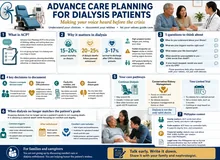
If you wish, discuss who should speak for you if you cannot communicate, what you would want if you became very ill, and what matters most: being at home, being free of pain, being with family, or trying every treatment. Ask a clinician how these preferences can be documented in your setting, since forms and legal recognition vary.

Talking about future care. An older woman speaks with her family at the kitchen table while a doctor and nurse listen. A card reads "What matters to me": being at home, free of pain, with family, or trying every treatment, and who should speak for me if I cannot. Ask your clinician how to record it; formal documents need your care team.
Make the plan usable
Share your preferences with the people you choose and keep a copy where it can be found. Ask who reviews the plan and how to get help outside regular hours. This course does not create legally binding advance directives or do-not-resuscitate orders; those require your clinical team and the applicable local process.
Manang Elsa's kitchen-table talk
Manang Elsa, 78, on dialysis for six years, tells her nurse she is tired of hospital stays and worries her children will fight if she can no longer speak.
Before reading on: what would you do, and whom would you call?
How sure are we? Limited evidence
Advance care planning and kidney supportive care are recommended by international kidney and palliative care groups, and National Institute of Diabetes and Digestive and Kidney Diseases (NIDDK) patient guidance describes symptom-focused care and future planning as active parts of kidney care. Evidence comes mainly from observational studies and qualitative research about patient and family experience.1
Questions to ask your team
- Which of my symptoms can be eased, and how?
- How can my wishes about future care be written down here?
- Can my family join a meeting with you?
Try it, then say it in your own words
Practice. Use W19 to draft a conversation invitation and a symptom priority; take formal documentation questions to the care team. Worksheet W19: My comfort and future care conversation is ready to print. Use invented details when practicing; keep your real health information on paper, not online.
Three quick questions
Choose the best answer for each, then select Check answers. An explanation appears under the best answer. Try again as often as you like. Nothing you select is sent anywhere.
Read next on this site
- Advance Care Planning for Dialysis PatientsTalking about future care.
Choose your own path on the course home. Last checked November 29, 2026.
Module 27 of 4013 modules to go