Patients & Care Partners · Kidney disease before dialysis · Module K02

Prepare for changing kidney care needs

Starting dialysis in an emergency is like moving house during a flood: everything is rushed, and the choices are made for you.

PublishedNailathalaGipatikPepalwal: ReferencesMga SanggunianMga TinubdanReng Reperensya: 4 Audience: People living with kidney disease and the people who support them Read timeOras ng pagbasaOras sa pagbasaOras ning pamamasa:
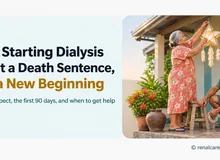
Nanay Lourdes and her husband walk out of a dialysis unit after a planned start.
Renal Care Academy›Renal Patients and Care Partners›Module K02
🤝

For patients and care partners

This course helps you understand your care and prepare questions. It does not give individual fluid limits, food limits, blood pressure targets, medicine doses or machine settings: those come from your own care team. Practical home dialysis training happens with your treatment service. No website, quiz or chat is watched in real time; in an emergency, get help now. Every person in the stories is fictional.

When to get urgent helpSevere breathlessness, chest pain, fainting, heavy bleeding, new confusion: get emergency help now. No website or chat is watched in real time.

After this module you should be able to

Suggested earlier modules: C01, C03, C04, C07, C08, C12. You may read any module in any order; the suggestion only helps the lessons build on each other.

The everyday picture

In plain wordsStarting dialysis in an emergency is like moving house during a flood: everything is rushed, and the choices are made for you. People who plan ahead are more likely to start with a ready access, a chosen treatment and a family that knows what to expect. Planning is not giving up hope. It is packing the bag early so that, if the day comes, you walk out the door instead of being carried.
A planned start: clinic visits, meeting the peritoneal dialysis nurse and visiting a unit, a fistula made months before, and a planned first session with home the same day. A crisis start: skipped visits, the emergency department while breathless, an urgent catheter in the chest, and a hospital stay. People who plan ahead are more likely to start with a ready access and a treatment they chose.

Two ways to start dialysis. A planned start: clinic visits, meeting the peritoneal dialysis nurse and visiting a unit, a fistula made months before, and a planned first session with home the same day. A crisis start: skipped visits, the emergency department while breathless, an urgent catheter in the chest, and a hospital stay. People who plan ahead are more likely to start with a ready access and a treatment they chose.

Preparation is a conversation

Ask your kidney team when to begin talking about future treatment. Many teams start this education when kidney function is falling steadily or is around a quarter of normal, but timing depends on your condition, how fast it is changing and your wishes. Planning may include visiting a dialysis unit, meeting a peritoneal dialysis (PD) nurse, being referred for transplant evaluation, or meeting a supportive care team. An access, such as a fistula, often needs months to mature, which is one reason early planning matters.

Bring real-life information

Tell the team about your travel distance, income, work, housing, hand strength, eyesight, who can help you and what you hope for. These details change which options are realistic. Ask which services are available locally, how each would fit your week, and what Philippine Health Insurance Corporation (PhilHealth) and other programs would cover. A social worker can help with benefits and transport.

Leave with a next step

At the end of each visit, write down who will arrange the next referral, what the next appointment is, and how to ask questions while waiting. Learning about dialysis or transplant does not mean you must start now, and many people with slowly changing kidney function never need dialysis. Preparation keeps the choice in your hands.

Two ways to start dialysis

What happened

Nanay Lourdes and Tatay Rodel both reach kidney failure in the same year. Lourdes had met a PD nurse and had a fistula created six months earlier. Rodel had skipped visits because he felt fine, and arrives at the emergency department breathless.

Before reading on: what would you do, and whom would you call?

What happened next, and why it mattersLourdes starts dialysis on a planned date using her matured fistula and goes home the same day. Rodel needs an urgent catheter in his neck and a week in hospital, and his family must choose a unit in a hurry. Both now do well, but Rodel's start was harder, riskier and more expensive. The difference was not luck; it was preparation.

How sure are we? Moderate evidence

Starting hemodialysis with a catheter rather than a fistula or graft is associated with more infections and hospital stays, which is why the Kidney Disease Outcomes Quality Initiative (KDOQI) 2019 guideline asks teams to plan access early as part of each person's end-stage kidney disease (ESKD) Life-Plan. Structured pre-dialysis education and decision aids help people make informed choices (Cochrane 2024).1,2,3,4

Questions to ask your team

Try it, then say it in your own words

Practice. Update W03 with one barrier, one available support and a named follow-up action. Worksheet W03: My treatment options conversation is ready to print. Use invented details when practicing; keep your real health information on paper, not online.

Teach backState the difference between preparing for treatment and deciding to start today. If a nurse educator is with you, they can record this on the teach-back record. Reading and quizzes never count as a hands-on skill check.

Three quick questions

Choose the best answer for each, then select Check answers. An explanation appears under the best answer. Try again as often as you like. Nothing you select is sent anywhere.

Question 1 of 3What is a useful outcome of a future-treatment appointment?
Question 2 of 3Why is a fistula often planned months before dialysis may be needed?
Question 3 of 3Does learning about dialysis mean you have agreed to start it?

Read next on this site

Choose your own path on the course home. Last checked November 29, 2026.

Glossary & abbreviationsTalahulugan at mga daglatTalaan sa mga pulong ug daglatTalatinigan ampo reng daglat terms used on this page

Abbreviations

ESKD
End-stage kidney disease.
KDOQI
Kidney Disease Outcomes Quality Initiative.
PD
Peritoneal dialysis.
PhilHealth
Philippine Health Insurance Corporation.
ReferencesMga SanggunianMga TinubdanReng Reperensya 4 sources
  1. National Institute for Health and Care Excellence. (2018). Preference-sensitive decisions about renal replacement therapy and conservative management (NICE guideline NG107 decision aid). https://www.nice.org.uk/guidance/ng107
  2. National Institute of Diabetes and Digestive and Kidney Diseases. (n.d.). Managing chronic kidney disease. https://www.niddk.nih.gov/health-information/kidney-disease/chronic-kidney-disease-ckd/managing
  3. Stacey, D., Lewis, K. B., Smith, M., Carley, M., Volk, R., Douglas, E. E., Pacheco-Brousseau, L., Finderup, J., Gunderson, J., Barry, M. J., Bennett, C. L., Bravo, P., Steffensen, K., Gogovor, A., Graham, I. D., Kelly, S. E., Légaré, F., Sondergaard, H., Thomson, R., . . . Trevena, L. (2024). Decision aids for people facing health treatment or screening decisions. Cochrane Database of Systematic Reviews, 2024(1), CD001431. https://doi.org/10.1002/14651858.CD001431.pub6
  4. Lok, C. E., Huber, T. S., Lee, T., Shenoy, S., Yevzlin, A. S., Abreo, K., Allon, M., Asif, A., Astor, B. C., Glickman, M. H., Graham, J., Moist, L. M., Rajan, D. K., Roberts, C., Vachharajani, T. J., Valentini, R. P., & National Kidney Foundation. (2020). KDOQI clinical practice guideline for vascular access: 2019 update. American Journal of Kidney Diseases, 75(4 Suppl 2), S1–S164. https://doi.org/10.1053/j.ajkd.2019.12.001
Dr. William Gregory M. Rivero, MD

William Gregory Rivero, MD, FPCP, DPSN

Internal Medicine · Nephrology · Nutrition · Philippines · PRC 0105184

Patient and care-partner education from the Renal Care Academy. It supports, and never replaces, the advice of your own kidney team, your unit’s written instructions, and supervised treatment training. Completing it is a self-reported learning record, not a qualification of any kind.

QR code — scan to save Dr. Rivero's contact info

Scan and save