Why function predicts outcomes in kidney disease, what an OT and a PT each own, and how to read a referral before you touch a patient.
PublishedNailathalaGipatikPepalwal:ReferencesMga SanggunianMga TinubdanReng Reperensya:5Audience: Philippine-registered occupational therapists and physical therapists who see people with kidney disease · rehabilitation leads, physiatrists and renal teams who refer to them · students on an observer pathwayRead timeOras ng pagbasaOras sa pagbasaOras ning pamamasa:
Renal rehabilitation track for licensed occupational and physical therapists
Study material for licensed occupational therapists (RA 11241) and physical therapists (RA 5680) working with people who have kidney disease. It explains the reasoning behind renal rehabilitation; it is not a hospital protocol. It never authorizes changes to dialysis settings, handling of a needled access or catheter, medicine decisions or benefit promises. Exercise parameters come from the referring physician and your unit’s agreed sheet: per unit protocol, but always ask the attending nephrologist’s guidance. Every case, name and number in the cases is fictional and illustrative.
Learning objectives
After this module you should be able to
Explain why physical function predicts outcomes in kidney disease, and what that does and does not prove.
Describe what an occupational therapist and a physical therapist each contribute to renal care, and where they overlap.
Verify professional authority, the referral or physician prescription, consent and the renal team’s current plan before any intervention.
Sort the requests in a referral into those you own and those that belong to the nurse or the nephrologist.
Write a first-contact note that records authority, consent, plan and the reason for proceeding, adapting or deferring.
Classroom 2 hSkills lab 2 hSupervised placement 1 h
Pre-testBefore you read, answer the 5 self-assessment questions and note your score. After the module, select New set of questions and compare. The difference is what you learned; the questions you still miss are what to reread.
Start here
The big picture, in plain words
In plain wordsThink of a dialysis unit as a relay team. The nephrologist sets the race plan. The nurse runs the dialysis leg. You run the movement and daily-life legs. A relay fails at the handoff, not on the straight: a baton dropped between runners, or a runner who sprints off before taking it.
The picture has a limit. In a relay, each runner runs alone. In renal care, your leg overlaps the others every day: the patient you walk on Tuesday is the patient whose blood pressure dropped on Monday’s session and whose fistula is three weeks old. So the first skill in this track is not an exercise. It is reading the referral, knowing who owns each decision, and taking the baton properly.
Why should a therapist be in the relay at all? Because physical function is not a side issue in kidney disease. In a cohort of 385 adults with chronic kidney disease (CKD) stages 2 to 4, lower-body performance was at least 30 percent below predicted, and each 0.1 meter per second slower walking speed was associated with a 26 percent higher risk of death over about three years, after adjustment. Gait speed and the Timed Up and Go predicted three-year mortality better than kidney function or common blood tests.1 That is an association, not proof that making someone walk faster makes them live longer. But it tells you that the thing you measure and treat is one of the strongest signals of how a person with kidney disease is doing.
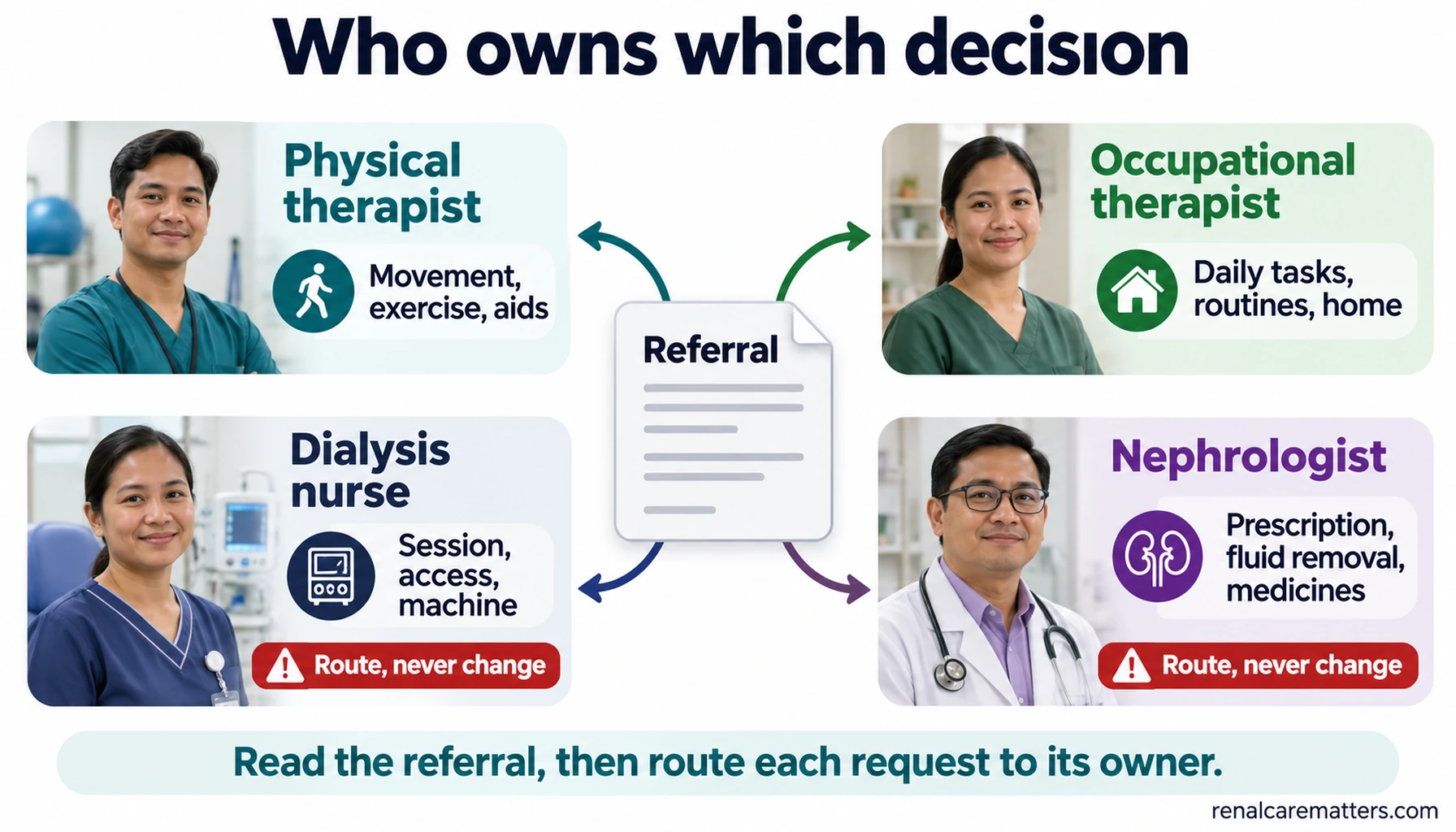
Figure 1. Who owns which decision. Read the referral, then route each request to its owner.
Figure 2 · Key terms for this module
ReferralA written request from an authorized clinician for your assessment or treatment. For physical therapy in the Philippines it is a physician’s prescription.
ScopeWhat your license and your employer’s privileges allow you to do.
Renal planThe nephrologist’s and nurse’s current instructions: dialysis schedule, fluid targets, access, restrictions.
Proceed, adapt, deferThe three decisions at every first contact; Module 3 adds stop.
Functional goalA change in what the person can do, stated in their words.
Opening case · fictional
Case: The referral that asked for too much
Tuesday, 9:40 a.m. physical therapist (PT) Carlo Dizon of the Santa Maria Kidney Center opens a referral for Mr. Ernesto Villanueva, 64, a retired jeepney dispatcher on hemodialysis three times a week for two years. The referral, written by a resident, reads: “Deconditioned. PT for strengthening. Kindly reduce ultrafiltration (UF) so patient can exercise during hemodialysis (HD). Also teach wife to transfer him to the tricycle.”
Mr. Villanueva’s chart shows a left forearm fistula, a recent fall at home, and type 2 diabetes. His wife, Aling Linda, tells Carlo that he no longer bathes himself because “he gets dizzy in the bathroom.” He would like to watch his grandson’s basketball games again.
The occupational therapist (OT), Bea Santiago, is in the next room. The nurse on the floor is Joy Marasigan. Dr. Ramon Uy, the attending nephrologist, rounds at 11.
Before reading on, decide:
Which requests in this referral belong to you, and which belong to someone else?
What must be true before Carlo starts any treatment?
Which parts of Mr. Villanueva’s story call for an occupational therapist, and how should Carlo bring Bea in?
Keep your answers in mind. The lesson gives you what you need, and the case review near the end shows one sound response.
Lesson · part 1
What an OT and a PT each bring
Occupational therapy and physical therapy share a clinic, sometimes a gym, and often a patient. They are separate professions with separate laws. Since 2019, occupational therapy has had its own statute, Republic Act (RA) 11241, which defines its scope and prohibits unlicensed practice; physical therapy remains under RA 5680, which requires a physician’s prescription for treatment.2,3 Treat OT as a profession, never as a PT assistant, and never let one profession’s license stand in for the other’s.
Question
Physical therapist leads
Occupational therapist leads
What limits this person?
Strength, endurance, balance, gait, transfers, pain with movement
Performance of daily tasks, fatigue in routines, cognition in tasks, environment
What do you measure?
Gait speed, sit-to-stand, Short Physical Performance Battery (SPPB), six-minute walk
Task observation, activities of daily living (ADL), instrumental activities, valued roles
What do you change?
The body’s capacity: exercise, mobility training, aids
The task and the setting: pacing, routines, equipment, home and work
Typical renal example
Leg strengthening for a man who cannot rise from a low chair
A bathing routine and shower chair for a man who gets dizzy in the bathroom
Overlap is normal and useful. Both of you will teach a safe transfer, both of you will screen before activity, and both of you will hear about fatigue. The rule for overlap is simple: agree who leads, tell the patient, and write it down.
RememberPT raises what the body can do. OT lowers what the task demands. Most renal patients need both, in one plan.
Lesson · part 2
Three checks before you touch anyone
Every intervention in this track rests on three checks. Do them at first contact and again whenever something changes.
Figure 3 · The three checks
Your authorityCurrent Professional Regulation Commission (PRC) registration, and the employer privileges for this setting. In a dialysis unit, that includes local orientation to infection control and emergencies.
The referralFor PT, a physician’s prescription under RA 5680. For OT, a referral consistent with RA 11241 and current PRC rules. Read what it asks, and what it does not ask.
Today’s renal planSpeak to the nurse caring for the patient: today’s session, access, symptoms, restrictions, and any parameters the physician has set.
Then obtain consent from the patient in a language they understand. Consent is not a signature at the start of a program; it is a conversation each session about what you plan, why, and what they can refuse.
The Department of Health (DOH) requires dialysis facilities to have competent staff, medical oversight and safe systems, but its order sets no therapist staffing ratio and creates no renal OT or PT credential.4 The Philippine Society of Nephrology publishes clinical guidance, but no renal therapist certificate was found in its public pages.5 Your authority comes from your license, your employer, and the referral. This course adds knowledge, not authority.
RememberNo license, no referral, no current plan: no treatment. Write each check in your first note.
Lesson · part 3
Yours, the nurse’s, or the nephrologist’s
Referrals are written in a hurry. They mix requests you own with requests you must route. Sort every line before you act.
Request type
Example
Owner
What you do
Movement, exercise, mobility aids
“PT for strengthening”
PT
Assess and treat within the prescription
Daily tasks, routines, home, work
“Unable to bathe”
OT
Co-refer or request an OT referral
Dialysis prescription
“Reduce UF so he can exercise”
Nephrologist
Do not act; explain and route
Access, needles, machine
“Exercise with needles in”
Nurse and nephrologist
Agree a joint plan; never handle the access
Medicines
“Give paracetamol before walking”
Physician and nurse
Route; never give or adjust
Benefits
“Philippine Health Insurance Corporation (PhilHealth) will cover PT”
Authorized coordinator
Do not promise; refer (Module 18)
On the floor · The UF request
PT Carlo Dizon reads “reduce UF so patient can exercise” and calls the resident. He says: “I can design exercise around his sessions. I can’t change his ultrafiltration; that’s Dr. Uy’s decision. If you’re worried about his pressure during exercise, can we ask Dr. Uy for the limits he wants me to work within?”
The resident agrees. Dr. Uy writes three lines of parameters at rounds.
A polite phone call turned an unsafe request into a usable plan.
Illustrative scenario. Names and details are invented.
Stop and callA referral never authorizes you to change ultrafiltration, dialysate, blood flow or any machine setting, to move needles or catheters, or to give a medicine. If a request needs one of those, stop and call: per unit protocol, but always ask the attending nephrologist’s guidance.
Lesson · part 4
Write the decision, not just the activity
Your first note does more than record what you did. It shows the next clinician that you checked the right things and made a reasoned decision. A useful first-contact note has six parts:
Authority and referral: who referred, when, for what; your profession.
Consent: obtained, language used, anything declined.
Renal handoff: treatment type and timing, access side and type, today’s symptoms and restrictions, the nurse you spoke to.
Findings: what you observed and measured.
Decision: proceed, adapt or defer, and why.
Plan and routing: what you will do, what you routed to whom, and when you will review.
Illustrative first note. “PT initial contact, 9:50 a.m., non-dialysis day. Prescription Dr. Uy (resident), 11/24, ‘strengthening.’ Consent verbal, Filipino, agrees to assessment, declines walking today (tired). Renal handoff Nurse Marasigan: HD M-W-F, left forearm arteriovenous fistula (AVF), no new symptoms, no parameters yet set. Request to reduce UF routed to Dr. Uy; awaiting exercise parameters. Decision: adapt, seated assessment only. Plan: baseline battery Thursday after parameters received; OT referral requested for bathing (dizziness in bathroom).”
RememberIf your note does not say why you proceeded, adapted or deferred, the next person cannot trust it.
On the floor
Real situations: problems and solutions
These are fictional but typical. For each one, cover the answer, decide what you would do, then compare. Where a step depends on local rules, your unit’s procedure and your supervisor’s direction come first.
“PT, kindly start tomorrow”
What you see
A nurse asks you to start walking a new patient tomorrow; there is no written prescription.
What is likely going on
A well-meant request without the authority RA 5680 requires.
What to do
Ask the physician for a written prescription; screen and assess only when it exists.
Why it matters
Treatment without a prescription leaves you and the patient unprotected.
The overlapping plans
What you see
OT and PT both teach the same patient a different way to stand from the toilet.
What is likely going on
No agreed lead for a shared task.
What to do
Agree one technique and one lead; tell the patient and family; write it in the plan.
Why it matters
Two methods confuse a tired patient and raise fall risk.
The family’s request
What you see
A daughter asks you to “make Papa skip dialysis today so he can do therapy.”
What is likely going on
A misunderstanding of what therapy can change.
What to do
Explain that dialysis comes first; offer a therapy time that fits; inform the nurse.
Why it matters
Missed dialysis is dangerous; therapy fits around it, never instead of it.
Field notes
Read every referral line aloud and sort it by owner.
Introduce yourself with your profession every time.
Write the decision and its reason in every note.
Keep a list of your unit’s escalation contacts on your phone.
Case review
Back to the case: The referral that asked for too much
What belongs to whom. Strengthening belongs to Carlo under the physician’s prescription. Reducing ultrafiltration (UF) belongs to Dr. Uy; Carlo routes it and asks for exercise parameters instead. Teaching the wife to transfer her husband into a tricycle is shared: Carlo leads the transfer technique, Bea leads the community-transport task and the home routine. Bathing with dizziness is an occupational problem with a medical question inside it: Bea analyzes the task, and the dizziness goes to the nurse and nephrologist (Module 3 explains why standing in a warm bathroom after dialysis can drop blood pressure).
What must be true first. Carlo’s registration and privileges, the physician’s prescription, Mr. Villanueva’s consent, and a renal handoff from Nurse Marasigan. The recent fall makes a careful screen essential before any walking.
Bringing Bea in. Carlo asks the resident to add an OT referral, or uses the unit’s co-referral pathway, then introduces Bea to the family with a shared goal in Mr. Villanueva’s own words: watching his grandson’s games. That goal needs both professions: the strength and endurance to walk into a covered court, and a bathing, dressing and transport routine that leaves him energy to stay.
Skills lab · with your preceptor
Skills checklist: First contact and referral sorting
Run a simulated first contact from a written referral while your preceptor observes. Your preceptor rates each step as satisfactory, needs practice, or not observed. Steps marked Critical must all be satisfactory before sign-off. This checklist supports supervised learning; your unit’s own procedure and competency form are the authority. A printable version of every checklist is on the trainer page.
CriticalStates own profession and verifies registration and local privileges for the setting.
CriticalConfirms a valid physician prescription (PT) or referral (OT) and reads its scope aloud.
CriticalObtains a renal handoff from the responsible nurse: treatment timing, access, symptoms, restrictions.
Sorts each referral line into own scope, co-referral, or route to nurse or nephrologist.
CriticalDeclines any request to change dialysis settings, handle the access or give medicines, and routes it.
Obtains informed consent in the patient’s language and records anything declined.
Writes a first-contact note with authority, consent, handoff, findings, decision and plan.
Placement activity. Collect five real referrals (deidentified). For each, sort every request by owner and note which were routed, and whether the referral named a functional goal.
Self-assessment
Check your understanding
Each visit draws 5 questions at random from this module’s 10-question bank. Choose the single best answer for each, then select Check answers; an explanation appears under the best answer. Select New set of questions for a different mix. A good target is 4 of 5 on two different sets. Nothing you select is sent anywhere; scoring happens in your browser.
Roshanravan, B., Robinson-Cohen, C., Patel, K. V., Ayers, E., Littman, A. J., de Boer, I. H., Ikizler, T. A., Himmelfarb, J., Katzel, L. I., Kestenbaum, B., & Seliger, S. (2013). Association between physical performance and all-cause mortality in CKD. Journal of the American Society of Nephrology, 24(5), 822–830. https://doi.org/10.1681/ASN.2012070702
Educational material for licensed occupational and physical therapists. Completing it is an Academy learning record only. It is not a PRC, DOH, PhilHealth or PSN credential, not CPD units, and not a workplace privilege. Your license, your referral or prescription, your employer’s privileges and the renal team’s plan govern what you may do.