Transfers, Transient Dialysis, and International Practice
The transfer packet, verifying the recipient, closing on receipt, downstream updates, and borrowing good process from abroad.
PublishedNailathalaGipatikPepalwal:ReferencesMga SanggunianMga TinubdanReng Reperensya:5Audience: Designated medical records officers, custodians, and deputies in standalone and hospital-based hemodialysis units · hospital health information management staff assigned to dialysis · unit managers who supervise recordsRead timeOras ng pagbasaOras sa pagbasaOras ning pamamasa:
Training track for the records officers of hemodialysis units
This module is study material for the records officers of hemodialysis units. It explains the reasoning behind common records decisions; it is not a records manual and not legal advice. Regulations change: confirm every rule against the current text and your facility’s approved policy before you rely on it. Clinical content belongs to its clinical author; questions about a patient’s care go to the attending nephrologist. Every case, name, and identifier is fictional.
Learning objectives
After this module you should be able to
Assemble a transfer packet against a manifest, with the clinical scope set by the clinical team.
Verify the receiving facility and its channel through a trusted directory, not the request itself.
Escalate a missing clinical item before dispatch and track it to delivery.
Close a transfer on acknowledgment and update the chart, registry, claims ledger, and retention trigger.
Use international practice as a source of ideas without mistaking it for Philippine law.
Pre-testBefore you read, answer the 8 self-assessment questions and note your score. After the module, select New set of questions and compare. The difference is what you learned; the questions you still miss are what to reread.
Start here
The big picture, in plain words
In plain wordsA transfer is a relay race. Your runner has carried the baton for years. Now another team’s runner is waiting, and the baton must pass from hand to hand without touching the ground. Most dropped batons are dropped in the handoff, not on the track.
The picture is useful, and it has one limit. In a relay, the next runner sees the baton coming. A receiving dialysis unit sees only what you send. If a page is missing, nothing tells them it should have been there. They will dialyze the patient, often within a day or two, on the strength of the packet, and fill any gap with assumptions.
For a patient with chronic kidney disease (CKD) who depends on dialysis, a missing dry weight or an outdated hepatitis result is not an administrative gap at that point. It is a clinical risk: a fluid target guessed, or a patient placed on the wrong machine. This module is about making the handoff complete, verified, and confirmed.
Figure 1 · Key terms for this module
ManifestThe itemized list of what a packet contains.
Acknowledgment of receiptThe recipient’s confirmation that the packet arrived, complete.
Transient dialysisTreatment at another unit while the patient is traveling.
Transfer-outThe event that ends a patient’s care at your unit and begins it elsewhere.
Local standardA practice the facility adopts by its own policy, clearly labeled as not a legal requirement.
Opening case · fictional
Case: Before tomorrow’s session
Mr. Eduardo Reyes, 70, is moving to live with his daughter in Laguna. A hospital-based unit there has accepted him and plans to dialyze him tomorrow morning. At 3:30 p.m. an email arrives asking for his current signed hemodialysis (HD) orders, his last treatment record, and his medication list “before tomorrow’s session.”
The email comes from an address you do not recognize: a free webmail account with the hospital’s name in it. Dr. Mendoza has already authorized the transfer packet. When you pull the chart, you see that his last run sheet, from this morning, still has no final weight.
Before reading on, decide:
How do you confirm where to send the packet?
What do you do about the missing final weight?
When is the transfer closed, and what else must you update?
Keep your answers in mind. The lesson gives you what you need, and the case review near the end shows one sound response.
Lesson · part 1
Build it, verify it, send it
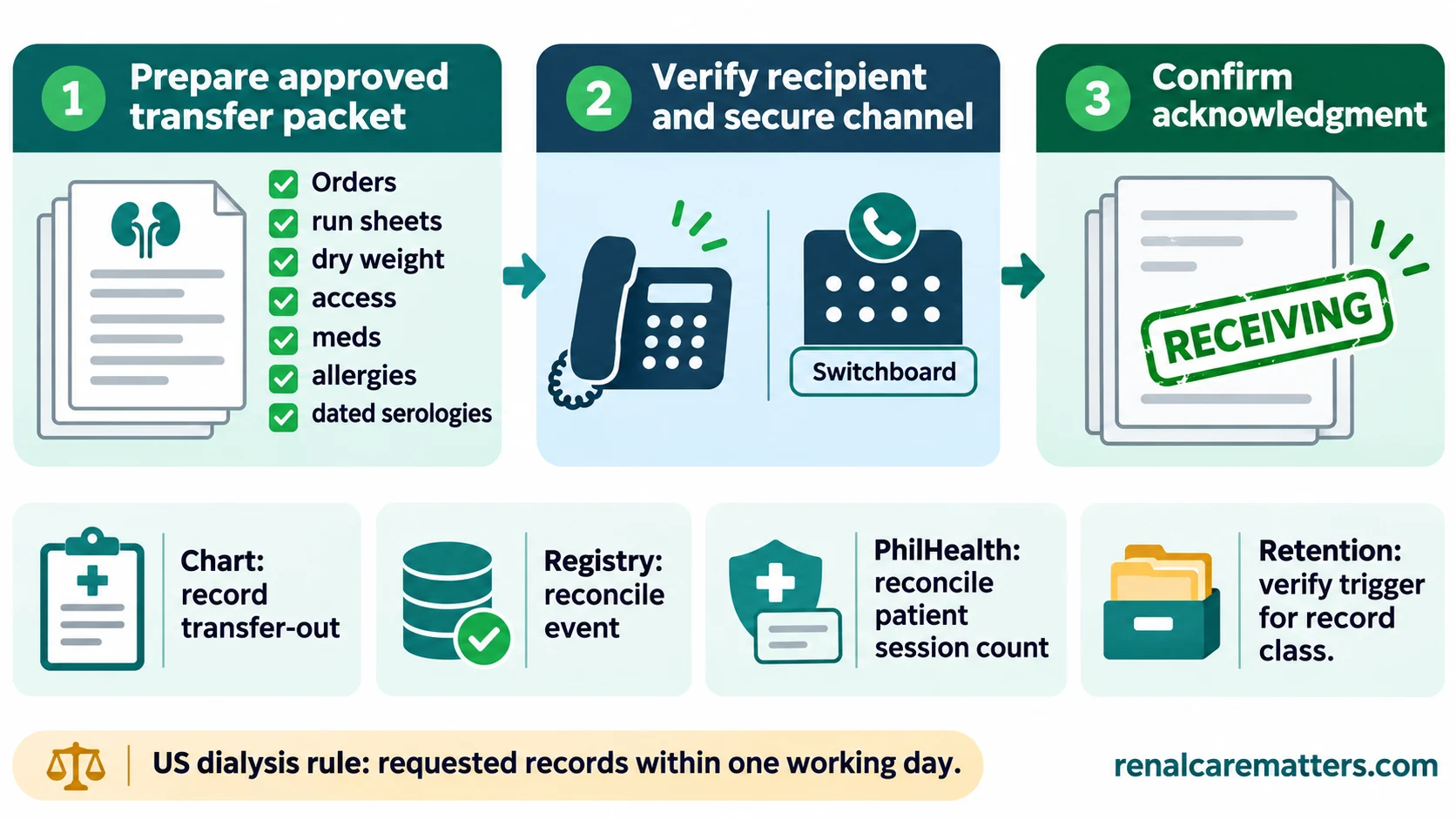
The clinical team decides what is clinically required and signs the treatment summary. A typical packet holds:
the current signed standing orders;
the last several run sheets;
the dry weight and recent weight trend;
vascular access details, including the access type, site, and any recent problems;
the current medication list and allergies;
the latest hepatitis serologies, each with its collection date;
recent laboratory results;
isolation status.
The records officer checks the packet against its manifest: identity on every page, legibility, completeness, the approved scope, and the documented basis for disclosure (Module 8). Write the manifest before you assemble the packet, not after. A manifest written from what is in the envelope cannot show what is missing from it.
Verify the destination
Confirm the receiving facility and its secure channel through a trusted directory or the facility’s switchboard, not the contact details in the request. A request that arrives from an unfamiliar address may be genuine; busy units do use personal accounts. It may also be mistyped, or not genuine at all. In either case, a hepatitis result sent to the wrong address is a breach (Module 8). Send only through the approved channel.
Figure 2. Dispatch is not delivery. A transfer closes on confirmed receipt, with pending items tracked. The United States one-working-day rule is shown for comparison only; it is not a Philippine deadline.
On the floor · The packet that went to the wrong Laguna
A transfer request names “Laguna Medical Center.” The clerk searches online and finds two hospitals with similar names in two different towns.
The records officer calls the patient’s daughter, confirms the town, finds the hospital’s switchboard in the unit directory, and confirms the receiving nurse and secure email. The packet goes to the right hospital the first time.
A name is not an address. Verify the receiver before you send.
Illustrative scenario. Names and details are invented.
Lesson · part 2
Close on receipt, then update four places
Record what was sent, when, by whom, and through which channel. Obtain the receiver’s acknowledgment. List any item still to follow, with its owner and a due time. An urgent gap, one the receiving team needs for the first session, goes to your clinical team immediately, before dispatch.
Figure 3 · Downstream updates
ChartTransfer-out event, date, and destination.
RegistryTransfer-out per the receiver’s definitions (Module 7).
Claims ledgerStop local claims after the last local session; the patient’s annual 156-session count travels with the patient, not the unit.
RetentionThe last local treatment becomes the retention trigger (Module 10).
The ledger point is worth telling the receiving unit. If Mr. Reyes has used 140 of his 156 Philippine Health Insurance Corporation (PhilHealth) sessions this year, the new unit needs to know that coverage runs out in about five weeks, not next November.
For transient dialysis, the same logic applies over a shorter horizon. The receiving unit’s checklist usually sets the scope, and the physician-signed certification follows Module 9. When the patient returns, ask for the treatment records from the transient unit and file them, because those sessions are part of the patient’s history and may count toward the annual cap.
RememberDispatch is not delivery. A transfer closes on confirmed receipt.
On the floor · Received, but not the hepatitis result
The receiving unit acknowledges a transfer packet for Mr. Alfredo Tolentino. Checking the acknowledgment against the manifest, the records officer sees that they list every item except the hepatitis serology.
She calls. The page had printed blank on their side. She resends it, gets a second acknowledgment naming it, and closes the transfer. Their first session for him was the next morning.
An acknowledgment is only as good as its match to the manifest.
Illustrative scenario. Names and details are invented.
Lesson · part 3
What other countries do, and how to use it
Other countries have thought hard about records custody, and their practices are worth knowing. They are also easy to misuse.
Jurisdiction
Practice worth knowing
United States
The federal dialysis rule requires one record available to the whole team, including advance-directive status; retention six years from discharge; requested records sent to a receiving facility within one working day of transfer.1
England
The National Health Service (NHS) records code calls for a named records lead and executive accountability.2
Australia
A New South Wales (NSW) Health directive covers capture, amendment, access, and incident escalation.3
Canada
The national organ replacement register uses secure batch submission with validation and acknowledgment.4
Singapore
The renal registry operates under national registry legislation with defined events.5
A Philippine unit may adopt a process control from abroad, such as a one-working-day internal target for sending transfer records, through its own approved policy, labeled clearly as a local standard. It never becomes a legal deadline by being copied. And no foreign rule can shorten a Philippine one: the United States six-year retention rule does not let a Philippine unit discard an outpatient chart before the Department of Health’s seven years.
On the floor · “By law, within one day”
A receiving unit’s nurse insists that records “must by law” arrive within one working day, citing a document she read online.
The records officer recognizes the United States federal dialysis rule. She sends the packet that afternoon anyway, because the patient dialyzes tomorrow, and mentions politely that the one-day target is good practice her unit follows as a local standard, not a Philippine legal deadline.
A good idea from abroad is worth adopting. It is still not Philippine law.
Illustrative scenario. Names and details are invented.
On the floor
Real situations: problems and solutions
These are fictional but typical. For each one, cover the answer, decide what you would do, then compare. Where a step depends on local rules, your unit’s procedure and your supervisor’s direction come first.
The transient unit’s own form
What you see
A resort-area unit sends its own 4-page form that asks for different items from your template.
What is likely going on
A receiving unit’s checklist.
What to do
Prepare the items the receiving unit asks for, within the scope the physician authorizes, and attach the physician-signed certification.
Why it matters
The receiving unit decides what it needs to treat safely.
Sent but not received
What you see
You emailed a transfer packet yesterday. The receiving unit says today they never got it.
What is likely going on
A filtered, misdirected, or lost email.
What to do
Confirm the address through the directory, resend through the approved channel, and get a written acknowledgment.
Why it matters
Dispatch is not delivery.
The patient going abroad
What you see
A patient is moving to work in the Middle East and asks for his records for a dialysis unit there.
What is likely going on
A cross-border transfer.
What to do
Verify his request and identity, ask the physician to prepare an English summary, and release to the patient or the receiving unit through an approved channel.
Why it matters
International transfers still pass the same five checks.
The receiving unit that copied a foreign rule
What you see
A receiving unit insists you must send records within 24 hours “by law.”
What is likely going on
A United States rule repeated as if it applied here.
What to do
Send as quickly as the patient’s care requires; explain politely if needed that this is a good practice, not a Philippine legal deadline.
Why it matters
Foreign rules can be useful targets, not legal deadlines.
The return from vacation
What you see
A patient returns from three weeks of transient dialysis in Iloilo with no records.
What is likely going on
Missing history and possibly uncounted PhilHealth sessions.
What to do
Ask the Iloilo unit for the treatment records and the session count, file them, and update the ledger.
Why it matters
Those sessions are part of the patient’s history and may count toward the annual cap.
Field notes
Write the manifest before you fill the envelope.
Verify the receiver through your own directory.
Tell the receiving unit how many PhilHealth sessions the patient has used.
Close a transfer only on acknowledgment.
Label any foreign idea you adopt as a local standard.
Case review
Back to the case: Before tomorrow’s session
Where to send. Call the Laguna hospital through its switchboard number from your directory, ask for the dialysis unit, and confirm who is receiving Mr. Reyes and the unit’s secure email or portal. Send there, not to the webmail address. If the webmail address turns out to be the right person, the unit can tell you so; you have lost ten minutes, not a hepatitis result.
The final weight. Alert the charge nurse and the nurse who ran this morning’s session now. The receiving unit will plan tomorrow’s fluid removal partly from it. Send the authorized items today, and log “final weight to follow,” with the assigned nurse as owner and a due time this evening. Do not estimate it or copy it from the machine screen yourself.
Closing. When the receiver acknowledges the packet, and the follow-up item has been sent and acknowledged too. Then update the chart, the registry, the claims ledger, and the retention trigger, and tell the receiving unit how many PhilHealth sessions Mr. Reyes has used this year.
Mr. Reyes will meet a new nurse tomorrow who has never seen him. Part of your role is to make sure everything she needs to know about him is already on her desk.
Skills lab · with your preceptor
Skills checklist: Transfer packet and closure
Assemble, verify, and close a fictional transfer while your preceptor observes. Your preceptor rates each step as satisfactory, needs practice, or not observed. Steps marked Critical must all be satisfactory before sign-off. This checklist supports supervised learning; your unit’s own procedure and competency form are the authority. A printable version of every checklist is on the trainer page.
Writes the manifest before assembling the packet.
Checks identity, legibility, scope, and authority against the manifest.
CriticalVerifies the recipient and channel through a trusted directory.
CriticalEscalates an urgent missing item to the clinical team before dispatch.
Closes on acknowledgment and tracks pending items with an owner and due time.
Updates the chart, registry, claims ledger, and retention trigger.
Distinguishes a foreign rule or local standard from a Philippine legal requirement.
Placement activity. Review your unit’s last three transfers and check that each has a manifest and an acknowledgment.
Self-assessment
Check your understanding
Each visit draws 8 questions at random from this module’s 15-question bank. Choose the single best answer for each, then select Check answers; an explanation appears under the best answer. Select New set of questions for a different mix. A good target is 7 of 8 on two different sets. Nothing you select is sent anywhere; scoring happens in your browser.
Conditions for coverage for end-stage renal disease facilities, 42 C.F.R. § 494 (2025).
NHS England. (n.d.). Records management code of practice. Retrieved November 24, 2026, from https://digital.nhs.uk/data-and-information/information-governance/guidance/records-management-code-of-practice/records-management-obligations
NSW Health. (2025). Policy Directive PD2025_035 [Health care records; confirm the official title before publication]. https://www1.health.nsw.gov.au/pds/ActivePDSDocuments/PD2025_035.pdf
Canadian Institute for Health Information. (n.d.). Canadian Organ Replacement Register (CORR). Retrieved November 24, 2026, from https://www.cihi.ca/en/canadian-organ-replacement-register-corr
National Registry of Diseases Office. (n.d.). Legislation. Retrieved November 24, 2026, from https://www.nrdo.gov.sg/legislation/
Educational material for records staff. Completing it is an Academy learning record only. It does not confer DOH-recognized training credit, a facility designation, or system access, and it does not replace current regulations, your facility’s records manual, or advice from your data protection officer or counsel.