What the order, the run sheet, and the dialyzer, water, and machine logs each prove, and routing deficiencies to their owners.
PublishedNailathalaGipatikPepalwal:ReferencesMga SanggunianMga TinubdanReng Reperensya:2Audience: Designated medical records officers, custodians, and deputies in standalone and hospital-based hemodialysis units · hospital health information management staff assigned to dialysis · unit managers who supervise recordsRead timeOras ng pagbasaOras sa pagbasaOras ning pamamasa:
Training track for the records officers of hemodialysis units
This module is study material for the records officers of hemodialysis units. It explains the reasoning behind common records decisions; it is not a records manual and not legal advice. Regulations change: confirm every rule against the current text and your facility’s approved policy before you rely on it. Clinical content belongs to its clinical author; questions about a patient’s care go to the attending nephrologist. Every case, name, and identifier is fictional.
Learning objectives
After this module you should be able to
List what belongs in a longitudinal hemodialysis chart and how often key items must be renewed.
Explain which document proves a session was authorized, which proves it was delivered, and which prove it was safe.
Trace one session from its run sheet to its dialyzer, water, and machine records.
Classify each expected item as present, deficient, unavailable, or not applicable, and give each gap an owner.
Recognize a deficiency that must reach the clinical team before the next treatment.
Pre-testBefore you read, answer the 8 self-assessment questions and note your score. After the module, select New set of questions and compare. The difference is what you learned; the questions you still miss are what to reread.
Start here
The big picture, in plain words
In plain wordsThink of a delivered parcel. The order form shows someone asked for it. The delivery receipt shows it arrived. The warehouse log shows it was packed safely and sent to the right address. Lose any one of the three and you cannot prove the whole story. Every hemodialysis (HD) session is a parcel of the same kind, delivered three times a week, for years.
The picture is useful, and it has one limit. A lost parcel can be replaced. A dialysis session cannot be repeated for yesterday. If the paperwork for a session is missing, no one can go back and gather it later. The evidence exists only if someone wrote it down at the time, and only if someone filed it where it can be found.
Every session must answer three questions. Was it authorized? Was it delivered? Was it safe? A different document answers each one, and an inspector, a payer such as the Philippine Health Insurance Corporation (PhilHealth), a lawyer, or a worried family member may ask all three. This module is about knowing which document answers which question, and noticing the moment one goes missing.
Figure 1 · Key terms for this module
Longitudinal chartThe patient’s record for as long as they dialyze with you, holding everything from intake onward.
Standing orderThe current dialysis prescription that applies to every session until a physician changes it.
ReprocessingCleaning, testing, and disinfecting a dialyzer so it can be reused by the same patient.
DeficiencyA required item that is unsigned, illegible, outdated, incomplete, or missing.
PhilHealth Dialysis Database (PDD)The Philippine Health Insurance Corporation’s registry of patients eligible for the hemodialysis package.
Opening case · fictional
Case: Reuse five, entry missing
It is Friday afternoon and you are doing the weekly chart audit. You open the chart of Mr. Ernesto Galang, 61, who dialyzes on Monday, Wednesday, and Friday mornings.
The November 18 run sheet is signed by the nurse, Ms. Joy Pangilinan. It shows a pre-dialysis weight of 64.2 kg, both blood pressures, and dialyzer D-044-07, reuse 5. The final weight box is blank.
You walk to the reprocessing room and open the logbook. Dialyzer D-044-07 shows reuse 4 on November 15. There is nothing after that. Mr. Galang’s dialyzer issue record shows 26 dialyzers issued to him this calendar year.
His next session is Monday at 6 a.m.
Before reading on, decide:
Which items are deficient, and who owns each one?
Why is the missing reprocessing entry more than a paperwork gap?
How many dialyzers remain in his annual allowance, and does anyone need to know before Monday?
Keep your answers in mind. The lesson gives you what you need, and the case review near the end shows one sound response.
Lesson · part 1
The longitudinal chart
A hemodialysis patient is not a one-visit patient. Most dialyze two or three times a week for years, so their chart grows into a long record that many people read. The longitudinal chart is kept for as long as the patient dialyzes with you. It usually holds:
intake demographics and identifiers;
the referral and the clinical abstract from the referring facility;
the initial physician assessment and problem list;
standing dialysis orders, which the posted Department of Health (DOH) assessment tool expects to be updated quarterly;
consent for hemodialysis, updated annually or as needed;
laboratory and imaging results;
the current medication list;
nutrition, patient-education, and social-work notes;
the vascular access history;
hospitalizations and their discharge summaries;
an advance directive, or a documented statement that none exists;
Two renewal dates on that list catch units out more than any others. A standing order signed in January is out of date by April. A consent signed last year needs renewal this year. Neither one announces itself. Build a calendar of renewal dates for every patient, and look ahead two weeks every Monday.
The laboratory section is not only clinical. The Philippine Health Insurance Corporation (PhilHealth) sets a minimum standard of care for the hemodialysis package that names scheduled laboratory tests, including serum albumin every three months and a hepatitis profile every six months as indicated.2 A missing quarterly albumin is therefore a clinical gap, a quality gap, and a claims-evidence gap at the same time.
RememberKeep a renewal calendar for standing orders and consents. An order that expires quietly is an order the nurse may still be following on Monday.
On the floor · The consent that ran out
Mrs. Natividad Ocampo signed her hemodialysis consent on October 3 last year. On October 10 this year, her chart still holds only that form. No one noticed, because nothing about her treatment changed.
The records officer’s renewal calendar flags it two weeks ahead. The charge nurse brings the new form to her Monday session, the attending physician explains it again, and Mrs. Ocampo signs. The audit three months later finds every consent current.
Renewal dates do not announce themselves. A calendar is the only reliable reminder.
Illustrative scenario. Names and details are invented.
Lesson · part 2
Authorized, delivered, safe
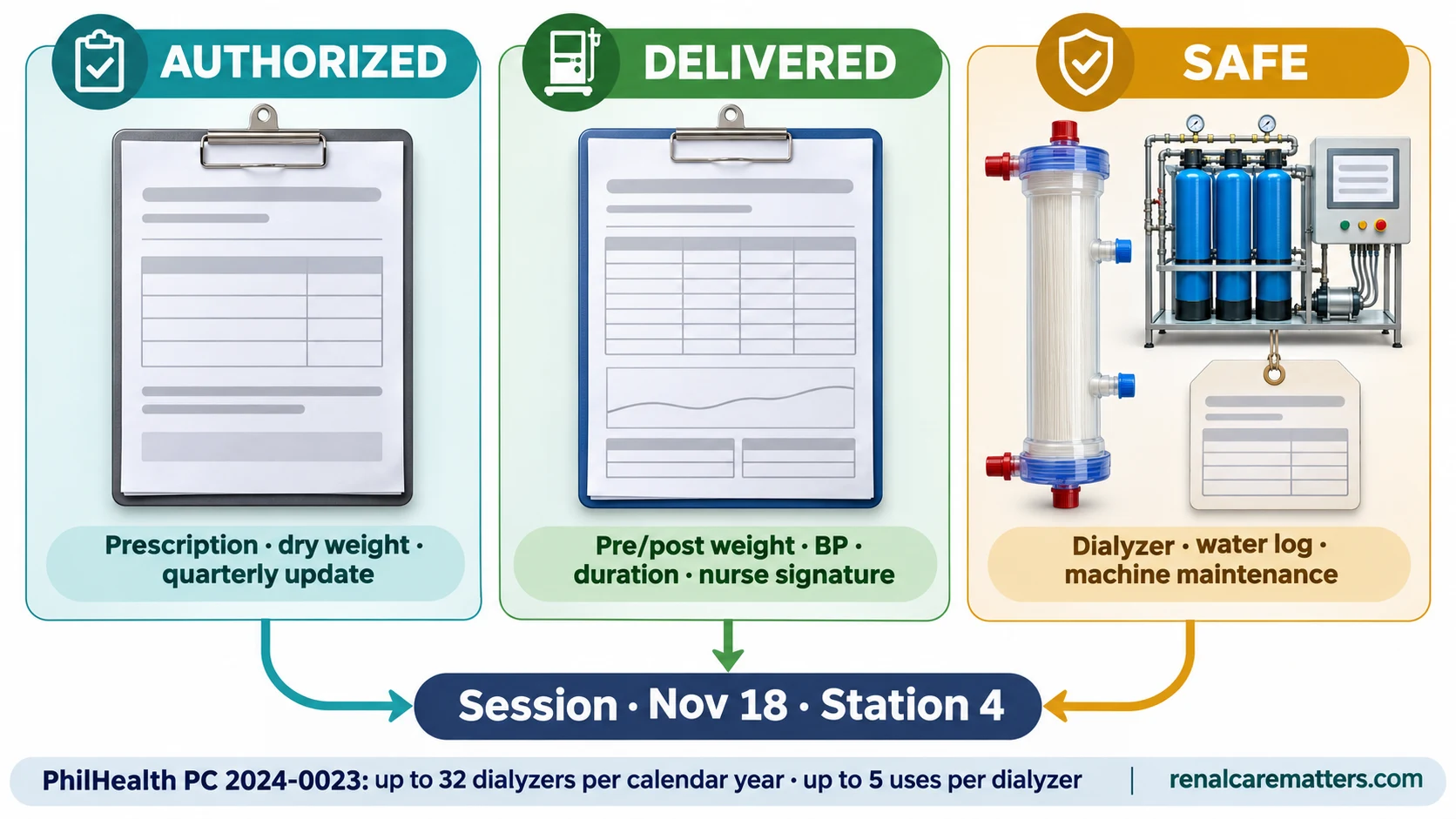
Figure 2. Authorized, delivered, safe. An audit-ready chart proves all three for every session.
Think of the evidence for a session as three layers stacked on one another.
Question
Main evidence
Who writes it
Weak substitutes
Was it authorized?
The signed, current standing order
The physician
A verbal instruction no one countersigned
Was it delivered?
The signed run sheet and nursing notes
The nurse and the dialysis staff
The schedule, an attendance list, a text message
Was it safe?
The dialyzer reprocessing log, the water-quality log, the machine maintenance record
Technicians
“We always do it”
The run sheet is the primary proof that care was delivered. It records the date and shift, the station and machine, the pre- and post-dialysis weights and blood pressures, the duration, events during the session, medicines given, the dialyzer and its reuse number, and the authenticating signatures. A schedule shows only that a session was planned. Patients miss sessions, arrive late, and stop early. Only the run sheet shows what happened.
The third layer lives outside the patient’s folder, which is why it is so often forgotten. Technical staff own the technical logs. The records officer makes sure those logs are complete, dated, signed by the person who did the work, retrievable, and cross-referenced to sessions.
The dialyzer log is an identity record
PhilHealth’s minimum standard allows up to 32 dialyzers per patient per calendar year, each reusable up to five times.2 Every reuse must link to the right patient and show the reprocessing date, the germicide used and its contact time, the residual-germicide test, and a performance test such as fiber bundle volume.
Now picture what happens if the link breaks. A reprocessed dialyzer carries traces of one person’s blood. Used on a different patient, it is a bloodborne-infection event, with hepatitis B, hepatitis C, and human immunodeficiency virus (HIV) among the risks. The reprocessing log is the only record that ties each dialyzer to exactly one person. That is why the records officer treats it as an identity record as much as a technical one.
RememberOrder proves authorized. Run sheet proves delivered. Technical logs prove safe. A chart that holds only the first two cannot prove the third.
On the floor · The dialyzer with two owners
During a weekly check, a technician notices that dialyzer D-117-03 appears in the reprocessing log under two patients with similar surnames, Mr. Dante Cruz and Mr. Danilo Cruz, on consecutive days.
He stops reprocessing it and tells the technical supervisor, who traces both run sheets. One entry was a transcription error: the dialyzer had always been Mr. Dante Cruz’s. The supervisor corrects the log through the technical correction process and asks the nephrologist to review whether any clinical action is needed. The records officer adds both patients’ full middle names to the reprocessing labels.
The reprocessing log is an identity record. A name error there is a safety event, not a typo.
Illustrative scenario. Names and details are invented.
Lesson · part 3
Following one session through every record
The best way to learn the three layers is to trace a single session from start to finish. Pick any session from last week and follow it.
Figure 3 · Tracing one session
ScheduleWas the patient booked for this date and shift?
Standing orderWas a current, signed order in force on that date?
Run sheetIs it signed, complete, and filed to the right patient and session?
Dialyzer logDoes the dialyzer number and reuse count on the run sheet match a reprocessing entry for this patient, dated before the session?
Water logWas water quality tested and recorded for that day, as the technical procedure requires?
Machine recordWas the machine at that station in service and maintained?
ClaimIf the session was claimed, does the claim match the run sheet?
Most traces end cleanly. The ones that do not teach you where your unit’s weak points are. A common pattern is a run sheet that lists a dialyzer number with no matching reprocessing entry, because the technician logged it at the end of a busy shift and forgot. Another is a machine number on the run sheet that does not exist in the maintenance record, because a machine was swapped mid-week and no one updated the station board.
Tracing is not an accusation. You are checking that the records agree, not that anyone did something wrong. When they disagree, the clinical or technical owner explains, and the explanation goes into the record.
On the floor · A trace that found a machine
Tracing one random session from last Wednesday, the records officer finds that the run sheet lists machine M-09 at station 9. The maintenance record shows M-09 was sent out for repair on Monday.
The charge nurse explains: M-12 was moved to station 9 on Monday, but the station board still said M-09. The run sheets for that week are corrected by their authors, the board is fixed, and the technical supervisor adds “update the station board” to the machine-swap checklist.
The trace did not find a wrong treatment. It found a habit that would eventually have hidden one.
Illustrative scenario. Names and details are invented.
Lesson · part 4
Four states, one owner each
When you audit a chart, mark every expected item as one of four states.
State
Meaning
Example
Present
Exists, current, complete, authenticated
A signed standing order within the quarter
Deficient
Exists but is unsigned, illegible, outdated, or incomplete
A run sheet with a blank final weight
Unavailable
Should exist but cannot be found
A reprocessing entry for a reuse logged on the run sheet
Not applicable
Excluded under a written applicability rule
A transplant work-up section for a patient whose physician has documented that work-up is not being pursued
“Not applicable” needs a written rule behind it. Without one, it becomes a convenient label for anything that is hard to find, and the audit stops measuring anything.
Each deficiency gets three things: an owner, a due date, and closure evidence. The owner is the person who can fix it, which is almost never you. The due date depends on risk. The closure evidence is what you will look at to confirm it was fixed: the signed late entry, the found document, the new order.
The deficiencies that cannot wait
Most deficiencies can wait for the weekly round. A few cannot, because they could change what happens to the patient at the next session.
Deficiency
Why it cannot wait
Standing order expired
The nurse has no current prescription to follow
A dose change written on a progress note but no signed order
Two versions of the prescription now exist
A dialyzer that cannot be traced to its patient
It may be used on the wrong person
A new positive hepatitis result not reflected in the station assignment record
Isolation may be wrong today
A document filed to the wrong patient
Someone may act on it
Stop and callAnything that could affect the next treatment goes to the charge nurse and the clinical team before that session, not to the weekly deficiency round. Never fill a clinical field yourself, even when the value seems obvious from another document. When in doubt about clinical risk, ask the attending nephrologist and follow your unit’s protocol.
On the floor · Not applicable, or not found?
An audit sheet comes back from a relief clerk with 14 items marked “N/A” across ten charts, including three advance-directive sections.
The records officer checks the written applicability rule. Advance-directive status is required for every patient: either a directive or a documented statement that none exists. The three charts had neither. She reclassifies them as deficient, assigns them to the attending physician, and adds one line to the audit instructions: “N/A only where the written rule says so.”
“Not applicable” without a rule behind it hides the very gaps an audit is meant to find.
Illustrative scenario. Names and details are invented.
Lesson · part 5
Usual office habits that change here
Many records habits come from hospital wards or general clinics. Some of them do not fit a dialysis unit.
Usual habit
In a dialysis unit
Why
“File the chart when the patient is discharged”
The patient is never discharged; file every session
The chart grows three times a week for years
“The schedule shows who came”
Only the run sheet shows who was treated
Patients skip, arrive late, and stop early
“Technical logs are not medical records”
They are evidence of safe care and must be retrievable
Reprocessing ties a dialyzer to one person
“Audit once a year”
Audit weekly, in small samples
Gaps compound with every session
“Fill obvious blanks to save time”
Never; route to the author
A blank honestly recorded is better than a value invented later
On the floor
Real situations: problems and solutions
These are fictional but typical. For each one, cover the answer, decide what you would do, then compare. Where a step depends on local rules, your unit’s procedure and your supervisor’s direction come first.
The order that expired on Sunday
What you see
On Monday morning you notice that a patient’s standing order was last signed four months ago.
What is likely going on
The quarterly renewal was missed, and the nurse is still following the old order.
What to do
Tell the charge nurse before the patient’s session and ask the attending nephrologist to review and sign a current order. Log the gap.
Why it matters
An expired order is a clinical risk today, not a paperwork gap for Friday.
Six identical blood pressures
What you see
A patient’s run sheets show 140/80 before and after dialysis on six sessions in a row.
What is likely going on
Possibly copied values, possibly a genuinely stable patient.
What to do
List the sessions and route them to the Dialysis Clinical Head for review, without naming anyone as at fault.
Why it matters
Repeated values can hide a real change in the patient.
The schedule says she came
What you see
The claims staging list includes a Wednesday session for a patient, but you cannot find a run sheet.
What is likely going on
Either the sheet is misfiled, or she did not dialyze.
What to do
Hold the claim, search for the sheet, and ask the charge nurse whether the treatment happened. Document the answer.
Why it matters
Only the run sheet proves delivery; the schedule proves only a plan.
The logbook in the back room
What you see
The dialyzer reprocessing logbook has two pages stuck together with dried disinfectant, hiding a week of entries.
What is likely going on
Water or germicide damage in the reprocessing room.
What to do
Tell the technical supervisor today. Ask them to recover what they can, document the damage, and move logs to a protected shelf.
Why it matters
Those pages tie dialyzers to patients. Losing them is losing proof of safety.
“I’ll sign it later”
What you see
A nurse leaves a stack of unsigned run sheets on your desk at the end of her shift.
What is likely going on
End-of-shift fatigue.
What to do
Return them to her, or put them in the unsigned queue with her name and a due time per unit policy. Do not file unsigned sheets as complete.
Why it matters
An unsigned run sheet is not yet evidence of anything.
Field notes
Keep a two-week look-ahead of standing-order and consent renewals and give it to the charge nurse every Monday.
Trace one random session from schedule to claim every week. It takes ten minutes.
Treat the reprocessing log as part of the patient record when you audit.
Mark "not applicable" only when a written rule says so.
Never fill a blank, even when you are sure of the value.
Case review
Back to the case: Reuse five, entry missing
Which items are deficient, and who owns them? Two. The blank final weight belongs to Ms. Pangilinan, who signed the run sheet. She reviews whatever contemporaneous evidence exists, such as the machine display log or her own notes, and makes an attributed late entry if appropriate, with both the service date and the date she wrote it. The missing reprocessing entry for reuse 5 belongs to the reprocessing technician and the technical supervisor. Both go on the deficiency log with today’s date.
Why is the missing entry more than paperwork? Without it, no one can show that the dialyzer used on November 18 was cleaned, tested, and belonged to Mr. Galang. That is a possible identity and infection risk. Tell the technical supervisor today, not on Monday. Do not create the entry yourself, even if the technician says, “I definitely did it.” The technician writes it, as a late entry, if they can support it.
The allowance. 32 minus 26 leaves 6 dialyzers for the rest of the year. Whether D-044-07 can be used again on Monday is a technical and clinical decision, not a records one. Make sure the supervisor and the charge nurse know about the gap before 6 a.m. Monday.
The blank weight is the gap most people would notice first. The missing logbook line in another room is the one that could hurt someone. Part of your role is to look in the other room.
Skills lab · with your preceptor
Skills checklist: Chart and technical-log audit
Audit three fictional charts and trace one session to its technical records while your preceptor observes. Your preceptor rates each step as satisfactory, needs practice, or not observed. Steps marked Critical must all be satisfactory before sign-off. This checklist supports supervised learning; your unit’s own procedure and competency form are the authority. A printable version of every checklist is on the trainer page.
Lists the contents of a longitudinal chart and the renewal interval of standing orders and consents.
Marks each expected item present, deficient, unavailable, or not applicable under a written rule.
CriticalRoutes every clinical deficiency to its author without filling any clinical field.
CriticalEscalates a deficiency that could affect the next treatment before that session.
Traces a session from the run sheet to its dialyzer reprocessing entry, water log, and machine record.
CriticalTreats an untraceable dialyzer as an identity risk and escalates it the same day.
Computes the remaining dialyzer allowance for the year.
Retrieves the current standing order and its superseded version.
Placement activity. Pick one session from last week and trace it from run sheet to dialyzer, water, and machine records. Write down every place the records disagreed.
Self-assessment
Check your understanding
Each visit draws 8 questions at random from this module’s 15-question bank. Choose the single best answer for each, then select Check answers; an explanation appears under the best answer. Select New set of questions for a different mix. A good target is 7 of 8 on two different sets. Nothing you select is sent anywhere; scoring happens in your browser.
Department of Health, Cordillera Administrative Region. (2015). Assessment tool for licensing a dialysis clinic (Revision 03). Retrieved November 23, 2026, from https://caro.doh.gov.ph/wp-content/uploads/2022/08/LICENSING-A-DIALYSIS-CLINIC-8-31-2022.pdf
Educational material for records staff. Completing it is an Academy learning record only. It does not confer DOH-recognized training credit, a facility designation, or system access, and it does not replace current regulations, your facility’s records manual, or advice from your data protection officer or counsel.