The four rulebooks that govern a dialysis record, reading a rule for issuer, scope, and date, the role file, and who decides what.
PublishedNailathalaGipatikPepalwal:ReferencesMga SanggunianMga TinubdanReng Reperensya:8Audience: Designated medical records officers, custodians, and deputies in standalone and hospital-based hemodialysis units · hospital health information management staff assigned to dialysis · unit managers who supervise recordsRead timeOras ng pagbasaOras sa pagbasaOras ning pamamasa:
Training track for the records officers of hemodialysis units
This module is study material for the records officers of hemodialysis units. It explains the reasoning behind common records decisions; it is not a records manual and not legal advice. Regulations change: confirm every rule against the current text and your facility’s approved policy before you rely on it. Clinical content belongs to its clinical author; questions about a patient’s care go to the attending nephrologist. Every case, name, and identifier is fictional.
Learning objectives
After this module you should be able to
Tell a licensing rule from a payer rule, a professional guideline, and a privacy law.
Read any rule for its issuer, scope, and effective date before acting on it.
Explain the line between keeping a record and authoring what is in it.
Assemble the role file an inspector expects: designation, contract, training, manual, and deputy.
Route coding, claims, privacy, and destruction decisions to their owners, each with a named alternate.
Pre-testBefore you read, answer the 8 self-assessment questions and note your score. After the module, select New set of questions and compare. The difference is what you learned; the questions you still miss are what to reread.
Start here
The big picture, in plain words
In plain wordsPicture a basketball game with four referees, each carrying a different rulebook. One decides whether your team may play at all. One decides whether your team gets paid. One judges whether you played well. One watches whether anyone was hurt. Each referee rewrites the rulebook on their own schedule and does not tell the others. A dialysis unit plays in front of all four, every day, and its records are the scoreboard all four read.
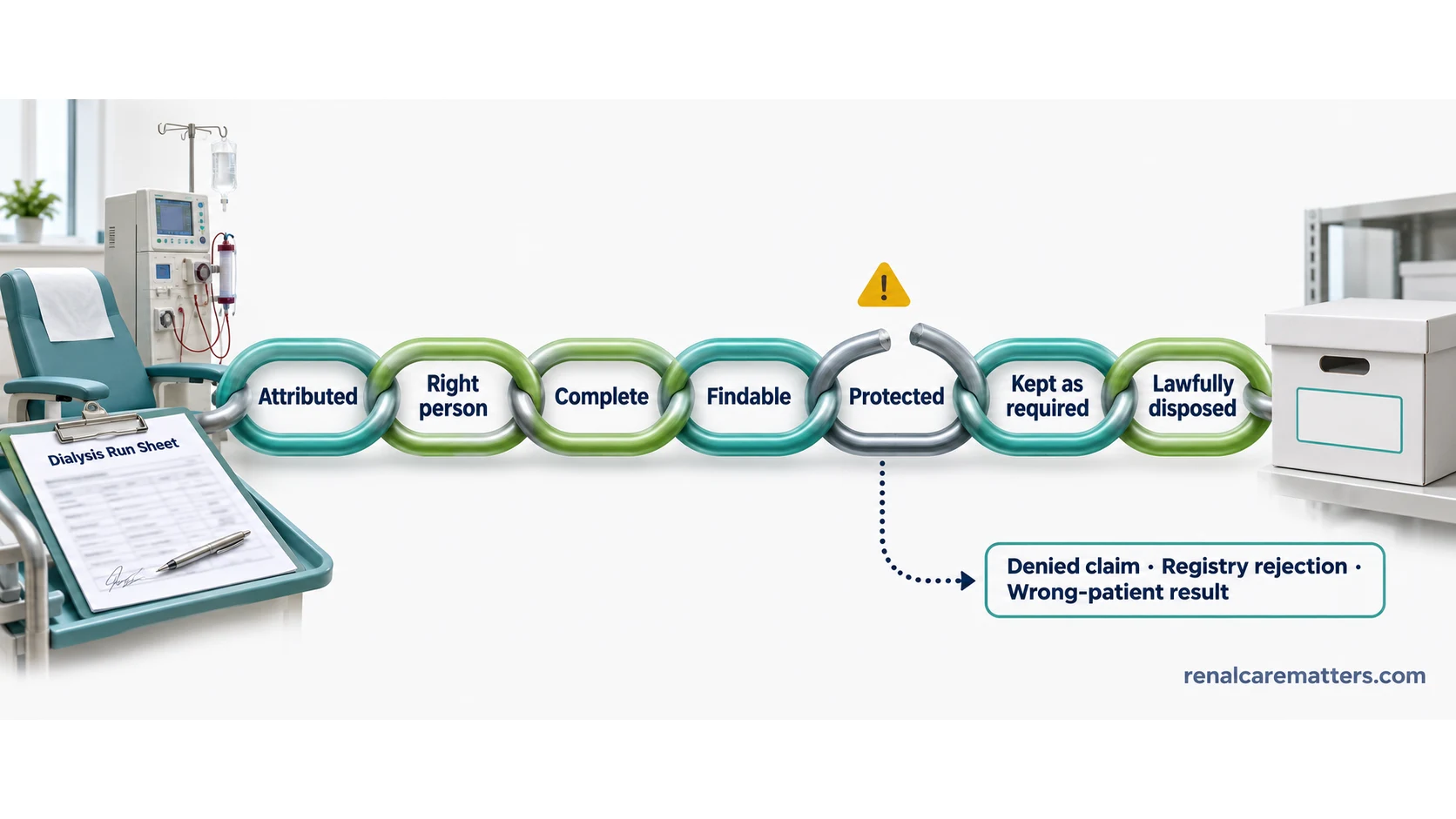
Figure 1. The chain of custody for clinical truth. Each module of this track is one link.
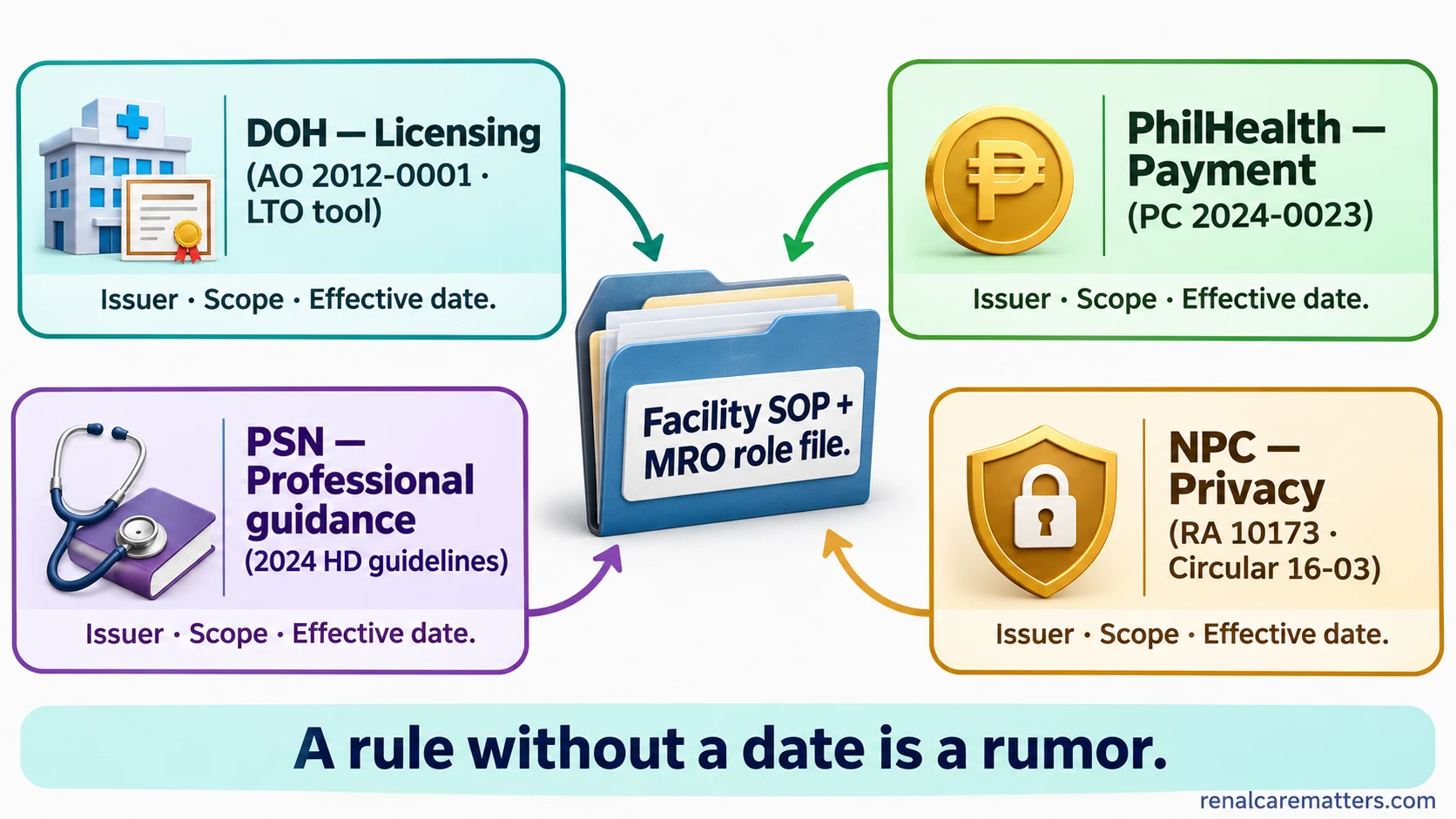
The picture is useful, and it has one limit. In a real game the referees agree on what a foul is. These four do not. The Department of Health (DOH) asks whether the unit may operate. The Philippine Health Insurance Corporation (PhilHealth) asks whether a session should be paid. The Philippine Society of Nephrology (PSN) describes what good practice looks like. The National Privacy Commission (NPC) asks whether personal information was handled lawfully. The same chart page can satisfy one and fail another.
This module builds one habit that the rest of the course depends on. Before you act on any instruction, find out who issued it, whom it covers, and when it took effect. Most records mistakes in dialysis units are not careless. They come from careful people following the wrong version of the right rule.
Figure 2 · Key terms for this module
Medical records officer (MRO)The person designated in writing to keep the unit’s records and run its records workflows.
DesignationThe written act that names a person to a role. Being told verbally is not a designation.
IssuanceA formally numbered order, circular, or advisory from a government agency, such as a DOH administrative order or a PhilHealth circular.
Standard operating procedure (SOP)The facility’s own written steps that turn the rules into local work, with forms, owners, and logs.
Personal information controller (PIC)The organization that decides how personal data are used. It owns breach-notification decisions.
Data protection officer (DPO)The person the controller designates to oversee privacy compliance and advise on incidents.
Opening case · fictional
Case: The binder before the inspection
You started on Monday as the medical records officer of a 22-station freestanding hemodialysis (HD) unit in Bulacan. On Wednesday, Ms. Teresita Aquino, the unit manager, places a thin blue binder on your desk. The label says “MRO.” Inside are a two-year-old memo naming your predecessor, Mr. Ramil Dizon, and a printout of a PhilHealth circular from 2022 with coffee rings on it. The DOH licensing visit is in three weeks.
“Are we covered?” she asks.
That evening, a friend who keeps records at a 16-station unit in Valenzuela messages you: “Relax. We never designated anyone. The rule only applies above 20 stations.”
Before reading on, decide:
What belongs in your role file, and what is missing from this one?
Is your friend right about the 20-station threshold?
Who signs off on a coding query, a claim, a privacy incident, and a destruction request in your unit, and who covers for each when they are away?
Keep your answers in mind. The lesson gives you what you need, and the case review near the end shows one sound response.
Lesson · part 1
Custody, not content
Start with the line that every other module depends on. The medical records officer (MRO) keeps the record. The MRO does not author what is in it.
Keeping the record is a large job. You capture and file documents, index them to the right patient and session, retrieve them when asked, track what is missing, validate coded fields within the authority delegated to you, coordinate registry returns, release copies through the approved process, and keep the evidence an inspector will ask to see. You also notice when something looks wrong and send it to the person who can fix it.
Authoring is different. A nurse who wrote a pre-dialysis weight is the author of that weight. A physician who wrote “chronic kidney disease stage 5” is the author of that diagnosis. Only they, through the clinical correction workflow, may change it, even when the right value seems obvious from another page. The facility head authorizes what leaves the building: claims, releases, system access, and destruction.
You own
You route to someone else
Filing a run sheet to the right patient and session
What the run sheet says
Noticing that the final weight box is blank
Filling in the final weight
Checking that a code matches the signed diagnosis
Choosing a diagnosis the physician did not write
Preparing a draft certificate with its sources
Signing the certificate
Logging a possible privacy breach within the hour
Deciding whether the NPC must be notified
Listing charts that are eligible for disposal
Approving their destruction
The PSN hemodialysis guidelines describe the records officer’s duties as coding, custody, registry coordination, completeness for the DOH, and carrying out the records manual. They recommend training in the International Classification of Diseases, 10th Revision (ICD-10), basic records management, and hospital health information management (HIM).1 That is strong professional guidance. It is not law, and the next section explains why that difference matters.
RememberYou keep the record. You never author the clinical facts inside it. When you catch yourself about to “just fix” a clinical value, stop and route it.
On the floor · The obvious weight
Ms. Cristina Lim, two months into the job, notices that Tuesday’s run sheet for Mr. Herminio Valdez has no post-dialysis weight. The machine log on the same clipboard shows 58.9 kg. It would take her five seconds to write it in.
She does not. She clips a note to the sheet for the nurse who ran the session, Mr. Jerome Tan, and enters it in the deficiency log. Mr. Tan checks his own notes, finds he weighed the patient after the machine log was printed, and writes 58.6 kg as a dated late entry.
The obvious value was wrong by 300 grams. Only the author knew the right one.
Illustrative scenario. Names and details are invented.
Lesson · part 2
Read every rule for issuer, scope, and date
Figure 3. Four rulebooks, one record. Read every rule for its issuer, scope, and effective date before acting on it.
Each referee speaks through its own kind of document. Learn to recognize them on sight.
Referee
What it decides
How it speaks
Example
DOH (licensing)
Whether the unit may operate
Administrative orders, department circulars, the License to Operate (LTO) assessment tool
Administrative Order 2012-0001 and the hemodialysis clinic assessment tool2,3
PhilHealth (payment)
Whether, and how much, a session is paid
Circulars, advisories, and their annexes
Circular 2024-0023 on the 156-session hemodialysis package4
PSN (professional)
What good practice looks like
Clinical practice guidelines and position statements
The Data Privacy Act, its implementing rules, circulars, and advisory opinions
Republic Act 10173 and NPC Circular 16-03 on breach management5,6
A DOH requirement can cost the unit its license. A PhilHealth requirement can cost it a payment. A PSN recommendation shapes what an inspector or a court will consider reasonable, but it does not by itself close a unit. An NPC requirement can bring a complaint, an order, or a fine. Knowing which referee wrote a rule tells you how much is at stake and whom to ask when it is unclear.
Three questions before you act
Read every instruction for three things.
Issuer. Who wrote it? A memo from the head office, a PhilHealth advisory, and a post in a records officers’ group chat are not equal.
Scope. Whom does it cover? Some rules apply to hospital-based units, some to freestanding units, some only to public entities, and some to everyone.
Effective date. Which version governs the date in question? This is the one most often missed.
Here is why the date matters. PhilHealth changed the hemodialysis rate twice in 2024. A session on September 30, 2024 and a session on October 9, 2024 fall under different rates, even if both claims are filed on the same afternoon.7 The governing version is the one in force on the service date, not the filing date. A records officer who keeps only the newest circular cannot answer a question about last year’s claim.
When the rules disagree
The facility’s standard operating procedure (SOP) translates the four rulebooks into local steps. SOPs age. When an SOP and a newer issuance disagree, the issuance wins. Do not quietly follow either one. Log the gap, tell your supervisor, and raise it for revision, so that everyone in the unit follows the same version.
Keep a source register: one row per rule, with its issuer, number, title, scope, effective date, the SOP that carries it out, its owner, and the date you will next check whether it has changed. It is a plain table, and it is the single most useful document you will build this year.
RememberBefore you act on any rule, say its issuer, scope, and effective date out loud. If you cannot, you are not ready to act on it.
On the floor · Two rates, one afternoon
In March 2025 a PhilHealth reviewer returns two claims from the same patient. One session was on September 30, 2024; the other on October 9, 2024. The clerk had billed both at the new rate because both were filed in October.
The records officer opens the source register, finds the rate change recorded with its effective date of October 9, 2024, and shows the clerk that the September session falls under the earlier rate. The corrected claim goes back the same week.
The service date decides which rule applies. A register with effective dates turns a dispute into a lookup.
Illustrative scenario. Names and details are invented.
Lesson · part 3
What an inspector expects to see
The DOH assessment tool for hemodialysis clinics, as posted, lists three items about the records officer: a designated MRO, a notarized employment contract that reflects MRO duties, and a medical-records-management training certificate for facilities with more than 20 stations.3
Read that last line slowly, because it is often misread. The 20-station threshold attaches to the training certificate. It does not attach to the designation. A 16-station unit still needs a designated records officer. It may not need the specific certificate. Assessment tools are revised, and regional offices differ on which training providers they accept, so confirm the current tool and the accepted providers with your Center for Health Development licensing office, and write down who told you and when.
Figure 4 · A complete role file
Designation memoSigned by the facility head, current, naming you and your deputy.
ContractNotarized, with your records duties written into it.
Training evidenceThe records-management certificate where required, plus ICD-10 and health information management training as PSN recommends.
Records manualApproved, signed, with its revision date.
Source registerEach rule with issuer, scope, effective date, owner, and next review.
Decision mapWho decides coding, claims, privacy, and destruction, each with an alternate.
Why a deputy? Because records work does not stop when you are on leave, sick, or at a seminar. If no one else is authorized to release a transfer packet, a patient may arrive at the receiving unit without orders. The deputy needs the same training, the same access, and a copy of the same decision map.
A role file is not a one-time project. Check it at least yearly and whenever you, your deputy, the facility head, or a governing issuance changes. An inspector who finds a memo naming someone who left two years ago will reasonably ask what else has not been updated.
On the floor · The 16-station unit
A 16-station unit in Pampanga prepares for its licensing visit. The owner has read online that records requirements “start at 20 stations” and has never designated anyone.
The new administrator reads the assessment tool line by line, sees that the 20-station threshold sits on the training certificate, and asks the facility head to sign a designation naming the senior clerk and a deputy the following Monday. She calls the regional office to ask whether the certificate applies to them, and files the answer with the name of the person she spoke to.
A threshold attached to one item is easy to stretch over the whole list. Read which line it belongs to.
Illustrative scenario. Names and details are invented.
Lesson · part 4
Log, preserve, and route
Every records decision belongs to someone. Your job is to know who, and to route the question to them quickly, with the facts, without deciding it yourself.
Decision
Owner
What you do
A clinical fact, diagnosis, or correction
The treating clinician; escalate to the Dialysis Clinical Head
Log the question, route it, check that it was answered
Indexing and deficiency tracking
You
Do it, and keep the trail
Code selection
The authorized coder or claims lead, with the physician answering diagnostic questions
Validate against the signed note; send queries
Claims submission
Authorized claims staff and the facility signatory
Make the packet complete and traceable
Whether a breach is notified to the NPC
The personal information controller (PIC), advised by the data protection officer (DPO)6
Report within the hour and preserve the evidence
Destruction of records
The facility head and counsel; for public entities, the National Archives process8
Prepare the list and the disposition record
Each row needs a named person and a named alternate. “The doctor” is not a name. “Dr. Mendoza, or Dr. Bautista when she is away” is.
How fast to escalate
Not every gap is urgent, but some are urgent in a way that a records office does not usually see. Sort every problem you find by what it could affect.
If the problem could affect…
Escalate to
How soon
The next treatment (an expired order, a document filed to the wrong patient, a dialyzer that cannot be traced)
The charge nurse and the clinical team
Before that session starts
A person’s privacy (a misdirected email, a lost logbook, odd access in the audit trail)
The DPO
Within the hour of discovery
A payment (a missing form, a duplicate claim)
The claims lead
Before the batch is sent
Everything else
The owner, through the deficiency log
By the due date you set
Stop and callWhen a records problem could affect the next treatment, escalate to the clinical team before that session. When it could affect a person’s privacy, escalate to the DPO within the hour of discovery. Local protocol sets the exact times, but when you are unsure, ask the attending nephrologist about clinical risk and the DPO about privacy. Asking early is never the mistake.
On the floor · Friday at 4:45 p.m.
At 4:45 p.m. on a Friday, the records officer finds three problems in one stack: a laboratory page in the wrong chart for a patient who dialyzes Saturday at 6 a.m., a claim missing its Annex A, and an email to the wrong address from Thursday.
She sorts them by what they could affect. The misfiled page goes to the charge nurse before she leaves, because Saturday’s session is first. The email goes to the data protection officer the same hour. The claim waits for Monday, logged with an owner.
Three problems, three clocks. The order comes from what each one could harm, not from which one is easiest.
Illustrative scenario. Names and details are invented.
Lesson · part 5
A first-week plan
A new records officer usually inherits a mix of good systems and loose ends. Use the first week to find out which is which before you change anything.
Day
What to do
What you will learn
1
Read the records manual and the role file. Note every date.
How old the paperwork is
2
Walk one patient’s session from schedule to run sheet to claim to registry.
Where documents actually travel
3
Start the source register with the four referees’ current issuances.
Which rules the unit is really following
4
Meet the charge nurse, claims lead, DPO, and IT contact. Agree how each wants to be reached.
Who to call, and how fast they answer
5
Draft the decision map and give it to the unit manager for sign-off.
Where ownership is unclear
Do not reorganize the records room in week one. A records officer who moves everything before learning where staff expect to find it can cause a missed order on the first busy Monday.
On the floor
Real situations: problems and solutions
These are fictional but typical. For each one, cover the answer, decide what you would do, then compare. Where a step depends on local rules, your unit’s procedure and your supervisor’s direction come first.
The memo from head office
What you see
An unsigned memo from the company’s head office says all units must now keep run sheets for 15 years.
What is likely going on
A well-meant instruction with no stated issuer, scope, or effective date.
What to do
Ask head office who issued it, which units it covers, and from when. Once confirmed in writing, add it to the source register as a company policy, longer than the DOH default, and update the SOP.
Why it matters
A company can set a longer period than the law, but no one can follow a rule they cannot trace.
“PhilHealth said so”
What you see
A claims clerk says PhilHealth now requires a new form, because a records officer at another unit posted it in a group chat.
What is likely going on
Possibly true, possibly an old or local rule passed along without its number.
What to do
Ask for the advisory or circular number. Check it on PhilHealth’s site or through your claims lead before anyone changes a form.
Why it matters
Group chats spread rules faster than they spread effective dates.
The deputy who was never trained
What you see
You go on leave for a week. On day two, a transfer packet is needed and your named deputy has never released one.
What is likely going on
A deputy on paper only.
What to do
After you return, schedule two supervised releases with the deputy and give them the same access, logs, and decision map you use.
Why it matters
A deputy who cannot act is a gap with a name on it.
Two answers from two regional offices
What you see
A colleague says her regional licensing office accepts any records seminar certificate; yours says only certain providers count.
Follow your own regional office’s answer, in writing, with the name of the person and the date, and file it in the role file.
Why it matters
An inspector will ask what your office told you, not what another office told someone else.
“Just sign as the doctor’s secretary”
What you see
A busy physician asks you to sign his name on a batch of routine request forms while he is in the ward.
What is likely going on
A shortcut that turns custody into authorship.
What to do
Decline politely, prepare the forms for his signature, and offer to bring them to him.
Why it matters
Your role is to keep the record, never to write in someone else’s name.
Field notes
Write the effective date next to every rule you print. A rule without a date is a rumor.
Keep the decision map on one page, taped inside the records room door.
When a new circular arrives, update the source register the same day, even if the SOP waits.
Ask "who issued this?" politely and often. It saves more trouble than any other question.
Introduce yourself to the DPO and the claims lead in your first week, before you need them.
Case review
Back to the case: The binder before the inspection
What belongs in the role file? A current designation memo naming you and a deputy, signed by the facility head. Your notarized contract with records duties written in. The records-management training certificate, which your unit needs because it has more than 20 stations, plus ICD-10 and health information management training evidence. The approved records manual with its revision date. A current source register and a signed decision map. Mr. Dizon’s memo stays in the file as history; it no longer designates anyone. The 2022 circular is replaced by the current one, recorded with its effective date.
Is your friend right? No. The 20-station threshold applies to the training certificate, not to the designation. Her unit still needs a designated records officer. Tell her kindly, and suggest she confirm the current assessment tool with her regional licensing office.
Who signs off? A coding query goes to the authorized coder or claims lead, with the physician answering the diagnostic question. A claim goes to the claims staff and the facility signatory. A privacy incident goes to the DPO within the hour, and the controller decides on notification. A destruction request goes to the facility head and counsel. Each of the four needs a named alternate, written into the decision map.
And Ms. Aquino’s question? “Not yet, but we will be in a week.” Give her the list of what is missing, who owns each item, and the date each will be done.
The licensing visit is three weeks away, but the habit you build this week matters for longer. A records officer who can name the issuer, scope, and date of every rule they follow is the person the whole unit learns to trust.
Skills lab · with your preceptor
Skills checklist: Role file and decision map
Assemble a role file and source register for a fictional unit while your preceptor observes. Your preceptor rates each step as satisfactory, needs practice, or not observed. Steps marked Critical must all be satisfactory before sign-off. This checklist supports supervised learning; your unit’s own procedure and competency form are the authority. A printable version of every checklist is on the trainer page.
CriticalStates the issuer, scope, and effective date for each rule in the register.
Explains which rules come from licensing, payment, professional guidance, and privacy law.
CriticalDistinguishes the designation requirement from the training-certificate threshold.
Produces a complete role file: designation, contract, training, manual, and deputy.
CriticalNames an owner and an alternate for coding, claims, privacy, and destruction decisions.
CriticalSorts three sample problems by urgency: next treatment, privacy, payment, or routine.
Flags an SOP that conflicts with a newer issuance and routes it for revision.
Placement activity. Find your own unit’s role file and source register. List every rule that has no recorded effective date, and every decision that has no named alternate.
Self-assessment
Check your understanding
Each visit draws 8 questions at random from this module’s 15-question bank. Choose the single best answer for each, then select Check answers; an explanation appears under the best answer. Select New set of questions for a different mix. A good target is 7 of 8 on two different sets. Nothing you select is sent anywhere; scoring happens in your browser.
Department of Health, Cordillera Administrative Region. (2015). Assessment tool for licensing a dialysis clinic (Revision 03). Retrieved November 23, 2026, from https://caro.doh.gov.ph/wp-content/uploads/2022/08/LICENSING-A-DIALYSIS-CLINIC-8-31-2022.pdf
Philippine Health Insurance Corporation. (2024). PhilHealth Circular No. 2024-0023: Institutionalization of 156 hemodialysis sessions and coverage expansion (Revision 2).
Republic Act No. 10173: Data Privacy Act of 2012. (2012). Congress of the Philippines.
National Privacy Commission. (2016). NPC Circular No. 16-03: Personal data breach management. https://privacy.gov.ph/?p=553
Philippine Health Insurance Corporation. (2025, March 27). PhilHealth’s expanded benefits bring financial relief to dialysis patients [News release]. https://www.philhealth.gov.ph/news/up/article/2025/news_67e9e793775ed.php
Republic Act No. 9470: National Archives of the Philippines Act of 2007. (2007). Congress of the Philippines. https://elibrary.judiciary.gov.ph/thebookshelf/showdocs/2/19575
Educational material for records staff. Completing it is an Academy learning record only. It does not confer DOH-recognized training credit, a facility designation, or system access, and it does not replace current regulations, your facility’s records manual, or advice from your data protection officer or counsel.