After this module you should be able to
- State the current Philippine Health Insurance Corporation (PhilHealth) hemodialysis package and what it includes.
- Describe the conditions that must all hold before a session is paid.
- Explain why covered sessions carry no co-payment, when an additional service may, and present it in writing before the first session.
- Plan with patients for the yearly session limit.
The big picture, in plain words
The picture has a limit. A student who misses class loses a lesson. A dialysis patient who misses a session risks a hospital admission. That is why the unit must treat every scheduled session as care first and revenue second, and why charges to patients must be clear before the first session, not after.
Figure 1 · Key terms for this module
Your work is to steward a public benefit honestly: claim what was delivered, charge only what is allowed and disclosed, and help patients plan for the limit.
Case: Why are we still paying?
Mr. and Mrs. Felipe Navarro, both in their sixties, come to the front desk of a unit in Marikina. Mr. Navarro has dialyzed three times a week since January. They read in the news that PhilHealth now pays “almost a million pesos a year,” yet the unit charges them 650 pesos per session. Their daughter asks whether the unit is allowed to do that.
Before reading on, decide:
- What does the package include?
- What should the family have been told before the first session?
- What happens late in the year?
Keep your answers in mind. The lesson gives you what you need, and the case review near the end shows one sound response.
The hemodialysis package

Under PhilHealth Circular No. 2024-0023, the hemodialysis (HD) package is 6,350 pesos per session for members and qualified dependents with chronic kidney disease stage 5, for up to 156 sessions a calendar year.1,2 The package includes both the facility fee and the professional fee; the agreement form the patient signs says so.3 At 156 sessions, PhilHealth pays up to 990,600 pesos a year per patient. That ceiling is arithmetic, not guaranteed revenue and not profit.
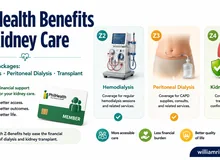
PhilHealth covers peritoneal dialysis (PD) and transplant through separate packages. Some public pages still carry older wording, including an earlier limit of 90 sessions. Where pages disagree, the circular prevails. Check for amendments before you set prices each year.
When a session is paid
A session is paid only when every link holds: the patient is an eligible member or dependent registered in the PhilHealth Dialysis Database (PDD); the facility is accredited; the session was delivered and documented; the agreement form was signed; and the claim was filed on time.4,5 Break any link and the claim fails. Module 15 follows the chain to the bank.
Register new patients in the PDD early, ideally before the first session, and check eligibility monthly. A patient who loses eligibility should hear it from the unit, early, with help from a social worker, not discover it at the counter.
What a patient may be charged

The package is meant to cover the minimum standard of hemodialysis care with no co-payment. When PhilHealth announced the 6,350-peso rate, it said the increase was approved so that patients would pay nothing extra for that minimum set of services, which the circular lists: the session itself, the dialyzer, solutions and supplies, anticoagulation, anemia medicines, and specified laboratory tests.6,1 A covered session therefore carries no charge to the patient above the package.
Co-payment is allowed only for additional or premium services beyond that minimum standard, and the facility must fully explain any such co-payment to the patient. Where a patient needs an additional professional service, such as a teleconsultation or an immediate intervention for a complication during the session, the professional fee co-payment is capped at 450 pesos and recorded on the agreement form.6,1 Neither is an automatic per-session surcharge.
The fair practice is simple: give every patient a written estimate before the first session, showing that covered sessions cost them nothing extra, which additional or premium services could carry a co-payment and why, and what happens beyond the yearly limit. Use the patient-share calculator to show the yearly total. If a family cannot read the estimate, explain it in their language and give them a copy.
Planning for the limit
A patient on three sessions a week needs about 156 sessions in a 52-week year, so the limit fits a normal schedule closely. Extra sessions for fluid overload or a 53rd week can push a patient past it. Track each patient’s sessions used and tell the patient and family early if the count will run out before December 31, with a social worker’s help to find other support.
Dialysis continues regardless. A patient who reaches the limit still needs every session, and the clinical decision about how often to dialyze is never changed to fit the package.
Back to the case: Why are we still paying?
What the package includes. 6,350 pesos per session, with both the facility and professional fees, up to 156 sessions a year.
The 650 pesos. A flat charge on every covered session is not allowed: the package covers the minimum standard of care with no co-payment. Stop it today. Review each session with the billing officer and the clinical head; refund every amount that was charged for covered services. A co-payment is possible only for an additional or premium service the patient actually received and was told about in advance, and an additional professional fee may not exceed 450 pesos.
Before the first session. A written estimate showing all of this, explained in the family’s language.
Skills checklist: Payer participation checklist and patient charge matrix
Build a charge matrix for your unit and test it with a mock family conversation. Your preceptor rates each step as satisfactory, needs practice, or not observed. Steps marked Critical must all be satisfactory before sign-off. This checklist supports supervised learning; your unit’s own procedure and competency form are the authority. A printable version of every checklist is on the trainer page.
- States the package rate, inclusions, and session limit from the current circular.
- Lists each link that must hold before a session is paid.
- CriticalRemoves any automatic surcharge and any charge for covered services.
- CriticalGives a written estimate before the first session.
- Tracks sessions used per patient and warns early about the limit.
- CriticalConfirms that dialysis frequency is never changed to fit the package.
Check your understanding
Each visit draws 5 questions at random from this module’s 6-question bank. Choose the single best answer for each, then select Check answers; an explanation appears under the best answer. Select New set of questions for a different mix. A good target is 4 of 5 on two different sets. Nothing you select is sent anywhere; scoring happens in your browser.
Read next on this site
- "Zero Balance" Doesn't Mean Zero WorriesWhat zero balance billing means for patients.
- PhilHealth Benefits: HD, PD & Kidney TransplantPhilHealth packages for kidney transplant and peritoneal dialysis.