After this module you should be able to
- Explain why patients on hemodialysis are at high risk of sudden cardiac arrest, especially around sessions.
- Recognize warning signs of deterioration and activate the emergency response without waiting for a numeric threshold.
- Describe your role in the team: call, bring equipment, clear space, relay facts, follow the leader’s instructions.
- State what the evidence shows about staff-initiated cardiopulmonary resuscitation (CPR) in dialysis clinics.
- Explain why basic life support (BLS) competence comes only from a practical course and drills, and report events factually afterward.
Pull the fire alarm on smoke
Nobody waits to see flames before pulling a fire alarm. Smoke is enough. The alarm costs little if it is a false alarm and saves everything if it is not. Deterioration in a patient works the same way. A change in breathing, color, speech or behavior is smoke.
The picture has a limit. A smoke detector reacts the same way every time. A patient’s warning signs vary, and some patients, especially older people and people with diabetes, have heart attacks without chest pain. That is why the rule is not a list of numbers. It is: if the patient looks or acts differently, or you are worried, call.
Why dialysis patients collapse
Kidney failure strains the heart in several ways at once. Fluid builds up and stretches it. Potassium rises between sessions, and a high potassium can disturb the heart’s rhythm suddenly, sometimes with no warning at all. Many patients also have coronary artery disease, a thick heart muscle and diabetes. During dialysis, fluid and potassium shift quickly, and blood pressure can fall.
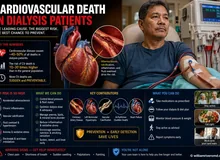
The timing shows this. In 32,065 patients, deaths from cardiac arrest were higher on the day after the long weekend gap (1.3 versus 1.0 per 100 person-years).1 The 2025 American Heart Association (AHA) resuscitation guidelines include a special section on hyperkalemia, because high potassium changes how a cardiac arrest is treated.2 For you, this means two things: take every complaint seriously, and know where the emergency equipment is before you need it.
| What you notice | What may be happening |
|---|---|
| Chest pain or pressure, pain in the jaw or arm, sweating | Heart attack |
| Severe breathlessness, cannot speak in sentences, gray or blue lips | Fluid in the lungs, heart failure, low oxygen |
| Palpitations, fainting, a very slow or very fast pulse | Rhythm problem, sometimes from high potassium |
| Sudden confusion, slurred speech, weakness of one side | Stroke, low blood sugar, very low blood pressure |
| Seizure, unresponsiveness | An emergency in itself |
| Fever with rigors, or “looks different” to you | Infection or another serious change |

Warning signs such as chest pain, breathlessness, confusion or fainting mean call now; an unresponsive patient who is not breathing normally means the emergency call, the AED and your BLS role.
- AED
- Automated external defibrillator
- BLS
- Basic life support
Activating help
Activate the unit’s emergency call and say the location and the concern: “Emergency, Station 6, patient unresponsive.” If your registered nurse (RN) does not respond, use the backup route at once. Stay with the patient if it is safe, and send someone else for equipment rather than leaving the patient alone to search for it.

In an emergency the assistant calls, brings equipment, clears space, relays facts, repeats instructions and records times, and never touches medicines or the circuit.
What staff-started CPR achieves in dialysis clinics
Cardiac arrest in a dialysis clinic happens in front of trained staff, with an AED nearby. That should mean fast help. A registry study of 398 cardiac arrests in outpatient dialysis clinics in the southeastern United States found that dialysis staff started CPR before emergency medical services (EMS) arrived in 81.4% of events, and applied a defibrillator in 52.3%. Staff-initiated CPR was associated with about three times the odds of surviving to hospital discharge with good neurological function.3 The study was observational: patients who received CPR may have differed in other ways. Still, the message for a unit is clear. One in five arrests did not get staff CPR, and those patients did worse.
The 2025 AHA adult BLS guideline keeps the core: recognize the arrest quickly, activate the emergency response, start high-quality chest compressions, and use an AED as soon as it is available.4 The Department of Health (DOH) requires current BLS for dialysis nurses; this course proposes current practical BLS for assistants before any patient contact.5

In 398 dialysis clinic arrests, staff began CPR in 81.4%, and staff CPR was associated with about three times the odds of surviving with good brain function; BLS must be learned hands-on.
- CPR
- Cardiopulmonary resuscitation
- EMS
- Emergency medical services
After the event
When the patient is handed over, write a factual account: times, what you saw, what you did, who was there. Do not guess or fill gaps from memory of what usually happens. Take part in the debrief. A good debrief asks what went well, what was hard and what to change; it is not a search for someone to blame. It is also normal to feel shaken afterward. Tell your RN or head nurse if you need support.
Case: Collapse during observations
Monday, 7:05 a.m. Bea is taking the delegated observations at Station 6. Mr. Felipe Ocampo, 59, diabetic, in his first hour, has just told her he feels “weak, like my chest is heavy.” As she reaches for the cuff, his head falls forward and he does not answer when she calls his name. His chest is not moving normally. Nurse Jessa is at the far end of Bay A, behind a curtain. Kuya Paolo is at Station 9.
Before reading on, decide what you would notice, whom you would tell and what you would say, what you would do within your role, and what would make you call for help at once. Then compare with the debrief below.
Notice
Communicate
Do
Escalate
The RN arrived within seconds and led the team; Paolo brought the AED and the cart. The code team managed the circuit. Mr. Ocampo had a shockable rhythm, received a shock, and regained a pulse before EMS took him to the emergency department. At the debrief, the team noted that his complaint of a heavy chest had come two minutes earlier. The unit added “chest heaviness or new weakness: call the RN before continuing” to the observation card.
Submit: What you say to her, and what you do.
Check your understanding
Each visit draws 5 questions at random from this module’s 10-question bank, in a shuffled order with shuffled options. Choose the single best answer for each, then select Check answers; a reason appears under every option. The target is 4 of 5 with every question marked safety-critical answered correctly (3 of the 10 are). Select New set of questions for a different mix. Nothing you select is sent anywhere; scoring happens in your browser and records self-study only. It never shows that you are competent at work.
What this module builds
| Code | The learner can | Course evidence |
|---|---|---|
| P8 | Recognize deterioration, activate the emergency response, and perform the role learned in a practical BLS course. | Emergency activation drill; BLS card |
Performance evidence for this module: Emergency activation drill with location and concern; correct team role; current practical BLS card (separate course); factual post-event record.
With your preceptor
Drills and simulation only; real emergencies are never used as practice. These are prompts for supervised learning, not a procedure. Use your center’s own procedures, device instructions, contacts and forms; your preceptor observes and signs off each item on the facility’s competency record. Proposed evidence: at least three satisfactory observations across two shifts for each workplace skill that applies to you.
- Locate the AED, emergency cart, oxygen and emergency call in your unit, and time the walk to the farthest station.
- Activate the emergency call in a drill, stating location and concern.
- Perform your assigned team role (bring, clear, relay, record) in a simulated arrest.
- Show your current practical BLS certificate from a recognized provider.
- Write a factual post-event record from a simulated scenario.
Read next on this site
Cross-track and patient-guide reading is background, not practical training for the assistant role.
- Cardiac Arrest Response in a Dialysis UnitHow the unit team runs a code.
- Cardiovascular Disease & Sudden Death in DialysisWhy heart problems are common in dialysis.
- Potassium and HyperkalemiaHigh potassium and its danger to the heart.
Back to the Nurse Assistant / Patient Care Assistant (PCA) course home · the Nephrology Nursing course, where nurses learn the clinical reasoning behind the care you support.