After this module you should be able to
- Explain in plain words what the kidneys do and what hemodialysis replaces and does not replace.
- Describe why fluid and potassium build up between sessions, and why the long weekend gap carries extra risk.
- State what the evidence shows about missed sessions, and report every missed or shortened session to the registered nurse (RN).
- Recognize hemodialysis, peritoneal dialysis, transplant and supportive care as different paths chosen with the clinical team.
- Route treatment, diet, medicine, psychosocial and billing questions to the right professional.
A water tank with a broken drain
Picture a water tank on a roof. Water comes in all day from the tap: what we drink, what we eat. A healthy tank has a drain that opens a little all the time and keeps the level steady. In kidney failure the drain is almost closed. The level rises day after day. Three times a week, someone comes with a pump and empties the tank in four hours.
The picture has a limit. The kidneys do much more than drain water. They remove waste such as urea, keep potassium, sodium and acid in a narrow safe range, help make red blood cells, keep bones strong and help control blood pressure. A machine three times a week does only part of that, in short bursts. Between sessions, water, potassium and acid build up again.
What happens inside the machine, in two ideas
Blood leaves the body through the access, passes through the dialyzer, and returns. The dialyzer is a bundle of thousands of thin hollow fibers. Blood flows inside the fibers; a cleaning fluid called dialysate flows outside them in the opposite direction.
The machine removes water only from the blood. The blood vessels then refill from the tissues, but refilling has a speed limit. When water is removed faster than the tissues can refill the vessels, blood pressure can fall and the patient feels it: yawning, cramps, dizziness, nausea. That is why the weight you measure and the symptoms you report matter so much (Modules 5 and 7). The fluid goal is a clinical decision. Your part is to measure and report.

Inside the dialyzer, waste diffuses from blood into dialysate flowing the opposite way, and water is squeezed out by ultrafiltration; the prescription sets the amount.
- UF
- Ultrafiltration
Why the weekend gap and a missed session are dangerous
On a Monday, Wednesday, Friday schedule, the gap from Friday to Monday is about 68 hours instead of 44. More water, potassium and acid build up. A large study of 32,065 patients in the United States compared events on the day after the long gap with other days. Deaths were 22.1 versus 18.0 per 100 person-years, and admissions for heart failure 29.9 versus 16.9.1 The study was observational; it shows when risk peaks, not that changing the schedule would remove it. For you, it means Monday and Tuesday arrivals deserve extra attention to breathlessness and weight.
A missed session turns a two-day gap into a four-day gap. In the international Dialysis Outcomes and Practice Patterns Study (DOPPS) cohort, skipping sessions was associated with higher mortality (relative risk 1.30) and more hospital admissions (relative risk 1.13).2 A later DOPPS analysis across 20 countries found that missed treatments were associated with all-cause death (hazard ratio 1.68); the share of patients missing a session in four months ranged from below 1% in some countries to 24% in others.3 These are associations; patients who miss sessions may also be sicker or poorer. They are still a strong reason to treat every missed or shortened session as news the RN must hear.
| What builds up | Why it is dangerous | What you may notice or hear |
|---|---|---|
| Water | Fluid backs up into the lungs | Breathlessness, cannot lie flat, swollen ankles, a large weight gain |
| Potassium | A high level can stop the heart without warning | Often nothing; sometimes weakness or palpitations. A missed session is enough reason to tell the RN |
| Acid and waste | Tiredness, nausea, confusion | Vomiting, drowsiness, new confusion |

Fluid and potassium build up between sessions; the weekend gap and any missed session carry the highest risk, so missed sessions are reported the same day.

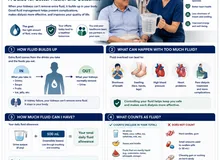
When the kidneys cannot remove fluid and potassium, the heart is strained and fluid backs up into the lungs; dialysis breaks the loop part-time.
One patient, several paths
Hemodialysis in a center is one path. Others are peritoneal dialysis (PD) at home, a kidney transplant, and supportive (conservative) care without dialysis, focused on symptoms and quality of life. People choose with their clinical team, based on health, preferences, family and money. A patient may move between paths over the years.
You can listen, notice questions and arrange for the RN or physician to talk with the patient. Do not promise that an option is suitable or available. Do not suggest that supportive care means giving up; it is active care with different goals. Home dialysis is not something an untrained employee teaches. If a patient asks “Can I have a transplant?”, the honest answer is: “That is a good question for your doctor. I will tell Nurse Jessa you want to talk about it.”

Hemodialysis, peritoneal dialysis, transplant and supportive care are different paths chosen with the clinical team; the assistant listens and passes questions to the RN.
Whose question is it?
Patients ask assistants things they feel shy asking doctors. That trust is valuable. Your job is to receive the question kindly and carry it to the right person, not to answer it yourself.
| The patient asks about | Who answers | What you can say |
|---|---|---|
| Fluid allowance, dry weight, session length | RN and physician | “Your nurse sets that with your doctor. I will ask her to come.” |
| Food, potassium, salt | Dietitian, RN | Repeat only the written plan they already have |
| Stopping or changing a medicine | Physician, RN | “Please do not stop it before you talk with the doctor.” |
| Fear, sadness, family problems, transport | RN, social worker | Listen; tell the RN with the patient’s permission |
| Philippine Health Insurance Corporation (PhilHealth) coverage and charges | Trained billing or PhilHealth staff | “Our PhilHealth officer can check that for you.” (Module 11) |
Case: After the flood
Wednesday, 6:30 a.m. Mr. Arnel Cruz, 52, normally dialyzes Monday, Wednesday and Friday. He did not come on Monday: the road from his barangay flooded. He arrives today and tells Kuya Paolo at the scale, quietly: “I felt fine, so I just drank less. Can I skip Friday too and come back next week? The fare is expensive.” He looks tired. His ankles are swollen.
Before reading on, decide what you would notice, whom you would tell and what you would say, what you would do within your role, and what would make you call for help at once. Then compare with the debrief below.
Notice
Communicate
Do
Escalate
The RN assessed him first, and the physician ordered an urgent potassium check. It was high, and his session started promptly. The social worker connected him with the barangay for transport help on flood days. Mr. Cruz kept his Friday session.
Submit: What you say to the patient, and what you do next.
Check your understanding
Each visit draws 5 questions at random from this module’s 10-question bank, in a shuffled order with shuffled options. Choose the single best answer for each, then select Check answers; a reason appears under every option. The target is 4 of 5 with every question marked safety-critical answered correctly (1 of the 10 are). Select New set of questions for a different mix. Nothing you select is sent anywhere; scoring happens in your browser and records self-study only. It never shows that you are competent at work.
What this module builds
| Code | The learner can | Course evidence |
|---|---|---|
| P2 | Explain dialysis in plain words and route treatment, diet, medicine and money questions to the right person. | Plain-language explanation; missed-treatment relay |
Performance evidence for this module: Plain-language explanation of hemodialysis (HD) observed by the preceptor; a missed-treatment relay without blame; correct routing of three patient questions.
With your preceptor
Observe in the unit during orientation; practice the conversations with your preceptor. These are prompts for supervised learning, not a procedure. Use your center’s own procedures, device instructions, contacts and forms; your preceptor observes and signs off each item on the facility’s competency record. Proposed evidence: at least three satisfactory observations across two shifts for each workplace skill that applies to you.
- Explain hemodialysis to your preceptor in three plain sentences, without technical words.
- Name the team member for treatment, nutrition, psychosocial and billing questions in your unit.
- Use teach-back to confirm that a patient understood a piece of orientation information.
- Relay a missed-treatment concern to the RN without blaming the patient.
- Role-play a respectful conversation about different treatment choices.
Read next on this site
Cross-track and patient-guide reading is background, not practical training for the assistant role.
- Why Starting Dialysis Is Not a Death Sentence, but a New BeginningWhat starting dialysis feels like for patients and families.
- Fluid Management on DialysisWhy fluid builds up between sessions and how the team manages it.
- Advance Care Planning for Dialysis PatientsSupportive care and advance care planning.
Back to the Nurse Assistant / Patient Care Assistant (PCA) course home · the Nephrology Nursing course, where nurses learn the clinical reasoning behind the care you support.