Nephrology Nursing Track · By Role · Module 14 of 18
Handoffs That Close the Loop
Why structured handoffs work, I-PASS on the dialysis floor, Situation-Background-Assessment-Recommendation (SBAR) calls with read-back, bedside handover, and closing the board.
PublishedNailathalaGipatikPepalwal:ReferencesMga SanggunianMga TinubdanReng Reperensya:5Audience: Experienced hemodialysis nurses who take charge of a shift · nurses being prepared for charge duty · head nurses and educators who orient themRead timeOras ng pagbasaOras sa pagbasaOras ning pamamasa:
This module is study material for charge nurses in hemodialysis units. It explains the reasoning behind common decisions; it is not a protocol. On the floor, follow your unit’s protocol and always ask the attending nephrologist for guidance. Doses, limits, and cut-off values are set by your unit. Every case is fictional.
Learning objectives
After this module you should be able to
Give and receive a structured handoff using I-PASS.
Include an action list with an owner and a time for every open item.
Make a concise Situation, Background, Assessment, Recommendation (SBAR) call to a physician and use read-back for orders.
Use the bedside to check the handoff while protecting privacy.
Close the board at the end of the shift so nothing is left unowned.
Pre-testBefore you read, answer the 8 self-assessment questions and note your score. After the module, select New set of questions and compare. The difference is what you learned; the questions you still miss are what to reread.
Start here
The big picture, in plain words
In plain wordsIn a relay race, most races are lost not by slow runners but by dropped batons in the exchange zone. The outgoing runner does not let go until the incoming runner has a firm grip.
A handoff moves responsibility, not just information. The outgoing charge nurse is still responsible until the incoming nurse has confirmed what she now owns. “I told her” is not the same as “she took it.”
Figure 1 · Key terms for this module
I-PASSA handoff structure: Illness severity, Patient summary, Action list, Situation awareness and contingency, Synthesis by receiver.
SBARA way to call for help: Situation, Background, Assessment, Recommendation.
Read-backRepeating an order aloud to confirm it.
SynthesisThe receiver summarizing what she now owns.
Contingency“If this happens, do that.”
Opening case · fictional
Case: “I thought you’d called”
At the 11:00 change, the outgoing charge nurse, Benjie, tells the incoming charge nurse, Liza: “Bed 3’s potassium was high; the doctor knows.”
The doctor had been told, and had asked for a repeat sample after the session. Nobody drew it. Mr. Santos in Bed 3 went home at 11:30.
Before reading on, decide:
What was missing from the handoff?
How would a structured handoff have caught it?
What does Liza do now?
Keep your answers in mind. The lesson gives you what you need, and the case review near the end shows one sound response.
Lesson · part 1
Why structured handoffs work
In a study across nine hospitals, introducing the I-PASS handoff program was associated with medical errors falling from 24.5 to 18.8 per 100 admissions, and preventable adverse events from 4.7 to 3.3.1 A later rollout across 32 programs was associated with a 47% fall in reported handoff-related adverse events.2
Figure 2. Responsibility moves only when the receiver confirms.
These studies were of physicians in hospitals. Applying them to dialysis nursing shift changes is a reasonable inference, not a tested finding. The mechanism is the same: handoffs lose actions, not facts, and structure protects the actions.
Lesson · part 2
I-PASS on the dialysis floor
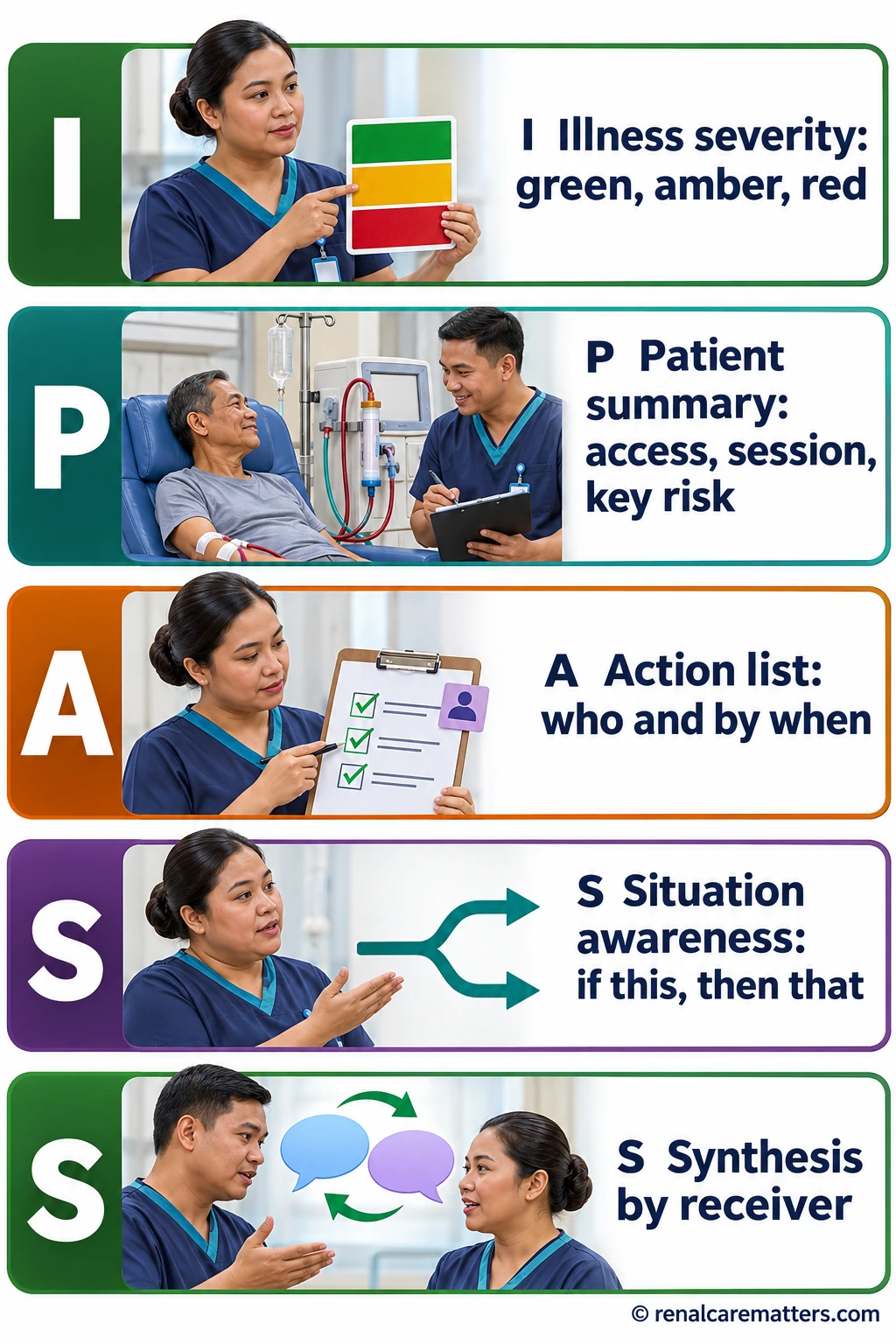
Figure 3. I-PASS on the dialysis floor.
Letter
What it means on a dialysis floor
Illness severity
Green, amber, or red, from the board
Patient summary
Who, access, where the session is, the one key risk
Action list
What must be done, by whom, by when
Situation awareness and contingency
“If the result is above 6.0 and she can’t be reached, call the backup physician.”
Synthesis by receiver
The incoming nurse repeats the actions and owners
The action list and the synthesis are the two parts most often skipped, and the two that would have saved Mr. Santos’s repeat potassium.
Lesson · part 3
SBAR for calling the physician
SBAR is a four-part way to call: Situation, Background, Assessment, Recommendation or request. A systematic review found it associated with better communication and patient safety, with evidence of moderate quality.3 End every call with a read-back: “So you want a repeat potassium after the session, and a call if it is above 6.0. I will do that.”
On the floor · The call that asked for nothing
A staff nurse calls the physician on duty: “Doc, Bed 5’s pressure is a bit low.” The physician asks three questions to find out what she wants. The charge nurse coaches her to call back with SBAR: “Bed 5, Mrs. Ong, 72. Pressure fell from 140 to 96 at hour two; she’s yawning. Fluid removal stopped, she’s flat, saline given; now 104. I think the fluid goal is too high for today. I’m asking whether to stop removal for the rest of the session.” The physician answers in ten seconds.
Illustrative scenario. Names and details are invented.
Lesson · part 4
Bedside handover
Handing over at the chair lets the patient correct errors and see the plan. Reviews report benefits for patient engagement and satisfaction, and concerns about privacy and time.4,5 On an open dialysis floor, do the visual check at the chair (access, patient, machine) and keep sensitive details (results, diagnoses) for the station.
Lesson · part 5
The end-of-shift close
Walk the board with the incoming charge nurse. Every amber and red flag gets a new owner or is closed. Name unresolved results, pending orders, broken machines, and patient complaints. Do not leave until the receiver has confirmed what she owns. If the incoming nurse is late, stay and tell the head nurse.
RememberNo release without a grip. Responsibility moves only when the receiver confirms.
On the floor
Real situations: problems and solutions
These are fictional but typical. For each one, cover the answer, decide what you would do, then compare. Where a step depends on local rules, your unit’s procedure and your supervisor’s direction come first.
The incoming nurse is late
What you see
Your relief is 30 minutes late.
What is likely going on
Traffic or a family emergency.
What to do
Stay until a handoff is complete and tell the head nurse.
Why it matters
Responsibility does not drop to the floor.
The phone order
What you see
A physician gives an order by phone at 10:40.
What is likely going on
A verbal order during a busy shift.
What to do
Read it back, write it, and flag it for countersignature.
Why it matters
Read-back catches mishearing.
The patient who corrects you
What you see
A patient at the chair says her session ends at 11:00, not 11:30.
What is likely going on
The board may be wrong.
What to do
Thank her, check, and update the board.
Why it matters
Patients catch errors staff miss.
Field notes
Facts are not actions.
The receiver repeats.
No release without a grip.
Case review
Back to the case: “I thought you’d called”
What was missing. The handoff contained a fact (“potassium high, doctor knows”) but no action, no owner, no time, and no synthesis.
The handoff done right. “Bed 3, Mr. Santos, amber. Fistula, finishes at 11:20. Pre-dialysis potassium 6.3. Dr. Lim was told at 7:15; she wants a repeat sample at the end of the session and a call if it is above 6.0. Action: you draw the post-dialysis sample at 11:20 and call her with the result; Mr. Santos should not leave until it is drawn. If it is above 6.0 and she cannot be reached, call the backup physician.” Liza: “So I draw the sample at 11:20, he stays until it is drawn, and I call Dr. Lim with the result, or the backup.” Benjie: “Yes.”
What Liza does now. She calls Mr. Santos, arranges a repeat potassium today, tells Dr. Lim, and records a near miss. At the next huddle she proposes that every handoff at the unit include an action list.
Skills lab · with your preceptor
Skills checklist: Handoffs and calls
Give and receive two recorded I-PASS handoffs, and make two SBAR calls to a facilitator playing the physician. Your preceptor rates each step as satisfactory, needs practice, or not observed. Steps marked Critical must all be satisfactory before sign-off. This checklist supports supervised learning; your unit’s own procedure and competency form are the authority. A printable version of every checklist is on the trainer page.
CriticalGives an I-PASS handoff with an action list, owners, and times.
CriticalRequires and gives a synthesis by the receiver.
Includes at least one contingency statement.
CriticalMakes an SBAR call that ends with a specific request.
CriticalReads back phone orders and records them.
Checks the access, patient, and machine at the chair without disclosing private details.
CriticalDoes not leave until every open flag has a new owner.
Placement activity. For one week, record each shift change: how many open items were handed over, and how many had an owner and a time.
Self-assessment
Check your understanding
Each visit draws 8 questions at random from this module’s 15-question bank. Choose the single best answer for each, then select Check answers; an explanation appears under the best answer. Select New set of questions for a different mix. A good target is 7 of 8 on two different sets. Nothing you select is sent anywhere; scoring happens in your browser.
Starmer, A. J., Spector, N. D., Srivastava, R., West, D. C., Rosenbluth, G., Allen, A. D., Noble, E. L., Tse, L. L., Dalal, A. K., Keohane, C. A., Lipsitz, S. R., Rothschild, J. M., Wien, M. F., Yoon, C. S., Zigmont, K. R., Wilson, K. M., O'Toole, J. K., Solan, L. G., Aylor, M., . . . I-PASS Study Group. (2014). Changes in medical errors after implementation of a handoff program. New England Journal of Medicine, 371(19), 1803–1812. https://doi.org/10.1056/NEJMsa1405556
Starmer, A. J., Spector, N. D., O'Toole, J. K., Bismilla, Z., Calaman, S., Campos, M.-L., Coffey, M., Destino, L. A., Everhart, J. L., Goldstein, J., Graham, D. A., Hepps, J. H., Howell, E. E., Kuzma, N., Maynard, G., Melvin, P., Patel, S. J., Popa, A., Rosenbluth, G., . . . I-PASS SHM Mentored Implementation Study Group. (2023). Implementation of the I-PASS handoff program in diverse clinical environments: A multicenter prospective effectiveness implementation study. Journal of Hospital Medicine, 18(1), 5–14. https://doi.org/10.1002/jhm.12979
Müller, M., Jürgens, J., Redaèlli, M., Klingberg, K., Hautz, W. E., & Stock, S. (2018). Impact of the communication and patient hand-off tool SBAR on patient safety: A systematic review. BMJ Open, 8(8), e022202. https://doi.org/10.1136/bmjopen-2018-022202
Tobiano, G., Bucknall, T., Sladdin, I., Whitty, J. A., & Chaboyer, W. (2018). Patient participation in nursing bedside handover: A systematic mixed-methods review. International Journal of Nursing Studies, 77, 243–258. https://doi.org/10.1016/j.ijnurstu.2017.10.014
Daicampi, C., Veronese, M., & Cesaro, E. (2025). Impact of bedside handover on patient perceptions and hospital organizational outcomes: A systematic review. Journal of Nursing Management, 2025, 3803491. https://doi.org/10.1155/jonm/3803491
Educational study material for nurses. Does not replace the attending nephrologist’s orders, the unit’s protocols, required training and certification, or supervised practice.